
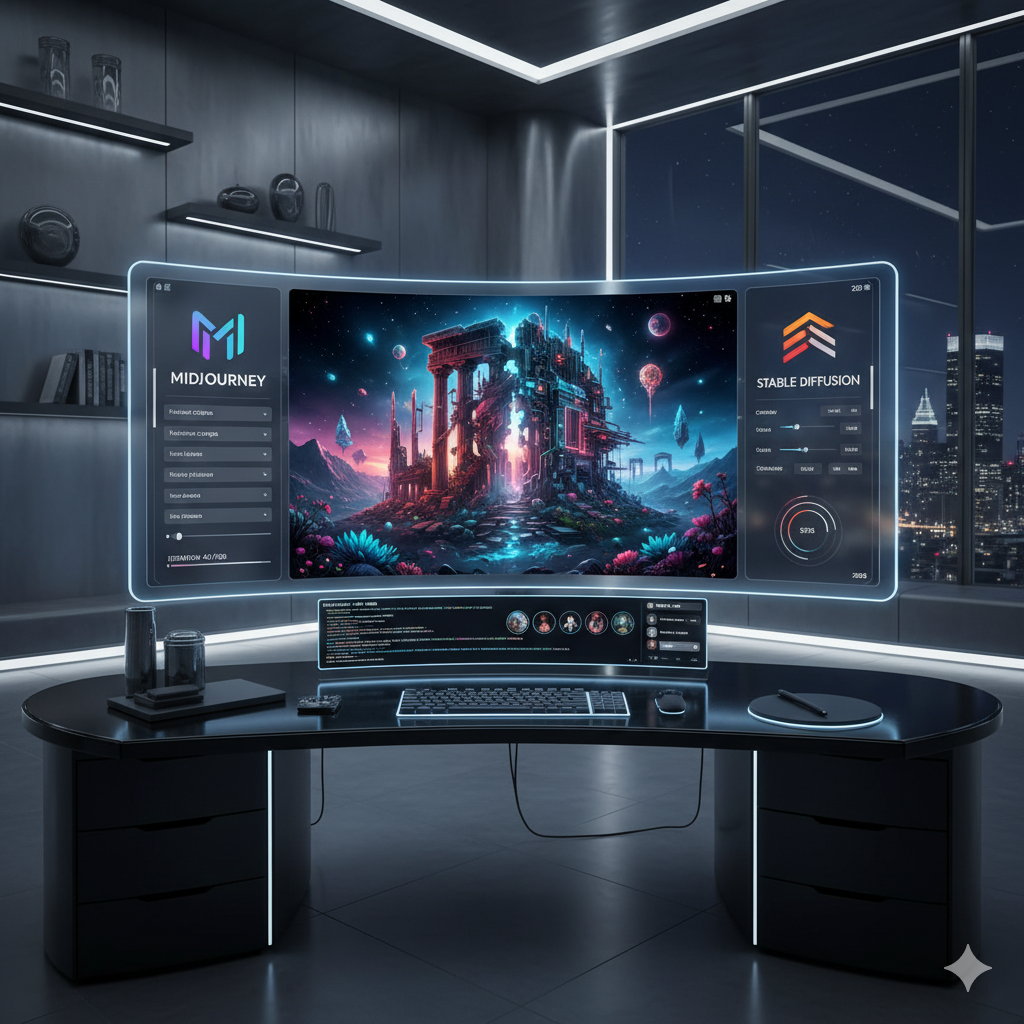
The art world is undergoing a seismic shift, driven by the rapid advancements in artificial intelligence. Far from being a mere novelty, AI tools like Midjourney and Stable Diffusion are emerging as powerful accelerators for artists, opening up unprecedented opportunities to generate new income streams and expand their creative horizons. For many, the initial reaction might be apprehension or skepticism, wondering if these tools threaten traditional artistry. However, a growing number of forward-thinking artists are embracing AI as a collaborator, a muse, and a highly efficient assistant, transforming their workflows and unlocking avenues for commercial success that were previously unimaginable or painstakingly slow to achieve.
This comprehensive guide delves into how artists can effectively harness the power of Midjourney and Stable Diffusion to not only enhance their creative output but also to build sustainable and diverse revenue models. We will explore the unique capabilities of each platform, detail various monetization strategies, discuss practical integration into existing art businesses, and address the crucial ethical considerations surrounding AI-generated art. Whether you are a painter, illustrator, graphic designer, or photographer, understanding and utilizing these tools could be the key to significantly boosting your artistic income in the digital age.
The AI Art Revolution for Creative Professionals
The emergence of advanced text-to-image AI models has fundamentally altered the landscape for creative professionals. What once required hours of meticulous manual work, extensive resources, or highly specialized skills can now be conceptualized and iterated upon in minutes. This speed and versatility are not about replacing human creativity but augmenting it, allowing artists to experiment more, produce diverse assets faster, and focus their human touch on refinement, storytelling, and unique vision.
AI tools empower artists by:
- Accelerating Ideation: Quickly generate hundreds of concepts and variations for brainstorming.
- Expanding Style Exploration: Experiment with styles, aesthetics, and themes beyond one’s comfort zone or traditional training.
- Reducing Production Time: Automate repetitive tasks or generate foundational elements that can be refined manually.
- Overcoming Creative Blocks: Use AI as a prompt for new ideas when inspiration wanes.
- Democratizing Complex Art Forms: Create intricate scenes, detailed textures, or specific moods without needing mastery of every artistic discipline.
Understanding these foundational shifts is crucial before diving into the specifics of Midjourney and Stable Diffusion, as they form the basis for why these tools are so potent for income generation.
Midjourney: The Artistic Visionary’s Companion
Midjourney has rapidly gained recognition for its exceptional aesthetic quality and intuitive approach to image generation. Operated primarily through a Discord bot, it excels at creating visually stunning and often dreamlike imagery with minimal prompting. For artists, Midjourney offers a powerful way to quickly visualize complex concepts and produce high-quality artistic assets.
Key Features and How Artists Use Them:
- Sophisticated Aesthetic Engine: Midjourney’s proprietary algorithms are trained on vast datasets, enabling it to produce images with a distinct, often captivating artistic style. Artists can leverage this to create mood boards, concept art, or standalone pieces quickly.
- Ease of Use: With a relatively straightforward command structure, artists can start generating impressive visuals almost immediately. The learning curve for basic generation is much flatter compared to some other AI tools.
- Iterative Refinement (Vary Region, Pan, Zoom): Recent updates like ‘Vary Region’ allow artists to select specific areas of an image for regeneration or modification, akin to inpainting. Features like ‘Pan’ and ‘Zoom’ extend the canvas or reframe existing images, offering remarkable control over composition post-generation. This is incredibly useful for refining details or adjusting aspect ratios for specific client needs.
- Stylize and Chaos Parameters: These parameters give artists control over the artistic flair and variability of the output, allowing for more experimental or more consistent results based on their needs.
- Consistent Character/Style: With techniques evolving for character consistency across multiple images, Midjourney is becoming increasingly viable for narrative art, comic panels, or branding where a consistent visual identity is paramount.
Practical Application: Concept Art and Visual Development
Practical Example: An independent game developer needs concept art for a new fantasy world. Instead of spending weeks sketching various creatures, environments, and character designs, they use Midjourney. By inputting prompts like “epic dwarven city carved into mountains, glowing runes, steampunk elements, cinematic lighting, ultra detailed,” they can generate dozens of high-quality concepts in a day. They then select the most promising outputs, refine them using ‘Vary Region’ for specific details or ‘Pan’ to expand landscapes, and then use these as a strong foundation for a human artist to paint over, ensuring stylistic consistency and saving immense time and budget.
Stable Diffusion: The Control and Customization Powerhouse
Stable Diffusion stands in contrast to Midjourney with its open-source nature and unparalleled flexibility. While it might require a slightly steeper learning curve, especially for local installations, its capacity for customization and fine-tuned control makes it an indispensable tool for artists seeking precise outputs.
Key Features and How Artists Leverage Them:
- Open Source and Local Deployment: Stable Diffusion models can be run locally on a user’s computer (with sufficient GPU power), offering privacy, offline capabilities, and no subscription fees for basic usage. This is a huge advantage for artists who prioritize control and ownership over their creative process.
- SDXL (Stable Diffusion XL): The latest flagship model offers significant improvements in image quality, aesthetic fidelity, and prompt understanding, rivaling and often surpassing commercial models. It generates more coherent and detailed images, especially for complex scenes and human anatomy.
- ControlNet: This groundbreaking feature allows artists to input reference images to guide the AI’s generation. This means you can provide a pose (via a depth map or a skeleton), a line drawing, a normal map, or even a segmentation map, and Stable Diffusion will generate an image that adheres to that structure. This offers an unprecedented level of control for artists.
- LoRAs (Low-Rank Adaptation): LoRAs are small add-on models that can be loaded into Stable Diffusion to fine-tune the output towards a specific style, character, or object. Artists can train their own LoRAs on their existing artwork or custom datasets, effectively teaching the AI to generate art in their unique style.
- Inpainting and Outpainting: These features allow artists to selectively modify parts of an image or extend the canvas beyond its original borders, seamlessly filling in new content. This is critical for editing and expanding compositions.
- Cloud Services and UIs: For those without powerful local hardware, cloud-based services (e.g., RunDiffusion, Mage.space, Clipdrop) provide access to Stable Diffusion’s capabilities through user-friendly interfaces.
Practical Application: Custom Commissions and Artistic Refinement
Practical Example: A client requests a portrait of themselves in a specific fantasy style, holding a unique magical artifact, and in a dynamic pose. A digital artist can use ControlNet to input a reference photograph for the client’s face and a rough sketch for the pose and artifact. They can then use a custom LoRA trained on their unique fantasy art style. Stable Diffusion then generates multiple variations adhering to these constraints. The artist takes the best generated image, refines it further in Photoshop or Procreate with their traditional digital painting skills, adding personal touches and intricate details, delivering a highly customized and high-quality piece much faster than entirely manual creation.
Diversifying Your Portfolio and Income with AI
The true power of Midjourney and Stable Diffusion lies in their ability to unlock a multitude of income streams for artists. It is no longer just about selling original pieces; it is about leveraging AI to create a broader range of products and services.
1. Direct Art Sales and Commissions:
- Fine Art Prints and Canvases: Generate stunning, high-resolution AI art that can be printed and sold as fine art. Artists can add unique post-processing, hand-painting, or mixed media elements to these prints to add a human touch and increase their value.
- Custom AI-Assisted Commissions: Offer bespoke artwork created with AI as a foundational element, then refined by your artistic hand. This can include character designs, concept art, custom backgrounds, or stylized portraits for individuals, businesses, or game developers.
- Digital Downloads: Sell digital files of your AI-generated artwork for personal use as wallpapers, profile pictures, or digital decor.
2. Merchandise and Print-on-Demand (POD):
- Apparel: Design unique graphics for T-shirts, hoodies, and tote bags using AI. The rapid generation capabilities allow for a diverse product line.
- Home Decor: Create patterns and imagery for mugs, phone cases, pillows, shower curtains, and wall tapestries.
- Stationery: Design greeting cards, journals, stickers, and calendars.
- Children’s Products: Generate illustrations for children’s books, toys, or nursery decor.
Practical Example: An artist uses Midjourney to generate hundreds of whimsical forest creatures and enchanting mushroom houses. They then upload these designs to a print-on-demand platform like Redbubble or Etsy (integrated with Printful/Printify). They create mockups for mugs, phone cases, and T-shirts, leveraging the AI-generated imagery to fill their online shop with a diverse range of products quickly, reaching a broader audience than just selling traditional art.
3. Digital Assets and Stock Content:
- Stock Photography/Illustrations: Create a vast library of high-quality, unique images for stock platforms (e.g., Adobe Stock, Shutterstock, Getty Images). AI can generate specific scenarios, objects, or styles on demand.
- Textures and Patterns: Generate seamless textures for 3D artists, game developers, or graphic designers. Create intricate patterns for fabrics, digital papers, or backgrounds.
- Game Assets: Produce concept art, character assets, environment elements, or UI components for indie game developers.
- Digital Brushes and Backgrounds: Design custom brushes for Photoshop/Procreate or unique digital backgrounds for photographers and graphic designers.
4. Licensing and Commercial Use:
- Book Covers and Album Art: Offer specialized services to authors and musicians for creating unique and compelling cover art. AI’s speed allows for quick revisions and concept iterations.
- Marketing and Advertising: Generate bespoke imagery for advertising campaigns, social media content, or website headers for businesses.
- Brand Identity: Create unique visual elements, logos, or brand collateral for startups and small businesses.
5. Education and Community Building:
- Online Courses and Tutorials: Share your expertise in using Midjourney and Stable Diffusion. Teach prompt engineering, ControlNet techniques, or how to integrate AI into existing art workflows. Platforms like Udemy, Skillshare, or your own website can host these.
- Patreon/Subscription Content: Offer exclusive AI art prompts, tutorials, behind-the-scenes content, or early access to new artwork for subscribers.
- Workshops and Webinars: Conduct live sessions demonstrating AI art techniques, charging for attendance.
6. NFTs (Non-Fungible Tokens):
- Unique Digital Collectibles: Create one-of-a-kind or limited-edition AI artworks and mint them as NFTs on platforms like OpenSea or Foundation. While the NFT market has fluctuated, truly unique and artistically compelling AI-generated pieces can still find an audience among collectors.
- Generative Art Collections: Develop a system where unique AI art pieces are programmatically generated and then minted as part of a larger collection.
Practical Examples of AI Art Income Streams in Action
Let’s delve into a few more detailed scenarios illustrating how artists are practically leveraging these AI tools to generate income.
Scenario 1: The Freelance Illustrator and Book Covers
A freelance illustrator specializing in fantasy art finds that traditional book cover commissions are time-consuming, often requiring multiple revisions and weeks of work. They integrate AI into their workflow. When an author requests a cover featuring a specific fantastical creature battling a knight in a magical forest, the illustrator uses Midjourney to generate dozens of creature variations, forest environments, and knight poses within hours. They show these concepts to the author, who picks a direction. The illustrator then uses Stable Diffusion with ControlNet to refine the chosen creature’s pose and ensure the knight’s armor details match the book’s description. The AI-generated base is then taken into Photoshop, where the artist applies their signature painting style, adds intricate details, adjusts lighting, and performs color grading. This hybrid approach significantly reduces the initial concepting and blocking phase, allowing the artist to complete commissions faster, take on more clients, and ultimately increase their hourly rate and overall income, while still delivering a highly personalized and professionally finished product.
Scenario 2: The E-commerce Entrepreneur and Unique Apparel
An aspiring entrepreneur with an eye for fashion but no traditional art skills wants to launch a clothing brand. They turn to Midjourney to generate unique, abstract, and vibrant patterns and graphics for T-shirts, hoodies, and leggings. They experiment with prompts like “abstract geometric patterns, flowing organic lines, neon synthwave aesthetic,” and “intricate Celtic knots, interwoven branches, mystical forest green palette.” Once they have generated hundreds of visually distinct designs, they use an upscaler tool (often integrated within Stable Diffusion UIs or as separate software) to ensure high resolution. These designs are then uploaded to a print-on-demand platform, which handles printing, shipping, and customer service. By continuously generating fresh designs, the entrepreneur keeps their product line dynamic and appealing to niche markets, building a brand around unique, AI-powered aesthetics without needing to hire designers or learn complex software.
Scenario 3: The Digital Artist and Stock Image Contribution
A digital artist creates illustrations for a living but wants to diversify their passive income. They decide to contribute to stock image platforms. Instead of painstakingly illustrating each scenario, they use Stable Diffusion to generate a wide array of images. For instance, they might need images of diverse people in various professional settings. They use SDXL with precise prompts and even ControlNet for specific poses or compositions. They can generate hundreds of high-quality, consistent images of “professional woman, dynamic pose, modern office setting, natural light, diverse ethnicity” in a fraction of the time it would take to draw them. They then perform minor edits and color corrections in a photo editor before uploading them to multiple stock sites. This allows them to quickly build a massive portfolio, generating continuous royalties from images that cater to a broad commercial need, all while freeing up time for their core illustration commissions.
Comparison Tables: Midjourney vs. Stable Diffusion and Income Streams
To help artists better understand the distinct advantages of each AI tool and the potential of AI-assisted income, here are two comparison tables.
| Feature/Aspect | Midjourney (e.g., V6) | Stable Diffusion (e.g., SDXL via local/cloud) |
|---|---|---|
| Accessibility/Ease of Use | Very High (Discord-based, intuitive prompts, excellent default aesthetics) | Moderate to High (Requires more setup for local; cloud UIs simplify, but more parameters) |
| Aesthetic Quality (Out-of-the-box) | Excellent (Known for captivating, artistic, often ethereal results) | Very Good (SDXL offers high fidelity, realism, and coherence; can be adjusted to any style) |
| Control & Customization | Moderate (Vary Region, Pan, Zoom offer good post-gen control; less pre-gen structural control) | Exceptional (ControlNet for precise structural guidance, LoRAs for style/character training, extensive parameters) |
| Speed of Generation | Fast (Typically seconds to minutes for multiple variations) | Variable (Fast on powerful GPUs; slower on less powerful local setups or depending on cloud service queues) |
| Cost Model | Subscription-based (Tiered plans, usage-based generation) | Free for local use (hardware cost); subscription/credit-based for cloud services |
| Privacy & Data Ownership | Outputs are generally public on Discord unless private mode is purchased; ownership terms vary by plan | High for local use (data never leaves your machine); cloud service terms vary |
| Open Source Community & Plugins | Proprietary system | Vast, active open-source community, numerous custom models, LoRAs, extensions (e.g., Automatic1111, ComfyUI) |
| Best For | Quick concepting, aesthetic exploration, high-quality general art pieces, mood boards, quick merchandise designs | Precise commissions, highly customized art, integrating AI into complex art pipelines, game asset creation, specific style replication, photo-realism with control |
| Income Stream Aspect | Traditional Art Approach | AI-Assisted Art Approach |
|---|---|---|
| Initial Production Time | High (Hours, days, weeks per piece depending on complexity) | Low (Minutes to hours for generating concepts/bases) |
| Scalability & Volume | Limited by artist’s time and physical capacity; difficult to mass produce unique items | High (Generate numerous variations/designs quickly; easily adaptable for mass production on POD) |
| Experimentation Costs (Time/Materials) | High (Physical materials, extensive time for new styles/concepts) | Low (Digital, quick iterations, minimal resource cost per concept) |
| Niche Market Reach | Often niche, but can be broadened with marketing; limited by artist’s existing style | Easily target diverse niches by generating specific themes, styles, and aesthetics on demand |
| Skill Requirements | Deep mastery of chosen medium, technique, composition, color theory, etc. | Strong prompt engineering skills, artistic eye for selection/refinement, digital art software proficiency (hybrid approach) |
| Passive Income Potential | Moderate (Prints, licensing existing work, but initial creation is manual) | High (Stock assets, POD designs, digital products can generate ongoing income after initial AI-assisted creation) |
| Creative Control (Raw Generation) | 100% human control from start to finish | AI dictates initial generation; human curates, refines, and directs with prompts/tools |
| Client Collaboration & Revisions | Can be lengthy; physical changes expensive; digital easier but still time-consuming | Faster iteration for client feedback, easier digital revisions; AI can quickly generate new options |
Navigating the Ethical and Copyright Landscape
The conversation around AI art would be incomplete without addressing the significant ethical and legal considerations. Artists embracing AI must do so responsibly and with awareness of the evolving landscape.
1. Copyright and Ownership:
The legal framework for AI-generated art is still developing. In the United States, the Copyright Office has generally stated that purely AI-generated works without significant human input are not eligible for copyright protection. However, works where an artist uses AI as a tool and then significantly modifies, arranges, or combines the AI output with their own creative input can be copyrightable, with the human artist as the author of the ‘human-authored parts.’ This emphasizes the hybrid approach: AI as an assistant, not an autonomous creator.
2. Data Sourcing and Attribution:
AI models are trained on vast datasets, often scraped from the internet without explicit consent from the original artists whose work is included. This raises concerns about fair use, compensation, and ethical sourcing. While current tools do not typically offer direct attribution to training data, artists should be mindful of these debates and advocate for ethical AI development.
3. Transparency and Disclosure:
When selling AI-assisted art or offering commissions, it is crucial to be transparent with clients about your creative process. Clearly communicate that AI tools were used as part of your workflow. This builds trust and manages expectations. Misleading clients about the extent of AI involvement can damage your reputation.
4. Originality and Style:
While AI can mimic styles, true artistry comes from unique vision. Artists should strive to use AI to develop *their own* distinct style or to execute *their own* unique ideas, rather than simply replicating existing artists’ works. The goal is to enhance creativity, not to plagiarize.
Best Practices for Artists:
- Educate Yourself: Stay informed about the latest developments in AI art law and ethics.
- Add Value: Always apply significant human artistic input (editing, painting over, compositing, unique concept development) to AI-generated assets before commercializing them.
- Be Transparent: Clearly state your use of AI tools in your workflow, especially for commissions and commercial projects.
- Focus on Uniqueness: Use AI to explore novel concepts and styles that reflect your personal artistic vision.
- Respect Copyright: Avoid intentionally prompting AI to replicate copyrighted characters or distinct artistic styles without permission.
Building Your Brand and Marketing AI-Assisted Art
Generating art with AI is only half the battle; successfully marketing it is equally important. Artists need to adapt their branding and marketing strategies to incorporate the unique aspects of AI-assisted creation.
1. Define Your Niche and Style:
Even with AI, having a distinct artistic voice is crucial. What kind of AI art do you want to be known for? Is it fantastical landscapes, abstract patterns, character concepts, or hyper-realistic renderings? Developing a recognizable style, even if AI-assisted, helps you stand out.
2. Showcase Your Process:
Many people are fascinated by how AI art is made. Share your workflow, showing how you craft prompts, use different AI tools, and then refine the output with traditional digital painting or editing software. This educates your audience and highlights your unique blend of AI proficiency and artistic skill.
3. High-Quality Portfolio:
Curate a professional online portfolio (e.g., ArtStation, DeviantArt, personal website) showcasing your best AI-assisted works. Ensure images are high-resolution and properly categorized. Include descriptions that explain the concept and, where appropriate, your creative process.
4. Engage on Social Media:
Platforms like Instagram, X (formerly Twitter), Pinterest, and Reddit have thriving AI art communities. Use relevant hashtags (e.g., #aiart, #midjourneyart, #stablediffusion, #generativeart) to reach a wider audience. Share your prompts (if comfortable), tutorials, and insights to build a following.
5. Collaborate with Others:
Partner with other artists, writers, game developers, or brands. Offer to create concept art, illustrations, or marketing visuals for their projects. Cross-promotion can significantly expand your reach.
6. SEO and Keywords:
Optimize your website, portfolio, and product listings with relevant keywords. Think about what potential clients or buyers would search for (e.g., “custom AI fantasy art,” “Midjourney landscape prints,” “Stable Diffusion character design”).
7. Price Strategically:
Pricing AI-assisted art can be tricky. Consider the value of your artistic input, the time saved by AI, the complexity of the project, and market demand. Don’t undersell your unique skills simply because AI was involved. Explain the value you bring through prompt engineering, refinement, and artistic vision.
The Future is Now: Sustaining an AI-Enhanced Art Career
The rapid pace of AI development means that what is cutting-edge today might be commonplace tomorrow. For artists, this necessitates a commitment to continuous learning and adaptation. The most successful AI-enhanced artists will be those who:
- Embrace Lifelong Learning: Stay updated with new models, features, and techniques in Midjourney, Stable Diffusion, and other emerging AI tools.
- Cultivate Human Skills: While AI automates creation, the human elements of critical thinking, artistic judgment, emotional intelligence, and storytelling become even more paramount.
- Focus on Unique Vision: Use AI to amplify your personal style and ideas, not to become a generic content generator.
- Network and Collaborate: Engage with the AI art community and seek opportunities for collaboration.
- Understand the Market: Continuously assess market demands and adapt your offerings to capitalize on new trends.
- Advocate for Ethical AI: Participate in discussions around AI ethics, copyright, and fair compensation to shape a more equitable future for all artists.
The fear that AI will replace artists often stems from a misunderstanding of how these tools truly function. Instead, they are offering a powerful augmentation, allowing artists to offload mundane tasks, explore new dimensions of creativity, and most importantly, open up entirely new avenues for income generation. The artists who thrive in this new era will be the ones who see AI not as a competitor, but as an incredibly versatile new brush in their artistic toolkit.
Frequently Asked Questions
Q: Do I need to be a programmer to use Midjourney or Stable Diffusion effectively?
A: Absolutely not! While Stable Diffusion can involve more technical aspects for local setup, both Midjourney and cloud-based Stable Diffusion interfaces are designed to be user-friendly for artists. Midjourney operates directly through Discord with simple text commands. Cloud platforms for Stable Diffusion provide graphical user interfaces (GUIs) that abstract away the complex coding, focusing on prompt input and parameter adjustments. Your artistic eye and ability to formulate descriptive prompts are far more important than coding skills.
Q: Is AI-generated art truly “art”?
A: This is a philosophical debate, but from a practical standpoint, when an artist uses AI as a tool to realize their creative vision, curate outputs, and add their unique refinements, the resulting work can certainly be considered art. Just like a photographer uses a camera or a sculptor uses power tools, AI becomes another instrument in the artist’s toolkit. The human intention, selection, and refinement are key to its artistic merit.
Q: Can I copyright art created with Midjourney or Stable Diffusion?
A: In the U.S., purely AI-generated works without significant human input are generally not copyrightable. However, if an artist uses AI tools as part of a creative process and then significantly modifies, transforms, or combines the AI output with their own creative input (e.g., painting over, compositing, unique artistic arrangement), the human-authored elements of that final work can be eligible for copyright protection. Transparency about AI use is recommended.
Q: What’s the biggest challenge for artists adopting AI tools for income?
A: One of the biggest challenges is staying current with the rapid pace of development in AI tools. Another is distinguishing one’s unique artistic voice and brand in a sea of potentially generic AI outputs. Overcoming the initial learning curve and effectively integrating AI into a human-centric workflow also requires effort and adaptability.
Q: How can I ensure my AI art is unique and not just a generic output?
A: Focus on advanced prompt engineering, combining various concepts, styles, and parameters in unique ways. Utilize features like Midjourney’s ‘Vary Region’ or Stable Diffusion’s ControlNet and LoRAs to introduce specific artistic guidance. Most importantly, use AI as a starting point, then bring in your unique artistic skills through post-processing, painting over, compositing, and thoughtful curation. Your personal taste and refinement are what make it unique.
Q: Do I need an expensive computer to run Stable Diffusion locally?
A: For optimal performance with Stable Diffusion XL (SDXL) models, a dedicated GPU with at least 8GB (preferably 12GB or more) of VRAM is highly recommended. While it can run on less powerful hardware, generation will be slower and model options might be limited. If you don’t have powerful hardware, consider using cloud-based Stable Diffusion services that handle the computing for you.
Q: Are there any ethical concerns about using AI for commissions?
A: Yes, transparency is paramount. Always disclose to your clients that you are using AI tools as part of your creative process. Explain how AI assists your workflow and how your human artistic skills still contribute significantly to the final product. This builds trust and avoids potential misunderstandings or ethical dilemmas regarding originality and effort.
Q: Can AI replace human artists entirely?
A: It’s highly unlikely that AI will replace human artists entirely. AI is a tool, not a sentient being with original thoughts or emotions. While it can automate creation, it lacks genuine creativity, subjective judgment, and the profound human experience that underpins truly impactful art. Instead, AI serves as a powerful assistant, freeing artists to focus on higher-level creative tasks, ideation, and the unique storytelling that only humans can provide.
Q: How do I get started learning Midjourney and Stable Diffusion?
A: For Midjourney, join their official Discord server and explore their documentation and community guides. For Stable Diffusion, you can start with user-friendly cloud services or, if you have capable hardware, explore local UIs like Automatic1111 or ComfyUI, accompanied by numerous online tutorials (YouTube, Reddit, dedicated blogs). Experimenting with prompts and exploring community-shared workflows are excellent ways to learn.
Q: What are the best ways to legally protect my AI-assisted art?
A: Focus on creating works where your human input is substantial and transformative. Document your creative process, showing how you guided the AI, selected outputs, and performed post-processing. Registering your finalized, human-authored AI-assisted works with your country’s copyright office (e.g., U.S. Copyright Office) is the most robust form of protection for the human-contributed elements.
Key Takeaways for Artists in the AI Era
- AI is an Augmentation, Not a Replacement: Midjourney and Stable Diffusion are powerful tools that enhance, not diminish, human creativity.
- Diversify Income Streams: AI unlocks numerous commercial avenues, from direct sales and commissions to merchandise, digital assets, and education.
- Master Prompt Engineering: Learning to effectively communicate your vision to AI is a crucial new skill.
- Embrace Hybrid Workflows: Combining AI generation with traditional digital art skills (painting over, compositing) yields the best and most unique results.
- Prioritize Control and Customization: Stable Diffusion, with ControlNet and LoRAs, offers unparalleled precision for specific artistic needs.
- Stay Ethical and Transparent: Be mindful of copyright, data sourcing, and always disclose AI use to clients.
- Build a Strong Brand: Showcase your unique style and process, leveraging social media and high-quality portfolios.
- Commit to Continuous Learning: The AI landscape evolves rapidly; staying updated is key to long-term success.
Conclusion
The advent of Midjourney and Stable Diffusion represents a pivotal moment for artists. Instead of viewing these advancements with trepidation, a proactive and informed approach reveals a landscape rich with unprecedented opportunities. By skillfully integrating AI tools into their creative process, artists can dramatically increase their efficiency, explore artistic styles previously out of reach, and, most importantly, unlock a diverse array of new income streams.
The future of art is not one where AI replaces human artists, but one where human artists, armed with these powerful new technologies, are empowered to reach new heights of creativity and commercial success. The canvas has expanded, the brushes have evolved, and the potential for imaginative expression and profitable ventures has never been greater. It is time for artists to embrace this revolution, experiment fearlessly, and forge a new path where human ingenuity and artificial intelligence collaborate to create truly remarkable and lucrative art.



























Leave a Reply