

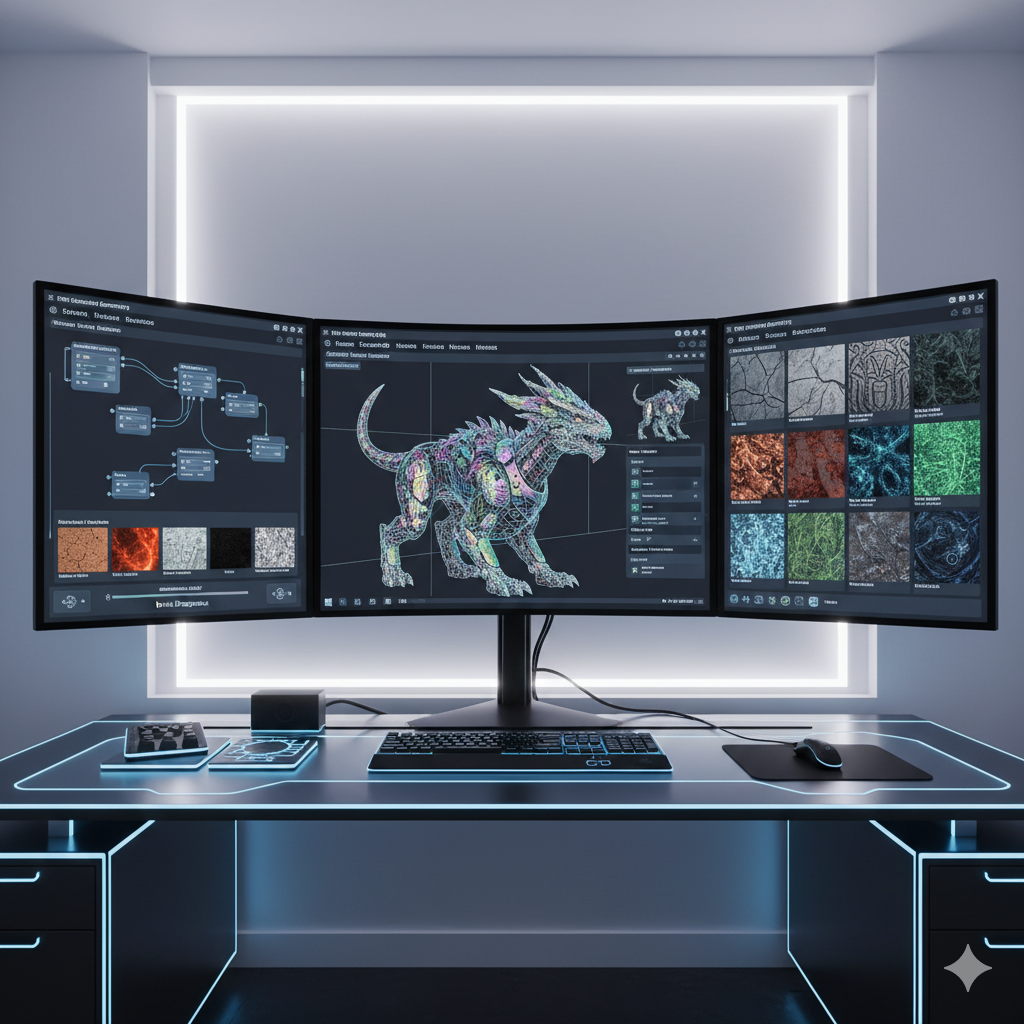
The world of video games has always been a frontier for innovation, pushing the boundaries of graphics, storytelling, and interactive experiences. At the heart of every immersive game lies a vast collection of meticulously crafted digital assets: everything from towering skyscrapers and lush foliage to the intricate details of a character’s armor and the nuanced textures of ancient ruins. Traditionally, the creation of these assets has been a labor-intensive, time-consuming, and often costly process, requiring immense artistic skill and technical expertise. However, a seismic shift is underway, driven by the remarkable advancements in Artificial Intelligence.
AI Game Asset Generation is rapidly emerging as a transformative force, promising to revolutionize how 3D models and textures are brought to life. Imagine creating entire landscapes, detailed characters, or vast libraries of props not in weeks or months, but in mere hours or even minutes. This is no longer a futuristic fantasy but a present-day reality, with AI tools now capable of generating highly realistic and production-ready game assets at unprecedented speeds. This blog post will delve deep into how AI is reshaping this crucial aspect of game development, exploring the underlying technologies, practical applications, the profound benefits it offers, and the exciting future it heralds for digital artists and game developers alike.
The Bottleneck of Traditional Asset Creation
For decades, game asset creation has followed a relatively standard pipeline, heavily reliant on manual labor and specialized software. A typical workflow involves concept art, followed by 3D modeling (often starting with low-polygon meshes and then sculpting high-detail versions), retopology to optimize polygon count, UV unwrapping for texture mapping, and then meticulous texture painting to add color, material properties, and surface details. This intricate dance requires artists to possess a diverse skill set, including sculpting, drawing, understanding of anatomy, lighting, and materials, alongside proficiency in complex software like Blender, Maya, ZBrush, and Substance Painter.
Consider the creation of a single, highly detailed character model. This process can easily consume hundreds of hours. From initial sketches to high-poly sculpts, efficient retopology, precise UV layout, and the layering of multiple PBR (Physically Based Rendering) textures (albedo, normal, roughness, metallic, ambient occlusion), every step demands significant human effort and attention to detail. Multiply this by the hundreds or thousands of unique assets required for a modern open-world game – environmental props, architectural elements, weapons, vehicles, creatures, and more – and the sheer scale of the challenge becomes apparent.
This traditional approach, while yielding incredible artistic results, comes with inherent limitations:
- Time Consumption: Manual creation is inherently slow. Even experienced artists can take days or weeks to perfect a single complex asset.
- High Labor Costs: The need for highly skilled and specialized artists translates into significant financial investment for studios.
- Limited Iteration Speed: Making significant changes to an already completed asset can be almost as time-consuming as creating it from scratch, hindering rapid prototyping and experimentation.
- Scalability Challenges: Populating vast game worlds with unique, high-quality assets is a monumental task that often forces compromises in detail or variety due to time and budget constraints.
- Repetitive Tasks: Many aspects, like UV unwrapping or basic retopology, can be highly repetitive and less creatively stimulating for artists.
These challenges represent a significant bottleneck in game development, impacting project timelines, budgets, and ultimately, the scope and ambition of the final product. It’s precisely these bottlenecks that AI is designed to address, offering solutions that promise to accelerate production, enhance quality, and free artists to focus on more creative and less mundane aspects of their work.
How AI is Reshaping 3D Model Generation
The advent of AI has introduced groundbreaking methodologies that dramatically streamline the creation of 3D models. Unlike traditional procedural generation, which relies on predefined rules and algorithms, AI leverages deep learning to understand and generate complex forms, structures, and details based on vast datasets of existing 3D models and images. This allows for a level of realism and artistic nuance that was previously unattainable through purely algorithmic means.
Generative Adversarial Networks (GANs) and Diffusion Models
At the forefront of AI-powered 3D generation are advanced neural network architectures, primarily Generative Adversarial Networks (GANs) and more recently, Diffusion Models.
- GANs: These consist of two competing networks: a generator that creates new data (e.g., 3D models or textures) and a discriminator that tries to distinguish between real and AI-generated data. Through this adversarial process, the generator learns to produce increasingly realistic and convincing outputs. While powerful, GANs can sometimes be challenging to train and control for specific outputs.
- Diffusion Models: These models work by learning to reverse a process of gradually adding noise to data until it becomes pure noise. By reversing this process, they can generate new data samples from noise. Diffusion models have shown exceptional capabilities in generating high-quality, diverse, and controllable images and are now being adapted for 3D generation, often yielding incredibly detailed and coherent results.
Text-to-3D Model Generation
Perhaps one of the most exciting recent developments is text-to-3D. Inspired by the success of text-to-image models like DALL-E and Midjourney, researchers and companies are now developing systems that can translate natural language descriptions directly into 3D models.
- Prompt-Based Creation: An artist can type a prompt like “a rusty medieval sword with an ornate hilt” or “a futuristic spaceship in the shape of a whale,” and the AI system will generate a corresponding 3D model.
- Iterative Refinement: These systems often allow for iterative refinement, where the artist can modify the prompt or provide additional guidance to adjust details, style, or specific features of the generated model.
- Examples: Projects like Google’s DreamFusion and NVIDIA’s neural rendering advancements are paving the way. Several companies are building on this, offering platforms where users can generate 3D assets from text prompts, often producing a mesh and corresponding PBR textures ready for use in game engines. While still nascent, the potential for rapid prototyping and idea generation is immense.
2D-to-3D Conversion and Photogrammetry Enhancement
AI is also significantly improving methods that start with 2D input:
- Image-to-3D Reconstruction: AI can analyze single or multiple 2D images and infer 3D geometry and depth information to reconstruct a 3D model. While complex objects still pose challenges, simple shapes and objects are becoming increasingly feasible for AI to convert.
- AI-Enhanced Photogrammetry: Photogrammetry, the process of creating 3D models from photographs, can be significantly enhanced by AI. AI algorithms can help with cleaning up noisy scan data, reconstructing missing geometry, automatically retopologizing meshes, and optimizing UVs, transforming raw scans into game-ready assets much faster.
Automated Mesh Reconstruction and Optimization
Even when a basic 3D shape exists, AI can optimize it for game engines:
- Retopology: AI can automatically create clean, quad-based topology from high-poly sculpts or dense photogrammetry scans, which is crucial for animation and performance.
- UV Unwrapping: Generating efficient and distortion-free UV maps for texturing is a notoriously tedious task. AI is making strides in automating this process, saving artists countless hours.
- Level of Detail (LOD) Generation: AI can automatically create multiple LOD versions of a model, essential for optimizing game performance by swapping out detailed models for simpler ones at a distance.
Tools like Kaedim and Pixcap are examples of platforms offering varying degrees of AI-powered 3D asset generation, demonstrating the commercial viability and growing sophistication of these technologies. This shift empowers artists to move from laborious manual creation to a more directive and supervisory role, guiding AI to achieve their creative vision.
AI-Powered Texture Generation: Beyond Basic Shaders
Textures are the skin of 3D models, providing the visual information that makes objects appear realistic, tactile, and aesthetically pleasing. AI’s impact on texture generation is as profound as its role in modeling, moving far beyond simply applying basic colors to creating rich, complex, and context-aware material properties.
Semantic Segmentation for PBR Textures
Modern game engines heavily rely on Physically Based Rendering (PBR), which uses multiple texture maps (albedo/base color, normal, roughness, metallic, ambient occlusion, height, etc.) to simulate how light interacts with materials realistically. Generating these PBR maps from a single source image or concept has historically been a manual, artistic process.
AI, particularly through techniques like semantic segmentation, can analyze an image and identify different materials or surface properties within it. For example, given a photograph of a worn wooden plank, AI can discern the wood grain, areas of chipped paint, and metallic nails, and then automatically generate corresponding PBR maps. This means:
- Automated Material Recognition: AI identifies distinct material regions in an input.
- PBR Map Generation: Based on the recognized materials and trained data, AI can extrapolate and generate all necessary PBR maps with remarkable accuracy.
Material Synthesis from Single Images or Concepts
Similar to text-to-3D, AI is excelling in text-to-texture or image-to-texture generation.
- Single Image to PBR: Upload a photo of a brick wall, and AI will analyze its features (bricks, mortar, cracks, roughness) to generate high-quality, tileable PBR texture sets. This is a game-changer for artists creating assets based on real-world references.
- Text Prompt to Material: Describe a material, for instance, “volcanic rock with glowing cracks,” and AI can synthesize a tileable PBR material that fits the description, complete with all the relevant texture maps.
- AI-driven Variation: Artists can generate multiple variations of a material with slight changes in color, wear, or specific features, allowing for immense creative freedom and rapid iteration.
Adobe Substance 3D Sampler is a prime example of this in action, leveraging AI to convert photos into 3D materials with impressive ease and quality. NVIDIA Omniverse also integrates AI tools for material generation and synthesis.
Upscaling, Denoising, and Style Transfer
AI also plays a crucial role in enhancing existing textures or adapting them to new contexts:
- Super-Resolution (Upscaling): Older games or low-resolution textures can be given a new lease on life. AI can intelligently upscale textures, adding detail and sharpness far beyond what traditional interpolation methods can achieve, making them suitable for modern high-resolution displays.
- Denoising: AI can effectively remove noise and artifacts from scanned textures or photographic sources, resulting in cleaner, more professional-looking materials.
- Style Transfer: While less common for production-ready textures, AI can apply the stylistic elements of one texture or image to another, opening possibilities for unique artistic effects or for ensuring visual consistency across diverse assets.
Automated Material ID Mapping and Parameterization
For complex models, assigning different materials to specific parts can be tedious. AI can assist by:
- Automated Material ID Generation: Analyzing the geometry and typical material distribution of an object to suggest or automatically create material ID masks.
- Smart Material Application: Applying “smart materials” (pre-configured PBR materials with wear and tear generators) based on the object’s form and context, dramatically accelerating the texturing process.
The ability of AI to understand the physical properties and visual characteristics of materials means that artists can now generate high-quality textures with unparalleled speed and detail, moving from foundational conceptualization to fully realized PBR materials in a fraction of the time. This not only saves resources but also enables richer, more varied environments and assets within games.
The Speed and Scale Advantage
The most immediate and tangible benefit of AI game asset generation is the dramatic increase in speed and the unprecedented ability to scale production. This impacts every facet of game development, from early prototyping to final environment population.
Dramatic Reduction in Production Time
What once took weeks of painstaking manual work can now be accomplished in hours, or even minutes, with AI assistance.
- Minutes, Not Months: Imagine needing a dozen variations of a wooden crate for an environment. Manually modeling and texturing each one distinctively would be a multi-day task. With AI, you could generate core models and then prompt for variations (“more damaged,” “mossy,” “painted red”) almost instantly.
- Accelerated Concept to Prototype: Game designers can rapidly iterate on ideas. A textual description or a rough sketch can be transformed into a tangible 3D asset much faster, allowing for quicker testing of gameplay mechanics and visual aesthetics. This cycle of “idea-to-asset-to-test” becomes incredibly agile.
Rapid Prototyping and Iteration
The ability to generate assets quickly empowers developers to experiment more freely.
- Fail Fast, Learn Faster: If an asset doesn’t quite fit the aesthetic or functional requirements, AI allows for its swift replacement or modification, minimizing wasted effort and accelerating the refinement process.
- Exploring Creative Options: Artists can explore numerous creative directions without the heavy time investment. Want to see a character with five different helmet designs? AI can generate them in the time it would take to sketch one.
Democratization of 3D Asset Creation
AI lowers the barrier to entry for 3D content creation, making it accessible to a broader audience.
- Indie Developers and Small Teams: Small studios with limited budgets and personnel can now create high-quality assets that rival those of larger studios, leveling the playing field.
- Non-Artists and Hobbyists: Even individuals without extensive 3D modeling skills can generate assets using intuitive AI tools and text prompts, allowing them to bring their game ideas to life more easily.
- Game Jams and Educational Settings: The speed of AI asset generation is perfect for contexts where time is extremely limited, fostering creativity and rapid development.
Handling Massive Open Worlds and Content Generation
Modern games, particularly open-world titles, demand an enormous quantity of unique assets. AI is the key to managing this scale.
- Populating Environments: AI can generate vast libraries of environmental props, foliage, rocks, and architectural elements with variations, ensuring environments feel rich and diverse without repetitive manual placement.
- Procedural Generation on Steroids: Combining traditional procedural generation techniques with AI means that not only can the layout of a world be generated, but the individual assets within it can also be AI-crafted to fit specific themes or conditions.
- Automated LOD Chains: For highly detailed assets, AI can automatically generate various levels of detail, ensuring optimal performance across different viewing distances without manual optimization.
Cost Efficiency
The reduction in time and the increased efficiency directly translate into significant cost savings.
- Reduced Labor Hours: Fewer hours spent by artists on mundane or repetitive tasks frees them for higher-value creative work.
- Faster Time to Market: Accelerated development cycles mean games can be released sooner, potentially increasing revenue and competitiveness.
- Resource Reallocation: Budget previously allocated for extensive manual asset creation can be redirected to other areas of development, such as deeper gameplay mechanics, more robust QA, or innovative marketing.
The speed and scale advantages offered by AI are not just incremental improvements; they represent a paradigm shift in game development. They enable more ambitious projects, empower smaller teams, and allow artists to focus on the truly creative aspects of their craft.
Enhancing Realism and Artistic Fidelity
Beyond mere speed, AI’s capability to generate highly realistic and aesthetically consistent assets is a game-changer. It elevates the visual quality of games and streamlines the process of maintaining artistic integrity across vast content libraries.
Learning Complex Patterns and Details from Real-World Data
AI models, especially those trained on extensive datasets of real-world objects, photographs, and 3D scans, possess an incredible ability to discern and reproduce intricate details that are often challenging for human artists to create consistently at scale.
- Micro-details: AI can generate highly convincing imperfections, wear and tear, subtle surface variations, and naturalistic erosion patterns on objects, making them feel more grounded and believable. This includes details like rust on metal, cracks in concrete, or veins on leaves.
- Organic Forms: Crafting realistic organic shapes, such as trees, rocks, or creature anatomy, often requires significant sculpting expertise. AI can generate these forms with naturalistic curves and details, mimicking the complexities found in nature.
- Photorealistic Textures: By analyzing thousands of PBR material examples, AI can synthesize textures with accurate albedo, roughness, metallic, and normal map data that precisely mimic real-world materials, contributing directly to a photorealistic look.
Consistent Art Style Generation Across Diverse Assets
One of the perennial challenges in game development is maintaining a cohesive art style across all assets, especially when multiple artists or teams are involved. AI offers powerful solutions to this problem.
- Style Transfer and Replication: Given a few reference assets that define the game’s art style (e.g., stylized low-poly, gritty realism, painterly), AI can learn these stylistic rules and apply them to newly generated assets, ensuring a unified visual language.
- Parameter-Driven Consistency: AI tools often allow artists to set parameters for stylistic elements (e.g., level of cartoonishness, degree of realism, specific color palettes). The AI then adheres to these parameters during generation, ensuring all outputs align with the desired aesthetic.
- Automated Variation within Style: While maintaining core stylistic elements, AI can also introduce subtle variations, preventing assets from looking repetitive while still fitting within the established visual theme. This is crucial for creating environments that feel rich and natural, rather than monotonous.
Automated Detail Addition (e.g., Wear and Tear, Organic Growth)
Adding context-specific details like aging, damage, or natural growth is a crucial step in making assets believable, but it’s often very time-consuming. AI can automate or greatly assist in this process.
- Contextual Weathering: AI can analyze an object’s form and perceived age, then procedurally apply weathering effects like scratches on edges, dirt accumulation in crevices, or moss growth in damp areas, all based on realistic physical simulations learned from data.
- Damage and Decay: Generate models with specific damage levels – from subtle dents to significant structural decay – based on simple prompts or parameters.
- Environmental Adaptation: An asset initially designed for a pristine environment can be quickly adapted by AI to appear worn, sandy, or overgrown to fit a desert or jungle setting, for example.
Bridging the Gap Between Artist’s Vision and Technical Execution
AI acts as a powerful bridge, allowing artists to focus more on creative ideation and less on the technical intricacies of 3D software.
- Directing Rather Than Manual Labor: Artists transition from being “sculptors” to “directors,” guiding the AI with prompts, sketches, or reference images, and then refining the AI’s output. This empowers them to explore more ideas quickly.
- Reducing Technical Overhead: Tasks like complex retopology, efficient UV mapping, and baking various texture maps can be largely automated by AI, freeing artists from these often tedious and technically demanding steps.
By leveraging AI, game developers can achieve higher levels of visual fidelity and stylistic coherence more efficiently, leading to more immersive and believable game worlds that truly captivate players. The combination of speed and enhanced quality is what makes AI asset generation so profoundly impactful.
Integration into Existing Game Development Pipelines
For AI asset generation to be truly impactful, it must seamlessly integrate into the established workflows and toolsets that game developers already use. The industry is rapidly adapting, with new plugins, standalone applications, and platforms emerging that bridge the gap between AI generation and conventional digital content creation (DCC) tools and game engines.
Plugins for Popular DCC Tools (Blender, Maya, 3ds Max)
Digital Content Creation (DCC) software like Blender, Autodesk Maya, and 3ds Max are the bedrock of 3D art production. AI integration often comes in the form of plugins or add-ons that enhance these tools’ capabilities without requiring artists to completely abandon their familiar environments.
- AI-Powered Retopology: Plugins can automatically convert high-polygon sculpts into clean, animatable, low-poly meshes, a task that traditionally consumes significant artist time.
- Smart UV Unwrapping: AI can analyze mesh geometry to generate optimal UV layouts, minimizing distortion and maximizing texture space efficiency, often with single-click solutions.
- Material Generation within DCC: Some AI tools allow artists to generate PBR materials directly within their DCC software by simply providing text prompts or image references, streamlining the texturing process.
- AI-Assisted Sculpting and Modeling: Future integrations might see AI offering suggestions for form, detail, or even generating base meshes that artists can then refine manually.
Interoperability with Game Engines (Unity, Unreal Engine)
Ultimately, game assets need to end up in a game engine. AI tools are increasingly designed with this in mind, ensuring compatibility and ease of import.
- Standard File Formats: AI-generated 3D models and textures are typically exported in industry-standard formats like FBX, OBJ, GLTF, and various image formats (PNG, JPG, EXR for textures), ensuring they can be imported directly into Unity, Unreal Engine, Godot, or any other modern game engine.
- Automatic Optimization: Many AI generation platforms automatically optimize models for real-time rendering, including generating appropriate LODs (Levels of Detail), simplifying meshes, and optimizing texture sizes, making them ready for game engine deployment with minimal manual tweaking.
- Direct Integrations: Some AI tools are developing direct integrations or dedicated plugins for game engines, allowing artists to generate or modify assets without leaving the engine environment, creating a highly fluid workflow.
Automated UV Mapping and Retopology
These two tasks are often cited as among the most tedious and technically demanding in the 3D pipeline. AI is making significant strides in automating them, freeing artists to focus on more creative aspects.
- Intelligent Mesh Analysis: AI algorithms can analyze the curvature and structure of a 3D model to determine the most efficient and aesthetically pleasing way to lay out UVs or reconstruct the mesh with optimal polygon flow.
- Consistency Across Assets: Automated solutions ensure a consistent approach to UVs and topology across an entire project, which is beneficial for animation, texture reuse, and performance.
Asset Management and Version Control with AI Assistance
Managing hundreds or thousands of assets throughout a game’s development cycle is complex. AI can assist in smart asset management:
- Automated Tagging and Categorization: AI can analyze newly generated or imported assets and automatically tag them with relevant keywords (e.g., “medieval,” “wooden,” “weapon,” “prop”), making them easily searchable and organized within asset libraries.
- Duplicate Detection and Variation Tracking: AI can identify near-duplicate assets or different variations of the same base asset, helping to maintain a clean and efficient asset database and track changes effectively.
- Usage Tracking: AI could potentially analyze where and how assets are used within a game project, providing insights into asset efficiency and areas where new assets might be needed.
The increasing sophistication of AI tools means they are not just isolated generation utilities but are becoming integral parts of a connected, efficient, and creatively empowering game development ecosystem. This seamless integration ensures that the benefits of AI are accessible and practical for real-world production pipelines.
Challenges, Limitations, and Ethical Considerations
While the promise of AI game asset generation is immense, it’s crucial to acknowledge the challenges, current limitations, and significant ethical considerations that accompany this technological revolution. A balanced perspective is essential for navigating its future development and adoption.
Quality Control and “Hallucinations”
AI models, especially generative ones, can sometimes produce unexpected or nonsensical outputs, often referred to as “hallucinations.”
- Inconsistent Details: AI might generate models with strange topological errors, illogical material transitions, or features that don’t quite make sense in a real-world context (e.g., a sword hilt with an extra pommel floating nearby).
- Artifacts and Glitches: Textures might have unusual patterns, seams, or blurs that require manual cleanup. Models might have non-manifold geometry or open edges that break real-time rendering.
- Need for Human Oversight: This necessitates human artists to act as quality control agents, curating, refining, and correcting AI-generated content. AI is a co-pilot, not an autonomous creator (yet).
Artistic Control vs. AI Autonomy
A core concern for artists is maintaining creative control when AI is involved.
- Loss of Direct Control: While AI accelerates generation, artists can sometimes feel a disconnect from the direct, hands-on sculpting or painting process, potentially impacting their sense of ownership and creative expression.
- Prompt Engineering Limitations: Relying solely on text prompts can be restrictive. Achieving a very specific, nuanced artistic vision often requires more direct manipulation than current prompt-based systems allow.
- Unpredictability: The probabilistic nature of AI generation means that achieving consistent results for very specific details can be challenging, often requiring multiple iterations and careful prompt adjustments.
Data Bias and Originality Concerns
AI models are only as good and as diverse as the data they are trained on.
- Bias Replication: If training data disproportionately features certain styles, demographics, or object types, the AI might reproduce these biases, leading to a lack of diversity or perpetuating stereotypes in generated assets.
- Lack of True Originality: While AI can generate novel combinations, its creations are fundamentally derived from its training data. The question arises whether AI can produce truly novel, groundbreaking artistic styles or concepts that transcend its learned patterns.
Copyright and Ownership of AI-Generated Content
This is perhaps the most pressing ethical and legal challenge.
- Training Data Origin: If AI models are trained on copyrighted art without explicit permission, does the AI’s output infringe upon those copyrights? This is a highly contentious area currently being debated in courts worldwide.
- Authorship: Who owns the copyright to an AI-generated asset? The user who provided the prompt? The company that developed the AI? The artists whose work was in the training data? Current legal frameworks are struggling to keep up with these questions.
- Fair Use vs. Derivation: The distinction between inspiration, fair use, and direct derivation becomes blurry with AI’s ability to synthesize and combine elements from vast datasets.
The “Job Displacement” Debate
A significant concern within the artistic community is the potential for AI to displace human jobs.
- Shifting Roles: While entry-level or highly repetitive 3D art roles might see changes, the more likely scenario is a shift in an artist’s responsibilities. Artists may become “AI wranglers,” art directors for AI, or focus on refining AI output.
- Demand for New Skills: There will be a growing demand for artists who understand how to effectively prompt, guide, and integrate AI tools into their workflows, alongside maintaining traditional artistic skills for refinement.
- Focus on High-Value Tasks: AI can free artists from mundane tasks, allowing them to concentrate on high-level creative direction, storytelling, unique character design, and ensuring the overall artistic vision of a game.
Addressing these challenges requires ongoing research, transparent development practices, clear legal frameworks, and a thoughtful approach to integrating AI into creative industries. It’s not about replacing artists, but about augmenting their capabilities and evolving the artistic process.
The Future Landscape: Collaborative AI and Beyond
The journey of AI in game asset generation is still in its early chapters, but the trajectory points towards an incredibly exciting and transformative future. The key theme emerging is one of collaboration: AI not as a replacement, but as an intelligent partner for human artists and developers.
AI as an Artist’s Co-Pilot
The vision for the near future sees AI deeply integrated into artists’ daily workflows, acting as a powerful assistant rather than an independent creator.
- Intelligent Idea Generation: AI could offer conceptual variations based on an artist’s initial sketch or prompt, exploring unforeseen creative avenues.
- Automated Base Mesh Generation: Artists could receive intelligently optimized base meshes and UVs for their detailed sculpting and texturing work, significantly cutting down initial setup time.
- Smart Material Brushes: Imagine a brush that intelligently applies wear, grime, or growth based on the underlying geometry and simulated environmental conditions, making texturing even more intuitive.
- Personalized Toolsets: AI could learn an individual artist’s style and preferences, offering tailored suggestions and automations that enhance their specific workflow.
Real-time Asset Generation In-Engine
A truly revolutionary step would be the ability to generate assets dynamically within the game engine itself, or even during gameplay.
- Dynamic Environment Creation: Imagine a game where the environment continuously evolves, with AI generating new foliage, rocks, or even architectural elements in real-time, responding to player actions or in-game events.
- Personalized Content: AI could generate unique assets for each player, perhaps a custom weapon skin, a unique creature variant, or a never-before-seen building, enhancing replayability and immersion.
- Contextual Asset Adaptation: An asset could dynamically adjust its appearance (e.g., rust levels, wear, color palette) based on the specific biome, weather, or time of day within the game world, adding incredible depth and realism.
Personalized Game Experiences
Beyond assets, AI-generated content could extend to personalize entire game experiences.
- Procedural Storytelling Integrated with Assets: AI could generate story beats and characters, and simultaneously create unique character models, props, and environments that perfectly match the unfolding narrative, making each playthrough unique.
- Player-Generated Content (AI-Assisted): Empowering players with AI tools to create and share their own assets and levels within a game, dramatically expanding user-generated content possibilities.
The Evolution of Artistic Skills
The rise of AI will necessitate an evolution in the skills required for game artists.
- Prompt Engineering: The ability to articulate creative ideas clearly and effectively to an AI model will become a vital skill.
- Curation and Refinement: Artists will increasingly focus on curating, refining, and integrating AI outputs, requiring a strong eye for quality and artistic consistency.
- Technical Understanding: A deeper understanding of how AI works and its limitations will help artists leverage it more effectively.
- High-Level Creative Direction: Free from repetitive tasks, artists can dedicate more energy to overarching artistic vision, innovation, and truly unique concept development.
The future of game asset generation is not a scenario where machines replace human creativity, but one where AI amplifies it. It promises a world where the only limit to a game’s visual richness and complexity is the imagination of its creators, now powerfully augmented by intelligent machines.
Comparison Tables
Table 1: Traditional vs. AI-Powered Game Asset Creation
| Feature | Traditional Asset Creation | AI-Powered Asset Creation | Impact on Game Dev |
|---|---|---|---|
| Time Investment | High (weeks to months per complex asset) | Low (minutes to hours per asset/variation) | Significantly reduces development cycles, speeds up prototyping. |
| Cost per Asset | High (requires skilled artists, software licenses, overhead) | Potentially Lower (reduced labor hours, subscription to AI services) | More budget can be allocated to other game aspects or small teams can achieve high quality. |
| Iteration Speed | Slow and costly (major changes require redoing significant work) | Very Fast (quick generation of variations and adjustments) | Enables rapid experimentation and refinement of artistic ideas. |
| Skill Requirement | Deep expertise in 3D modeling, sculpting, texturing, UV unwrapping, retopology | Understanding of prompts, AI tools, artistic refinement, quality control | Lowers entry barrier for basic asset creation, shifts artist’s focus to direction. |
| Scalability for Worlds | Challenging to populate vast worlds with unique assets at high quality | High capability to generate diverse assets for large environments rapidly | Allows for creation of larger, richer, and more varied game worlds. |
| Artistic Consistency | Can be challenging to maintain across large teams/projects | Easier to maintain (AI learns and applies defined stylistic parameters) | Ensures a cohesive visual style throughout the entire game. |
| Creative Focus | Often bogged down by repetitive and technical tasks | Shifts focus to high-level conceptualization and refinement | Artists can dedicate more time to innovation and unique concepts. |
Table 2: Key AI Techniques for 3D Generation and Their Applications
| AI Technique | Description | Pros | Cons | Best Use Case |
|---|---|---|---|---|
| Generative Adversarial Networks (GANs) | Two neural networks (generator, discriminator) compete to create realistic data (3D models, textures). | Can generate highly realistic and diverse outputs. Good for style transfer. | Can be unstable to train; less direct control over specific features; may produce artifacts. | Generating variations of existing assets, texture synthesis, creating novel stylistic elements. |
| Diffusion Models | Learn to reverse a process of gradually adding noise to data, generating new samples from noise. | Exceptional quality and coherence; good for fine details; more controllable than GANs. | Computationally intensive; generation can be slower than other methods. | High-fidelity 3D model generation from text, realistic PBR texture creation, image-to-3D. |
| Text-to-3D Generation | Translates natural language descriptions directly into 3D models with textures. | Incredibly fast conceptualization; intuitive for non-3D artists; rapid prototyping. | Output quality can vary; limited fine-tuned control over complex geometry; can “hallucinate.” | Early-stage prototyping, generating environmental props, concept art in 3D, exploring variations. |
| AI-Enhanced Photogrammetry | AI cleans, reconstructs, retopologizes, and optimizes 3D models derived from real-world photos. | Transforms raw scan data into game-ready assets efficiently; high realism. | Requires initial photographic input; AI still needs oversight for complex cleanups. | Converting real-world objects into optimized game assets, environment capture. |
| Automated Retopology & UV Mapping | AI intelligently generates optimized polygon meshes and efficient UV layouts. | Eliminates tedious manual work; improves animation, performance, and texturing efficiency. | May not always produce optimal results for highly specific animation needs; requires refinement. | Optimizing high-poly sculpts for game engines, preparing assets for texturing and rigging. |
Practical Examples
The theoretical benefits of AI game asset generation come to life through practical applications in various scenarios, demonstrating how this technology is already being leveraged across the game development spectrum.
Indie Developer Creating Rapid Prototypes
Consider a small indie studio of two developers with a fantastic idea for a new game but limited artistic resources. Traditionally, creating even a basic playable prototype with custom assets would be a significant hurdle. With AI, they can:
- Environment Assets: Use text-to-3D tools to rapidly generate diverse trees, rocks, buildings, and ground textures based on simple prompts like “ancient fantasy forest tree” or “damaged concrete wall.”
- Character & Prop Bases: Create basic character models and weapon prototypes from descriptions, allowing them to quickly block out gameplay mechanics and test animations without waiting weeks for finished art.
- Material Variations: Take a single reference photo of a cobblestone street and use an AI texture generator to create multiple variations – wet cobblestones, mossy cobblestones, dusty cobblestones – to add visual depth to their level.
This allows them to iterate on their game idea much faster, get player feedback earlier, and potentially attract publishers or investors with a visually richer prototype.
AAA Studio Populating Vast Open Worlds
Large AAA titles, especially those with sprawling open worlds, require hundreds of thousands of unique assets. AI is becoming indispensable for managing this scale:
- Background Asset Generation: AI can generate countless variations of distant buildings, generic props, and environmental clutter that populate the vast distances, ensuring visual diversity without explicit manual creation for each item.
- Foliage and Terrain Detail: AI-powered tools can generate entire ecosystems of plants, rocks, and ground materials that adapt to different biomes, ensuring rich and believable landscapes. For example, generating hundreds of unique tree models with varying leaf structures and bark patterns for a single forest.
- Automated LOD Pipelines: AI efficiently creates optimized Level of Detail (LOD) models for every asset, ensuring that performance remains high even in densely packed scenes, a task that would be incredibly time-consuming if done manually for every asset.
This frees up senior artists to focus on hero assets, key characters, and bespoke environments, while AI handles the bulk of the background content.
Small Team Generating Multiple Variations of Props
Imagine a game that features customizable player housing or crafting. Players expect a wide variety of furniture, decorations, or weapon parts. A small team would struggle to create hundreds of distinct items.
- Modular Asset Variations: An artist designs a base sword hilt. AI can then generate dozens of variations: “rusty hilt with dragon motif,” “polished silver hilt with gem inlay,” “weathered leather-wrapped hilt,” all while maintaining the core shape.
- Furniture Sets: Create a base chair model, then use AI to generate a matching table, cabinet, and bed in the same style, or iterate on the chair itself (“antique chair,” “modern minimalist chair,” “ornate throne-like chair”).
- Character Customization Elements: Generate a wide array of facial features, hairstyles, armor pieces, or clothing variations for character customization systems, offering players unprecedented choices.
This massively expands the content offering of the game without proportional increases in development time or cost, leading to richer player experiences.
Architectural Visualization (Beyond Games, but Relevant)
While primarily focused on games, the principles extend to other 3D industries. Architectural visualization benefits greatly from AI asset generation for populating scenes.
- Interior Furnishings: Generate realistic furniture, fixtures, and decorative elements (lamps, books, plants) to fill interior renders, bringing a sense of life to architectural designs.
- Exterior Landscaping: Populate exterior scenes with varied trees, shrubs, rocks, and pavement textures, matching specific climates or design aesthetics.
- Rapid Scenario Creation: Quickly generate different environmental settings around a proposed building, such as a sunny urban park, a foggy industrial district, or a bustling street scene, allowing architects to visualize their designs in diverse contexts.
These examples underscore that AI isn’t just a conceptual idea; it’s a practical, powerful tool actively reshaping how digital art is produced across industries, making complex 3D content creation more accessible, faster, and more versatile than ever before.
Frequently Asked Questions
Q: What exactly is AI game asset generation?
A: AI game asset generation refers to the use of artificial intelligence, particularly deep learning models like GANs and Diffusion Models, to automatically create 3D models, textures, materials, and other digital assets required for video games. Instead of manual modeling and texturing, artists can use AI to generate high-quality, realistic content from text prompts, 2D images, or rough sketches, significantly accelerating the production pipeline.
Q: Is AI replacing human artists in game development?
A: The general consensus is that AI will augment, not replace, human artists. AI excels at generating variations, handling repetitive tasks, and accelerating prototyping. Artists will likely transition into roles of ‘AI wranglers,’ ‘art directors for AI,’ or ‘content refiners,’ focusing on conceptualization, curating AI outputs, ensuring artistic vision, and adding the unique human touch and nuanced storytelling that AI currently lacks. The demand for creative human input remains paramount.
Q: What types of assets can AI generate?
A: AI can generate a wide range of game assets, including:
- 3D Models: Environmental props (rocks, trees, furniture), architectural elements (buildings, fences), simple characters, weapons, and vehicles.
- Textures: PBR texture sets (albedo, normal, roughness, metallic, etc.) from images or text, material variations, upscaled textures, and stylized textures.
- Environments: Elements for landscapes, foliage, and sometimes even entire scene layouts.
- Utility Assets: Such as optimized low-poly meshes, UV maps, and LODs from high-poly sculpts.
Q: How realistic can AI-generated assets be?
A: AI-generated assets can be remarkably realistic, often achieving photorealistic quality. Modern AI models are trained on vast datasets of real-world objects and high-quality 3D scans, allowing them to capture intricate details, naturalistic forms, and accurate material properties. With human refinement, these assets are often indistinguishable from manually created ones and are fully production-ready for modern game engines.
Q: What software or tools are used for AI game asset generation?
A: A growing number of tools and platforms are emerging, including:
- Adobe Substance 3D Sampler: Uses AI to generate PBR materials from photos.
- Kaedim: Converts 2D images to 3D models.
- Pixcap: AI-powered 3D design platform.
- Blockade Labs: Generates skyboxes and environments from text.
- Luma AI and NVIDIA’s tools: Advancing text-to-3D model generation and neural rendering.
- Blender/Maya/Unreal Engine plugins: Many AI functionalities are integrated as add-ons to existing DCC tools and game engines.
Q: Are there copyright issues with AI-generated assets?
A: Yes, copyright and ownership are significant and evolving challenges. Key concerns include:
- Training Data: If the AI model was trained on copyrighted material without proper licensing, questions arise about whether its output infringes on original works.
- Authorship: Who owns the AI-generated content? The user, the AI developer, or the source material creators? Legal frameworks are still developing.
- Originality: The extent to which AI-generated content can be considered ‘original’ is under debate.
Users should always review the terms of service for any AI tool they use regarding commercial use and ownership.
Q: How does AI handle art style consistency across a game?
A: AI can significantly aid in maintaining art style consistency. Artists can feed the AI examples of the desired art style (e.g., stylized, photorealistic, painterly), and the AI will learn these characteristics. When generating new assets, the AI can then adhere to these stylistic parameters, ensuring that all new content fits seamlessly within the game’s established visual language, even when generating variations or large quantities of assets.
Q: What are the main challenges in using AI for assets?
A: Challenges include:
- Quality Control: AI can sometimes produce “hallucinations” or unexpected artifacts that require human correction.
- Artistic Control: Achieving extremely specific artistic visions can be difficult with prompt-based systems, requiring iterative refinement.
- Data Bias: AI models can inherit biases from their training data, potentially leading to a lack of diversity or unintentional replication of existing styles.
- Ethical and Legal Concerns: Including copyright, ownership, and the potential impact on artists’ livelihoods.
- Computational Cost: Training and running advanced AI models can be resource-intensive.
Q: Can AI generate assets for any game engine?
A: Generally, yes. Most AI asset generation tools output models in standard 3D file formats (e.g., FBX, OBJ, GLTF) and textures in common image formats (PNG, JPG, TGA, EXR). These formats are universally compatible with popular game engines like Unity, Unreal Engine, Godot, and custom engines. Many tools also offer built-in optimization features, such as LOD generation, to ensure assets are game-ready.
Q: What skills should an artist learn to work with AI tools?
A: Artists looking to embrace AI should focus on developing:
- Prompt Engineering: The ability to write clear, descriptive, and effective prompts for AI models.
- Art Direction & Curation: Guiding the AI’s output, selecting the best results, and refining them to match the artistic vision.
- Traditional Art Fundamentals: A strong understanding of form, anatomy, lighting, color, and composition is essential for evaluating and correcting AI outputs.
- Proficiency in DCC Tools: While AI automates some tasks, artists will still need to use traditional software for detailed refinement, rigging, animation, and integration.
- Technical Understanding: Basic knowledge of how AI works and its limitations helps in troubleshooting and optimizing workflows.
Key Takeaways
- AI is Revolutionizing Production Speed: AI tools drastically reduce the time and effort required to create 3D models and textures, accelerating game development cycles from months to hours or minutes.
- Enhanced Realism and Fidelity: AI can generate highly realistic assets with intricate details and consistent art styles, improving the overall visual quality and immersion of games.
- Empowering All Developers: From indie studios to AAA giants, AI democratizes access to high-quality content, enabling smaller teams to compete and larger studios to populate massive worlds efficiently.
- Shifting Artist Roles: AI transforms the artist’s role from manual laborer to creative director, curator, and refiner, allowing them to focus on high-level conceptualization and unique artistic contributions.
- Seamless Integration: AI tools are increasingly designed to integrate with existing DCC software and game engines, fitting into established production pipelines with minimal disruption.
- Navigating Challenges is Crucial: Addressing concerns around quality control, artistic control, data bias, and especially copyright and ethical considerations is vital for the responsible growth of AI in creative fields.
- Future is Collaborative: The most impactful future sees AI as a powerful co-pilot, augmenting human creativity and opening new frontiers for dynamic, personalized, and visually stunning game experiences.
Conclusion
The landscape of game development is undergoing a profound transformation, spearheaded by the incredible capabilities of AI in generating realistic 3D models and textures at speed. What was once a slow, laborious, and resource-intensive process is now being accelerated and streamlined, pushing the boundaries of what’s possible in digital art production. From rapid prototyping for indie developers to populating vast open worlds for AAA studios, AI is proving to be an indispensable tool, offering unprecedented efficiency, scalability, and artistic potential.
While the journey is not without its challenges – from ensuring creative control and maintaining artistic integrity to navigating complex ethical and legal questions surrounding data and authorship – the direction is clear. AI is not here to replace human creativity but to augment it, empowering artists and developers to achieve more ambitious visions, explore new creative avenues, and ultimately craft richer, more immersive, and more engaging game worlds. The future of game asset generation is a collaborative one, where the ingenuity of human artists, combined with the power of artificial intelligence, will unlock an era of unparalleled digital artistry and interactive experiences. The canvas is expanding, and the tools are becoming smarter; it’s an exhilarating time to be a part of the gaming industry.












































































Leave a Reply