

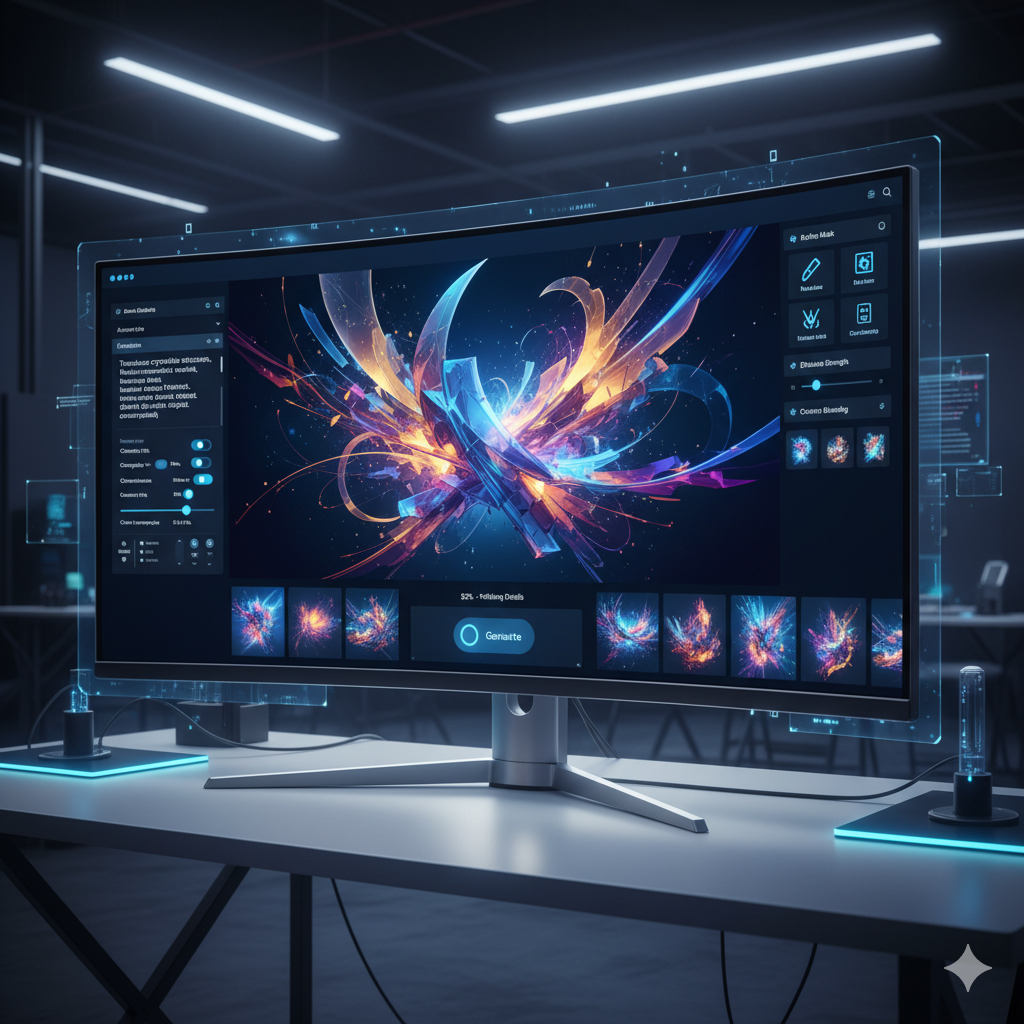
In an increasingly visual world, the ability to tell compelling stories through imagery is paramount. From social media feeds to immersive brand experiences, visuals capture attention, convey emotion, and drive engagement like no other medium. For content creators, marketers, designers, and educators alike, the demand for high-quality, relevant, and unique visual content is insatiable. However, the traditional process of creating such visuals can be time-consuming, expensive, and resource-intensive, often posing a significant bottleneck to creativity and scalability.
Enter Artificial Intelligence. Over the past few years, AI has transcended theoretical discussions to become a transformative force in the realm of visual content design. What once seemed like science fiction—generating hyper-realistic images from mere text prompts, modifying existing visuals with unprecedented precision, or even creating entire animated sequences—is now a tangible reality. AI is not just a tool; it is a creative partner, an accelerator, and a democratizer, enabling individuals and organizations to unlock new dimensions of visual storytelling.
This comprehensive guide delves deep into the practical applications of AI in content design, under the overarching theme of ‘The Future of Visual Content: Emerging Trends in AI Image Generation Technology’. We will explore how AI is reshaping creative workflows, empowering non-designers, and pushing the boundaries of what’s possible. From understanding the core AI technologies driving this revolution to examining real-world case studies across diverse industries, we will uncover the immense potential and critical considerations of integrating AI into your visual storytelling strategy. Prepare to discover how AI is not just changing how we create, but also how we imagine, communicate, and connect through visuals.
The Dawn of AI in Visual Content Creation
The journey of AI in visual content creation has been nothing short of spectacular, evolving from rudimentary image manipulation to sophisticated generative artistry. Initially, AI applications in visuals were limited to tasks like image recognition, classification, and basic enhancements such as upscaling or noise reduction. These early iterations, while useful, primarily served to assist human designers rather than to create autonomously.
The true turning point arrived with the advent of
More recently, the landscape has been revolutionized by
The impact of these technological advancements on creative workflows has been profound. What used to take hours of manual effort – brainstorming concepts, sketching, sourcing stock images, and complex photo manipulation – can now be initiated with a simple text prompt. Designers can rapidly prototype ideas, explore countless variations, and iterate on concepts at a speed previously unimaginable. Marketers can generate bespoke visuals for targeted campaigns in minutes. Small businesses and individual creators, who might not have the budget for professional graphic designers, can now access tools that empower them to produce stunning visuals for their brands. This shift signifies more than just efficiency; it represents a fundamental change in how we conceive, produce, and distribute visual narratives, democratizing access to high-end visual production capabilities.
Core AI Technologies Powering Visual Storytelling
Understanding the foundational AI technologies is key to appreciating the capabilities and potential of AI in visual storytelling. These technologies work in concert, sometimes integrated within a single platform, to deliver the sophisticated visual outcomes we see today.
Generative Adversarial Networks (GANs)
As mentioned, GANs were pioneers in generative AI. They consist of two deep neural networks: a generator that creates new data (images) and a discriminator that evaluates whether the generated data is real or fake. This ‘game’ drives the generator to produce increasingly realistic output. Early GANs faced challenges with mode collapse (where the generator produces limited variations) and often required significant computational power and careful tuning. However, they were instrumental in demonstrating the potential for AI to create novel, never-before-seen visuals.
Diffusion Models
Diffusion models have largely superseded GANs in terms of quality and control for text-to-image generation. They learn to reverse a process of gradually adding Gaussian noise to an image until it becomes pure noise. By learning this reversal, they can start from random noise and progressively denoise it into a coherent image guided by a text prompt. This iterative process allows for incredibly detailed, high-resolution, and stylistically diverse images. Key examples include DALL-E 2/3, Midjourney, and Stable Diffusion. Their ability to understand nuanced text prompts and translate them into complex visual compositions makes them exceptionally powerful for creative tasks.
Large Language Models (LLMs) & Multimodal AI
While LLMs like GPT-4 are primarily text-based, their integration with visual AI has led to powerful multimodal systems. DALL-E 3, for instance, is integrated with ChatGPT, allowing users to converse with the AI to refine prompts and generate more precise images. The LLM helps in interpreting complex textual descriptions, expanding on ideas, and ensuring the visual AI understands the intent behind the prompt. Multimodal AI extends beyond text-to-image to include image-to-text (captioning), video generation from text, and even understanding contextual cues from multiple data types simultaneously.
AI for Image Upscaling and Enhancement
Beyond generation, AI also excels at improving existing visuals. AI upscaling algorithms can increase the resolution of an image without significant loss of quality, often “inventing” details based on learned patterns. AI can also remove noise, sharpen blurry images, correct colors, and even fill in missing parts of an image (inpainting) or remove unwanted objects (outpainting).
AI for Object Recognition and Segmentation
These technologies allow AI to identify and isolate specific objects or regions within an image. Object recognition helps AI understand the content of an image (e.g., “this is a dog on a beach”), while segmentation precisely outlines these objects. This capability is crucial for smart editing tools, automated background removal, and personalized content creation.
The synergy between these technologies represents the cutting edge of AI in visual storytelling. As these models become more refined and integrated, the possibilities for creative expression and efficient content production continue to expand exponentially.
Practical Applications Across Industries: Transforming Content Design
The transformative power of AI in visual storytelling is not confined to a single domain; it reverberates across a multitude of industries, redefining how content is designed, produced, and consumed. Here’s a look at how different sectors are leveraging AI for visual design:
Marketing & Advertising
AI is a game-changer for marketers. It enables the rapid creation of countless ad creatives tailored to specific audience segments, demographics, and platforms. Imagine generating hundreds of unique social media visuals for an A/B test in minutes, or crafting personalized banner ads that resonate with individual user preferences. AI can also produce mockups for product launches, create dynamic content for digital signage, and even generate entire brand campaigns complete with diverse model representations and scene variations.
E-commerce
For online retailers, high-quality product visuals are paramount. AI can generate product images in various contexts and lighting conditions without the need for extensive physical staging. This includes virtual try-ons, visualizing products with different textures or colors, or placing them in diverse lifestyle settings. AI can also create product videos and 3D models, offering customers a richer, more interactive shopping experience.
Publishing & Media
News outlets, bloggers, and book publishers are utilizing AI to generate unique illustrations, article headers, cover designs, and infographics. This speeds up content production, reduces reliance on stock photo libraries, and ensures visual originality. AI can quickly adapt existing visuals to new dimensions or formats, ensuring consistent branding across all platforms.
Gaming & Entertainment
The gaming industry benefits immensely from AI in concept art generation, texture creation, and environment design. Artists can rapidly prototype ideas for characters, creatures, and worlds, iterating on concepts at a much faster pace. AI can also generate variations of in-game assets, populate virtual worlds with diverse elements, and even assist in creating dynamic visual effects.
Education & Training
AI helps create engaging explainer visuals, interactive learning modules, and educational infographics. It can simplify complex concepts into easily digestible visual stories, generate diverse scenarios for training simulations, and even create accessible versions of visual content (e.g., generating image descriptions for visually impaired learners).
Architecture & Interior Design
Architects and interior designers can leverage AI for rapid prototyping and visualization. AI can generate multiple design options for spaces, apply different material textures, or visualize concepts in various lighting conditions. This significantly speeds up the design process and enhances client presentations.
Fashion Design
In fashion, AI can assist in creating mood boards, generating textile patterns, designing garment variations, and even visualizing clothing on virtual models. This accelerates the design cycle, allows for more experimentation, and helps identify emerging trends through visual analysis.
These examples merely scratch the surface of AI’s potential. As the technology matures, we can expect even more sophisticated and integrated applications, further blurring the lines between human creativity and artificial intelligence.
Benefits of Integrating AI into Visual Storytelling Workflows
The adoption of AI in visual content design is not merely a trend; it’s a strategic move offering a multitude of benefits that can fundamentally transform how organizations and individuals create and disseminate visual stories.
- Unprecedented Speed and Efficiency: AI tools can generate images in seconds or minutes, a stark contrast to the hours or days required for traditional design methods. This rapid turnaround allows for faster content production cycles, enabling teams to respond quickly to market trends or breaking news. Designers can prototype ideas almost instantly, reducing the time spent on initial conceptualization.
- Significant Cost Reduction: AI can dramatically lower expenses associated with visual content creation. It reduces the need for extensive photoshoots, expensive stock photo subscriptions, or outsourcing to highly paid graphic designers for every visual asset. For small businesses or startups, this democratizes access to professional-grade visuals.
- Massive Scalability: The ability to generate vast amounts of unique visual content on demand is a cornerstone benefit. AI can produce thousands of variations of an ad creative, product image, or social media post, making it ideal for large-scale marketing campaigns, personalized content delivery, or diverse cultural representations.
- Democratization of Design: AI empowers non-designers—marketers, writers, educators, entrepreneurs—to create visually appealing content without specialized skills or software. This enables a broader range of individuals to effectively tell their stories, reducing dependence on a dedicated design team for every visual need.
- Enhanced Personalization and Customization: AI excels at generating highly tailored visuals. By feeding specific data points or prompts (e.g., user demographics, cultural context, emotional tone), AI can produce images that resonate deeply with individual audience segments, leading to higher engagement and conversion rates.
- Augmented Creativity and Ideation: Far from stifling creativity, AI acts as a powerful brainstorming partner. Designers can use AI to quickly explore new styles, conceptualize challenging ideas, or break through creative blocks by generating unexpected visual interpretations. It expands the creative possibilities beyond what a single human mind might conceive.
- Improved Accessibility: AI can aid in making visual content more accessible. It can automatically generate descriptive captions for images, ensuring that visually impaired users can understand the content. It also facilitates the creation of diverse representations in visuals, promoting inclusivity and reaching broader audiences.
- Consistency and Brand Adherence: While AI can generate diverse outputs, it can also be trained or prompted to adhere strictly to brand guidelines, color palettes, and stylistic preferences. This ensures visual consistency across all touchpoints, reinforcing brand identity.
These benefits collectively underscore why AI is not just an efficiency tool but a strategic asset in the modern visual content landscape, enabling more agile, cost-effective, and creative storytelling.
Navigating the Challenges and Ethical Considerations
While the promise of AI in visual storytelling is immense, its rapid advancement also brings forth a spectrum of challenges and critical ethical considerations that demand careful attention. Addressing these issues is crucial for responsible and sustainable integration of AI into creative workflows.
- Quality Control & Consistency: Achieving consistent brand voice, style, and quality across AI-generated visuals can be challenging. AI models, while powerful, can sometimes produce outputs that are aesthetically inconsistent, contain subtle errors, or deviate from established brand guidelines. Human oversight and iterative refinement through prompt engineering are essential to maintain high standards.
- Bias in AI Models: AI models are trained on vast datasets, and if these datasets contain inherent biases (e.g., disproportionate representation of certain demographics, stereotypes), the AI-generated output will reflect and perpetuate these biases. This can lead to visuals that lack diversity, reinforce harmful stereotypes, or misrepresent certain groups. Addressing bias requires careful curation of training data and active efforts to promote inclusive outputs.
- Copyright & Ownership: One of the most contentious issues surrounds copyright. Who owns an AI-generated image? The user who wrote the prompt? The developer of the AI model? The artists whose work was used in the training data? Current copyright laws are struggling to keep pace with these new forms of creation, leading to legal ambiguities and disputes. Different jurisdictions and platforms are adopting varying stances.
- Misinformation & Deepfakes: The ability of AI to generate hyper-realistic images and videos poses a significant threat in the form of misinformation and deepfakes. Malicious actors can create convincing but entirely fabricated visuals that can spread false narratives, defame individuals, or influence public opinion, making it difficult to discern truth from deception.
- Job Displacement vs. Augmentation: A common concern is that AI will replace human graphic designers and artists. While AI certainly automates certain tasks, the prevailing view is that it will primarily augment human capabilities, shifting roles towards prompt engineering, creative direction, AI supervision, and strategic design thinking. Human creativity, empathy, and critical judgment remain irreplaceable.
- Environmental Impact: Training and running large AI models, especially generative ones, require substantial computational power and energy. This contributes to carbon emissions, raising concerns about the environmental footprint of AI, particularly as its usage becomes more widespread.
- Prompt Engineering Complexity: While AI democratizes design, getting precisely what you want from an AI image generator often requires skill in “prompt engineering”—crafting detailed, nuanced text commands. This can have a learning curve and requires a different kind of creative thinking compared to traditional design tools.
- Ethical Sourcing of Training Data: The ethical implications of using vast amounts of internet-scraped data, including copyrighted material, for training AI models are a significant concern. This raises questions about fair compensation for artists and creators whose work contributes to the AI’s learning.
Navigating these challenges requires ongoing dialogue, technological innovation, robust policy frameworks, and a commitment to ethical AI development and deployment. The goal is to harness AI’s power responsibly, ensuring it serves humanity’s creative and communicative needs without undermining trust or perpetuating harm.
The Future Landscape: Emerging Trends and Innovations
The pace of innovation in AI for visual content design shows no signs of slowing down. We are on the cusp of even more revolutionary developments that will further redefine the boundaries of visual storytelling.
- Real-time AI Generation and Editing: Imagine generating complex visuals or making intricate edits with instant feedback, similar to painting on a digital canvas. Future AI models will offer near real-time interaction, allowing creators to sculpt images and videos dynamically, making the creative process more intuitive and fluid.
- Advanced Multimodal AI Refinement: The integration of text, image, video, and audio AI will become even more seamless. We will see AI systems that can generate entire multimedia stories from a simple prompt, where visuals, narration, and soundscapes are co-created and harmonized by AI. This means generating a video complete with motion graphics and a voiceover from a text script.
- 3D Content Generation from 2D Input: A significant leap forward will be AI’s ability to reliably generate intricate 3D models, textures, and entire virtual environments directly from 2D images or text descriptions. This will revolutionize industries like gaming, virtual reality, architectural visualization, and product design by dramatically cutting down on 3D asset creation time.
- Personalized AI Models and Fine-tuning: Businesses and individual creators will increasingly be able to fine-tune open-source or proprietary AI models with their own specific datasets, brand guidelines, and artistic styles. This will lead to highly personalized AI assistants that consistently generate visuals perfectly aligned with a creator’s unique aesthetic and brand identity.
- Interactive and Adaptive AI Storytelling: Future AI will enable visual stories that adapt and evolve based on user interaction, context, or real-time data. This could manifest as dynamic advertisements that change content based on viewer demographics, interactive narratives in games, or educational content that visually responds to a learner’s progress.
- AI in Augmented and Virtual Reality (AR/VR): AI will play a pivotal role in creating realistic and immersive AR/VR experiences. From generating complex virtual worlds and lifelike avatars to enhancing real-world environments with AI-powered overlays, AI will make the creation of immersive content more accessible and sophisticated.
- Ethical AI Design and Governance: As AI becomes more ubiquitous, there will be a stronger emphasis on developing AI models with built-in ethical safeguards. This includes tools for detecting and mitigating bias, ensuring transparency in AI-generated content (e.g., watermarking), and developing clear guidelines for responsible AI use.
- AI-Powered Creative Collaboration Platforms: The future will see more sophisticated platforms where human and AI collaboration is central. These platforms will offer intuitive interfaces for prompt engineering, style transfer, creative exploration, and automated content generation, fostering a symbiotic relationship between human artistic vision and AI’s processing power.
These emerging trends point towards a future where AI isn’t just a tool for generating images, but a fundamental component of a new creative ecosystem—one that is more dynamic, personalized, and creatively expansive than ever before. The key will be learning to collaborate effectively with these intelligent systems.
Comparison Tables
To further illustrate the impact of AI, let’s look at how it stacks up against traditional methods and compare some of the leading tools.
Table 1: Traditional vs. AI-Powered Visual Content Creation
| Feature | Traditional Content Creation | AI-Powered Content Creation |
|---|---|---|
| Speed of Production | Hours to weeks, depending on complexity. Involves manual design, photography, illustration, editing. | Seconds to minutes for initial generation, with refinement taking minutes to hours. Highly automated. |
| Cost per Asset | High (designer fees, photoshoot costs, stock subscriptions, software licenses). | Low to moderate (subscription to AI tools, less reliance on stock, reduced manual labor). |
| Scalability | Limited; producing large volumes of unique assets is resource-intensive and expensive. | High; can generate hundreds or thousands of unique variations rapidly and cost-effectively. |
| Required Skill Level | Requires professional design skills, software proficiency (Photoshop, Illustrator, etc.), artistic talent. | Lower barrier to entry; requires prompt engineering skills, creative vision, and understanding of AI tool nuances. |
| Creative Control & Iteration | High, but iteration cycles are long and costly. Direct manual control over every pixel. | High, with rapid iteration via prompt adjustments. Control exercised through language and parameters. |
| Originality of Output | Guaranteed original if created from scratch; reliance on stock can lead to common visuals. | Generates novel, unique images; potential for similar outputs if prompts are generic; concerns about training data originality. |
| Personalization | Limited and expensive to personalize visuals for many segments. | Highly effective for generating bespoke visuals for specific audiences at scale. |
Table 2: Popular AI Image Generation Tools Comparison (as of late 2023/early 2024)
| Tool | Core Model Type | Strengths | Primary Use Cases | Ease of Use | Pricing Model |
|---|---|---|---|---|---|
| Midjourney | Proprietary Diffusion Model | Exceptional for artistic, imaginative, and aesthetically pleasing visuals. Strong with abstract and detailed concepts. | Concept art, character design, expressive marketing visuals, artistic illustrations, mood boards. | Moderate (Discord-based interaction, highly prompt-sensitive). | Subscription-based (paid tiers). |
| DALL-E 3 (via ChatGPT Plus/Copilot Pro) | Proprietary Diffusion Model (integrated with LLM) | Excellent understanding of complex, nuanced text prompts. Strong for literal interpretation and text rendering within images. | Marketing materials, blog illustrations, product mockups, detailed scene generation, visuals with specific text. | High (conversational interface via ChatGPT, very intuitive). | Subscription (ChatGPT Plus, Copilot Pro). |
| Stable Diffusion (Open-source) | Open-source Diffusion Model | Highly customizable, can be run locally or via various interfaces (e.g., Automatic1111). Extensive control over parameters, styles, and fine-tuning. | Technical art, specific style generation, NSFW content (with user discretion), custom model training, professional production pipelines. | Low to High (depending on interface and technical proficiency, high for local installation). | Free (open-source), paid cloud services available. |
| Adobe Firefly | Proprietary Diffusion Model (trained on Adobe Stock & public domain) | Seamless integration with Adobe Creative Cloud. Emphasis on commercial safety (no brand names, less controversial content). Strong for creative fill and vector graphics. | Graphic design, photo editing, content fill/expansion, text effects, integration into existing design workflows. | High (intuitive interface, familiar to Adobe users). | Subscription (part of Creative Cloud or standalone). |
| Canva’s Text to Image | Various (often integrated with Stable Diffusion or similar) | Integrated into an easy-to-use design platform. Great for quick visual ideation within existing design projects. | Social media posts, presentations, basic blog graphics, quick design elements for non-designers. | Very High (simple, user-friendly interface). | Freemium (basic use free, advanced features with Canva Pro). |
Practical Examples and Case Studies
Beyond the theoretical discussions, real-world implementations vividly demonstrate the power of AI in visual storytelling. These examples showcase how AI is not just a futuristic concept but a practical tool transforming daily operations across various sectors.
Case Study 1: Rapid Ad Creative Generation for E-commerce
A fast-growing online fashion retailer needed to launch multiple ad campaigns for a new collection across Facebook, Instagram, and TikTok. Traditional methods would involve extensive photoshoots, graphic design work, and A/B testing, taking weeks and significant budget. Instead, they utilized an AI image generator (like Midjourney or DALL-E 3). They provided product photos and brand guidelines. With a series of prompts, they generated hundreds of unique lifestyle images featuring models of diverse ages, ethnicities, and body types, placed in various aspirational settings (e.g., “model wearing red dress in Parisian café,” “diverse group enjoying beach party with new swimwear”). This allowed them to:
- Test a vast array of visual concepts quickly.
- Personalize ads for different demographic segments.
- Reduce photoshoot costs by over 80%.
- Increase ad click-through rates by identifying top-performing visuals through rapid iteration.
Case Study 2: Personalized Learning Materials for Educators
An educational content creator specializing in online science courses faced the challenge of creating engaging, unique, and easy-to-understand diagrams and illustrations for complex topics like cellular biology and astrophysics. Hiring illustrators for every concept was prohibitive. They turned to AI image generation.
- For a lesson on photosynthesis, they prompted the AI to create “a stylized, vibrant illustration of chloroplasts absorbing sunlight, with energy conversion depicted by glowing particles.”
- For a section on black holes, they requested “an abstract, cosmic artwork depicting spacetime distortion around a supermassive black hole, with light bending.”
- The AI allowed them to generate visual metaphors and simplified diagrams that enhanced comprehension, making abstract concepts more tangible.
- They could also adapt visuals for different learning styles or age groups by adjusting the artistic style in their prompts.
This led to more engaging course material and improved student retention, all while significantly cutting down on production time and costs for visual assets.
Case Study 3: Game Environment Prototyping
An indie game development studio was creating a fantasy RPG and needed to quickly prototype various environmental concepts for forests, mountains, and dungeons. Manual concept art creation was slow and labor-intensive. They integrated Stable Diffusion into their workflow.
- Artists would input prompts like “lush enchanted forest, ancient trees, glowing flora, misty atmosphere, high fantasy art style.”
- They could then iterate on these prompts, adding parameters for specific lighting, time of day, or weather conditions.
- The AI generated dozens of high-quality concept art pieces in minutes, allowing the team to visualize different aesthetics and quickly decide on the art direction.
- They even used AI to generate seamless textures for in-game assets, speeding up the asset creation pipeline.
This approach dramatically accelerated the pre-production phase, enabling the team to explore more creative avenues and solidify their game’s visual identity much faster.
Case Study 4: AI-Powered Interior Design Visualization
An interior design firm specialized in custom home renovations. Presenting diverse design options to clients traditionally involved manual rendering or sourcing numerous example photos, which could be time-consuming and sometimes failed to capture the client’s specific vision. They adopted an AI tool like Adobe Firefly’s generative fill and text-to-image features.
- Starting with a photo of a client’s current living room, they could use AI to “change wall color to deep sapphire,” “add a modern minimalist sofa,” or “replace existing fireplace with a stone one.”
- For entirely new concepts, they would prompt the AI: “design a Scandinavian-style kitchen with light wood cabinets, white quartz countertops, and natural light.”
This allowed them to present multiple high-fidelity design variations to clients in real-time during consultations, gather instant feedback, and iterate on designs on the fly, leading to higher client satisfaction and faster project approvals.
These examples underscore that AI is not merely a novelty but a powerful, versatile tool already making a tangible difference in how visual content is conceived, created, and deployed across a spectrum of industries.
Frequently Asked Questions
Q: What is AI visual storytelling?
A: AI visual storytelling refers to the process of using artificial intelligence tools and algorithms to generate, modify, and enhance visual content to convey narratives, emotions, and information. This includes generating images from text descriptions, creating illustrations, editing photos, generating videos, and more, all powered by AI to accelerate and expand creative possibilities.
Q: How do AI image generators work?
A: Most modern AI image generators, like DALL-E, Midjourney, and Stable Diffusion, are based on “diffusion models.” These models learn by progressively adding noise to training images until they are completely scrambled. Then, they learn to reverse this process, starting from random noise and gradually denoising it into a coherent image based on a given text prompt. They essentially learn the underlying patterns and structures of images from vast datasets and can then synthesize new images that align with textual descriptions.
Q: Are AI-generated images copyrightable?
A: This is a complex and evolving legal area. In many jurisdictions, including the U.S., content created solely by AI without significant human creative input is generally not eligible for copyright protection. The U.S. Copyright Office has stated that human authorship is a prerequisite for copyright. However, if a human significantly modifies, selects, or arranges AI-generated content to create a new work of authorship, that human input may be copyrightable. Laws vary globally, and this area is subject to ongoing debate and legal interpretation.
Q: Can AI replace human graphic designers?
A: While AI can automate many routine and repetitive design tasks, it is unlikely to fully replace human graphic designers. Instead, AI is seen as an augmentation tool that empowers designers to work faster, explore more ideas, and focus on higher-level creative direction, strategy, and problem-solving. Human designers bring unique elements like empathy, cultural understanding, critical judgment, and nuanced creative vision that AI currently lacks. The role of designers is evolving to include prompt engineering and AI supervision.
Q: What are the best AI tools for visual content?
A: The “best” tool depends on your specific needs:
- Midjourney: Excellent for artistic, imaginative, and aesthetically pleasing visuals, great for concept art.
- DALL-E 3 (via ChatGPT Plus/Copilot Pro): Strong for understanding complex, nuanced text prompts and generating literal interpretations, good for marketing visuals with specific requirements.
- Stable Diffusion (open-source): Highly customizable, offers extensive control, and can be fine-tuned for specific styles, ideal for technical users or custom projects.
- Adobe Firefly: Integrates seamlessly with Adobe Creative Cloud, focused on commercial safety, and great for content fill and editing within existing workflows.
- Canva’s Text to Image: Very easy to use, integrated into a popular design platform, perfect for quick graphics for non-designers.
Q: How can I ensure ethical use of AI in design?
A: Ensuring ethical use involves several practices:
- Be mindful of potential biases in AI outputs and actively work to diversify representations.
- Respect copyright and intellectual property rights, acknowledging the evolving legal landscape.
- Be transparent about AI’s role in content creation, especially for sensitive or journalistic content.
- Avoid using AI to create harmful deepfakes or propagate misinformation.
- Consider the environmental impact of AI model training and usage.
- Prioritize augmenting human creativity rather than replacing it.
Q: What is prompt engineering?
A: Prompt engineering is the art and science of crafting effective text prompts to guide AI models to generate desired outputs. It involves understanding how AI models interpret language, experimenting with different keywords, phrases, negative prompts, and parameters to achieve precise and high-quality results. It requires a blend of creativity, technical understanding, and iterative refinement.
Q: Is AI limited to generating still images?
A: No, AI’s capabilities extend beyond still images. AI is increasingly used for:
- Video Generation: Creating short video clips or animations from text prompts or images.
- Video Editing: Automating tasks like object removal, color grading, stabilization, and generating slow-motion effects.
- 3D Asset Creation: Generating 3D models, textures, and environments.
- Audio Generation: Creating soundtracks, sound effects, or voiceovers for visual content.
Multimodal AI is leading to seamless integration of these different content types.
Q: How quickly can AI generate visuals?
A: Most AI image generators can produce a set of initial images in a matter of seconds to a few minutes, depending on the complexity of the prompt, the chosen model, and the processing power available (e.g., local machine vs. cloud service). Refining these images or generating more variations can take additional minutes, but the speed is orders of magnitude faster than traditional manual creation.
Q: What’s the learning curve for using AI image tools?
A: The learning curve varies significantly between tools.
- Beginner-friendly tools like Canva’s AI or DALL-E 3 (via ChatGPT) are very intuitive, with a low learning curve, focusing on simple text prompts.
- Intermediate tools like Midjourney require more understanding of prompt structure and iterative refinement but can be mastered relatively quickly.
- Advanced tools like Stable Diffusion (especially for local installations with extensive plugins) have a steeper learning curve, demanding technical proficiency and a deeper understanding of parameters and fine-tuning.
Overall, the basic concept is easy to grasp, but mastering the art of prompt engineering for specific, high-quality results takes practice.
Key Takeaways
- AI is Revolutionizing Visual Content: Artificial intelligence, particularly generative AI like diffusion models, is fundamentally transforming how visual content is created, from static images to dynamic videos.
- Unprecedented Efficiency and Scalability: AI dramatically accelerates content production, reduces costs, and enables the creation of vast amounts of unique, personalized visuals at scale.
- Broad Industry Applications: From marketing and e-commerce to gaming and education, AI is finding practical applications across diverse industries, empowering various professionals.
- Augmentation, Not Replacement: While AI automates tasks, it primarily augments human creativity, allowing designers to focus on strategic thinking, creative direction, and prompt engineering.
- Core Technologies Driving Innovation: GANs, Diffusion Models, LLM integration, and AI for enhancement/recognition are the foundational technologies powering this visual revolution.
- Critical Challenges Demand Attention: Ethical concerns around bias, copyright, deepfakes, and job displacement, alongside quality control issues, require ongoing responsible development and thoughtful management.
- Future Promises Advanced Integration: Emerging trends point towards real-time generation, multimodal AI, 3D content creation, personalized AI models, and interactive storytelling.
- Embrace Prompt Engineering: Mastering the art of crafting effective prompts is a key skill for unlocking the full potential of AI image generation tools.
Conclusion
The journey into the world of AI-powered visual storytelling reveals a landscape brimming with unprecedented possibilities. We stand at a pivotal moment where artificial intelligence is not merely a supplementary tool but a core engine driving innovation in content design. From its foundational technologies like diffusion models to its practical applications spanning virtually every industry, AI is proving to be a catalyst for efficiency, creativity, and personalization.
The ability to conjure detailed visuals from mere words, to iterate on designs at lightning speed, and to scale content production to previously unimaginable levels empowers creators and businesses alike. It democratizes access to high-quality visuals, allowing small startups to compete with large corporations in terms of visual impact, and enabling individual storytellers to bring their most imaginative visions to life with greater ease.
However, with great power comes great responsibility. Navigating the ethical complexities of AI—addressing bias, clarifying copyright, guarding against misinformation, and fostering responsible development—is not just an option but an imperative. The future of visual content is one of collaboration, where human ingenuity, empathy, and strategic thinking guide the incredible capabilities of AI.
As we look ahead, the continuous evolution of AI promises even more sophisticated tools for real-time creation, seamless multimodal integration, and immersive 3D experiences. The ultimate value of AI in content design lies not in its ability to replace human creativity, but in its capacity to amplify it, to open new frontiers of visual expression, and to enable richer, more impactful storytelling than ever before. Embrace this transformative technology, learn its language, and prepare to unlock an entirely new dimension of visual communication.





























































Leave a Reply