

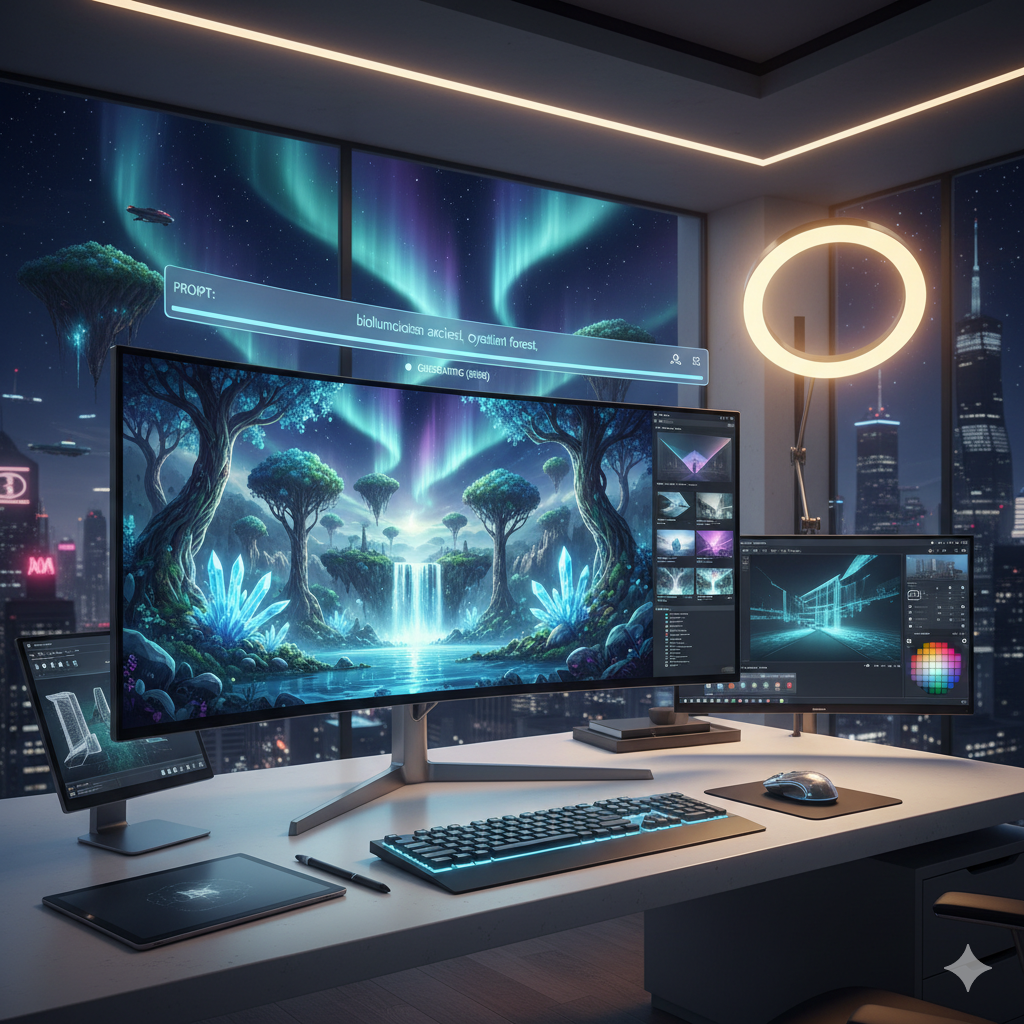
In an era where artificial intelligence is democratizing creativity, the ability to generate stunning visuals has moved from the exclusive domain of professional artists to the fingertips of anyone with an internet connection. Thanks to the rapid advancements in AI image generation, particularly with tools that offer robust free tiers, the barrier to entry for creating incredible digital art has never been lower. However, simply typing a few words into a text box often leads to generic or unsatisfying results. The true magic lies in prompt engineering – the art and science of communicating effectively with AI models to elicit precisely the images you envision.
This comprehensive guide will demystify the process, revealing the ‘secrets’ of prompt engineering that empower you to craft breathtaking visuals using readily available free AI image generation tools. We will dive deep into the fundamental principles, dissecting the anatomy of a powerful prompt, exploring advanced techniques, and providing practical examples that you can immediately apply. Whether you’re an aspiring artist, a marketer looking for quick visuals, a writer seeking inspiration, or simply curious about the frontiers of AI, prepare to unlock your creative potential and transform your ideas into stunning visual realities.
Understanding AI Image Generation Fundamentals
Before we can master prompt engineering, it is crucial to grasp the basic mechanism behind how these incredible AI image generation tools actually work. At their core, most modern AI image generators, like those built upon the Stable Diffusion architecture, are powered by a type of neural network called a diffusion model. These models are trained on colossal datasets of images and their corresponding text descriptions, learning the intricate relationships between words and visual concepts.
Imagine the AI starting with a canvas of pure static noise, like a blurry television screen. The text prompt you provide acts as a set of instructions, guiding the AI to “denoise” this static until it forms a coherent image that aligns with your description. This process is iterative, with the AI progressively refining the image over many steps, adding details and structure based on its learned understanding. Every word in your prompt, and even the order and emphasis of those words, contributes to this denoising process, subtly influencing the final output.
Understanding this fundamental concept helps us appreciate why detailed, specific, and well-structured prompts are so effective. The AI isn’t simply searching a database for pre-existing images; it’s actively *creating* something new based on your guidance. Your prompt is the blueprint, and the AI is the architect and builder, translating your textual vision into a visual masterpiece. This generative nature is what makes AI art so revolutionary, offering limitless possibilities for unique creations that have never existed before.
The Core Principles of Prompt Engineering for Visuals
Prompt engineering isn’t just about throwing words at an AI; it’s a strategic approach built on several core principles that significantly enhance your chances of generating desired results. Adhering to these principles will transform your prompting from a hit-or-miss endeavor into a predictable and powerful creative process.
- Clarity and Specificity: Vague prompts lead to vague images. Be as clear and specific as possible about your subject, setting, actions, style, and any other crucial details. Instead of “a dog,” try “a golden retriever running through a sunlit meadow.”
- Iteration and Experimentation: Rarely will your first prompt yield a perfect result. Prompt engineering is an iterative process. Generate an image, analyze what worked and what didn’t, then refine your prompt based on those observations. Small changes can lead to dramatic differences.
- Understanding Model Bias and Strengths: Different AI models, even within the same architecture, can have distinct biases or excel in certain styles. Some might be better at photorealism, others at fantasy art. Experiment with different free tools to see which best aligns with your creative vision.
- Prioritization and Weighting: While most free tools don’t offer advanced weighting syntax by default, the order of your words often matters. Place the most important elements at the beginning of your prompt. Some tools might implicitly give more weight to terms appearing earlier.
- Using Keywords and Descriptive Language: AI models understand specific keywords incredibly well. Utilize descriptive adjectives, adverbs, and nouns to paint a vivid picture for the AI. Think like a poet or a storyteller, but with a focus on visual attributes.
- Negative Prompting: Just as important as telling the AI what you want, is telling it what you don’t want. Negative prompts are a powerful tool to eliminate unwanted artifacts, styles, or elements from your generations.
Embracing these principles as foundational tenets will empower you to move beyond basic generations and start truly directing the AI towards your creative goals. It’s about learning the AI’s language and speaking it fluently.
Deconstructing a Great Prompt: Elements and Anatomy
A powerful prompt is not just a sentence; it’s a carefully constructed set of instructions. Breaking down a prompt into its essential components allows for systematic construction and refinement. Think of it as building a house – you need a foundation, walls, a roof, and then the decorative elements.
Here are the key anatomical elements that typically form a comprehensive prompt, presented in a logical order that often yields excellent results:
- Subject: What is the main focal point of your image? Be highly specific.
- Example: “A majestic lion,” “a young woman with auburn hair,” “an ancient spaceship.”
- Action/Pose (if applicable): What is the subject doing? How are they positioned?
- Example: “roaring at the sunset,” “reading a book by the fireplace,” “hovering over a futuristic city.”
- Environment/Setting: Where is the scene taking place? Describe the background and surroundings.
- Example: “in a lush jungle,” “inside a cozy, rustic cabin,” “against a backdrop of neon-lit skyscrapers.”
- Art Style/Medium: How should the image look aesthetically? This is crucial for guiding the AI’s artistic interpretation.
- Example: “oil painting by Van Gogh,” “digital art, cyberpunk style,” “photorealistic,” “anime illustration,” “watercolor sketch,” “hyperdetailed concept art.”
- Lighting: Describe the quality, direction, and color of the light. Lighting dramatically impacts mood and realism.
- Example: “golden hour light,” “dramatic volumetric lighting,” “soft rim light,” “neon glow,” “studio lighting,” “cinematic lighting.”
- Composition/Camera Angle: How is the scene framed? What perspective is the viewer taking?
- Example: “wide-angle shot,” “close-up portrait,” “low-angle perspective,” “cinematic shot,” “dutch angle,” “rule of thirds.”
- Details and Attributes: Add specific characteristics or embellishments for the subject or environment.
- Example: “wearing intricate armor,” “with glowing eyes,” “ancient ruins overgrown with vines,” “sparkling dust particles.”
- Quality/Resolution Modifiers: Instructions to enhance the overall fidelity and detail of the image.
- Example: “8K, photorealistic, hyperdetailed, intricately designed, octane render, unreal engine.” These terms often push the AI to generate higher quality outputs.
By consciously including these elements, you provide the AI with a rich, multi-dimensional description, significantly increasing the likelihood of generating an image that closely matches your mental picture. Think of each element as a brushstroke, collectively painting your desired scene.
Mastering Modifiers: Style, Lighting, Composition, and More
Modifiers are the secret sauce of prompt engineering. They are the specific keywords and phrases that fine-tune the AI’s interpretation, allowing you to control nuanced aspects of your image. Understanding and strategically applying these modifiers can elevate your generations from good to truly stunning. Let’s explore some key categories:
Style Modifiers
These dictate the overall aesthetic and artistic direction of your image. They are incredibly powerful in transforming the same subject into vastly different artworks.
- Artistic Movements: “Impressionist painting,” “Surrealism,” “Baroque,” “Art Deco,” “Abstract Expressionism.”
- Specific Artists: “by Vincent van Gogh,” “in the style of Frida Kahlo,” “digital art by Greg Rutkowski” (a popular one in AI art communities).
- Digital Art Styles: “cyberpunk art,” “fantasy illustration,” “sci-fi concept art,” “pixel art,” “low poly,” “voxel art.”
- Traditional Mediums: “oil painting,” “watercolor,” “charcoal sketch,” “ink drawing,” “pastel art,” “stained glass.”
- Photography Styles: “photorealistic,” “documentary photography,” “street photography,” “bokeh,” “HDR,” “cinematic photo,” “fashion photography.”
- Other Styles: “anime style,” “manga art,” “cartoon art,” “comic book art,” “children’s book illustration.”
Lighting Modifiers
Lighting is paramount in setting mood, creating depth, and highlighting textures. Precise lighting descriptions can dramatically alter the emotional impact of your image.
- Time of Day/Natural Light: “golden hour,” “blue hour,” “moonlight,” “sunlight,” “dusk,” “dawn,” “overcast,” “stormy weather light.”
- Artificial Light: “neon lights,” “fluorescent lights,” “backlit,” “rim light,” “spotlight,” “studio lighting,” “cinematic lighting,” “volumetric lighting,” “god rays.”
- Light Qualities: “soft light,” “hard shadows,” “dramatic lighting,” “diffused light,” “gloomy light,” “ethereal light,” “vibrant lighting.”
Composition and Camera Modifiers
These terms guide the AI on how to frame the scene, controlling the viewer’s perspective and the spatial arrangement of elements.
- Shot Types: “wide shot,” “close-up,” “full body shot,” “medium shot,” “headshot,” “extreme close-up.”
- Angles: “low angle,” “high angle,” “bird’s eye view,” “worm’s eye view,” “dutch angle.”
- Compositional Rules: “rule of thirds,” “symmetrical composition,” “asymmetrical composition,” “leading lines,” “dynamic composition.”
- Depth and Focus: “shallow depth of field,” “deep depth of field,” “bokeh effect,” “in focus,” “out of focus background.”
Color and Tone Modifiers
Direct the AI to use specific color palettes or overall tonal qualities.
- Palettes: “vibrant colors,” “muted tones,” “monochrome,” “sepia,” “pastel colors,” “complementary colors,” “warm colors,” “cool colors.”
- Mood: “dark fantasy,” “bright and cheerful,” “somber atmosphere,” “dreamlike colors.”
Quality and Detail Modifiers
These are general terms that encourage the AI to render with higher fidelity and more intricate detail. While not always a magic bullet, they often help.
- “8K,” “4K,” “photorealistic,” “hyperdetailed,” “ultra detailed,” “intricate,” “masterpiece,” “award-winning photo,” “best quality,” “smooth,” “sharp focus,” “octane render,” “unreal engine,” “ray tracing,” “volumetric lighting.”
By combining these modifiers strategically, you can create prompts that are incredibly rich and descriptive, leaving less to the AI’s interpretation and giving you more control over the final output. The key is to experiment with different combinations and observe their effects.
Leveraging Free AI Image Tools: A Practical Guide
The landscape of AI image generation tools is constantly evolving, with new platforms emerging and existing ones improving their free tiers. While paid subscriptions often offer more features, faster generation, and higher limits, the free options are incredibly powerful for learning prompt engineering and producing stunning visuals without any financial commitment. Here are some popular free AI image tools and how they fit into your prompt engineering journey:
Leonardo AI
Leonardo AI offers a very generous free tier, typically providing a significant number of daily credits that refresh. It’s built on various Stable Diffusion models and also features its own custom-trained models, making it highly versatile. It boasts a user-friendly interface with options for fine-tuning, such as image dimensions, guidance scale (how closely the AI follows the prompt), and negative prompts.
- Strengths: Wide array of models, intuitive interface, good control over parameters, excellent for a range of styles from photorealism to illustration.
- Prompting Insight: Leonardo AI responds very well to detailed stylistic and quality modifiers. Experiment with their different fine-tuned models for specific aesthetics.
Playground AI
Playground AI is another excellent free option, often providing a large number of free generations per day. It also leverages Stable Diffusion models and offers a clean, straightforward interface. It’s known for its ease of use and good default settings, making it accessible for beginners.
- Strengths: Very high daily free generation limits, easy to use, good for rapid prototyping and idea generation.
- Prompting Insight: It’s quite responsive to direct stylistic cues and excels at quickly generating variations. Pay attention to its negative prompt field for cleaning up outputs.
Stable Diffusion Web UIs (e.g., Hugging Face, Civitai, Local Installs)
While installing Stable Diffusion locally (e.g., Automatic1111 web UI) requires a powerful GPU, many online platforms offer free access to Stable Diffusion models for limited generations or through community-driven instances. Sites like Hugging Face Spaces or specific community sites often host free demos of various Stable Diffusion models.
- Strengths: Access to cutting-edge models, often supports advanced prompting syntax (like weighting, if available), and allows deep customization for those running local versions.
- Prompting Insight: These platforms are often the purest form of Stable Diffusion, meaning they respond exceptionally well to standard prompt engineering techniques. Understanding negative prompts is critical here.
DreamStudio (Stability AI)
DreamStudio, developed by Stability AI (the creators of Stable Diffusion), often provides free credits upon signing up. While these credits might not refresh daily as generously as others, they are perfect for getting a feel for the direct Stable Diffusion experience.
- Strengths: Direct access to the latest official Stable Diffusion models, a clean interface.
- Prompting Insight: Great for understanding the raw power of Stable Diffusion and how prompt parameters (like CFG scale and steps) interact with your text.
The key takeaway is that the principles of prompt engineering remain largely universal across these tools. Each tool might have slight nuances in how it interprets prompts or what specific features it offers, but a well-constructed prompt will generally perform well everywhere. Start with one, get comfortable, and then experiment with others to find your favorite workflow and model combinations.
Advanced Prompting Techniques: Iteration, Blending, and Negative Prompts
Once you’ve mastered the basics, you can elevate your prompt engineering with advanced techniques that offer greater control and precision. These methods are essential for moving beyond good results to truly exceptional, bespoke creations.
Iteration and Refinement: The Core of Mastery
Iteration is not just a principle; it’s a technique. It involves a systematic approach to refining your prompts. Start with a broad concept, generate an image, and then incrementally adjust your prompt based on the output. This process can be broken down into steps:
- Initial Broad Prompt: Begin with the core subject and setting.
Example: “A wizard in a forest.”
- Add Specifics: Introduce details about the subject, action, and environment.
Example: “An old wizard with a long beard, staff in hand, standing in a magical glowing forest, casting a spell.”
- Refine Style and Mood: Inject artistic direction, lighting, and emotional tone.
Example: “An old wizard with a long white beard, ornate wooden staff in hand, standing in a magical glowing forest at dusk, casting a vibrant blue spell. Fantasy art, volumetric lighting, epic.”
- Introduce Composition and Quality: Frame the shot and demand higher fidelity.
Example: “Close-up portrait of an old wizard with a long white beard, ornate wooden staff in hand, standing in a magical glowing forest at dusk, casting a vibrant blue spell. Fantasy art, dramatic volumetric lighting, epic, highly detailed, 8K, cinematic shot, unreal engine.”
- Utilize Negative Prompts: Address unwanted elements or general AI artifacts.
Example Positive Prompt: “Close-up portrait of an old wizard with a long white beard, ornate wooden staff in hand, standing in a magical glowing forest at dusk, casting a vibrant blue spell. Fantasy art, dramatic volumetric lighting, epic, highly detailed, 8K, cinematic shot, unreal engine.”
Example Negative Prompt: “ugly, deformed, disfigured, low quality, bad anatomy, text, watermark, blurry, extra limbs.”
Each step informs the next, transforming a simple idea into a complex, detailed vision.
Negative Prompting: The Art of Exclusion
Negative prompts are incredibly powerful. They instruct the AI on what *not* to include or what characteristics to avoid. This is vital for cleaning up common AI quirks and steering the image away from undesirable outcomes.
- Common Negative Prompts for General Quality:
“low quality, blurry, bad anatomy, deformed, disfigured, ugly, extra limbs, missing limbs, poorly drawn hands, extra fingers, text, watermark, signature, jpeg artifacts, noise, grayscale, monochrome.”
- Specific Exclusions: If your image keeps generating unwanted elements (e.g., “no cars,” “no trees,” “no facial hair”).
- Style Correction: If the AI leans towards a cartoonish style when you want realism: “cartoon, anime, drawing, illustration.”
Always use a robust negative prompt. It is arguably as important as your positive prompt for achieving professional-looking results.
Prompt Weighting (Tool-Dependent)
While not universally available in all free tools, some advanced Stable Diffusion interfaces allow you to assign weight to specific words or phrases in your prompt. This tells the AI to pay more or less attention to certain elements. For example, `(red:1.3) apple` would emphasize “red” more than `red apple`.
- Check Documentation: If a free tool offers advanced syntax, consult its documentation for how to apply weighting (e.g., parentheses, colons).
- Prioritize Naturally: If weighting isn’t available, simply placing more important keywords earlier in your prompt often gives them more implicit weight.
Seed Numbers: Reproducibility and Exploration
A seed number is like a unique identifier for the initial noise pattern from which the AI starts generating an image. If you use the same prompt, seed, and other parameters, you should get a very similar (if not identical) image. This is invaluable for:
- Reproducing Good Results: If you generate something you love, save the seed number to potentially regenerate it or iterate from it.
- Exploring Variations: Keep the prompt mostly the same, but slightly change the seed number to get similar but distinct variations.
Most free tools will display the seed number after generation; make a habit of noting it down for promising results.
Mastering these advanced techniques will transform you into a true prompt engineer, capable of sculpting the AI’s output with remarkable precision and consistency.
Troubleshooting Common Prompting Challenges
Even with a solid understanding of prompt engineering, you’ll inevitably encounter challenges. AI image generation isn’t always straightforward, and understanding how to diagnose and fix common issues is a crucial skill.
1. Vague or Generic Outputs
Problem: The image generated is bland, lacks detail, or doesn’t capture the essence of your vision.
Solution:
- Be More Specific: Add descriptive adjectives, adverbs, and specific nouns. Instead of “a city,” try “a bustling cyberpunk metropolis at night with holographic advertisements and flying cars.”
- Add Style Modifiers: Explicitly state the desired art style (e.g., “digital painting,” “cinematic photo,” “anime illustration”).
- Use Quality Modifiers: Include terms like “8K, hyperdetailed, masterpiece, award-winning.”
2. Unwanted Elements or Artifacts
Problem: The image contains weird distortions, strange extra limbs, text, watermarks, or objects you didn’t ask for.
Solution:
- Utilize Negative Prompts: This is the primary solution. Add keywords like “ugly, deformed, bad anatomy, extra limbs, text, watermark, blurry, low quality” to your negative prompt.
- Increase Guidance Scale (CFG Scale): In tools that allow it, increasing the guidance scale tells the AI to adhere more strictly to your prompt, potentially reducing random artifacts. (Be cautious, too high can lead to over-saturation or distorted images).
3. Not Matching Intent/Incorrect Subject
Problem: The AI generates something completely different from what you intended, or misinterprets a key element.
Solution:
- Rephrase and Reorder: Sometimes a simple rephrasing or moving important keywords to the beginning of the prompt can clarify your intent.
- Break Down Complex Ideas: If your prompt is very long or complex, try simplifying it to its core elements first, get a good base, then add complexity iteratively.
- Use Synonyms: The AI might have a better understanding of a synonym. Try “ancient structure” instead of “ruin” if “ruin” isn’t working.
- Add Context: Provide more context around ambiguous terms.
4. Repetitive or Similar Images
Problem: Despite prompt changes, the AI keeps generating very similar images.
Solution:
- Change Seed Number: If you’re stuck in a loop, try changing the seed number.
- Introduce Randomness: Sometimes adding a new, slightly unexpected element can break the pattern.
- Adjust CFG Scale: Slightly lowering the guidance scale can give the AI more creative freedom and lead to more varied results.
5. Inconsistent Style Across Generations
Problem: You want a series of images in the same style, but they look different.
Solution:
- Be Extremely Specific with Style: Use precise style modifiers (e.g., “Impressionist painting by Claude Monet,” not just “Impressionist”).
- Keep Parameters Consistent: Use the same seed (if iterating for variations), same guidance scale, same number of steps, and same model for all images in the series.
- Use Image-to-Image (if available): Some free tools allow you to provide an initial image as a style reference, which can help maintain consistency.
Patience and systematic experimentation are your best friends in troubleshooting. Each failed generation is a learning opportunity that brings you closer to mastering the AI.
Ethical Considerations and Future Trends
As powerful as AI image generation tools are, it’s crucial to approach their use with an understanding of the ethical landscape and an eye towards future developments. The rapid evolution of this technology brings both immense creative potential and important responsibilities.
Ethical Considerations
- Bias in Training Data: AI models are trained on vast datasets, and these datasets often reflect existing societal biases. This can lead to AI generating images that perpetuate stereotypes (e.g., certain professions always being portrayed by one gender, or biased representations of ethnicities). As a prompt engineer, be mindful of this and actively try to prompt for diverse and inclusive representations.
- Copyright and Attribution: The legal landscape around AI-generated art and copyright is still evolving. While you own the images you generate with most free tools for personal use, commercial rights can be murky. Moreover, models are trained on existing art, raising questions about attribution to human artists whose work informed the AI. Always be transparent about AI involvement and respect intellectual property where applicable.
- Deepfakes and Misinformation: The ability to generate hyperrealistic images also carries the risk of creating convincing deepfakes or spreading misinformation. Responsible use dictates that you do not use these tools to deceive, harm, or misrepresent individuals or events.
- Exploitative Content: Avoid using AI to generate harmful, hateful, or explicit content. Most reputable free tools have safeguards against this, but the ethical responsibility ultimately rests with the user.
Future Trends in AI Image Generation
The field of AI image generation is advancing at an astonishing pace. Here are some trends to watch:
- Improved Coherence and Detail: Models will continue to get better at understanding complex prompts and generating images with fewer artifacts and more intricate details, especially with hands and text, which are current challenges.
- Enhanced Control Mechanisms: Expect more sophisticated ways to control image generation beyond simple text prompts, such as better integration of depth maps, pose estimation (ControlNet-like features becoming more mainstream), and 3D model inputs.
- Personalized Models: The ability to fine-tune models with your own datasets will become easier and more accessible, allowing individuals to create AI models that specialize in their unique artistic style or specific subjects.
- Multi-Modal Integration: AI will increasingly integrate image generation with other modalities like video, audio, and even physical interaction, leading to dynamic, immersive creative experiences.
- Real-time Generation: We may see a shift towards faster, near real-time image generation, enabling more fluid and interactive creative workflows.
Staying informed about these ethical considerations and future trends is part of being a responsible and forward-thinking prompt engineer. The power of these tools is immense, and with that power comes the responsibility to wield it wisely and creatively.
Comparison Tables
Table 1: Key Prompt Elements and Their Impact
| Prompt Element | Description | Impact on Output | Example Keywords |
|---|---|---|---|
| Subject | The main focus of the image. | Defines the core entity or object. Clarity prevents misinterpretation. | "A dragon", "a woman", "a car" |
| Action/Pose | What the subject is doing or its posture. | Adds dynamism and specific positioning. | "flying", "sitting", "leaping", "meditating" |
| Environment/Setting | The background or surrounding scene. | Establishes context, atmosphere, and spatial relationships. | "in a cave", "on Mars", "underwater", "forest" |
| Art Style/Medium | The aesthetic or artistic interpretation. | Controls the overall visual language, texture, and rendering technique. | "oil painting", "photorealistic", "anime style", "cyberpunk art" |
| Lighting | The quality, direction, and color of light. | Sets the mood, creates depth, highlights details, affects realism. | "golden hour", "dramatic lighting", "neon glow", "backlit" |
| Composition/Camera | How the scene is framed and viewed. | Determines perspective, focus, and visual hierarchy. | "close-up", "wide-angle", "low angle", "bokeh" |
| Details/Attributes | Specific characteristics of subjects or objects. | Adds intricacy, texture, and unique features. | "glowing eyes", "intricate armor", "rusty", "sparkling" |
| Quality Modifiers | Terms to enhance overall image fidelity. | Encourages higher resolution, better rendering, and finer details. | "8K", "hyperdetailed", "masterpiece", "octane render" |
Table 2: Comparison of Popular Free AI Image Tools
| Tool Name | Primary AI Model(s) | Free Tier Offerings | Key Strengths for Prompt Engineering | Common Limitations/Considerations |
|---|---|---|---|---|
| Leonardo AI | Stable Diffusion variants, Custom Models | Generous daily credits (e.g., 150-250), typically refreshes daily. | Diverse range of models, intuitive UI, good parameter controls (CFG, steps), useful image-to-image. | Credits can run out quickly with high-res or many generations; some advanced features gated. |
| Playground AI | Stable Diffusion variants | Very high daily generations (e.g., 1000+), often for non-commercial use. | Extremely generous free tier, user-friendly interface, good for rapid iteration and exploration. | May have fewer advanced controls compared to Leonardo, watermarks on some free outputs. |
| DreamStudio (Stability AI) | Official Stable Diffusion models | Initial free credits upon sign-up (e.g., 25-100), then pay-as-you-go. | Direct access to official latest SD models, clean interface for core parameters. | Limited free credits after initial allocation, not designed for extensive daily free use. |
| Hugging Face Spaces / Community Demos | Various (often latest Stable Diffusion, specific models) | Varies by space; usually limited runs or queue-based access. | Access to experimental/new models, direct exposure to different SD versions. | Can be slow, unstable, or have very low limits; interfaces can be less polished. |
Practical Examples
Let’s put these prompt engineering secrets into action with a few real-world scenarios. These examples will illustrate how to build prompts from an idea to a detailed instruction set for the AI.
Example 1: Generating a Fantasy Creature
Goal: Create an image of a majestic, glowing forest spirit.
- Initial Idea: “Forest spirit in a forest.” (Too vague!)
- Adding Subject and Action: “A majestic forest spirit, serene and wise, standing amidst ancient trees.”
- Adding Environment and Details: “A majestic forest spirit, serene and wise, with antlers like branches and glowing moss on its skin, standing amidst ancient, moss-covered trees in a mystical forest.”
- Adding Style and Lighting: “A majestic forest spirit, ethereal and wise, with glowing antlers like branches and bioluminescent moss on its skin, standing amidst ancient, moss-covered trees in a mystical, twilight forest. Digital art, fantasy illustration, dramatic volumetric lighting, ethereal glow.”
- Adding Composition and Quality: “Full body shot of a majestic forest spirit, ethereal and wise, with glowing antlers like branches and bioluminescent moss on its skin, standing amidst ancient, moss-covered trees in a mystical, twilight forest. Digital art, fantasy illustration, dramatic volumetric lighting, ethereal glow, hyperdetailed, 8K, masterpiece, cinematic.”
- Negative Prompt: “ugly, deformed, low quality, bad anatomy, blurry, noise, text, watermark, extra limbs, human, animal.”
Expected Output: A stunning, detailed image of a magical forest being, bathed in enchanting light.
Example 2: Creating a Product Mock-up/Advertisement
Goal: Generate an advertisement for a sleek, futuristic smartphone.
- Initial Idea: “Smartphone ad.” (Will be generic!)
- Adding Subject and Action: “A sleek, minimalist futuristic smartphone, held by a hand.”
- Adding Environment and Details: “A sleek, minimalist futuristic smartphone, with a glowing screen displaying abstract code, held by a person’s hand, against a blurred, high-tech background.”
- Adding Style and Lighting: “A sleek, minimalist futuristic smartphone, silver body, with a glowing blue screen displaying abstract code, held by a person’s hand, against a blurred, high-tech, dark laboratory background. Product photography, studio lighting, soft rim light, sharp focus.”
- Adding Composition and Quality: “Close-up shot of a sleek, minimalist futuristic smartphone, silver body, with a glowing blue screen displaying abstract code, held by a person’s hand with gentle reflections, against a blurred, high-tech, dark laboratory background. Product photography, studio lighting, soft rim light, sharp focus, 8K, hyperrealistic, professional advertisement, award winning photo.”
- Negative Prompt: “ugly, deformed, low quality, blurry, text, watermark, multiple phones, bad hands, cartoon, illustration.”
Expected Output: A professional-looking product shot suitable for an advertisement, highlighting the phone’s futuristic design.
Example 3: Illustrating a Blog Post (like this one!)
Goal: Generate an image depicting ‘prompt engineering’ creatively for a blog post header.
- Initial Idea: “AI prompting.” (Again, too broad!)
- Adding Concept and Subject: “A person typing at a glowing keyboard, with ethereal lines connecting to a developing image.”
- Adding Style and Environment: “A person typing at a glowing holographic keyboard, focused intently, with ethereal lines of light connecting their thoughts to a developing, intricate image on a large floating screen. Digital art, concept art, sci-fi.”
- Adding Lighting and Mood: “A person typing at a glowing holographic keyboard, focused intently, with ethereal lines of light connecting their thoughts to a developing, intricate image on a large floating screen in a dark, futuristic room. Digital art, concept art, sci-fi, dramatic blue and purple lighting, volumetric light, sense of focus and creativity.”
- Adding Composition and Quality: “Medium shot of a person typing at a glowing holographic keyboard, focused intently, with ethereal lines of light connecting their thoughts to a developing, intricate image on a large floating screen in a dark, futuristic room. Digital art, concept art, sci-fi, dramatic blue and purple lighting, volumetric light, sense of focus and creativity, intricate details, 8K, cinematic.”
- Negative Prompt: “ugly, deformed, low quality, bad hands, blurry, text, watermark, cartoon, low resolution.”
Expected Output: An evocative header image that visually represents the concept of crafting visuals through AI prompts.
These examples demonstrate the iterative process and the power of breaking down your vision into manageable, descriptive parts for the AI to interpret. Practice is key, so don’t be afraid to experiment!
Frequently Asked Questions
Q: What exactly is prompt engineering?
A: Prompt engineering is the art and science of designing effective text inputs (prompts) to guide AI models, especially generative AI models like image or text generators, to produce desired outputs. For image generation, it means crafting specific, detailed descriptions that tell the AI what to create, how it should look, its style, lighting, composition, and other nuances. It’s about learning the AI’s “language” to communicate your vision effectively.
Q: Can I really create professional-quality images with free AI tools?
A: Absolutely, yes! While paid tiers often offer more generations, faster processing, or additional features, the core image generation capabilities of free tiers from tools like Leonardo AI and Playground AI are incredibly robust. With skilled prompt engineering, you can consistently produce images that rival professional-grade output for many applications, from personal projects to social media content and blog illustrations.
Q: What are the most important elements of a good prompt?
A: The most important elements are the subject (what is it?), action (what is it doing?), environment (where is it?), and style (how should it look?). Additionally, lighting, composition, and quality modifiers (like “8K, hyperdetailed”) play a critical role in refining the output. Being specific and detailed in each of these areas dramatically improves results.
Q: Why are my AI-generated images coming out blurry or with weird artifacts?
A: This is a very common issue! It’s often due to insufficient detail in the prompt or, more frequently, a lack of effective negative prompting. Make sure your positive prompt is descriptive, and crucially, always use a comprehensive negative prompt including terms like “ugly, deformed, bad anatomy, blurry, low quality, extra limbs, noise, text, watermark.” Sometimes, adjusting the guidance scale (CFG) slightly can also help.
Q: What is a “negative prompt” and why is it important?
A: A negative prompt tells the AI what *not* to include or what characteristics to avoid in the generated image. It’s important because AI models can sometimes introduce unwanted elements, distortions, or stylistic tendencies. By specifying what you don’t want (e.g., “ugly, deformed hands, text, blurry”), you can significantly clean up and improve the quality and relevance of your images.
Q: How do I get the AI to generate images in a specific artist’s style?
A: To achieve a specific artist’s style, simply include their name or the name of an art movement in your prompt. For example, “a landscape in the style of Vincent van Gogh” or “digital art by Greg Rutkowski.” You can also combine this with medium descriptors like “oil painting by Claude Monet.” Experiment with various artists and movements to see how the AI interprets them.
Q: My AI images all look similar even with different prompts. What am I doing wrong?
A: If you’re getting repetitive results, ensure you’re changing the “seed” number for each new generation (if the tool allows). The seed number controls the initial noise pattern, so changing it ensures a fresh starting point. Also, try introducing more variety in your stylistic modifiers, compositions, and lighting descriptions, or even slightly adjusting the guidance scale to give the AI more creative freedom.
Q: What is the “guidance scale” or “CFG scale” and how should I use it?
A: The guidance scale (also known as CFG scale, or Classifier-Free Guidance scale) determines how strongly the AI adheres to your text prompt. A higher value means the AI will try harder to match your prompt, often resulting in more structured but potentially less creative images. A lower value gives the AI more artistic freedom, which can lead to more varied but sometimes less coherent results. Experiment with values typically between 5 and 12; too high can introduce artifacts.
Q: Are there any ethical concerns I should be aware of when using AI image generators?
A: Yes, several. These include potential biases in the AI’s training data leading to stereotypical outputs, questions around copyright and attribution since models are trained on existing art, and the risk of generating misinformation or harmful content (deepfakes). Always strive for responsible, ethical, and transparent use, avoiding deception or perpetuating harmful biases.
Q: How can I stay updated with new prompt engineering techniques and tools?
A: The AI art community is very active! Follow AI art communities on platforms like Reddit (r/StableDiffusion, r/midjourney), Discord servers dedicated to AI art, YouTube channels that provide tutorials, and blogs from AI developers. Regularly check the updates sections of your favorite free AI image tools, as they often introduce new features and model versions.
Key Takeaways
- Prompt engineering is the secret sauce: It’s the skill of guiding AI to produce specific, desired visuals, transforming generic outputs into stunning art.
- Clarity and specificity are paramount: The more detailed your prompt, the better the AI can translate your vision. Vague prompts yield vague results.
- Deconstruct your vision: Break down your ideas into core elements like subject, action, environment, style, lighting, and composition.
- Master modifiers: Utilize specific keywords for style, lighting, composition, and quality to fine-tune your creations.
- Leverage free tools effectively: Platforms like Leonardo AI and Playground AI offer powerful capabilities for learning and creating without cost.
- Negative prompts are essential: Always tell the AI what you *don’t* want to eliminate artifacts and refine image quality.
- Iteration is key to mastery: Rarely will your first prompt be perfect. Refine, experiment, and learn from each generation.
- Understand ethical implications: Be aware of bias, copyright, and responsible use of AI tools.
- Stay curious and experiment: The field is rapidly evolving; continuous learning and experimentation will keep your skills sharp.
Conclusion
The journey into prompt engineering for AI image generation is an exciting and empowering one. What once seemed like a mystical black box of artificial intelligence is now a canvas awaiting your words. By understanding the core principles, mastering the anatomy of a powerful prompt, and skillfully applying advanced techniques, you are no longer just a user of AI tools, but a true co-creator.
The free AI image tools available today provide an unprecedented opportunity to explore your creative boundaries without financial barriers. They democratize art, allowing anyone to bring their wildest imaginations to life. Remember that every “failed” generation is a step towards understanding the AI better and refining your craft. Embrace the iterative process, be specific in your instructions, and don’t shy away from experimenting with different modifiers and techniques.
The secrets of crafting stunning visuals with free AI image tools are now within your grasp. Go forth, experiment, create, and unlock the boundless creative potential that lies within the fascinating intersection of human imagination and artificial intelligence. The future of art is being written, one prompt at a time, and you are now equipped to be a part of it.
































































Leave a Reply