

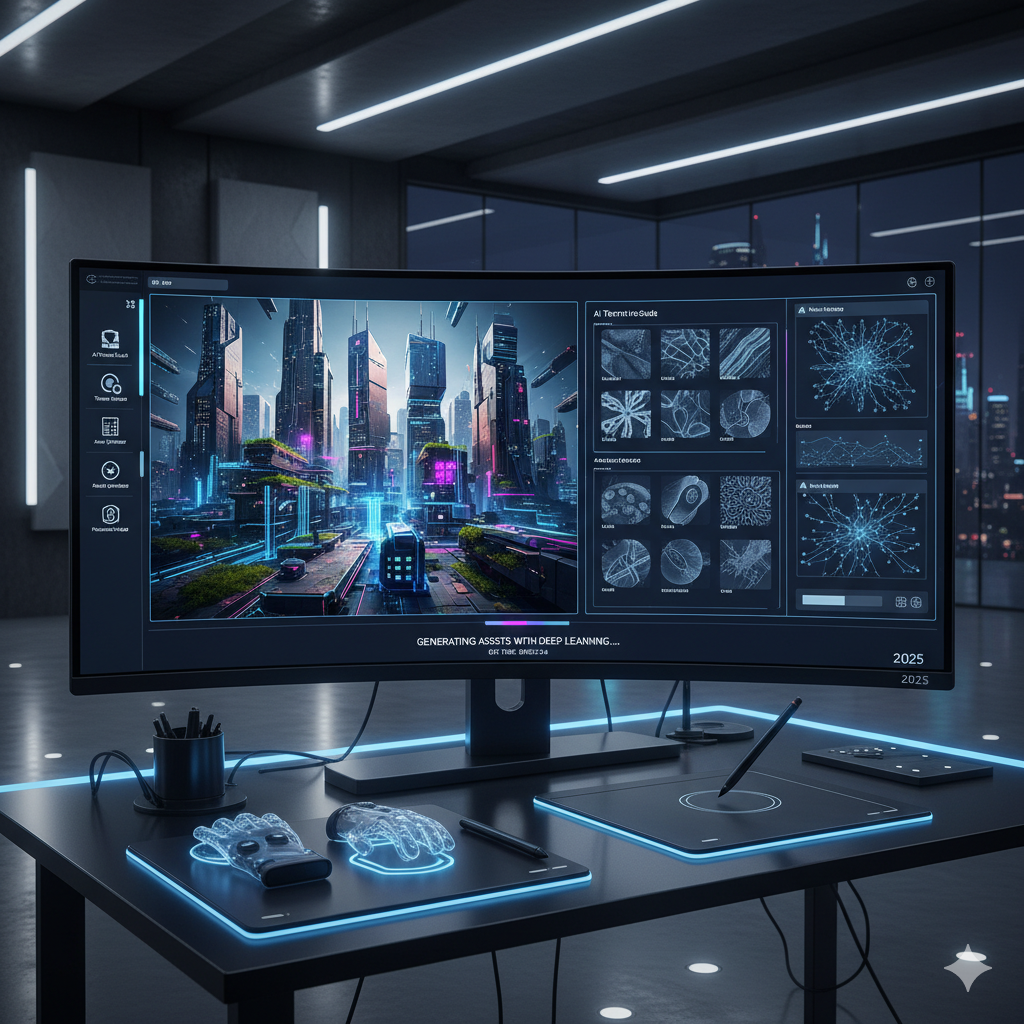
The gaming industry stands at the precipice of a new technological era, one where Artificial Intelligence (AI) is no longer a futuristic concept but a tangible tool actively reshaping development pipelines. For game art production, AI is proving to be a true game-changer, offering unprecedented opportunities to streamline workflows, enhance creative possibilities, and democratize access to high-quality asset creation. From concept art generation to intricate 3D modeling, texturing, and animation, AI is empowering both burgeoning indie teams and colossal AAA studios to push boundaries and achieve results previously unimaginable under traditional constraints.
This comprehensive exploration delves into how AI is fundamentally transforming the creation of digital art for games. We will examine the various applications of generative AI, machine learning, and automation in different facets of game art, dissecting its impact on efficiency, cost, and creative output. We will also address the practical considerations for integrating AI tools into existing pipelines, providing insights into real-world use cases and outlining the future trajectory of this exciting technology. Prepare to discover how AI is not just assisting artists, but revolutionizing the very fabric of game art production, making complex tasks simpler and ambitious visions more attainable.
The Paradigm Shift: Why AI in Game Art Now?
For decades, game art production has been a labor-intensive process, demanding immense time, skill, and resources. Creating detailed 3D models, intricate textures, fluid animations, and expansive environments has traditionally required large teams of highly specialized artists working for months, if not years. The advent of sophisticated AI technologies, particularly in the realm of generative adversarial networks (GANs) and diffusion models, has fundamentally altered this landscape. These advancements enable computers to not just process and analyze data, but to create original content that mimics human artistry, often with astonishing speed and fidelity.
Several factors converge to make this a pivotal moment for AI in game art. Firstly, the exponential growth in computational power and the availability of vast datasets have provided the necessary infrastructure for training complex AI models. Secondly, the increasing demand for high-fidelity graphics and ever-expanding game worlds places immense pressure on art teams, making efficiency gains critically important. Players expect photorealistic environments, diverse character rosters, and seamless animations, all of which traditionally translate to higher budgets and longer development cycles. AI offers a compelling solution to these escalating demands.
Moreover, the tools themselves have become more accessible and user-friendly. What once required deep technical expertise in machine learning can now often be achieved through intuitive interfaces and prompt-based interactions, bringing AI into the hands of artists rather than just AI researchers. This democratization of AI art tools is a significant driver, allowing individual artists and smaller indie studios to leverage capabilities that were once exclusive to large, well-funded organizations. The industry is moving from a question of “if” AI will be adopted to “how swiftly and effectively” it can be integrated into every stage of the artistic workflow.
The paradigm shift is not about replacing human creativity but augmenting it. AI acts as a powerful co-creator and an invaluable assistant, handling repetitive tasks, generating variations, and providing creative starting points, thereby freeing artists to focus on high-level artistic direction, refinement, and injecting the unique vision that only a human can provide. This symbiotic relationship promises to elevate the quality of game art while dramatically improving the speed and cost-effectiveness of its production.
Generative AI: The Core of Future Game Art Production
At the heart of the AI revolution in game art lies generative AI. This category of artificial intelligence focuses on producing new content, whether it be images, 3D models, textures, or animations, rather than merely analyzing existing data. The most prominent examples currently making waves are diffusion models, like those powering Stable Diffusion, Midjourney, and DALL-E, which have demonstrated an extraordinary ability to create highly detailed and contextually relevant images from simple text prompts. These models learn from vast datasets of existing artwork, enabling them to understand artistic styles, compositions, and semantic meanings, which they then apply to generate novel visuals.
The core principle involves a “denoising” process. Starting with an image of pure noise, the AI progressively refines it, guided by a text prompt, until a coherent and detailed image emerges. This iterative process allows for a high degree of control and flexibility, enabling artists to specify elements like art style, color palette, lighting conditions, and specific objects or themes. For game art, this translates into a powerful tool for rapid ideation and asset creation. Instead of manually sketching dozens of concept variations, an artist can generate hundreds in minutes, selecting the most promising ones for further development.
Beyond 2D image generation, generative AI is rapidly expanding into the 3D domain. Tools are emerging that can interpret text descriptions or 2D images to produce rudimentary 3D models, complete with textures. While these 3D outputs often require significant refinement from human artists, they provide an invaluable starting point, drastically cutting down the initial modeling time. Similarly, AI models can generate an endless array of procedural textures, normal maps, and other material properties, ensuring consistency and variety across large game environments.
The potential of generative AI extends to automatic rigging, animation synthesis, and even generating entire environmental layouts. Imagine describing a “verdant forest with ancient ruins and a shimmering river,” and an AI generating not just a 2D concept, but a basic 3D scene with placement of trees, rocks, and water bodies. This technology is not just about making things faster; it’s about fundamentally changing the creative process itself, allowing artists to prototype ideas at an unprecedented pace and explore visual directions that might have been too time-consuming or expensive to attempt traditionally.
AI for 2D Art Assets: From Concept to Production
The impact of AI on 2D game art is perhaps the most immediate and visible. Artists are already leveraging generative AI tools to accelerate various stages of 2D asset production, from the earliest conceptual phases to final production-ready elements.
- Concept Art Generation: This is one of the most transformative applications. Instead of spending hours sketching multiple iterations of characters, environments, or props, artists can use prompt-based AI tools to generate a wide array of concepts in minutes. By providing descriptive text prompts (e.g., “cyberpunk samurai warrior, grim, chrome armor, neon lights, city background, dramatic lighting, detailed”), artists can explore numerous visual directions, experiment with different styles, and quickly narrow down design choices. This drastically speeds up the ideation phase, allowing more time for refinement and crucial artistic decisions.
- Environment Textures and Skyboxes: Creating seamless, high-resolution textures for environments can be incredibly time-consuming. AI can generate photorealistic or stylized textures from simple descriptions or even existing reference images. Artists can specify properties like “mossy forest floor texture,” “cracked desert ground,” or “grimy sci-fi wall panel,” and the AI will produce tiling textures that can be directly applied or further refined. Similarly, dynamic skyboxes that respond to time-of-day or weather conditions can be quickly prototyped or fully generated using AI, providing rich environmental backdrops.
- UI Elements and Icons: User Interface (UI) design often requires a consistent visual language across many small assets. AI can assist in generating icon sets, button styles, and other UI components, ensuring stylistic coherence. Artists can input a desired theme (e.g., “medieval fantasy UI, golden filigree, rustic wood”) and receive a suite of elements that maintain that aesthetic, reducing the manual effort required to design each individual piece.
- Sprite Generation and Variation: For 2D games, especially those with a pixel art or stylized aesthetic, generating variations of characters, enemies, or objects can be tedious. AI can take a base sprite and generate numerous variations in poses, expressions, clothing, or color palettes. This is particularly useful for creating diverse enemy types, environmental interactables, or character customization options without requiring a human artist to hand-draw every single variant. AI-powered upscaling tools can also take low-resolution legacy sprites and intelligently enhance them for modern displays.
- Image Editing and Inpainting/Outpainting: Beyond generation, AI assists in manipulating existing 2D assets. Inpainting tools can intelligently fill in missing parts of an image (e.g., removing an unwanted object and seamlessly reconstructing the background), while outpainting can expand an image beyond its original borders, generating new content that matches the existing style and context. These features are invaluable for adjusting existing assets, creating wider vistas from smaller concepts, or cleaning up scanned artwork.
The flexibility and speed offered by AI in 2D art production allow artists to focus less on repetitive execution and more on the creative vision and artistic polish that truly differentiate a game’s visual identity. It transforms the pipeline from a linear, laborious process into a dynamic, iterative, and highly experimental playground.
AI for 3D Art Assets: Revolutionizing Modeling and Texturing
The creation of 3D assets is arguably one of the most resource-intensive aspects of game development. From complex character models to sprawling architectural structures and realistic natural elements, 3D art demands a unique blend of artistic skill and technical proficiency. AI is rapidly emerging as a powerful ally, streamlining several stages of 3D asset production.
- 3D Model Generation and Sculpting Assistance: While fully autonomous, high-quality 3D model generation from text prompts is still an area of active research and development, significant progress has been made. AI can now generate rough base meshes or concept sculpts from 2D images or descriptive text, providing artists with a strong starting point. Tools leveraging neural networks can interpret sketches or low-poly models and generate more detailed, high-poly versions, saving countless hours of manual sculpting. Furthermore, AI-powered topology optimization tools can automatically retopologize high-poly sculpts into clean, game-ready meshes, a task traditionally tedious and time-consuming.
- Procedural Texturing and Material Generation: This is an area where AI truly shines. Creating realistic and varied textures for 3D models is critical for visual fidelity. AI tools can generate an infinite array of PBR (Physically Based Rendering) textures – diffuse, normal, roughness, metallic, ambient occlusion maps – from a simple text description or a single reference image. For example, an artist can prompt for “weathered concrete with exposed rebar” or “shiny alien metal with bioluminescent patterns,” and the AI will produce a complete set of seamless, tiling textures. This not only dramatically speeds up the texturing process but also ensures consistency and high quality across vast libraries of assets. Companies like Adobe Substance 3D tools are already incorporating AI to assist artists in creating materials with unprecedented speed.
- Photogrammetry Enhancement and Reconstruction: Photogrammetry, the process of creating 3D models from photographs, is a powerful technique but often yields noisy or incomplete results. AI is being used to clean up photogrammetry scans, fill in missing geometric data, and intelligently reconstruct details that were obscured. This makes the conversion of real-world objects into game assets more efficient and produces cleaner, more usable meshes and textures, reducing manual cleanup significantly.
- LOD (Level of Detail) Generation: For performance optimization in games, it’s crucial to have multiple versions of a 3D model with varying levels of detail. Manually creating these LODs can be a tedious and technical task. AI-powered tools can automatically generate optimized LODs for complex models, intelligently reducing polygon count while preserving visual integrity as much as possible, thus freeing artists from this repetitive optimization work.
- Asset Variation and Diversity: For open-world games or titles with extensive customization options, generating numerous variations of props, environmental elements, or character accessories can be a monumental task. AI can take a base 3D model and generate stylistic or structural variations based on given parameters, creating a diverse library of assets quickly and consistently. This is invaluable for populating vast game worlds with unique visual elements without exhausting an art team.
The integration of AI into 3D art pipelines means that artists can spend less time on the technical intricacies of modeling and texturing and more time on high-level design, aesthetic choices, and overall creative direction. It acts as a powerful multiplier for their efforts, enabling the creation of larger, more detailed, and visually richer game worlds than ever before.
AI in Animation and Rigging: Breathing Life into Characters Faster
Animation is the art of bringing characters and objects to life, a process that traditionally requires meticulous keyframing, motion capture cleanup, and complex rigging. AI is now offering powerful solutions that promise to drastically reduce the time and effort involved, making animation more accessible and efficient.
- Automatic Rigging: Rigging, the process of creating a skeletal structure (rig) for a 3D model to control its movement, is a highly technical and time-consuming task. AI-powered rigging tools can automatically generate a functional rig for a 3D character model, intelligently identifying joints, creating skin weights, and setting up controls. This can reduce the rigging time from days or weeks to mere minutes or hours, allowing animators to jump straight into the creative process of animating. While these automatic rigs might require some manual refinement for highly specialized animations, they provide an excellent baseline.
- Motion Capture Data Cleanup and Retargeting: Motion capture (mocap) is widely used for realistic animation, but raw mocap data often contains noise, jitter, and imperfections that require extensive manual cleanup. AI algorithms can analyze mocap data, identify and smooth out anomalies, and even predict missing frames. Furthermore, retargeting animation from one character rig to another with different proportions can be complex. AI tools can intelligently adapt mocap data to various character models, making it easier to reuse animation libraries across diverse character sets.
- Procedural Animation and Style Transfer: AI can generate entire animation sequences based on high-level descriptions or by observing existing animation data. For instance, an AI can learn locomotion patterns (walking, running, jumping) from a dataset and generate natural-looking cycles for different character types and speeds. More advanced applications involve style transfer, where an AI can take a base animation and apply the stylistic nuances of another animation, like transforming a standard walk into a confident strut or a stealthy creep, without requiring manual keyframing of every subtle movement.
- Realistic Facial Animation and Lip-Sync: Generating convincing facial expressions and accurate lip-sync for dialogue is a major challenge in game development. AI can analyze audio tracks and automatically generate corresponding mouth movements and facial expressions, greatly enhancing character believability. These tools often integrate with speech recognition to precisely match phonemes to animated visemes, saving animators countless hours of manual work on character dialogue.
- Crowd Simulation and Physics-Based Animation: For games with large crowds or dynamic environmental interactions, AI can drive the behavior and animation of numerous non-player characters (NPCs) more realistically. Beyond simple pathfinding, AI can simulate complex crowd dynamics, reactions to stimuli, and even generate unique idles or subtle movements for individual characters, adding to the immersion. Similarly, AI can enhance physics-based animation by predicting realistic deformation or interaction, ensuring objects behave believably within the game world.
By automating or significantly assisting in these traditionally demanding animation tasks, AI empowers animators to focus on the artistic nuances, emotional expression, and overall storytelling through movement, rather than getting bogged down in the technical minutiae. This leads to faster iteration, higher quality animation, and more ambitious animated content within games.
Workflow Integration: AI Tools in the Artist’s Pipeline
The true power of AI in game art production isn’t just in its individual capabilities, but in how seamlessly it can be integrated into an artist’s existing workflow. The goal is to augment, not disrupt, the creative process. Developers of AI tools are increasingly focusing on creating solutions that fit naturally into established pipelines, whether through plugins for popular DCC (Digital Content Creation) software or standalone applications designed for specific tasks.
Common Integration Strategies:
- Plugins for DCC Software: Many AI tools are developed as plugins for industry-standard software like Blender, Maya, ZBrush, Substance Painter, and Photoshop. This allows artists to access AI capabilities directly within their familiar environments, minimizing context switching and learning curves. For example, an AI texture generator might appear as a filter in Substance Painter, or an AI retopology tool might be an operator within Blender.
- Standalone Applications with Export Capabilities: Some AI tools, especially generative art platforms like Midjourney or specific 3D generation tools, function as standalone applications. The key to their integration is robust export functionalities (e.g., to FBX, OBJ, PNG, EXR formats) that ensure compatibility with DCC software and game engines. Artists can generate assets in these tools and then easily import them for refinement and integration.
- Cloud-Based Solutions: For computationally intensive AI tasks, cloud-based platforms are becoming prevalent. Artists can upload their data, leverage powerful remote GPUs for AI processing, and download the results. This democratizes access to high-end AI capabilities for users without expensive local hardware.
- AI-Powered Features within Game Engines: Game engines like Unity and Unreal Engine are also beginning to incorporate AI features directly. This includes AI-assisted level design, procedural content generation within the engine, or AI tools for optimizing assets for real-time performance, making the final stages of asset integration even smoother.
The Role of Prompt Engineering:
A crucial aspect of integrating generative AI is prompt engineering. This refers to the art and science of crafting effective text prompts to guide AI models to produce desired outputs. For game artists, this means learning how to articulate their artistic vision in a way that AI can understand and interpret. This skill involves:
- Specificity: Providing clear details about subject, style, lighting, composition, and mood.
- Keywords and Modifiers: Using relevant keywords (e.g., “cyberpunk,” “gritty,” “epic,” “photorealistic,” “Unreal Engine 5”) and stylistic modifiers (e.g., “by Artgerm,” “Greg Rutkowski style,” “octane render”).
- Negative Prompts: Specifying what not to include, helping to refine results and avoid unwanted elements.
- Iterative Refinement: Experimenting with prompts, generating multiple variations, and learning how changes in wording affect the output.
Prompt engineering is becoming an essential skill for game artists, transforming them from solely hands-on creators to more akin to creative directors, orchestrating AI to bring their visions to life. This synergy between human creativity and AI efficiency is redefining the modern game art pipeline.
Impact on Indie Studios: Leveling the Playing Field
For independent game development studios, AI in game art production represents nothing short of a revolution. Indie teams often operate with minuscule budgets, limited personnel, and ambitious creative visions that frequently outstrip their resources. AI offers a powerful solution to these inherent challenges, effectively leveling the playing field against larger, well-funded AAA competitors.
Key Impacts for Indie Studios:
- Cost Reduction: Hiring a full team of specialized 2D artists, 3D modelers, texture artists, and animators is prohibitively expensive for most indie studios. AI tools can significantly reduce the need for extensive human resources in these areas. An indie artist, armed with AI, can accomplish tasks that would traditionally require multiple specialists, thereby dramatically cutting personnel costs.
- Accelerated Development Cycles: The speed at which AI can generate assets or assist with repetitive tasks means indie studios can prototype ideas much faster, iterate on designs more frequently, and bring their games to market quicker. This agility is crucial in a competitive industry where timing can make or break a project.
- High-Quality Assets on a Budget: AI allows indie teams to achieve a level of visual fidelity that was once the exclusive domain of AAA productions. Photorealistic textures, complex 3D models, and convincing animations can be generated or assisted by AI, allowing small teams to create games that visually compete with much larger titles, enhancing player perception and market appeal.
- Democratization of Art Creation: Artists without extensive traditional art training or highly specialized skills in 3D software can still contribute significantly to game art by leveraging AI tools. They can focus on creative direction and prompt engineering, using AI as an extension of their artistic intent, making game development more accessible to a wider range of creators.
- Rapid Prototyping and Exploration: AI enables indie developers to quickly create placeholder assets for game mechanics testing or to rapidly explore different art styles and themes without committing significant human artist time. This allows for more creative freedom and a higher degree of experimentation early in development.
- Enabling Ambitious Projects: Indie studios can now tackle projects with larger scope and more detailed worlds that would have been impossible with conventional methods. An environmental artist working alone can populate an expansive open world with diverse assets generated or enhanced by AI, bringing ambitious visions to life on a shoestring budget.
While AI doesn’t remove the need for human artistic vision and refinement, it empowers indie artists to multiply their output and elevate their quality, enabling them to compete more effectively and bring unique, compelling gaming experiences to players worldwide.
Impact on AAA Studios: Scaling Production and Innovation
For large-scale AAA game development studios, the impact of AI is equally profound, albeit with a different set of priorities and benefits. AAA studios deal with massive production pipelines, enormous asset libraries, and the relentless pursuit of hyper-realism and expansive game worlds. AI offers solutions for scaling these operations, fostering innovation, and optimizing the allocation of highly specialized human talent.
Key Impacts for AAA Studios:
- Massive Asset Library Generation: AAA titles often require tens of thousands, if not hundreds of thousands, of unique assets – from environmental props to character variations, weapons, and vehicles. AI can automate the generation of these assets, or at least a significant portion of their initial creation and variation. This frees human artists from repetitive modeling and texturing tasks, allowing them to focus on unique hero assets, artistic direction, and quality control.
- Enhanced Iteration and Prototyping: The ability to generate multiple variations of concepts, models, or textures rapidly allows AAA studios to iterate on designs at an unprecedented pace. This leads to more robust art direction, quicker decision-making, and the ability to explore a wider range of artistic possibilities before committing to final production. This is invaluable for refining a game’s visual identity and ensuring it resonates with target audiences.
- Optimizing Resource Allocation: With AI handling many of the more mundane or repetitive tasks, highly specialized and expensive human artists can be redirected to areas where their unique skills are most critical: developing key artistic visions, creating groundbreaking visual effects, refining character details, and ensuring overall artistic coherence and quality. This optimizes the utilization of top-tier talent.
- Consistency and Quality Control at Scale: Maintaining visual consistency across a vast game world created by hundreds of artists can be a major challenge. AI can help enforce stylistic guidelines and generate assets that adhere to specific aesthetic parameters, ensuring a cohesive visual experience. AI-powered tools can also automate quality checks, identifying texture stretching, topology issues, or animation glitches.
- Faster Content Updates and DLC: In the live-service era, AAA games require continuous content updates and DLC. AI can significantly accelerate the production of new assets for these updates, allowing studios to deliver fresh content more frequently and efficiently, keeping players engaged for longer periods.
- Innovation and Experimental Art: By automating routine tasks, AI allows AAA art teams more bandwidth to experiment with new techniques, push graphical boundaries, and explore novel artistic directions that would otherwise be too risky or time-consuming. This fosters innovation and helps studios stay ahead in a highly competitive market.
Ultimately, for AAA studios, AI is a tool for supercharging their already impressive capabilities. It enables them to manage the complexity and scale of modern game development more effectively, achieve higher levels of visual fidelity, and allocate their human creative capital to its most impactful applications, leading to richer, more immersive, and more visually stunning game experiences.
Comparison Tables
To further illustrate the tangible benefits and shifts introduced by AI in game art production, let us consider two comparative tables outlining key differences and advantages.
| Feature | Traditional Game Art Production | AI-Assisted Game Art Production |
|---|---|---|
| Time for Asset Creation | Slow: Manual creation, significant hours/days per asset. Repetitive tasks consume considerable time. | Fast: Rapid generation of initial concepts, textures, models, and variations. Reduces time from days to minutes/hours for many tasks. |
| Cost (Labor & Resources) | High: Requires large teams of specialized artists, extensive training, and prolonged development cycles. | Lower: Reduces reliance on large teams for repetitive tasks, allowing smaller teams to achieve more. Optimizes existing artist workload. |
| Iteration Speed | Limited: Each iteration requires significant manual effort, making extensive experimentation costly and slow. | High: Enables rapid prototyping and exploration of countless variations quickly, fostering better design decisions. |
| Scalability of Content | Challenging: Generating a massive library of unique assets is a monumental task requiring huge teams. | Excellent: AI can generate vast quantities of diverse assets, variations, and textures efficiently, ideal for open worlds and live services. |
| Consistency & Style Adherence | Variable: Difficult to maintain perfect consistency across large teams and long projects. | High: AI can be trained on specific styles, ensuring consistent aesthetic and quality across generated assets. |
| Artist’s Role | Hands-on creation, technical execution, and creative input for all stages. | Creative director, prompt engineer, refiner, and quality controller. Focuses on high-level artistic vision and polish. |
| Barrier to Entry | High; requires extensive specialized skills in various DCC tools and art disciplines. | Lower; democratizes high-quality asset creation, allowing smaller teams or individual artists to achieve more with less technical expertise. |
| Benefit Category | Indie Studios (Small Teams, Limited Budget) | AAA Studios (Large Teams, Extensive Resources) |
|---|---|---|
| Asset Volume & Diversity | Enables creation of diverse and substantial asset libraries that would otherwise be impossible due to resource constraints. | Massively scales production of generic assets and variations, freeing up expert artists for hero content. |
| Quality & Fidelity | Achieve visual quality comparable to larger studios, enhancing market competitiveness and player perception. | Push the boundaries of realism and detail, supporting cinematic visuals and immersive experiences. |
| Cost-Efficiency | Significantly reduces per-asset cost and overall art budget, making ambitious projects financially viable. | Optimizes art budget allocation, reducing costs for repetitive tasks and maximizing return on investment for specialized talent. |
| Development Speed | Accelerates entire art pipeline, leading to faster prototyping, iteration, and quicker time-to-market. | Speeds up content generation for large-scale games, live service updates, and expansion packs. |
| Creative Exploration | Allows for rapid testing of numerous art styles and concepts, fostering innovation with minimal risk. | Enables extensive iteration on key visual elements and experimental art techniques for cutting-edge experiences. |
| Talent Focus | Empowers individual artists to wear multiple hats and achieve more, reducing the need for large, specialized teams. | Redirects highly specialized artists from mundane tasks to high-impact creative and artistic direction roles. |
| Accessibility | Democratizes access to high-end art production, enabling smaller teams to compete visually. | Integrates into existing robust pipelines, enhancing efficiency and scalability without overhauling fundamental workflows. |
Practical Examples: Real-World Use Cases and Scenarios
To truly grasp the transformative potential of AI in game art, let’s explore some tangible scenarios for both indie and AAA studios, demonstrating how AI tools translate into practical advantages.
Scenario 1: Indie Studio – Rapid Environmental Asset Generation for a Fantasy RPG
The Challenge: “Emberforge Games,” a small indie studio of three developers, is creating an open-world fantasy RPG. Their environmental artist is tasked with populating vast forests, rocky terrains, and ancient ruins. Manually modeling and texturing hundreds of unique trees, rocks, shrubs, and architectural elements is a monumental, if not impossible, undertaking for one person.
AI Solution:
- Concept Ideation: The artist starts by using a generative AI image tool (e.g., Midjourney or Stable Diffusion) with prompts like “ancient elven forest, glowing flora, mystical atmosphere, concept art, Unreal Engine 5” to quickly generate dozens of visual ideas for distinct forest biomes and ancient ruin aesthetics. This helps solidify the art direction rapidly.
- 3D Model Base Generation: For rocks and simple props, the artist might use an AI tool that converts 2D images or simple sketches into basic 3D meshes. For instance, feeding in a photo of a unique rock formation or a simple drawing of a magical altar. These AI-generated base meshes are then imported into Blender for quick manual cleanup and refinement.
- PBR Texture Sets: Utilizing AI-powered texture generation (e.g., Adobe Substance 3D Sampler’s AI features, or other dedicated AI texture generators), the artist inputs reference images of mossy bark, eroded stone, or forest ground. The AI quickly generates full PBR texture sets (Albedo, Normal, Roughness, Height, AO maps) that are seamless and tileable. This provides a rich library of high-quality materials for the environment.
- Variations and Optimization: For trees and shrubs, the artist creates a few hero assets manually. Then, AI is used to generate variations in leaf density, branch structures, and seasonal changes (e.g., autumnal leaves). AI also assists in generating optimized LODs for all environmental assets, ensuring smooth performance across the large open world.
Outcome: The indie environmental artist, with AI assistance, can generate a diverse and high-quality library of hundreds of environmental assets in a fraction of the time it would take manually. This allows “Emberforge Games” to achieve a visually rich open world that would typically require a much larger team, enhancing their game’s immersion and competitiveness.
Scenario 2: AAA Studio – Rapid Character Concepting and Iteration
The Challenge: “Titan Studios,” a large AAA developer, is embarking on a new IP, a sci-fi action RPG. Their concept art team needs to design dozens of unique alien races, robotic adversaries, and human factions, each with multiple variations for different classes and roles. The traditional process of hand-sketching, digital painting, and revising each concept is time-consuming, bottlenecking the 3D modeling team.
AI Solution:
- Initial Concept Generation: Instead of starting from scratch, concept artists leverage generative AI models (e.g., DALL-E 3, Midjourney) with detailed prompts like “bipedal alien warrior, obsidian skin, glowing eyes, bio-mechanical armor, ancient tribal markings, professional concept art, cinematic lighting” for various alien designs. They generate hundreds of high-quality initial concepts within hours.
- Stylistic Consistency and Variations: Once a core visual style is established, the AI is further guided to generate variations within that style. For example, creating different ranks of the same alien species (e.g., “alien warrior – leader,” “alien warrior – grunt”) or different color schemes and armor types. This ensures stylistic consistency across the many character types.
- Refinement and Integration: The concept artists select the most promising AI-generated images, which serve as detailed starting points. They then import these into Photoshop or other digital painting software for human refinement, adding unique artistic flair, ensuring anatomical correctness for rigging, and preparing them for the 3D team. AI inpainting and outpainting tools can also be used to add or extend elements within the chosen concepts.
- Prop and Accessory Design: AI is also utilized to generate concepts for character props like weapons, armor pieces, and utility gadgets, again maintaining the established sci-fi aesthetic.
Outcome: Titan Studios’ concept art team can explore a far wider range of creative ideas in a significantly shorter timeframe. This accelerated ideation and iteration process allows the 3D modeling team to receive highly refined and diverse concepts much faster, preventing bottlenecks and ultimately leading to a more visually rich and varied cast of characters in the final game, without compromising quality.
Scenario 3: AAA Studio – Large-Scale Open-World Texture Pipeline
The Challenge: “WorldForge Entertainment” is developing a massive open-world game set across diverse biomes: dense urban areas, sprawling deserts, and treacherous mountain ranges. The need for thousands of unique, high-resolution PBR texture sets for terrain, buildings, vehicles, and props is immense. Manually creating or sourcing all these textures to maintain consistency and quality across a vast environment is a monumental task for their texture artists.
AI Solution:
- Automated Texture Generation: Texture artists utilize AI-powered material generation tools. For terrain, they input parameters like “sandy desert floor with small pebbles,” “cracked asphalt street texture with oil stains,” or “mossy mountain rock face.” The AI instantly generates complete sets of seamless PBR maps (Albedo, Normal, Roughness, Metallic, Height, AO) for hundreds of unique surfaces.
- Photogrammetry Enhancement: When real-world scans are used, AI helps clean up noisy photogrammetry data, intelligently filling in missing texture details and reconstructing high-frequency information, turning imperfect scans into production-ready assets more efficiently.
- Style Transfer for Consistency: If the game has a specific stylized look, AI can be used to apply that style to existing photorealistic textures or even generate new textures that inherently match the desired aesthetic.
- Material Variations: For structural assets like buildings, AI generates variations of materials (e.g., different types of brick, aged concrete, clean glass, rusted metal) based on a core style, ensuring diversity without manual effort for each permutation.
- Performance Optimization: AI tools can analyze generated textures and automatically optimize them for different LODs or platforms, compressing them efficiently while maintaining visual quality, crucial for open-world performance.
Outcome: WorldForge Entertainment’s texture artists can focus on creating hero materials and defining the overall look, while AI handles the bulk of the procedural texture generation and variation. This ensures a consistent, high-fidelity texture library across the entire expansive game world, delivered faster and with less manual labor, allowing the studio to push visual boundaries without ballooning their art budget or development timeline.
Frequently Asked Questions
Q: Will AI replace game artists?
A: While AI will undoubtedly transform the roles of game artists, it is highly unlikely to replace them entirely. AI excels at repetitive, data-driven, and generative tasks, acting as a powerful assistant. However, human artists bring irreplaceable elements to the creative process: unique artistic vision, emotional intelligence, storytelling, critical decision-making, aesthetic judgment, and the ability to define and refine artistic direction. Artists will evolve into creative directors, prompt engineers, and expert refiners, leveraging AI to multiply their output and focus on higher-level creative tasks rather than being bogged down by manual execution. The skillset will shift, but the demand for human creativity and oversight will remain crucial.
Q: What are the main types of AI used in game art?
A: The primary types of AI used in game art are:
- Generative AI: This category, including Generative Adversarial Networks (GANs) and Diffusion Models, is used to create new content like concept art, textures, 3D models, and animations from text prompts or existing data.
- Machine Learning (ML): ML algorithms are employed for tasks like image recognition (e.g., smart selection tools), style transfer (applying one artistic style to another image), upscaling low-resolution assets, and data cleanup (e.g., motion capture refinement).
- Neural Networks: These are the underlying architecture for many generative and machine learning AI models, enabling them to learn complex patterns from vast datasets.
- Procedural Generation (AI-assisted): While procedural generation existed before AI, AI enhances it by making generated content more intelligent, varied, and artistically coherent based on learned patterns and styles.
Q: How does AI help with consistency across assets?
A: AI significantly enhances consistency in several ways. Firstly, by training on specific art styles and themes, AI can generate new assets (textures, props, character variations) that inherently adhere to those established visual guidelines. This avoids the discrepancies that can arise when multiple human artists work on different parts of a project over a long period. Secondly, AI can apply a learned style to a diverse set of assets, ensuring a cohesive look. Thirdly, for tasks like texture generation, AI can produce seamless and consistent PBR maps, leading to uniform material quality across the game world.
Q: What’s “prompt engineering” in game art?
A: Prompt engineering is the skill of crafting precise and effective text instructions (prompts) to guide a generative AI model to produce a desired artistic output. For game artists, this means learning how to communicate their creative vision through descriptive text, including details about subject matter, art style, mood, lighting, composition, and specific elements. It involves experimenting with keywords, modifiers, and negative prompts to refine the AI’s output, essentially becoming the “director” of the AI’s creative process to achieve specific game art assets or concepts.
Q: Are there ethical concerns with AI-generated art?
A: Yes, there are significant ethical concerns. The main ones include:
- Copyright and Attribution: AI models are often trained on vast datasets of existing artwork without explicit consent from the original artists. This raises questions about who owns the copyright of AI-generated art and whether original artists are properly attributed or compensated.
- Job Displacement: While AI is seen as an augmentation tool, concerns exist about potential job displacement for artists performing repetitive or entry-level tasks.
- Misinformation and Deepfakes: The ability of AI to create highly realistic imagery can be misused to generate misleading or harmful content.
- Bias: AI models can inherit biases present in their training data, potentially perpetuating stereotypes or underrepresenting certain demographics in generated content.
Addressing these concerns requires ongoing dialogue, clear policies, and responsible development of AI tools.
Q: What are some of the best AI tools currently available for game artists?
A: The landscape of AI tools is rapidly evolving, but some prominent ones include:
- Generative Image AI: Midjourney, Stable Diffusion, DALL-E (for concept art, texture ideas, mood boards).
- 3D Asset Generation/Texturing: Adobe Substance 3D Sampler (AI-powered material creation from photos), Poly (text-to-3D), various plugins for Blender/ZBrush for retopology, base mesh generation, and sculpting assistance.
- Animation/Rigging: DeepMotion (AI motion capture), Mixamo (Adobe, automated rigging/animation, though not strictly AI-generative, it uses smart automation), various research projects for facial animation and lip-sync.
- Upscaling/Image Enhancement: Topaz Gigapixel AI, various open-source tools for enhancing existing textures and sprites.
Many game engines also integrate AI features, and new specialized tools are constantly emerging.
Q: Can AI assist with optimizing assets for performance?
A: Absolutely. AI is increasingly used for asset optimization. This includes:
- LOD (Level of Detail) Generation: AI can automatically create optimized lower-polygon versions of 3D models for different distances, ensuring good performance without manual effort.
- Texture Compression: AI can intelligently compress textures, reducing file sizes and memory footprint while minimizing visual quality loss.
- Automated Retopology: AI can convert high-poly sculpts into clean, game-ready low-poly meshes with efficient topology, crucial for performance and animation.
- Asset Instancing and Management: AI can assist in intelligent placement and management of large numbers of environmental assets to optimize rendering and draw calls.
These capabilities are vital for modern games with vast open worlds and high graphical demands.
Q: How do indie studios integrate AI without a large budget?
A: Indie studios can integrate AI cost-effectively through several strategies:
- Freemium and Open-Source Tools: Many powerful AI tools (e.g., Stable Diffusion, various Blender plugins) have free or open-source versions that are highly capable.
- Subscription-Based Services: Many premium generative AI tools (e.g., Midjourney, DALL-E, specialized texture generators) offer affordable monthly subscriptions tailored for individual artists or small teams.
- Focus on Key Bottlenecks: Instead of trying to automate everything, indies can identify the most time-consuming or resource-intensive art tasks and strategically apply AI there (e.g., concept art, texture generation).
- Learning Prompt Engineering: Investing time in learning how to effectively prompt AI tools is a skill that costs nothing but yields significant returns.
- Leveraging AI for Prototyping: Use AI to quickly generate placeholder assets or explore concepts, saving valuable human artist time for final polish.
The low barrier to entry for many AI tools makes them incredibly accessible for budget-conscious indie developers.
Q: What are the current limitations of AI in game art?
A: Despite rapid advancements, AI in game art has limitations:
- Lack of True Creativity/Intent: AI cannot originate truly novel concepts or artistic intent from scratch; it generates based on patterns learned from existing data. It lacks contextual understanding and a “soul.”
- Inconsistency in Complex Scenes: While good at individual elements, AI can struggle with maintaining narrative coherence, complex spatial relationships, or storytelling within highly complex generated scenes without significant human guidance.
- Technical Artifacts and “AI Glitches”: AI-generated content can sometimes exhibit strange artifacts, anatomical inaccuracies, or illogical elements that require manual correction.
- Fine Detail and Polish: While AI can generate impressive initial concepts or base assets, achieving the highest level of artistic polish, unique stylization, or intricate hand-crafted details almost always requires human intervention.
- Limited Understanding of 3D Structure: Text-to-3D generation is still in its early stages. AI often struggles to create complex, topologically sound, and game-ready 3D models directly, often requiring human retopology and sculpting.
- Data Dependence: The quality of AI output is heavily dependent on the quality and diversity of its training data. Biased or limited datasets can lead to biased or limited outputs.
These limitations highlight that AI is currently a powerful assistant, not a replacement, for human artists.
Q: How can artists adapt to the rise of AI?
A: Artists can adapt by embracing AI as a tool rather than fearing it:
- Become a “Prompt Engineer”: Master the art of communicating with AI to get desired results.
- Focus on High-Level Creativity: Shift focus from repetitive execution to artistic direction, unique vision, storytelling, and concept refinement.
- Learn AI Tools: Integrate AI-powered plugins and standalone applications into existing workflows.
- Develop Critical Eye and Refinement Skills: Be adept at identifying AI-generated imperfections and skillfully refining them to production quality.
- Specialize in AI Integration: Become experts in building AI-powered pipelines or customizing AI models for specific artistic needs.
- Stay Updated: The AI landscape evolves rapidly, so continuous learning and experimentation are crucial.
By evolving their skill sets, artists can become even more productive and creatively empowered in the AI era.
Key Takeaways
The integration of AI into game art production is not merely an incremental improvement; it is a fundamental shift in how digital art is created for interactive experiences. Its transformative impact can be summarized by several key points:
- Unprecedented Efficiency: AI drastically reduces the time and manual effort required for numerous art tasks, from concept generation and texturing to rigging and animation, leading to faster development cycles.
- Cost-Effectiveness: For indie studios, AI democratizes access to high-quality asset creation, enabling ambitious projects on limited budgets. For AAA studios, it optimizes resource allocation, allowing specialized artists to focus on high-impact work.
- Enhanced Creativity and Iteration: AI acts as a powerful creative partner, allowing artists to explore a wider range of ideas, generate countless variations, and iterate on designs at an unprecedented pace, fostering innovation.
- Scalability of Content: Both indie and AAA studios can now generate vast libraries of diverse and consistent assets required for expansive open worlds and live service games, which would be impossible with traditional methods alone.
- Quality and Consistency: AI helps maintain a consistent art style and high visual fidelity across all assets, ensuring a cohesive and immersive player experience.
- Evolution of Artist Roles: Artists are evolving from purely hands-on creators to more of a creative director role, focusing on vision, prompt engineering, refinement, and quality assurance, working in synergy with AI.
- Accessible Innovation: The ease of use and availability of many AI tools mean that even small teams can leverage cutting-edge technology to achieve impressive visual results.
- Future-Proofing Production: Embracing AI is becoming essential for studios of all sizes to remain competitive and adapt to the ever-increasing demands for graphical fidelity and content volume in the gaming industry.
Conclusion
The journey of game art production has always been one of innovation, pushing the boundaries of technology to tell more immersive and visually stunning stories. With Artificial Intelligence, we are entering an exciting new chapter, one that promises to redefine what is possible for artists and developers alike. AI is not a threat to human creativity but a powerful amplifier, an indispensable tool that frees artists from the mundane and repetitive, allowing them to soar to new creative heights.
From empowering small indie teams to realize ambitious visions with limited resources, to enabling colossal AAA studios to manage the immense scale and complexity of modern game development, AI is streamlining workflows, driving down costs, and fundamentally changing the creative process. The artists of tomorrow will be those who can harness the power of AI, blending their unique human touch with the efficiency and generative capabilities of machine intelligence. The games we play in the coming years will be richer, more diverse, and more visually spectacular, all thanks to this revolution in digital art production.
As the technology continues to evolve, the possibilities for AI in game art will only expand, opening doors to entirely new forms of interactive storytelling and artistic expression. The future of game art is collaborative, innovative, and undeniably intelligent, promising an era of unprecedented creativity and boundless digital worlds.












































Leave a Reply