

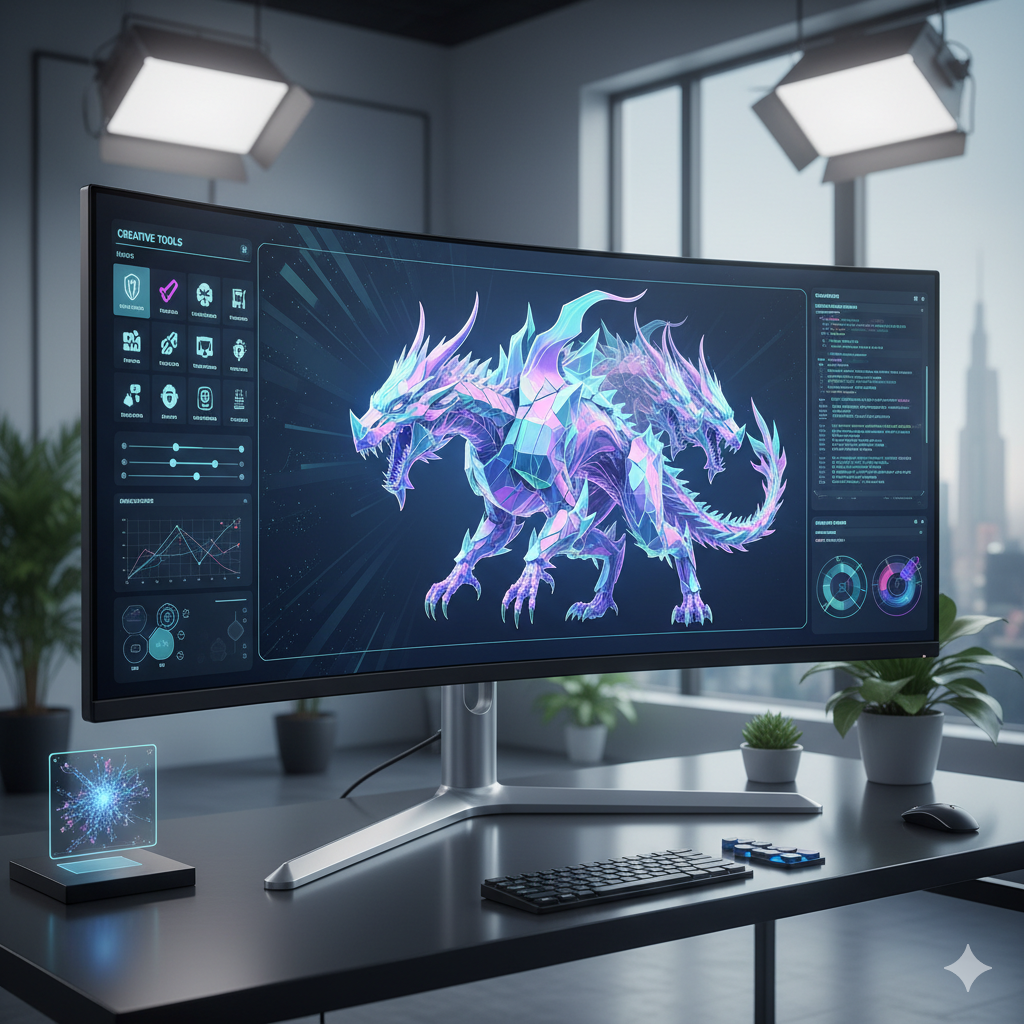
Topic: Creating Game Assets with AI: Revolutionizing Digital Art Production
Introduction
The game industry has always been at the forefront of technological innovation, constantly pushing boundaries to deliver immersive and visually stunning experiences. From the intricate details of a hero’s armor to the sprawling landscapes of an open world, game assets are the foundational building blocks of these digital universes. Traditionally, the creation of these assets has been a meticulous, time-consuming process, relying heavily on the skill, dedication, and often repetitive manual labor of human artists. While automation has long played a role in streamlining workflows, a new paradigm is emerging with the advent of advanced Artificial Intelligence (AI). This isn’t just about making processes faster; it’s about fundamentally transforming the creative landscape, empowering artists in ways previously unimaginable.
Many perceive AI as a tool for efficiency, a robotic assistant capable of handling mundane tasks, thus freeing up human counterparts for more ‘creative’ endeavors. While this perspective holds some truth, it barely scratches the surface of AI’s potential in game asset design. We are moving beyond mere automation—beyond simple procedural generation and script-based optimizations. Today’s AI, particularly generative AI, is capable of acting as a true creative partner, suggesting novel ideas, rapidly generating diverse prototypes, and even collaborating with artists in real-time to bring complex visions to life. This article will delve deep into how AI is not just automating, but actively enhancing and expanding the horizons of human creativity in game asset production, revolutionizing digital art as we know it.
The Traditional Game Asset Pipeline: A Foundation of Craft
Before we explore AI’s transformative impact, it’s crucial to understand the intricate traditional pipeline for creating game assets. This process is a testament to human ingenuity and artistic skill, involving multiple specialized roles and iterative stages.
From Concept to Completion: The Manual Journey
- Concept Art: The journey begins with concept artists who visualize ideas, sketching characters, environments, props, and user interfaces. This stage is purely creative, translating narrative and design briefs into visual forms.
- 3D Modeling: Once concepts are approved, 3D modelers sculpt digital objects using specialized software (e.g., Maya, Blender, ZBrush). This involves creating high-polygon models for detail and then optimizing them into lower-polygon versions for in-game performance (retopology).
- Texturing: Texturing artists paint surfaces onto the 3D models, adding color, material properties (like roughness, metallic, normal maps), and intricate details that bring the assets to life. This can be highly artistic, requiring a deep understanding of light and shadow, and material physics.
- Rigging and Animation: For characters and movable objects, riggers create a skeletal structure (a ‘rig’) within the 3D model. Animators then manipulate this rig to create movement, expressions, and actions.
- Lighting and Shading: Technical artists and environment artists ensure assets are correctly lit and shaded within the game engine, optimizing their appearance and performance.
- Integration and Optimization: Finally, assets are imported into the game engine, tested, and optimized to ensure they run efficiently without compromising visual quality.
Each of these stages is labor-intensive, often requiring weeks or months for complex assets, and iterative feedback loops between teams. The sheer volume of assets required for modern games—think thousands of unique props, characters, and environmental elements—makes this a monumental undertaking.
The Dawn of AI in Game Art: Beyond Simple Automation
AI’s initial foray into game development focused primarily on automation: streamlining repetitive tasks, optimizing data, or generating procedural content based on predefined rules. This early phase was valuable but fundamentally different from how modern generative AI is now reshaping the creative process.
Early Applications of AI in Game Assets: Efficiency, Not Creativity
- Procedural Generation: Tools like SpeedTree for foliage or Houdini for complex environmental elements allowed developers to generate vast landscapes, intricate structures, or diverse flora with relative ease. While impressive, these systems largely relied on pre-coded rules and parameters set by artists, often requiring significant manual tweaking to achieve desired aesthetics.
- Asset Optimization: AI algorithms were used to automatically simplify 3D models (LOD generation), compress textures, or optimize mesh topology, improving game performance without drastic manual effort.
- Style Transfer (Early Stages): Experimental applications of neural style transfer allowed artists to apply the stylistic elements of one image to another, offering new textural possibilities, but often lacking the coherence required for production-ready assets.
These early advancements, while crucial for efficiency, primarily served to assist or accelerate existing manual workflows. They did not inherently contribute to the ideation or conceptualization phase in a deeply creative sense. The artist remained the sole originator of novel forms and ideas. However, the rapid evolution of machine learning, particularly in deep learning and generative adversarial networks (GANs), has fundamentally shifted this paradigm.
AI as a Creative Partner: Ideation and Concept Generation
The most profound impact of modern AI in game asset design lies in its ability to actively participate in the creative ideation and concept generation stages. This moves AI beyond being a mere tool for execution and elevates it to a collaborative partner that can spark inspiration and unlock entirely new design possibilities.
Brainstorming with Machines: Unlocking New Visions
Imagine an artist struggling with a creative block, needing a fresh perspective for a unique alien creature or an unprecedented architectural style. Traditionally, this might involve endless sketching, mood boarding, or brainstorming sessions with colleagues. Now, an artist can prompt an AI to generate hundreds of variations based on textual descriptions, image references, or even abstract concepts.
- Text-to-Image Generation (e.g., Midjourney, DALL-E, Stable Diffusion): Artists can input descriptive text prompts like “cyberpunk warrior, glowing katana, gritty urban background, anime style” and receive highly detailed, stylistically consistent concept art within seconds. This allows for rapid exploration of countless aesthetic avenues, helping artists pinpoint the most compelling directions.
- Image-to-Image and Style Blending: AI tools can take existing sketches or photographs and transform them into new artistic styles, merge features from multiple inputs, or generate variations with different material properties. An artist might provide a rough sketch of a sword and ask the AI to render it in “elven, dwarven, and futuristic” styles, instantly seeing diverse interpretations.
- 3D Concept Generation: Emerging AI tools are now moving beyond 2D images to generate rudimentary 3D models from text or 2D inputs. While often requiring refinement, these serve as excellent starting points for modelers, providing a volumetric concept far quicker than manual blocking.
This capability dramatically shortens the conceptualization phase, allowing artists to explore a wider design space. It transforms creative exploration from a linear path into a multi-dimensional journey, where AI acts as an infinitely patient and imaginative brainstorming partner, providing unexpected juxtapositions and novel interpretations that can spark genuine human creativity.
Accelerating Iteration and Prototyping with AI
One of the most time-consuming aspects of game development is the iterative process—creating multiple versions of an asset to test different ideas, gather feedback, and refine the design. AI significantly accelerates this cycle, allowing for rapid prototyping and faster evolution of assets.
From Idea to Playable Prototype, Faster
- Variational Generation: Once a core concept is established, AI can generate endless variations of that concept. For instance, if a game needs 50 different types of barrels, instead of an artist manually designing each one, AI can create a diverse array based on parameters like material (wood, metal, stone), condition (new, rusty, broken), and style (fantasy, sci-fi). The artist then curates and refines the best options.
- Automated Texturing and Material Generation: AI-powered tools like Adobe Substance 3D Sampler or various AI texture generators can convert real-world photos into seamless, physically-based rendering (PBR) materials. Artists can also describe a material (e.g., “cracked desert ground,” “mossy ancient stone”) and have the AI generate the necessary texture maps (albedo, normal, roughness, metallic, height) instantly. This drastically reduces the manual painting and baking process.
- Mesh Generation and Retopology Assistance: While full 3D model generation from scratch is still evolving, AI is becoming incredibly adept at assisting with mesh creation and optimization. Tools can automatically retopologize high-polygon sculpts into game-ready low-polygon meshes, a task that traditionally requires significant manual effort and expertise. AI can also suggest optimal UV unwrapping layouts, further speeding up the texturing pipeline.
- Animation Augmentation: AI is beginning to assist with animation, generating basic walk cycles, facial expressions, or even complex movements from motion capture data or simple descriptions. While requiring human oversight and artistic polish, these AI-generated animations provide excellent base layers for animators to build upon, significantly cutting down initial production time.
This ability to rapidly iterate means artists can test more ideas, fail faster, and arrive at optimal designs with unprecedented speed. It shifts the artist’s role from laborious creation to thoughtful curation, refinement, and strategic decision-making, allowing them to focus on the higher-level creative aspects of their work.
Comparison Tables
Table 1: Traditional vs. AI-Assisted Game Asset Workflow
| Aspect | Traditional Workflow | AI-Assisted Workflow | Impact on Creativity |
|---|---|---|---|
| Concept Art Generation | Manual sketching, mood boards, artist experience. Time-intensive, limited iterations. | Text-to-image AI (Midjourney, DALL-E) generates diverse concepts rapidly. Image-to-image variations. | Expanded exploration, novel ideas, breaks creative blocks. Artist curates and refines. |
| 3D Modeling (Initial Blockout) | Manual sculpting/modeling in software like Blender, ZBrush. Can be slow for complex shapes. | AI-generated 3D forms from text/2D. AI-assisted mesh creation (e.g., instant basic geometry). | Faster prototyping, quicker visualization of volumetric ideas. Artist focuses on refinement. |
| Texturing & Materials | Manual painting, baking maps, scanning real-world materials, photo manipulation. Very time-consuming. | AI texture generation from text/image. AI-powered PBR material creation (Substance Sampler). | Rapid material creation, experimentation with unique surfaces, higher quality with less effort. |
| Retopology & UV Unwrapping | Manual, highly technical, repetitive, and time-consuming process requiring specialized skill. | AI-powered automatic retopology and UV unwrapping tools. Significant time savings. | Frees artist from technical drudgery, allows focus on aesthetic quality and creative solutions. |
| Iteration Speed | Slow, often involves significant manual rework for each change or variation. | Extremely fast, AI can generate hundreds of variations or adjustments in minutes. | Allows for bolder experimentation, quicker feedback loops, and more refined final assets. |
| Skill Barrier | High; requires years of training in specialized software and artistic principles. | Lowered for initial concept and basic asset creation; shifts focus to prompt engineering, curation, and refinement. | Democratizes design, allows smaller teams/indie devs to achieve high visual fidelity. |
Table 2: Types of AI Tools and Their Creative Enhancement
| AI Tool Category | Description | Creative Enhancement | Example Use Case |
|---|---|---|---|
| Generative Text-to-Image (Diffusion Models) | Generates 2D images from textual prompts, capable of high photorealism or stylized art. | Rapid concept generation, brainstorming, style exploration, mood board creation. | An artist needs 10 variations of “sci-fi jungle flora” for a level. AI generates hundreds in minutes. |
| Image-to-Image / Inpainting / Outpainting | Modifies existing images, expands canvases, fills missing areas, or applies style transfers. | Refining sketches, expanding concept art, quickly exploring stylistic variations on existing assets. | An artist has a character sketch and wants to see it in “oil painting” and “comic book” styles. |
| 3D Generative AI (Early Stages) | Generates basic 3D models or point clouds from text or 2D images. | Quick 3D blockouts, volumetric concept visualization, early prototyping of objects/structures. | A designer needs a rough 3D model of “a futuristic weapon” to block out a scene quickly. |
| Material & Texture Generators | Converts images to PBR materials, generates textures from text, or creates seamless patterns. | Fast material iteration, creation of unique surface details, realistic environmental textures. | An artist needs a “worn cobblestone” texture for a path, complete with normal and roughness maps. |
| AI-Assisted Retopology & UV | Automates the process of creating low-poly meshes from high-poly sculpts and unwrapping UVs. | Reduces technical burden, speeds up production, ensures optimal mesh for game performance. | A sculptor finishes a detailed character model and needs a clean, game-ready mesh for animation. |
| AI for Animation & Rigging | Generates basic animations (walk cycles, facial expressions) or assists in rigging models. | Provides starting points for animators, reduces tedious manual keyframing for repetitive actions. | An animator needs a basic “idle pose” and “running cycle” for 20 non-player characters. |
Democratizing Design: Lowering the Barrier to Entry
Historically, becoming a proficient game artist required years of specialized education, mastery of complex software suites, and innate artistic talent. While talent and vision remain paramount, AI is significantly lowering the technical barrier to entry, democratizing high-quality asset creation.
Empowering Independent Creators and Small Teams
For independent game developers (indie devs) or small studios, resource constraints are a constant challenge. Producing thousands of bespoke, high-quality assets often falls beyond their budget and manpower. AI changes this equation dramatically:
- Access to High-Quality Visuals: Indie developers can now leverage AI to generate placeholder assets, unique concept art, or even production-ready textures that would otherwise require dedicated senior artists. This allows them to achieve a visual fidelity previously exclusive to AAA studios.
- Rapid Prototyping for Everyone: A single developer can quickly visualize and test ideas by generating diverse assets on the fly. This iterative power allows them to validate concepts faster and pivot designs efficiently without significant art investment.
- Filling Skill Gaps: If a small team lacks a dedicated texture artist, an AI-powered texture generator can bridge that gap, allowing a generalist designer to create convincing materials. Similarly, for concept art, an artist without strong drawing skills can leverage AI to bring their visions to life visually.
- Fostering Cross-Disciplinary Creativity: Game designers with strong narrative or systems design skills, but limited artistic proficiency, can now directly contribute to the visual aesthetic of their games. They can experiment with visual styles and asset types, bringing a more holistic vision to their projects.
This democratization doesn’t mean the end of specialized artists; rather, it amplifies their impact and empowers a broader range of creators. It enables smaller teams to compete more effectively and allows individual creators to realize ambitious artistic visions that were once out of reach due to technical or financial limitations.
Maintaining Artistic Vision and Control with AI
A common concern surrounding AI in creative fields is the fear of losing artistic control or yielding to a machine’s aesthetic. However, the most effective use of AI in game asset design isn’t about replacing the artist; it’s about providing a powerful co-pilot that expands their capabilities while keeping them firmly in the driver’s seat.
The Artist as a Director and Curator
When interacting with generative AI, the artist’s role shifts from a primary creator of every pixel and polygon to a director, curator, and master editor. Their responsibilities evolve:
- Prompt Engineering: Crafting effective prompts is an art in itself. Artists learn to articulate their vision with precision, using keywords, stylistic descriptors, and negative prompts to guide the AI toward desired outcomes. This requires a deep understanding of aesthetics and the ability to deconstruct visual styles into their core components.
- Curation and Selection: AI can generate hundreds of variations. The artist’s discerning eye is crucial for selecting the most promising outputs, those that align with the game’s art style, narrative, and technical requirements. This selection process is a highly creative act, identifying the ‘diamond in the rough.’
- Refinement and Polish: AI-generated assets, especially 3D models or complex textures, often serve as excellent starting points but typically require human refinement. Artists use their traditional tools and expertise to clean up meshes, adjust UVs, fine-tune textures, and add bespoke details that imbue the asset with unique character and artistic soul.
- Iterative Guidance: The creative process with AI is rarely one-shot. Artists provide initial prompts, evaluate results, modify prompts based on feedback, and iteratively guide the AI closer to their ultimate vision. This constant feedback loop is where human artistic intelligence truly shines.
- Injecting Unique Artistic Signature: While AI can mimic styles, true innovation and unique artistic signatures still stem from human creativity. Artists can leverage AI to quickly generate base assets, then spend their time injecting distinctive flourishes, narrative details, and emotional resonance that only a human can truly conceive and execute.
Ultimately, AI becomes an extension of the artist’s will, a super-powered brush or chisel that allows them to execute their vision with greater speed and scope. It removes much of the tedious manual labor, allowing artists to dedicate more energy to the conceptual, stylistic, and emotional aspects of their craft.
Ethical Considerations and the Future of AI in Game Art
The rise of AI in creative fields, while incredibly promising, also brings forth important ethical considerations and sparks debate about the future of artistic professions. Addressing these concerns thoughtfully is crucial for the sustainable integration of AI into game asset design.
Navigating the Ethical Landscape
- Data Sourcing and Copyright: Many generative AI models are trained on vast datasets scraped from the internet, often without explicit consent from the original creators. This raises significant questions about copyright infringement, fair use, and the ethical responsibility of AI developers and users. Clear guidelines and potentially new legal frameworks are needed to ensure artists are credited and compensated fairly.
- Bias in Datasets: If training data is skewed or biased, AI models can perpetuate or even amplify those biases in their output. This could lead to a lack of diversity in character designs, stereotypical representations, or unintended cultural insensitivity. Vigilance in data curation and model training is essential.
- Job Displacement: A major concern is that AI will replace human artists. While some highly repetitive or entry-level tasks might be automated, the more likely scenario is a shift in roles. Artists will need to adapt, learning to integrate AI tools into their workflows and focusing on higher-order creative tasks, prompt engineering, and refinement. It creates new roles (AI art directors, AI tool specialists) rather than total elimination.
- Authenticity and Artistic Value: Questions arise about the ‘authenticity’ and ‘artistic value’ of AI-generated art. Is it truly creative? Does it diminish the effort of human artists? The consensus among many creatives is that AI is a tool, and its output’s value ultimately depends on the human intent, curation, and refinement behind it.
The Evolving Future
The trajectory of AI in game asset design points towards an increasingly integrated and symbiotic relationship between human and machine:
- Hyper-Personalized Content: Future AI might dynamically generate assets based on player behavior, preferences, or even real-time environmental conditions within the game, leading to truly unique player experiences.
- Intuitive Creative Interfaces: AI tools will become even more accessible and intuitive, allowing artists to interact with them through natural language, gesture, or even thought-provoking concepts rather than complex technical parameters.
- Holistic Game World Generation: We could see AI not just generating individual assets, but entire, coherent game worlds, complete with interconnected lore, environmental storytelling, and stylized consistency, all guided by a human director.
- New Artistic Mediums: AI might enable entirely new forms of digital art, where the interaction between human and AI creates emergent aesthetics and experiences that are currently unimaginable.
The future of AI in game asset design is not one where machines take over, but one where human creativity is amplified, liberated from technical constraints, and propelled into exciting new dimensions. It demands adaptability, critical thinking, and a willingness to embrace new paradigms from artists and developers alike.
Practical Examples: AI in Action in Game Asset Design
To truly understand the impact of AI, let’s look at some real-world and hypothetical practical applications across different stages of game asset design.
Example 1: Concept Art for a New RPG
Scenario: A concept art team is tasked with designing unique flora and fauna for a newly discovered alien planet in a sci-fi RPG. They need hundreds of distinct designs to fill diverse biomes quickly.
AI Enhancement:
- Initial Brainstorming: Instead of manually sketching dozens of ideas, the concept artist inputs prompts into a generative AI tool like Midjourney: “Luminescent alien jungle plant, glowing spores, bioluminescent, ethereal, dense foliage, concept art,” and “Six-legged alien creature, predatory, metallic exoskeleton, camouflage skin, glowing eyes, dense jungle habitat.”
- Rapid Variation: The AI instantly generates hundreds of images. The artist quickly reviews, selects promising candidates, and uses image-to-image prompting to iterate. “Generate variations of this plant, but with purple leaves and crystalline growths,” or “Change this creature’s skin to integrate with a volcanic environment.”
- Style Cohesion: The artist can upload a few approved concept artworks to the AI to “learn” the game’s specific art style, ensuring newly generated concepts adhere to the established visual language.
- Outcome: In a fraction of the time, the team has a vast library of unique, stylistically consistent alien flora and fauna concepts, ready for refinement and selection by the art director. The human artist focuses on selecting the most compelling designs and providing artistic direction, rather than drawing every single leaf or scale.
Example 2: Texturing a Modular Environment Kit
Scenario: A 3D environment artist is building a modular medieval castle kit. They need a variety of high-quality PBR textures for stone walls, wooden beams, mossy surfaces, and cracked plaster, each with variations for wear and tear.
AI Enhancement:
- Material Generation from Photos: The artist takes photos of real-world stone walls and wood planks. Using an AI-powered material generation tool (like Adobe Substance 3D Sampler with its AI capabilities), these photos are instantly converted into seamless PBR materials (albedo, normal, roughness, metallic, height maps).
- Text-to-Texture: For specific needs, the artist prompts an AI texture generator: “Gritty, moss-covered medieval stone wall, dark cracks, damp, PBR texture.” The AI generates the required maps.
- Variation and Degradation: The artist then uses AI to generate variations of the base textures. For example, taking the clean stone texture and prompting: “Add heavy moss and water stains,” or “Show significant battle damage, cracks, and scorch marks.”
- Smart Tiling: Advanced AI algorithms can intelligently tile textures, even those that aren’t perfectly seamless initially, reducing visible repetition and increasing visual fidelity.
- Outcome: Instead of hours spent in Photoshop or dedicated texture creation software for each material, the artist quickly builds a comprehensive library of high-quality, varied PBR textures. This allows them to focus on the overall environmental composition and lighting, knowing the foundational material work is rapidly handled.
Example 3: Character Retopology and UV Unwrapping
Scenario: A character artist has sculpted a highly detailed, high-polygon creature in ZBrush. Before it can be animated and used in-game, it needs to be retopologized to a low-polygon mesh and have its UVs unwrapped for texturing.
AI Enhancement:
- Automated Retopology: The artist inputs the high-poly sculpt into a 3D software with AI retopology features (e.g., Blender’s QuadRemesher or plugins using similar tech). The AI analyzes the mesh curvature and automatically generates a clean, animatable low-polygon mesh with optimal edge flow, adhering to a specified polygon count target.
- Smart UV Unwrapping: Following retopology, AI-powered UV tools can analyze the low-poly mesh and automatically unwrap the UVs, minimizing stretching and maximizing texture space utilization. Some tools can even pack UV islands efficiently.
- Outcome: What used to be a tedious, highly technical process taking hours or even days, is now completed in minutes with significant precision. The character artist can then proceed directly to baking normal maps from the high-poly detail onto the new low-poly mesh and begin texturing, saving immense production time and reducing repetitive strain. The artist’s creative input is focused on the initial sculpting and the final texturing, not the technical intermediate steps.
These examples illustrate how AI is not replacing the artist but rather augmenting their capabilities, taking on the heavy lifting of repetitive tasks, accelerating ideation, and broadening the scope of what a single artist or small team can achieve. The human element of vision, curation, and refinement remains indispensable, but it is now amplified by the power of machine intelligence.
Frequently Asked Questions
Q: Is AI going to replace game artists?
A: The prevailing view among industry experts and artists is that AI will not entirely replace human game artists, but rather transform their roles. AI excels at automation, generating variations, and handling repetitive tasks. This frees up human artists to focus on higher-level creative direction, conceptualization, storytelling, curation, and adding the unique artistic “soul” that machines cannot replicate. Artists who learn to leverage AI tools will likely be more sought after, as they can achieve greater output and explore more creative avenues.
Q: What kind of AI tools are currently used in game asset design?
A: A variety of AI tools are emerging. These include: Generative AI for 2D assets (e.g., Midjourney, DALL-E, Stable Diffusion for concept art, textures, UI elements), AI-powered material generators (e.g., Adobe Substance 3D Sampler for creating PBR materials from photos or text), AI-assisted 3D modeling tools (for retopology, mesh optimization, or generating initial 3D blockouts), and AI for animation assistance (generating basic walk cycles or facial animations). Many traditional 3D software packages are also integrating AI features.
Q: How does AI enhance creativity, rather than just automating tasks?
A: AI enhances creativity by acting as a powerful brainstorming partner. It can rapidly generate hundreds of diverse concepts and variations from simple prompts, exposing artists to ideas they might not have conceived manually. This expands the creative possibility space, helps overcome creative blocks, and allows artists to explore many more stylistic and conceptual directions quickly. The artist’s role shifts to curation, refinement, and strategic decision-making, allowing them to focus on the overarching artistic vision rather than tedious execution.
Q: What are the main ethical concerns surrounding AI in game art?
A: Key ethical concerns include: Copyright and data sourcing (AI models trained on copyrighted data without consent), job displacement (fear of artists losing jobs, though roles are more likely to evolve), bias in AI-generated content (perpetuating stereotypes if training data is biased), and questions around the authenticity and artistic value of AI-generated art. Addressing these requires ongoing dialogue, clear policies, and responsible development practices.
Q: Do I need to be a programmer to use AI for game asset creation?
A: Not at all! Most modern AI tools for artists are designed with user-friendly interfaces, often relying on natural language prompts (text-to-image/text-to-texture) or simple graphical interfaces. While understanding basic principles of prompt engineering can be beneficial, you don’t need to write code. The focus shifts from traditional technical skills to effective communication with the AI and artistic curation of its output.
Q: How can indie game developers benefit from AI in asset design?
A: Indie developers can benefit immensely. AI can help them: Achieve higher visual fidelity with limited resources, rapidly prototype and test diverse ideas, fill skill gaps within small teams (e.g., generating textures if no dedicated texture artist), and accelerate content creation, enabling them to realize ambitious visions faster and more affordably. It democratizes access to high-quality visual assets.
Q: Will AI-generated assets always require human refinement?
A: Currently, yes, almost always. While AI can produce impressive results, especially for concept art or textures, production-ready game assets typically require human refinement. This involves cleaning up meshes, optimizing UVs, adding bespoke details that align with specific game lore or artistic intent, correcting subtle errors, and ensuring overall consistency and polish. The human touch ensures the assets are unique, functional, and imbued with artistic personality.
Q: How does AI handle artistic styles and consistency across assets?
A: AI can be trained or prompted to adhere to specific artistic styles. For instance, in text-to-image models, artists can include style descriptors (e.g., “fantasy medieval,” “cyberpunk anime,” “photorealistic”) in their prompts. Some advanced AI tools allow uploading reference images or an existing art style guide to influence future generations, helping to maintain visual consistency across a suite of assets. The artist’s role in curating and selecting outputs that match the desired style is crucial.
Q: What skills should game artists develop to stay relevant with AI advancements?
A: To thrive in an AI-assisted future, game artists should develop skills in: Prompt engineering (effectively communicating with AI), curation and critical selection (identifying the best AI outputs), refinement and polishing (using traditional tools to finish AI-generated assets), artistic direction (guiding AI towards a coherent vision), understanding technical constraints (knowing how to make AI output game-ready), and continuous learning about new AI tools and techniques.
Q: Can AI assist in generating animations for game characters?
A: Yes, AI is increasingly being used to assist with animation. This can include generating basic locomotion cycles (walks, runs), automating facial expressions based on audio input, or even converting motion capture data into refined animations. While fully autonomous, high-quality character animation is still a challenge, AI can provide excellent base animations, reduce the amount of manual keyframing, and accelerate the prototyping of character movements, leaving human animators to focus on nuanced performance and storytelling.
Key Takeaways
- AI is moving beyond simple automation to actively enhance creativity in game asset design.
- It serves as a powerful creative partner, especially in ideation and concept generation, accelerating the initial brainstorming phase.
- AI significantly speeds up iteration and prototyping, allowing artists to explore more design variations faster.
- It democratizes high-quality asset creation, empowering indie developers and smaller teams to achieve greater visual fidelity.
- Artists maintain crucial artistic vision and control, shifting their role to directors, curators, and refiners of AI-generated content.
- Ethical considerations regarding copyright, data sourcing, and job evolution are important and require ongoing discussion and adaptation.
- The future points to a symbiotic relationship where human creativity is amplified and new artistic mediums emerge.
- Adaptability, prompt engineering, and critical curation are vital skills for modern game artists.
Conclusion
The integration of Artificial Intelligence into game asset design marks a pivotal moment, ushering in an era where creativity is not just automated but profoundly enhanced. Far from being a threat to artistic expression, AI is proving to be an invaluable collaborator, offering unprecedented speed in ideation, unparalleled efficiency in iteration, and a powerful means of democratizing access to high-quality visual content. It frees artists from the most repetitive and technically arduous tasks, allowing them to channel their genius into truly novel concepts, intricate narratives, and the subtle nuances that define compelling art.
As the technology continues to evolve, the conversation must shift from whether AI will replace artists to how artists can best harness this revolutionary power. The future of game asset design is not one where machines create in isolation, nor one where humans toil without aid. Instead, it is a synergistic landscape where the boundless imagination of human artists, empowered by the intelligent assistance of AI, crafts breathtaking digital worlds with greater efficiency, creativity, and artistic scope than ever before. Embracing this evolution is not just an option; it’s a pathway to unlocking the next frontier of digital art and interactive entertainment.

















































Leave a Reply