

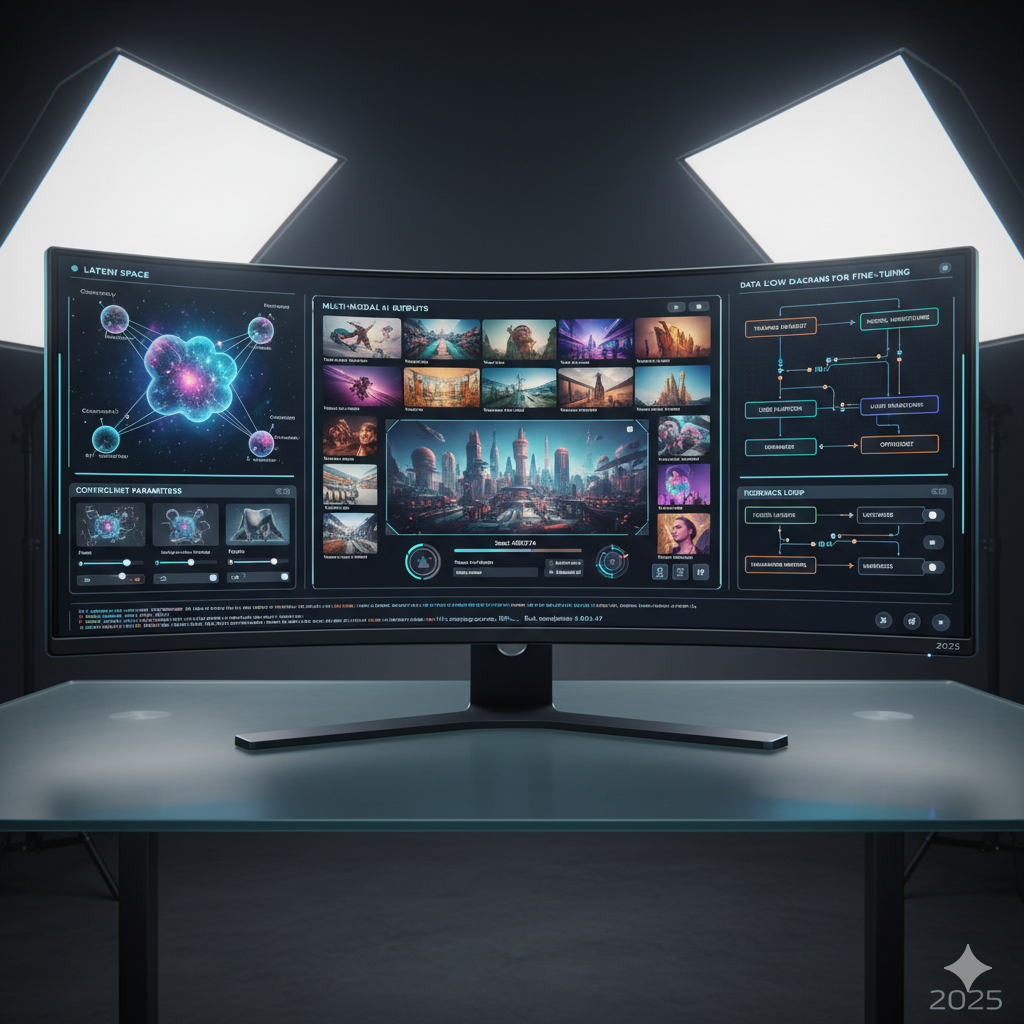
The landscape of digital content creation has been irrevocably reshaped by the advent of Artificial Intelligence. What began as a nascent curiosity, capable of generating surreal and abstract imagery from simple text commands, has rapidly matured into a sophisticated toolkit offering unprecedented levels of control, precision, and efficiency. For creators, this evolution marks a pivotal moment. No longer are we solely reliant on the serendipity of a well-crafted prompt; the future of visual content generation lies in a deeper, more intricate dance with AI, leveraging emerging technologies that move far beyond the prompt. This comprehensive guide will explore these groundbreaking advancements, offering practical insights and real-world examples to empower artists, designers, marketers, and storytellers to harness the full potential of this exciting frontier.
From the early days of DALL-E and Midjourney, where textual descriptions were the primary interface, the demand for more granular control quickly emerged. Creators needed to dictate specific poses, maintain consistent styles, integrate existing visual elements, and achieve a level of fidelity that generic prompts simply couldn’t deliver. This pressing need has fueled a rapid innovation cycle, giving rise to techniques like latent space manipulation, ControlNet, consistency models, multi-modal AI, and efficient fine-tuning methods like LoRA. These aren’t just incremental improvements; they represent a paradigm shift, transforming AI from a magic box that spits out images into a highly responsive, customizable, and collaborative creative partner. Join us as we delve into these fascinating developments and uncover how they are empowering creators to push the boundaries of imagination and production.
The Evolution from Simple Text Prompts to Granular Control
The initial wave of AI image generation tools like DALL-E, Midjourney, and Stable Diffusion democratized visual content creation in an unprecedented way. Suddenly, anyone with an idea and a keyboard could conjure fantastical scenes, hyperrealistic portraits, or abstract art. The primary interface was the text prompt – a natural language description guiding the AI’s output. While revolutionary, this prompt-centric approach, often dubbed “prompt engineering,” quickly revealed its limitations for professional workflows.
Imagine a graphic designer needing to create a series of advertisements featuring a consistent character in various poses, or an architect wanting to visualize a building design with specific structural elements preserved. Relying solely on text prompts often led to frustrating cycles of trial and error, inconsistent outputs, and an inability to dictate precise compositional details. A prompt like “a superhero flying over a city” might yield a visually stunning image, but if you needed that superhero to be in a very specific dynamic pose, or facing a particular direction, or for the city to have a distinct architectural style, the prompt alone fell short. You might spend hours refining adjectives and adverbs, adding negative prompts, and adjusting parameters, often still without the exact desired outcome.
This challenge gave birth to a new generation of technologies focused on providing more profound levels of control. Creators yearned for ways to input not just textual descriptions, but also visual references, structural guides, and stylistic directives that transcended mere words. The shift has been towards a more interactive and multimodal approach, where AI becomes less of a black box interpreting vague commands and more of a malleable clay responding to precise sculpting tools. This fundamental transition from “tell me what to make” to “show me how to make it, and here are my exact specifications” is at the heart of the emerging AI image generation landscape.
This evolution has been driven by both academic research and open-source communities, pushing the boundaries of what is technically feasible. The goal is to move beyond the aesthetic appeal of AI-generated art and towards its practical utility in diverse creative fields. By offering granular control, these emerging technologies empower creators to integrate AI seamlessly into their existing workflows, augmenting their capabilities rather than replacing them. The tools are becoming smarter, more intuitive, and critically, more predictable, allowing for iterative design and precise execution of creative visions.
Latent Space Manipulation and Image-to-Image Generation
To understand how AI image generation goes beyond the prompt, we first need to grasp the concept of latent space. Imagine a vast, multi-dimensional hidden world within the AI model where all possible images are encoded as numerical vectors. When you provide a text prompt, the AI translates that prompt into a specific “location” or vector in this latent space. The generative model then “decodes” this latent vector back into a visible image. It’s a highly compressed, meaningful representation of data, where similar images are clustered together.
Direct text prompts essentially navigate this space by inferring directions. However, what if you could directly manipulate the coordinates within this latent space? This is where latent space manipulation comes into play, offering a much finer degree of control. Instead of relying on the AI’s interpretation of your words, you’re directly influencing the underlying structure of the generated image.
One of the most accessible forms of latent space manipulation is image-to-image (img2img) translation. With img2img, you provide an existing image as a starting point, along with a text prompt. The AI then takes the latent representation of your input image and modifies it according to the prompt, while still retaining elements of the original. This is incredibly powerful for:
- Style Transfer: Applying the aesthetic of one image (e.g., a painting style) to the content of another (e.g., a photograph).
- Variations on a Theme: Generating multiple interpretations of an existing image while preserving its core elements. You can upload a sketch or a simple photo and ask the AI to render it in different styles or settings.
- Image Editing and Inpainting/Outpainting: Using a mask to specify areas of an image to be regenerated or extended, providing contextual information from the surrounding pixels. For example, removing an unwanted object or extending the background of a photograph.
Another powerful technique involves latent space interpolation. By identifying the latent vectors for two different images (or two different prompts), you can smoothly blend between them. This is achieved by creating a sequence of latent vectors that lie along a path connecting the two initial vectors. When decoded, these intermediate vectors produce a series of images that transition seamlessly from one concept or style to another. This technique is invaluable for:
- Animation and Morphing: Creating smooth visual transitions between different states or characters.
- Exploring Design Spaces: Visualizing a spectrum of possibilities between two distinct ideas, helping designers understand the nuances of various design choices.
Furthermore, understanding the role of the seed in deterministic generation is crucial. Most AI image models use a seed number to initialize their random processes. For a given prompt and seed, the AI will consistently produce the same image. By manipulating the seed while keeping the prompt constant, creators can explore diverse variations without fundamentally altering the textual input, offering another layer of controlled experimentation within the latent space. This allows for focused iteration and finding subtle differences that might be missed with purely prompt-based adjustments.
In essence, latent space manipulation empowers creators to guide the AI with existing visual context, making the creative process more iterative, controlled, and aligned with specific artistic visions. It transforms the AI from a purely generative engine into a powerful visual editor and creative assistant.
ControlNet and Structural Guidance for Unprecedented Precision
While latent space manipulation offers significant control, it still operates somewhat abstractly. What if you need to dictate precise structural elements, like a character’s pose, the exact layout of a room, or the specific edges of an object, regardless of the prompt? This is where ControlNet emerges as a game-changer, providing an unparalleled level of structural and compositional control over AI-generated images.
ControlNet is a neural network architecture designed to “control” large pre-trained diffusion models (like Stable Diffusion) with additional input conditions. Think of it as adding a sensitive, intelligent layer that understands spatial information and can guide the generation process based on visual cues. Instead of just a text prompt, you feed ControlNet an additional input image that dictates specific aspects like edges, depth, or human poses. The AI then generates an image that adheres to both your text prompt and the structural guidance provided by the ControlNet input.
The magic of ControlNet lies in its ability to preserve key spatial information from an input image while allowing the generative model to create new content around it. This is achieved by taking a pre-trained diffusion model and creating a “trainable copy” of its encoder. This copy is then fine-tuned on specific tasks using conditional inputs (like a Canny edge map), effectively teaching the model to respect these conditions during image generation. The original diffusion model remains frozen, ensuring that its vast knowledge of image generation is preserved, while the ControlNet layer learns to interpret and apply external guidance.
There are various types of ControlNet models, each specialized in interpreting different kinds of input conditions:
- Canny Edge Detection: You provide a line drawing or an image from which Canny edges are extracted. The AI then generates an image that follows these precise contours, filling in details based on your prompt. This is invaluable for artists wanting to color or stylize their sketches.
- OpenPose: You provide a stick figure or a reference image from which OpenPose detects keypoints of human bodies (head, shoulders, elbows, etc.). The AI then generates characters in exactly those poses, making it perfect for character design, animation pre-visualization, and fashion photography.
- Depth Maps: Based on a grayscale depth map (where lighter pixels are closer and darker pixels are farther), the AI generates an image respecting the 3D spatial arrangement. Useful for architectural visualization and scene composition.
- Segmentation Maps: You provide an image segmented into different categories (e.g., “sky,” “tree,” “road,” “car”). The AI then generates a new image where these segments are preserved, allowing for precise control over object placement and scene layout.
- Normal Maps: These represent the surface orientation of objects. Using normal maps, creators can dictate the 3D surface details and lighting interaction, crucial for realistic rendering and game asset creation.
- Scribble/Doodle: Turn rough sketches into detailed images, allowing creators to quickly prototype ideas.
The benefits of ControlNet for creators are profound. It enables:
- Precise Compositional Control: Dictate the layout of elements within an image.
- Consistent Character Posing: Generate a character in any desired pose without endless prompt variations.
- Architectural and Product Visualization: Create highly accurate renders from blueprints or simple 3D models.
- Artistic Workflow Integration: Combine traditional art forms (sketches, wireframes) with AI generation.
For example, a concept artist can sketch a character pose, feed it to ControlNet (using OpenPose), and then use a prompt like “sci-fi warrior, intricate armor, futuristic cityscape background” to generate a fully realized character in the exact desired stance. This level of control was unimaginable with prompt-only systems and fundamentally changes how creators interact with generative AI, making it a truly powerful and predictable design tool.
Consistency Models and Fast, High-Quality Synthesis
One of the initial hurdles with early diffusion models was their computational cost and speed. Generating a high-quality image often involved a multi-step denoising process, iteratively refining noise into a coherent image. While the quality was often remarkable, the time taken could be a bottleneck for real-time applications or rapid iterative design. This challenge spurred the development of Consistency Models (CMs), a groundbreaking family of generative models designed for rapid, high-quality image synthesis, often in a single step.
Traditional Denoising Diffusion Probabilistic Models (DDPMs) work by gradually adding noise to an image and then learning to reverse this process, step by step, to reconstruct the original image. This iterative denoising is what makes them powerful but also inherently slow, often requiring dozens or even hundreds of steps to produce a final output. For every step, the model needs to perform computations, leading to latency that can interrupt creative flow.
Consistency Models address this by redefining the learning objective. Instead of learning the *path* back to a clean image, they learn to map *any* noisy input directly to the corresponding clean image, or more precisely, to a consistent point on the “probability flow ODE trajectory” that leads to the clean image. In simpler terms, if a diffusion model is like drawing a detailed map of a winding road, a consistency model learns to take a shortcut, directly mapping any point on that road to its destination.
The core idea behind CMs is to train a model to be “consistent” across different timesteps of the diffusion process. This means that if you take a noisy image at any point in the denoising process, the consistency model should output an image that is equivalent to what the full diffusion model would produce if run for many steps from that same noisy starting point. This enables the model to generate high-quality images in just a few, or even a single, sampling step.
The advantages of Consistency Models for creators are significant:
- Exceptional Speed: Generate high-resolution images in milliseconds, enabling real-time interaction and immediate feedback. This is a game-changer for live creative sessions.
- Efficiency: Reduced computational resources required for generation, making them more accessible on consumer hardware or for large-scale production.
- Interactive Design: Facilitates “live sketching” or “real-time painting” where a rough input can instantly transform into a detailed AI-generated image as the user draws.
- Rapid Prototyping: Quickly visualize numerous iterations of a design idea without waiting, speeding up the ideation phase significantly.
For instance, an artist could use a consistency model-powered tool to sketch a quick character concept, and as they draw, the AI instantly renders it into a fully textured, shaded image. If they change a line, the rendered image updates in real-time. This dynamic responsiveness fosters a more fluid and intuitive creative process, blurring the lines between human input and AI output. While still a relatively new development, consistency models, such as those integrated into some versions of Stable Diffusion, represent a monumental leap forward in making AI image generation a truly interactive and instantaneous creative partner.
Multi-modal AI and Beyond Textual Input
The journey beyond the prompt naturally leads to a future where AI isn’t limited to a single mode of communication. While text prompts were revolutionary, and image-based controls like ControlNet added precision, true human creativity often involves a blend of senses and inputs. Multi-modal AI refers to systems that can process and generate content using multiple types of data simultaneously, moving beyond text and even single image inputs to integrate audio, 3D data, and video.
Imagine being able to describe a scene, hum a melody that evokes its mood, and sketch a rough layout, all at once, to generate a coherent image or even a short animation. This is the promise of multi-modal AI, creating a more natural and expressive interface for creators. Here are some compelling applications:
- Text + Audio Generation:
- Sound-to-Image: Generating images based on sound descriptions or musical themes. For example, a prompt like “a bustling city street” combined with ambient city sounds could produce a more dynamic and contextually rich image than text alone.
- Mood-driven visuals: A composer could input a piece of music, and AI generates abstract visuals that perfectly match the tempo, emotion, and dynamics of the score. This has huge implications for music visualization and live performance art.
- Text + 3D Data Integration:
- 3D-to-Image/Texture: Using existing 3D models or simple blockouts as a structural guide, combined with text prompts, to generate highly detailed textures or photorealistic renders. An architect could import a basic 3D model of a building and ask the AI to “render as Brutalist architecture in a foggy urban environment” to quickly visualize different styles.
- Scene Composition: Placing basic 3D assets in a virtual scene and then using text to describe the lighting, atmosphere, and stylistic rendering, generating a cohesive 2D image. This accelerates concept art for games and film significantly.
- Text + Video for Consistent Scenes:
- Video-to-Image Consistency: Inputting a video clip and a text prompt to generate images that maintain stylistic consistency with the video while adapting to new descriptions. This is crucial for maintaining character and environment continuity across multiple shots or frames.
- Concept Art for Video: Generate a series of storyboard frames from a rough video and text descriptions, ensuring visual coherence throughout.
- Natural Language + Sketches/Doodles: Building upon ControlNet, multi-modal systems can interpret even rougher, more abstract visual inputs alongside detailed text. A user could scribble a vague shape and then verbally describe “a serene mountain range, watercolor style,” allowing the AI to integrate both inputs seamlessly.
The implications of multi-modal AI are vast. For game developers, it means quicker iteration on environment art and character designs by leveraging existing 3D models and textual descriptions. For filmmakers, it simplifies concept art and storyboard generation, maintaining visual consistency across an entire project. For educators, it opens up new ways to create engaging, dynamic learning materials. By allowing creators to interact with AI in a way that mirrors human thought processes – combining visual, auditory, and linguistic cues – multi-modal AI represents a significant leap towards more intuitive and powerful creative partnerships.
Fine-tuning and Personalization with LoRA and Custom Models
While the general-purpose AI models like Stable Diffusion are incredibly versatile, creators often need to achieve a very specific look, feel, or even generate a consistent character across multiple images. Training an entire large language model (LLM) or diffusion model from scratch is prohibitively expensive and resource-intensive for most individuals or small studios. This is where the power of fine-tuning comes into play, particularly with efficient methods like LoRA (Low-Rank Adaptation).
Fine-tuning involves taking a pre-trained, general-purpose model and further training it on a smaller, specific dataset. This allows the model to adapt its vast knowledge to a niche domain without losing its general capabilities. For AI image generation, this means teaching the model to recognize and reproduce specific visual styles, objects, characters, or even the distinct aesthetic of a particular artist.
The challenge with traditional fine-tuning is that it still requires significant computational power and storage. A fully fine-tuned version of a model like Stable Diffusion could be gigabytes in size. This is where LoRA provides an elegant and highly efficient solution.
What is LoRA (Low-Rank Adaptation)?
LoRA is a technique that significantly reduces the number of trainable parameters needed for fine-tuning large models. Instead of retraining the entire model, LoRA inserts small, trainable matrices into specific layers of the pre-trained neural network. During training, only these newly added low-rank matrices are updated, while the vast majority of the original model’s weights remain frozen. When the fine-tuning is complete, these small LoRA weights (often just megabytes in size) can be easily merged with the original model or loaded on demand.
How LoRA Works (Simplified):
Imagine a complex piece of machinery (the pre-trained model). Instead of rebuilding the entire machine to perform a slightly different task, LoRA attaches a small, specialized module that modifies the machine’s behavior for that specific task. This module is tiny compared to the whole machine, but it effectively adapts its output. The “low-rank” aspect refers to a mathematical property that allows these matrices to be very small yet effectively capture the necessary changes in the model’s behavior.
Benefits of LoRA for Creators:
- Efficient Fine-tuning: Significantly faster and requires less GPU memory than full fine-tuning.
- Small File Sizes: LoRA models are typically hundreds of kilobytes to a few megabytes, making them easy to share, download, and manage. You can have dozens or hundreds of specific LoRA models for different styles, characters, or objects.
- Personalized Content Creation:
- Consistent Characters: Train a LoRA on images of a specific character (e.g., your original character, a brand mascot) to generate them consistently in various poses and situations.
- Niche Styles: Fine-tune on a specific artistic style (e.g., “vintage comic book style,” “impressionistic oil painting of a specific artist”) to apply that aesthetic to any generated image.
- Object Generation: Create LoRA models for specific products, logos, or unique props to integrate them into diverse scenes.
- Personal Branding: Develop unique visual styles for your brand or client projects, ensuring brand consistency across all AI-generated visuals.
- Community and Collaboration: The small file size of LoRAs has fostered a vibrant community of creators sharing their specialized models, expanding the creative toolkit for everyone.
For example, a children’s book illustrator could train a LoRA model on their unique character designs. Then, with simple text prompts, they could generate countless scenes featuring their characters in consistent styles and poses, dramatically speeding up the illustration process. Similarly, a marketer could train a LoRA on their brand’s specific aesthetic, ensuring all AI-generated promotional materials align perfectly with their visual identity. LoRA empowers creators to move beyond generic AI outputs and imbue their work with a unique, personalized, and consistent artistic voice, making AI a truly bespoke creative assistant.
Ethical Considerations and the Future Landscape for Creators
As AI image generation technologies advance, so too do the ethical considerations surrounding their use. The power to create highly realistic or stylized images with unprecedented ease brings with it responsibilities and challenges that creators, developers, and society at large must address. Understanding these ethical dimensions is crucial for navigating the evolving landscape and ensuring responsible innovation.
Key Ethical Concerns:
- Deepfakes and Misinformation: The ability to generate photorealistic images of people, events, or scenes that never existed poses a significant risk for the spread of misinformation, propaganda, and malicious content. The line between reality and synthetic content becomes increasingly blurred.
- Copyright and Attribution: AI models are trained on vast datasets, often scraped from the internet without explicit consent or attribution to the original artists. This raises complex questions about intellectual property, ownership of AI-generated content, and fair compensation for artists whose work implicitly contributes to the models’ capabilities. Who owns an image generated by AI? Does it infringe on the style of artists whose work was in the training data?
- Bias in Training Data: AI models reflect the biases present in their training data. If a dataset predominantly features certain demographics, styles, or perspectives, the AI will perpetuate and amplify those biases in its outputs, leading to unrepresentative, stereotypical, or even harmful imagery.
- Job Displacement and the Changing Role of Creators: While AI can augment creativity, concerns about job displacement for traditional artists, photographers, and designers are valid. The nature of creative work is changing, requiring new skills and adaptations.
- Consent and Personal Image Rights: The ability to generate images of individuals, even if they are not real people, can raise issues of consent and the right to one’s own image, especially if models are trained on personal photos without permission.
The Future Landscape for Creators:
Despite these challenges, the future of AI for creators is not one of replacement, but of transformation and augmentation. New roles and opportunities are emerging:
- AI Whisperers/Prompt Engineers: Highly skilled individuals who can expertly guide AI models to produce precise and desired outputs, leveraging advanced prompting and control techniques.
- AI Curators and Editors: People who select, refine, and integrate AI-generated content into larger creative projects, ensuring quality, coherence, and ethical compliance.
- Ethical AI Designers: Creators who actively work on developing and implementing ethical guidelines, bias detection, and responsible usage policies for AI tools.
- Hybrid Artists: Creators who seamlessly blend traditional artistic skills with AI tools, using AI as an extension of their creative process rather than a standalone solution.
- Storytellers and Concept Developers: With the drudgery of visual execution potentially automated, creators can focus more on high-level ideation, narrative development, and emotional impact.
The imperative for the creative community is to engage proactively with these technologies. This involves advocating for ethical AI development, pushing for transparent data sourcing, demanding attribution, and actively shaping the future legal and ethical frameworks. Creators must see AI as a powerful collaborator, a tool that can unlock new forms of expression and efficiency, but one that requires thoughtful and responsible stewardship. The future will be defined by how well we integrate AI into our creative ecosystems, ensuring it serves human ingenuity and values, rather than undermining them. Education, critical thinking, and a commitment to ethical practices will be paramount in this exciting, yet complex, new era.
Comparison Tables
Table 1: Comparison of AI Image Generation Control Mechanisms
| Control Mechanism | Description | Level of Control | Typical Use Case | Pros | Cons |
|---|---|---|---|---|---|
| Text Prompt Engineering | Guiding AI with detailed natural language descriptions. | Low-Medium (Abstract) | Quick ideation, conceptual art, diverse exploration. | Accessible, flexible, broad scope. | Inconsistent, lacks precise compositional control, trial and error. |
| Latent Space Manipulation (e.g., img2img) | Using existing images or numerical vectors to influence the generation, preserving style or composition. | Medium (Semantic/Stylistic) | Style transfer, variations, image editing, animation morphing. | Good for variations and consistency, retains visual context. | Can be abstract, less precise on structural elements. |
| ControlNet | Providing explicit structural guides (e.g., edges, poses, depth maps) alongside text prompts. | High (Structural/Compositional) | Precise character posing, architectural visualization, scene layout, converting sketches. | Unprecedented precision, aligns AI output with exact visual references. | Requires additional input images/maps, can be complex to set up. |
| Fine-tuning (e.g., LoRA) | Adapting a pre-trained model to a specific dataset (characters, styles, objects). | Very High (Personalized/Stylistic) | Brand consistency, specific character generation, niche artistic styles. | Highly customized outputs, consistent results, efficient. | Requires training data, initial setup time. |
| Multi-modal Input | Combining various data types (text, image, audio, 3D) for generation. | High (Integrated/Holistic) | Game concept art, interactive media, dynamic visualizations, comprehensive scene building. | More intuitive interaction, richer contextual understanding. | Still emerging, complex integration, potentially high resource usage. |
Table 2: Emerging AI Image Generation Technologies vs. Traditional Text-to-Image
| Feature | Traditional Text-to-Image | Emerging Advanced Technologies (e.g., ControlNet, CMs, LoRA, Multi-modal) |
|---|---|---|
| Primary Input | Text prompt only. | Text prompt + image(s), sketches, depth maps, poses, 3D data, audio. |
| Level of Creative Control | Generative, relies heavily on prompt crafting and randomness. | Deterministic, allows precise control over composition, pose, style, and content. |
| Consistency Across Generations | Challenging to maintain character/style consistency without advanced prompt workarounds. | Easier to achieve consistent characters, styles, and layouts, especially with LoRA and ControlNet. |
| Speed of Generation | Typically slower due to iterative denoising steps (e.g., 20-50 steps). | Can be much faster (e.g., 1-4 steps with Consistency Models) enabling real-time interaction. |
| Resource Requirements (Training/Fine-tuning) | High (for base models), negligible (for users). | Moderate-High (for training specific ControlNets/LoRAs), but often minimal for usage after creation. |
| Typical Output | Diverse, sometimes unpredictable images; good for exploration. | Targeted, predictable images; suitable for specific production needs. |
| Target User | General users, hobbyists, quick ideation. | Professional artists, designers, developers, studios requiring precision and customization. |
| Learning Curve | Relatively low for basic use, higher for advanced prompt engineering. | Higher, requires understanding of specific tools and their parameters. |
Practical Examples and Real-World Use Cases
These emerging AI image generation technologies are not merely theoretical advancements; they are powerful tools already being deployed by creators across various industries. Here are some real-world scenarios illustrating their transformative potential:
- Concept Art for Games and Film: A game studio needs to rapidly iterate on character designs and environmental concepts. Using ControlNet with OpenPose, their concept artists can quickly sketch a character in various dynamic poses. The AI then instantly generates highly detailed renders of that character in the exact pose, adorned with different armor styles (guided by text prompts), dramatically reducing the time from sketch to polished concept. Similarly, for film, multi-modal AI combining rough 3D scene blockouts with textual descriptions can generate varied lighting and atmospheric effects, speeding up pre-visualization.
- Fashion Design and Product Visualization: A fashion designer wants to visualize new garment collections. By using image-to-image translation, they can upload a photo of a basic dress and prompt the AI to apply different fabric textures, patterns, or even alter the cut and drape. For product visualization, a manufacturer can use ControlNet with Canny edges or depth maps from a product CAD drawing to generate photorealistic images of their product in different settings, lighting conditions, and materials, creating extensive marketing collateral without expensive photoshohoots.
- Architectural Visualization: Architects and interior designers can leverage ControlNet with segmentation maps or depth maps. They can sketch a basic floor plan or 3D wireframe, outline areas for “wall,” “window,” “furniture,” and then use prompts like “modern minimalist living room, golden hour light, lush indoor plants” to generate stunning, photorealistic interior renders within minutes. This allows clients to visualize spaces with unprecedented realism during the design phase.
- Children’s Book Illustration: An illustrator specializing in children’s books faces the challenge of maintaining character consistency across dozens of pages. By training a dedicated LoRA model on their protagonist’s unique design, they can then generate countless scenes featuring that character in various poses, expressions, and interactions with different backgrounds, all while preserving the distinct artistic style and character likeness, saving immense time on repetitive drawing.
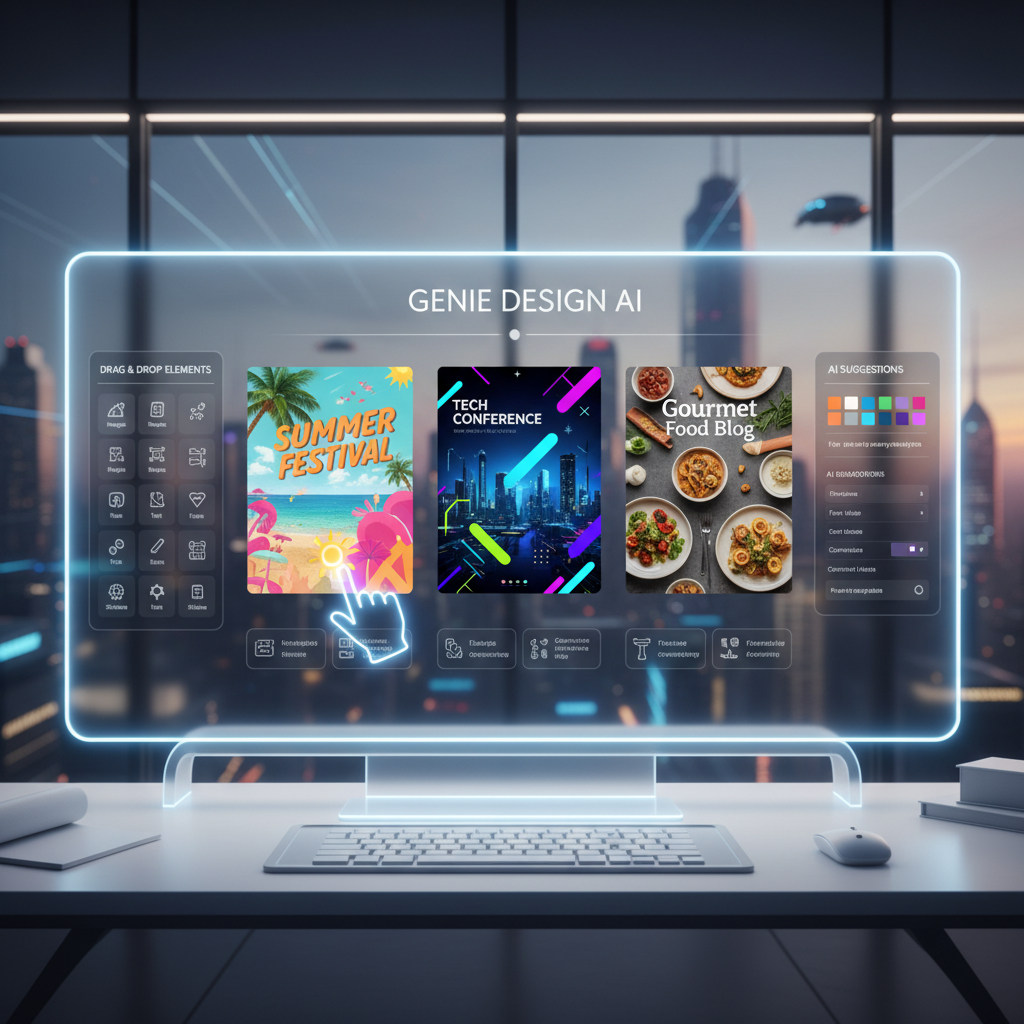
- Interactive Design and Real-time Creative Tools: With the speed of Consistency Models, new interactive design applications are emerging. Imagine a digital whiteboard where designers can sketch rough ideas for logos or website layouts, and as they draw, the AI instantly renders high-fidelity versions in real-time. This allows for immediate visual feedback and a highly fluid creative process, enabling designers to rapidly prototype and explore options without interruption.
- Marketing and Advertising Content: Marketing agencies need to create diverse visual content for various campaigns quickly. They can use LoRA models trained on specific brand aesthetics or product lines to generate consistent imagery across all channels. If they need to quickly create variations of an ad with a specific model in a specific pose, ControlNet with OpenPose allows them to dictate the exact human body posture, ensuring brand message consistency and efficiency.
These examples highlight how advanced AI image generation tools are transforming workflows, enabling creators to achieve higher levels of precision, speed, and personalization, ultimately fostering more innovative and impactful visual content.
Frequently Asked Questions
Q: What is the main difference between traditional text-to-image and these emerging technologies?
A: The main difference lies in the level of control and input modality. Traditional text-to-image generation relies primarily on written prompts, which can be abstract and lead to unpredictable results. Emerging technologies, on the other hand, offer significantly more granular control. They allow for additional inputs beyond text, such as reference images, structural maps (like edges or poses), 3D data, and even audio. This enables creators to dictate precise compositional elements, maintain stylistic consistency, and achieve specific outcomes that are difficult or impossible with text prompts alone. It’s a shift from ‘describe what you want’ to ‘show me exactly how you want it, and I’ll generate it.’
Q: How does latent space manipulation give creators more control?
A: Latent space is the compressed, numerical representation of an image within an AI model. When you manipulate the latent space, you’re directly interacting with the AI’s internal understanding of images, rather than indirectly through text. This gives creators more direct control by allowing them to blend between concepts (interpolation), apply styles from existing images (image-to-image), or make subtle variations while maintaining core elements. It’s like having direct access to the creative levers of the AI, enabling nuanced adjustments that are difficult to convey with words, leading to more predictable and iterative creative workflows.
Q: Is ControlNet difficult for beginners to use?
A: While ControlNet offers advanced capabilities, its fundamental concept is relatively straightforward, making it accessible even for beginners, especially with user-friendly interfaces. The main challenge for beginners is understanding the different types of control maps (e.g., Canny, OpenPose, Depth) and how to generate or acquire them. However, many tools provide built-in functions to automatically extract these maps from reference images, simplifying the process. With a bit of practice and experimentation, beginners can quickly grasp the power of ControlNet to achieve precise results, though mastering all its nuances requires dedication.
Q: What are consistency models, and why are they important?
A: Consistency Models (CMs) are a new class of generative AI models designed to produce high-quality images much faster than traditional diffusion models, often in a single or very few steps. They are important because they address the issue of speed and efficiency, which was a significant bottleneck for real-time applications. By generating images almost instantaneously, CMs enable interactive creative workflows, live editing, and rapid prototyping. This responsiveness transforms AI from a batch processing tool into a dynamic, real-time creative partner, fostering a more fluid and intuitive design experience for artists and designers.
Q: Can I train my own LoRA model?
A: Yes, absolutely! Training your own LoRA (Low-Rank Adaptation) model is one of the most exciting and accessible ways for creators to personalize AI image generation. It requires a relatively small dataset of images (e.g., 10-20 high-quality images of a character or specific style) and a consumer-grade GPU with sufficient VRAM (typically 8GB or more). There are numerous open-source tools and guides available that walk you through the process, making it feasible for individual creators to develop highly customized models for their unique characters, artistic styles, or specific objects, without needing extensive machine learning expertise.
Q: What kind of hardware do I need to run these advanced AI tools?
A: The hardware requirements can vary depending on the specific tool and the complexity of the task. Generally, a dedicated GPU (Graphics Processing Unit) with ample VRAM (Video Random Access Memory) is crucial. For basic usage of advanced models like Stable Diffusion with ControlNet or LoRA, a GPU with 8GB of VRAM (e.g., NVIDIA RTX 3060/4060 or better) is a good starting point. For faster generation, higher resolutions, or more complex multi-modal tasks, 12GB, 16GB, or even 24GB VRAM (e.g., RTX 3080/4080/4090) will provide a significantly smoother experience. Cloud GPU services are also a viable option for those without powerful local hardware.
Q: How do these technologies address the issue of artistic style consistency?
A: These advanced technologies address style consistency in several ways. LoRA models are specifically designed to fine-tune a base model to a very specific artistic style or character, ensuring that all subsequent generations adhere to that learned aesthetic. Image-to-image translation allows creators to use a reference image’s style or composition as a starting point, promoting visual coherence across a series. Furthermore, by providing precise structural guidance with ControlNet, creators can generate multiple images that share consistent compositional elements, regardless of stylistic variations. This combination of tools offers unprecedented control over maintaining a consistent artistic vision across an entire project.
Q: What are the ethical challenges associated with these powerful tools?
A: The ethical challenges are significant and multifaceted. They include the potential for creating convincing deepfakes and spreading misinformation, issues of copyright infringement and fair use regarding the training data, perpetuation of biases present in the training datasets, and concerns about job displacement for human artists. There are also questions about the authenticity and value of AI-generated art, and the potential for misuse in creating harmful or exploitative content. Responsible development and usage, along with robust ethical guidelines and legal frameworks, are crucial to mitigate these risks.
Q: Will AI image generation replace human artists?
A: While AI image generation tools are powerful, they are more likely to augment human creativity rather than replace it entirely. They can automate repetitive tasks, accelerate ideation, and provide new avenues for artistic expression. The role of the artist is evolving; instead of just executing, artists become ‘AI whisperers,’ curators, ethical designers, and visionaries who leverage AI as a sophisticated tool. Human artists bring unique conceptual understanding, emotional depth, critical judgment, and the spark of genuine originality that AI currently lacks. The future likely involves a collaborative ecosystem where humans and AI work together, each bringing their unique strengths to the creative process.
Q: Where can I learn more about these tools?
A: There are many excellent resources available online. For practical applications and tutorials, platforms like YouTube (channels dedicated to AI art, Stable Diffusion, Midjourney), Reddit communities (e.g., r/StableDiffusion, r/Midjourney), and specialized blogs offer extensive guides. For deeper technical understanding, academic papers (e.g., arXiv), developer documentation for open-source projects (e.g., Hugging Face Diffusers library), and online courses in AI and machine learning are invaluable. Experimenting with open-source software and participating in community discussions are also fantastic ways to learn and stay updated.
Key Takeaways
- Beyond the Prompt: The AI image generation landscape is rapidly evolving past simple text prompts, offering creators more precise and granular control.
- Latent Space as a Canvas: Direct manipulation of latent space through techniques like image-to-image translation and interpolation allows for sophisticated style transfer, variations, and image editing.
- ControlNet for Precision: ControlNet provides unprecedented structural and compositional control by allowing creators to guide AI generation with explicit visual inputs like edges, poses, and depth maps.
- Speed and Efficiency with Consistency Models: New models like Consistency Models enable rapid, high-quality image synthesis in very few steps, opening doors for real-time interactive design and prototyping.
- Multi-modal for Richer Interaction: Future AI systems will integrate multiple input types (text, image, audio, 3D data) to create more intuitive and holistic creative experiences.
- Personalization through Fine-tuning: LoRA (Low-Rank Adaptation) offers an efficient way to fine-tune models to specific characters, styles, or objects, enabling consistent branding and unique artistic voices.
- Ethical Responsibility is Paramount: While powerful, these technologies come with significant ethical challenges regarding deepfakes, copyright, bias, and job evolution, requiring thoughtful and responsible engagement from creators and developers alike.
- AI as a Creative Collaborator: These emerging tools position AI not as a replacement for human artists, but as a powerful collaborator that augments capabilities, streamlines workflows, and unlocks new realms of creative expression.
Conclusion
The journey beyond the prompt marks a thrilling new chapter in the saga of AI and creativity. We’ve moved from an era of descriptive magic words to one of precise control, allowing creators to sculpt their visions with unprecedented accuracy and efficiency. Technologies like latent space manipulation, ControlNet, consistency models, multi-modal AI, and LoRA are not just technical marvels; they are practical tools that are fundamentally reshaping the creative workflow across industries, from concept art and fashion design to architectural visualization and marketing.
For the modern creator, understanding and embracing these emerging technologies is no longer optional; it is essential for staying at the forefront of innovation. They empower artists, designers, and storytellers to transcend the limitations of traditional methods, to iterate faster, to maintain unparalleled consistency, and to bring even the most complex ideas to vivid life. The AI is evolving into a more responsive, collaborative, and intuitive partner, ready to execute on detailed instructions and specialized training.
However, with this immense power comes a shared responsibility. As we harness the capabilities of advanced AI, we must also actively engage with the ethical considerations—ensuring fairness, respecting intellectual property, and safeguarding against misuse. The future of visual content will be a dynamic interplay between human ingenuity and artificial intelligence, one where creators leverage these sophisticated tools not to replace their inherent talent, but to amplify it, pushing the boundaries of what’s possible and crafting experiences that are richer, more immersive, and deeply personal. The era of truly intelligent visual creation has only just begun, and its most exciting developments lie just beyond the horizon, waiting for creators to discover and define them.









































Leave a Reply