

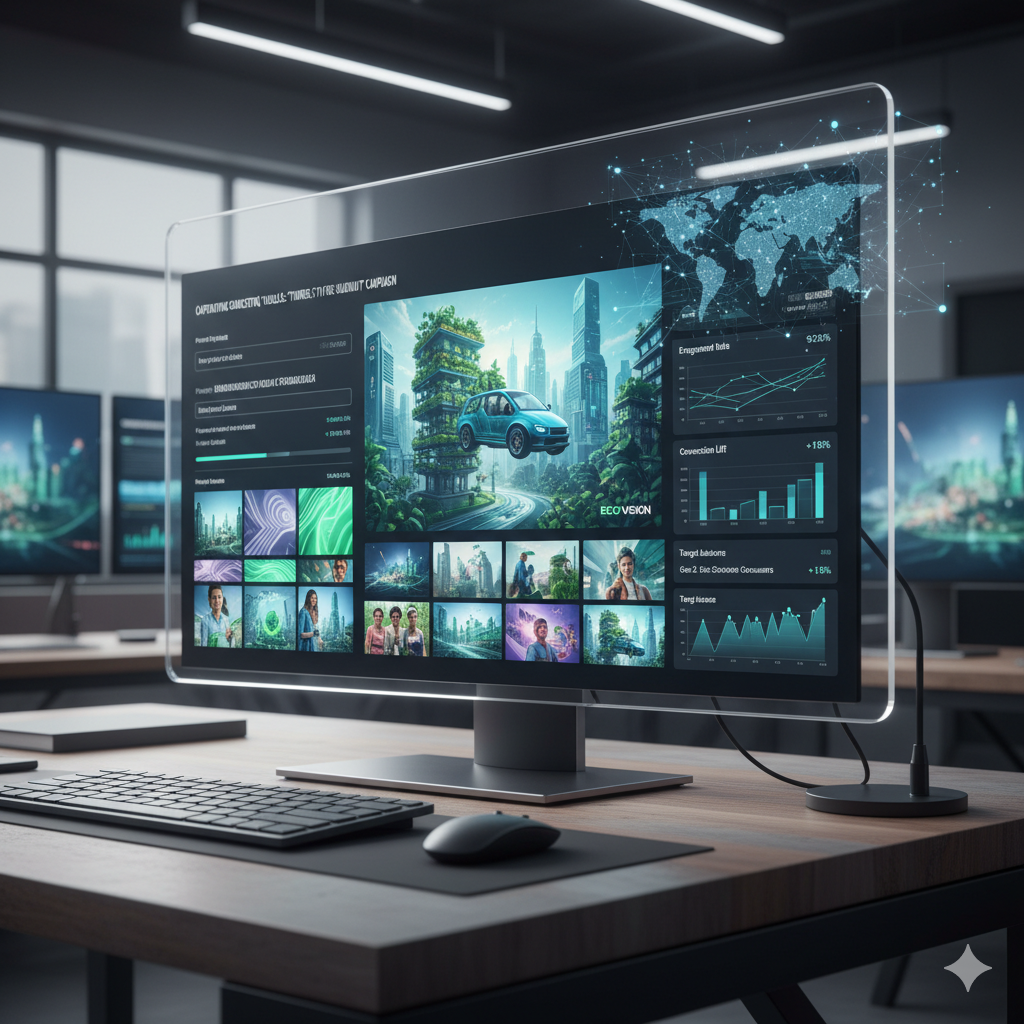
In the fast-paced, visually-driven world of social media, standing out from the crowd is no longer just an advantage; it’s a necessity. Every scroll past a generic post is a lost opportunity. Marketers are constantly seeking innovative ways to capture attention, tell compelling stories, and foster genuine connection. Enter AI image generation – a groundbreaking technology that’s transforming how brands create and deploy visual content, offering an unprecedented ability to produce eye-catching, high-impact visuals at scale. This comprehensive guide will explore how AI visuals can revolutionize your social media marketing campaigns, driving superior engagement and measurable results.
1. Introduction: The Visual Arms Race on Social Media
Social media platforms are saturated with content. From Instagram and Facebook to TikTok and LinkedIn, users are bombarded with an endless stream of images, videos, and text. In this ‘attention economy,’ visuals reign supreme. Posts with compelling images or videos consistently outperform text-only updates, garnering more likes, shares, comments, and clicks. However, creating a constant stream of fresh, high-quality, and unique visuals can be a significant drain on time, resources, and creative energy for even the most well-staffed marketing teams.
Traditionally, visual content creation has involved a lengthy process: ideation, photography or illustration, design, revisions, and approvals. This pipeline can be slow and expensive, often struggling to keep pace with the real-time demands of social media trends and campaign cycles. The quest for originality often leads to high costs, limiting the volume and variety of visuals a brand can deploy. This is where AI image generation steps in, not just as a tool, but as a paradigm shift. It democratizes high-quality visual creation, empowering marketers to unleash their creativity, personalize content like never before, and rapidly iterate on ideas, all while significantly reducing production costs and timelines.
This article will delve into the transformative power of AI-generated visuals, from understanding their core mechanisms to practical implementation strategies. We will cover the types of visuals AI can produce, the tangible benefits for engagement metrics, real-world examples, and best practices to navigate this exciting new frontier responsibly and effectively. Get ready to elevate your social media presence and captivate your audience with the power of artificial intelligence.
2. The Foundation: Understanding AI Image Generation
Before diving into strategies, it’s essential to grasp what AI image generation is and how it functions. At its core, AI image generation refers to the use of artificial intelligence models to create new images from various inputs, most commonly text descriptions (prompts). These models have been trained on vast datasets of images and their corresponding textual descriptions, learning to understand the relationships between words and visual elements.
2.1. How AI Image Generation Works: A Simplified Explanation
The most prominent AI image generation models today, such as DALL-E 3, Midjourney, Stable Diffusion, and Adobe Firefly, primarily rely on a technique called diffusion models or sometimes Generative Adversarial Networks (GANs), though diffusion models are currently dominant for high-quality image generation. Here’s a simplified breakdown:
- Training Phase: An AI model is fed billions of image-text pairs. It learns to associate specific words, phrases, styles, and concepts with visual patterns, textures, colors, and compositions. For instance, it learns what a “cat” looks like, what “wearing a hat” implies visually, and what constitutes a “photorealistic” or “watercolor” style.
- Noise Introduction: During training, the model is shown an image and then progressively “noises” it up until it becomes pure static. It learns the steps to add noise.
- Denoising Process: Crucially, it then learns to reverse this process – to “denoise” an image, step by step, back to its original form.
- Generation Phase (Text-to-Image): When you provide a text prompt (e.g., “A futuristic cityscape at sunset, highly detailed, cyberpunk aesthetic”), the model starts with random noise. Using its learned understanding, it iteratively “denoises” this random noise, guided by your prompt. Each step refines the image, adding details and structure until a coherent, detailed image matching your description emerges.
The sophistication lies in the model’s ability to interpret nuanced language, combine disparate concepts, and generate unique visuals that often surprise with their creativity and quality. This process, which once took human artists hours or days, can now be accomplished in seconds or minutes.
2.2. Evolution and Recent Developments
AI image generation has evolved rapidly. Early models produced abstract or rudimentary images. Today, models can generate photorealistic images indistinguishable from real photographs, sophisticated illustrations, 3D renders, and even short video sequences. Recent developments include:
- Improved Coherence and Detail: Newer models produce more logically consistent images with finer details, fewer anatomical errors, and better text rendering within images.
- ControlNet and Regional Conditioning: Advanced techniques like ControlNet allow users unprecedented control over composition, pose, and structure, using input images or sketches as guides. Regional conditioning enables different parts of an image to be generated from separate prompts.
- Inpainting and Outpainting: Tools now allow users to selectively modify parts of an image (inpainting) or expand an image beyond its original borders (outpainting), seamlessly filling in new content.
- Integration into Creative Suites: Major creative software like Adobe Photoshop and Illustrator are integrating generative AI features directly, making these tools accessible within familiar workflows.
- Video Generation: While still nascent, models like Sora (OpenAI) are pushing the boundaries of generating coherent, high-quality video clips from text prompts, promising even greater impact on dynamic marketing content.
3. Types of AI Visuals Revolutionizing Marketing Campaigns
The versatility of AI-generated visuals means they can be deployed across a wide spectrum of marketing needs. Here are some key types that are currently making a significant impact:
3.1. Photorealistic Imagery and Lifestyle Shots
Need a product shot in a specific setting without a costly photoshoot? AI can create it. Imagine needing a diverse range of models interacting with your product in various scenarios – urban, natural, professional, casual – all customized to your target demographic. AI can generate these images on demand, providing diverse representation and tailored contexts that resonate deeply with specific audience segments.
- Examples: A new coffee blend shown in a bustling cafe, a serene home office, or a rustic outdoor camping scene. Apparel modeled by individuals of varying ages, ethnicities, and body types.
3.2. Stylized Illustrations and Digital Art
For brands that prefer a more artistic or branded aesthetic, AI can produce illustrations in virtually any style imaginable: watercolor, vector art, cyberpunk, minimalist, vintage comic, isometric, and more. This is invaluable for creating unique brand identities and campaigns that stand out from conventional photography.
- Examples: Animated characters for explainer videos, unique mascots, infographics with a consistent artistic theme, social media memes with a branded touch.
3.3. Product Mockups and Variations
AI excels at visualizing products in new ways. Generate countless variations of a product – different colors, textures, materials, packaging designs – without manufacturing a single physical prototype. This accelerates the design process and allows for extensive A/B testing of visual appeal before production.
- Examples: A new smartphone in various colors held by different hands, cosmetic packaging with diverse branding elements, apparel designs draped on mannequins or models in a studio setting.
3.4. Background Generation and Scene Extension
AI can create or extend backgrounds for existing product images or marketing materials, making them fit specific themes or aspect ratios. This is perfect for adapting content across different platforms (e.g., horizontal for YouTube, vertical for Instagram Stories) or placing products in more engaging environments.
- Examples: Placing a car on a scenic mountain road, adding a vibrant cityscape behind a portrait, expanding the canvas of an existing image to fit a banner advertisement.
3.5. Personalized and Hyper-Targeted Visuals
One of the most powerful applications is the ability to generate visuals tailored to individual user preferences or segments. Imagine a user seeing an ad for a hiking boot, where the image depicts a person who looks like them, hiking in a landscape similar to their local region. This level of personalization significantly boosts relevance and engagement.
- Examples: Dynamic ads that show products in contexts relevant to a user’s browsing history or demographic, email campaigns featuring visuals designed to appeal to specific recipient segments.
3.6. Concept Art and Storyboarding
For larger campaigns or video projects, AI can rapidly generate concept art and storyboards, helping teams visualize ideas quickly and iterate on creative directions before committing to costly production phases.
- Examples: Visualizing scenes for a commercial, creating character designs for an animated series, mock-ups for event spaces or installations.
4. The Power of AI: Boosting Engagement Metrics Across the Board
The tangible benefits of incorporating AI visuals extend far beyond mere novelty. They directly translate into improved engagement metrics, stronger brand performance, and more efficient marketing operations.
4.1. Unprecedented Speed and Efficiency
Traditional visual asset creation is a time-consuming process. AI shatters these timelines. What once took days or weeks (photoshoots, design cycles) can now be accomplished in minutes. This speed allows marketers to:
- Respond to Trends Instantly: Capitalize on viral trends or breaking news with timely, relevant visuals before the moment passes.
- Increase Content Volume: Maintain a consistent and high-frequency posting schedule across all platforms without compromising quality.
- Accelerate Campaign Launches: Get campaigns off the ground faster, reducing time-to-market for new products or promotions.
4.2. Significant Cost Reduction
Hiring photographers, models, illustrators, and graphic designers, along with studio rentals and equipment, adds up quickly. AI image generation drastically cuts these expenses, making high-quality visual content accessible even for small businesses and startups.
- Reduced Production Costs: Eliminate or minimize expenses associated with photoshoots, stock image licenses, and outsourced design work.
- Optimized Resource Allocation: Reallocate budget from visual creation to other critical areas like ad spend, talent acquisition, or market research.
4.3. Hyper-Personalization at Scale
Generic visuals often fall flat. AI allows for the creation of unique, personalized content for different audience segments, demographics, or even individual users. This level of tailoring makes content far more relevant and engaging.
- Targeted Advertising: Create variations of ad creatives that resonate with specific user profiles based on their interests, location, or past behavior.
- Dynamic Content: Power personalized email marketing, website experiences, and app notifications with custom visuals.
4.4. Enhanced A/B Testing and Iteration
With the ability to generate countless visual variations quickly and cheaply, marketers can conduct extensive A/B tests to determine which visuals perform best with specific audiences. This data-driven approach leads to optimized campaigns and better ROI.
- Optimized Ad Creatives: Test different headlines, imagery, and calls-to-action to maximize click-through rates and conversions.
- Refined Visual Language: Continuously improve the visual style and content that resonates most with your audience.
4.5. Maintaining Brand Consistency and Adherence
AI can be trained or prompted to adhere strictly to brand guidelines, including color palettes, artistic styles, and specific visual elements. This ensures brand consistency across all marketing touchpoints, reinforcing brand identity.
- Unified Aesthetics: Generate visuals that always align with your brand’s unique look and feel.
- Scalable Brand Identity: Ensure consistency even when producing a high volume of diverse content.
4.6. Unlocking Unprecedented Creativity and Uniqueness
AI isn’t just about efficiency; it’s a creative partner. It can generate novel concepts, unexpected combinations, and surreal imagery that might be difficult or impossible for humans to conceive or produce quickly. This leads to truly unique and memorable campaigns that cut through the noise.
- Innovative Storytelling: Create visuals that push creative boundaries and tell unique brand stories.
- Novel Visual Experiences: Surprise and delight audiences with fresh, never-before-seen imagery.
5. Practical Steps to Integrate AI Visuals into Your Social Media Strategy
Adopting AI visuals effectively requires a strategic approach. Here’s a step-by-step guide to integrating this powerful technology into your marketing efforts:
5.1. Define Your Campaign Goals and Target Audience
Before generating any visuals, clearly articulate what you want to achieve. Are you aiming for brand awareness, lead generation, website traffic, or sales? Who is your primary target audience? Understanding your objectives and audience will guide your prompt engineering and choice of visual style.
- Example: For a youth-focused fashion brand aiming for brand awareness, you might prioritize vibrant, surreal, or street-style visuals. For a B2B SaaS company aiming for lead generation, professional, clean, and conceptual visuals might be more appropriate.
5.2. Choose the Right AI Image Generation Tool
The market is rapidly evolving, with several robust AI image generators available. Each has its strengths, weaknesses, and pricing models.
- Midjourney: Known for highly artistic, aesthetic, and often fantastical outputs. Excellent for concept art, unique illustrations, and stylistic branding.
- Best for: Creative agencies, fashion, gaming, artistic brands.
- DALL-E 3 (via ChatGPT Plus/Enterprise, Microsoft Copilot): Offers strong compositional understanding and excellent text rendering within images. Integrated into user-friendly interfaces.
- Best for: General marketing, content creation, social media, subtle brand integration.
- Stable Diffusion (various interfaces like InvokeAI, Automatic1111, DreamStudio): Open-source and highly customizable. Offers unparalleled control with advanced techniques like ControlNet.
- Best for: Technical users, niche applications, detailed control over composition, in-house development.
- Adobe Firefly: Integrated into Adobe Creative Cloud apps, focusing on commercially safe and ethically sourced training data. Great for quick edits, variations, and seamless workflow integration.
- Best for: Designers, photographers, agencies already in the Adobe ecosystem.
- Canva’s Magic Media: User-friendly, integrated into a popular design platform. Ideal for quick, accessible content creation for non-designers.
- Best for: Small businesses, social media managers, individuals with limited design experience.
5.3. Master the Art of Prompt Engineering
The quality of your AI-generated visuals directly correlates with the quality of your prompts. Prompt engineering is the skill of crafting clear, detailed, and effective text instructions for the AI. Think of it as communicating with a highly imaginative but literal artist.
Key elements of a good prompt:
- Subject: What is the main focus? (e.g., “A golden retriever puppy”)
- Action/Context: What is it doing or where is it? (e.g., “playing in a field of sunflowers”)
- Style/Aesthetics: What visual style? (e.g., “oil painting, impressionistic, vibrant colors”)
- Lighting/Composition: How is it lit? What’s the shot? (e.g., “golden hour lighting, shallow depth of field, close-up shot”)
- Quality/Detail: Desired level of realism or detail. (e.g., “ultra-realistic, highly detailed, 8K, cinematic”)
- Negative Prompts (if applicable): What you don’t want to see (e.g., “blurry, distorted, ugly, watermark”).
Example Prompt: “A futuristic electric car, sleek design, parked in front of a cyberpunk city skyline at night, rain on the asphalt reflecting neon lights, highly detailed, cinematic, volumetric lighting, 8K, octane render.”
5.4. Iterate, Refine, and Experiment
Rarely will your first prompt yield the perfect image. AI generation is an iterative process. Generate multiple options, refine your prompts based on the results, and experiment with different keywords, styles, and parameters. Save your best-performing prompts for future use.
5.5. Integrate with Existing Workflows
AI visuals shouldn’t exist in a silo. Integrate them seamlessly into your existing marketing workflows. Use tools that allow for easy export and import into your design software, social media management platforms, or ad creative builders.
5.6. Ethical Considerations and Disclosures
As powerful as AI is, it comes with ethical responsibilities. Be mindful of potential biases in AI models (which can reflect biases in their training data), intellectual property rights, and the importance of transparency. For highly sensitive campaigns or when featuring identifiable human likenesses, consider human review and even disclosure that AI was used. Respect existing copyrights and trademarks.
6. Overcoming Challenges and Adopting Best Practices
While the benefits are immense, integrating AI visuals isn’t without its challenges. Addressing these proactively and adopting best practices will ensure long-term success.
6.1. Challenges to Consider
- “Garbage In, Garbage Out”: Poorly crafted prompts lead to irrelevant or low-quality visuals.
- Maintaining Brand Voice: Ensuring AI-generated content consistently aligns with a brand’s unique tone and messaging can be tricky without careful prompt engineering and human oversight.
- Bias and Stereotypes: AI models can perpetuate biases present in their training data, potentially generating stereotypical or unrepresentative images.
- Ethical and Copyright Concerns: Questions around ownership of AI-generated content and the ethical implications of using images derived from copyrighted material remain areas of ongoing debate and legal development.
- Lack of Human Nuance: While AI can be incredibly creative, it sometimes lacks the subtle emotional nuance or specific cultural understanding that a human artist brings.
- “AI Aesthetic”: Sometimes, AI-generated images can have a recognizable “AI look” that some audiences might find generic or inauthentic if not carefully curated.
6.2. Best Practices for Successful AI Visual Integration
- Human Oversight is Crucial: AI is a tool, not a replacement. Always have a human review and refine AI-generated visuals to ensure they meet quality standards, align with brand messaging, and are free from unintended biases or errors.
- Develop a Prompt Library: Create and maintain a library of successful prompts and prompt templates specific to your brand’s needs and aesthetic. This saves time and ensures consistency.
- Establish Brand-Specific AI Guidelines: Define clear rules for how AI visuals should be used, what styles are acceptable, and any specific negative prompts to avoid certain outputs.
- Educate Your Team: Provide training for your marketing and creative teams on how to effectively use AI tools, prompt engineering, and ethical considerations.
- Focus on Augmentation, Not Replacement: View AI as a powerful assistant that augments human creativity and efficiency, rather than a standalone solution. It frees up human talent for higher-level strategic and creative tasks.
- Stay Updated: The AI landscape is evolving rapidly. Regularly research new tools, features, and best practices to keep your strategy cutting-edge.
- Experiment with A/B Testing: Leverage AI’s ability to create variations by A/B testing different AI-generated visuals to see what resonates most with your audience.
- Consider AI-Assisted Customization: Use AI to generate base images, then have human designers add final touches, branding elements, or specific details for a polished, unique look.
7. Comparison Tables
To further illustrate the impact of AI in visual content creation, let’s compare traditional methods with AI-powered approaches, and then look at some popular AI tools.
7.1. Traditional vs. AI-Powered Visual Creation
| Aspect | Traditional Visual Creation | AI-Powered Visual Creation |
|---|---|---|
| Time to Create | Hours to weeks (photoshoots, design cycles, approvals) | Seconds to minutes (prompt generation, iteration) |
| Cost per Asset | High (photographers, models, studio, licenses, designers) | Low to moderate (subscription fees, per-generation costs) |
| Volume of Assets | Limited by time and budget; typically small batches | Virtually limitless; easy to generate many variations |
| Personalization | Difficult and expensive to personalize at scale | Highly scalable personalization for different segments |
| A/B Testing | Resource-intensive due to limited variations | Easy and efficient with rapid generation of alternatives |
| Creative Control | Direct human control, but constrained by practicalities | Indirect via prompt engineering; can be highly specific or exploratory |
| Skill Required | Expertise in photography, graphic design, art direction | Prompt engineering skills, critical evaluation, design sensibility |
| Ethical Concerns | Generally fewer, but still require model releases, licensing | Bias, deepfakes, copyright complexities, transparency needs |
| Innovation & Uniqueness | Relies on human creativity; can be groundbreaking | Generates novel, sometimes surreal, concepts quickly; unique styles |
7.2. Popular AI Image Generation Tools Overview
| Tool Name | Primary Strengths | Best Use Cases | Key Features |
|---|---|---|---|
| Midjourney | Highly artistic, aesthetic, cinematic, often fantastical outputs. Excellent for unique styles. | Concept art, creative branding, high-fashion, gaming visuals, artistic social media posts. | Discord-based interface, strong community, V6 model for improved detail, advanced stylistic parameters. |
| DALL-E 3 (OpenAI) | Exceptional prompt understanding, strong coherence, good for text in images. Integrated with ChatGPT. | General marketing, precise creative briefs, social media graphics with embedded text, content creation. | Accessible via ChatGPT Plus/Enterprise and Microsoft Copilot, robust safety features, high-quality results. |
| Stable Diffusion (various interfaces) | Open-source, highly customizable, immense control with advanced features like ControlNet. | Technical users, in-house development, specific pose/composition control, architectural visualization, niche content. | Open-source flexibility, extensive community models (LoRAs), inpainting/outpainting, image-to-image. |
| Adobe Firefly | Focus on commercial safety, integrated into Creative Cloud, quick editing and variations. | Designers already in Adobe ecosystem, stock asset generation, quick graphic adjustments, text effects. | Text-to-image, Generative Fill/Expand in Photoshop, text effects, commercially safe content. |
| Canva’s Magic Media | Extremely user-friendly, integrated into a popular drag-and-drop design platform. | Small businesses, social media managers, rapid content creation, non-designers needing quick visuals. | Simple text-to-image, integrated directly into Canva projects, easy to combine with other design elements. |
8. Practical Examples: AI Visuals in Action
Let’s look at some real-world scenarios where AI visuals can dramatically enhance marketing efforts:
8.1. E-commerce Product Launches
Scenario: A new footwear brand is launching a line of eco-friendly sneakers. They need a variety of engaging visuals for their social media ads, website banners, and email campaigns, showcasing the shoes in different environments and on diverse models, all before physical samples are widely available.
AI Solution:
- Generate photorealistic images of the sneakers in various settings: urban street style, nature trails, casual coffee shop, gym.
- Create images of models with diverse demographics (age, ethnicity, body type) wearing the shoes, ensuring broad appeal and representation.
- Develop several packaging mockups with different branding elements for A/B testing before final production.
- Produce stylized illustrations for a “sustainability story” campaign highlighting the eco-friendly materials.
Impact: Rapid creation of a rich visual library, extensive testing of visual appeal, reduced costs of photoshoots, and a highly personalized visual campaign that resonates with different customer segments.
8.2. Local Restaurant Promotion
Scenario: A new fusion restaurant wants to promote its unique dishes and ambiance to attract local diners. They need fresh, mouth-watering content daily without the budget for a professional food photographer every week.
AI Solution:
- Generate high-quality, close-up images of new menu items with various garnishes and plating styles.
- Create atmospheric shots of a bustling restaurant interior or a cozy outdoor dining area, customized to match the restaurant’s decor.
- Produce fun, illustrative graphics for daily specials or themed nights (e.g., “Taco Tuesday,” “Weekend Brunch”).
- Generate images of diverse groups of friends or families enjoying meals at the restaurant, creating an inviting atmosphere.
Impact: Consistent flow of professional-looking food and ambiance visuals, ability to quickly promote daily specials, increased local engagement due to fresh and appealing content, and significant savings on photography costs.
8.3. B2B Software Company Content Marketing
Scenario: A B2B SaaS company specializing in project management software needs compelling visuals for its blog posts, LinkedIn updates, and whitepapers to explain complex concepts and make their content more engaging.
AI Solution:
- Generate conceptual images illustrating abstract ideas like “streamlined workflow,” “data security,” “team collaboration,” or “efficiency gains” in a modern, professional style.
- Create infographic elements or icons that maintain brand consistency across all their content.
- Produce visual metaphors for complex features (e.g., a “digital bridge” connecting teams, a “layered shield” for data protection).
- Generate diverse stock-photo-quality images of professionals working in various modern office environments using their software interface (without showing the actual UI for confidentiality).
Impact: Transforms dry, technical content into visually appealing and easier-to-understand narratives, enhances professional branding, allows for rapid creation of visuals for numerous articles, and improves content shareability on professional networks.
8.4. Non-Profit Awareness Campaign
Scenario: A non-profit organization is running a campaign to raise awareness about global climate change and needs powerful, emotionally resonant visuals that convey urgency and hope.
AI Solution:
- Generate impactful imagery of environmental challenges (e.g., melting glaciers, deforested landscapes, extreme weather events), but carefully balanced with images of positive solutions (e.g., renewable energy, reforestation, community action).
- Create allegorical or symbolic art pieces that represent the struggle and resilience of affected communities.
- Produce diverse portraits of people from various regions impacted by climate change, humanizing the issue.
- Develop compelling visuals for calls to action, such as “Donate Now” or “Join the Movement,” using a consistent, hopeful aesthetic.
Impact: Generates a wide array of emotionally powerful visuals to tell a compelling story, overcomes the limitations of stock photography in depicting specific scenarios, enables testing of different visual approaches to maximize donor engagement and awareness, and saves critical budget resources for programmatic work.
9. Frequently Asked Questions (FAQs)
Q: What is AI image generation in simple terms?
A: AI image generation is when a computer program uses artificial intelligence to create new pictures or graphics from scratch, usually based on text descriptions you give it. Imagine you type “a cat riding a skateboard in space,” and the AI draws that exact image for you in seconds.
Q: Is AI image generation replacing human designers and artists?
A: Not replacing, but augmenting. AI tools are powerful assistants that handle repetitive tasks, generate ideas, and create initial drafts rapidly. This frees up human designers and artists to focus on higher-level creative direction, strategic thinking, refinement, and adding that unique human touch that AI currently can’t replicate. It transforms workflows rather than eliminating roles.
Q: Are AI-generated images copyrightable?
A: This is a rapidly evolving and complex legal area. In many jurisdictions, including the U.S., purely AI-generated images without significant human creative input are currently not considered copyrightable by the AI itself. The human who uses the AI tool and makes creative choices (like prompt engineering, selection, and editing) might have some claim to copyright on the specific output they produce, especially if they make substantial modifications. Always check local laws and the terms of service for the specific AI tool you are using.
Q: How can I ensure my AI visuals align with my brand’s style?
A: To ensure brand alignment, you need strong prompt engineering. Incorporate brand-specific keywords for style, color palettes, and aesthetics into your prompts (e.g., “minimalist, pastel colors, corporate style, clean lines”). Many advanced tools also allow you to train the AI on your brand’s existing imagery or provide “style references” to guide the generation process. Consistent human review and editing are also critical.
Q: What are the main ethical considerations when using AI visuals?
A: Key ethical concerns include: Bias (AI reflecting and amplifying biases from its training data, leading to stereotypes), Misinformation/Deepfakes (creating misleading or false images), Intellectual Property (training data often includes copyrighted material, raising questions about infringement), and Transparency (whether to disclose if an image is AI-generated). Responsible use requires awareness, careful vetting, and sometimes disclosure.
Q: Can AI create visuals for specific holidays or events?
A: Absolutely! AI is excellent for this. You can prompt it with themes like “Christmas,” “Halloween,” “Valentine’s Day,” “Earth Day,” or “Summer Sale,” along with your specific product or brand elements. This allows for rapid creation of timely and relevant campaign visuals that resonate with seasonal trends.
Q: Is it expensive to use AI image generation tools?
A: Pricing varies widely. Many tools offer free trials or limited free tiers. Paid subscriptions can range from around $10-20 per month for basic access to hundreds of dollars for professional, high-volume use. The cost is generally significantly lower than hiring professional photographers, illustrators, or purchasing extensive stock photo licenses, especially when considering the volume and variety of content you can produce.
Q: How can I prevent AI from generating inaccurate or weird images?
A: This often comes down to prompt engineering. Be as specific and detailed as possible. Use negative prompts (e.g., “ugly, distorted, blurry, extra limbs”) to explicitly tell the AI what you don’t want. Iterate and refine your prompts. Sometimes, simply regenerating an image several times with the same prompt will yield better results as the AI explores different possibilities. Human review and selection are always the final quality control step.
Q: Can AI visuals generate images with text within them?
A: Older AI models struggled significantly with text generation, often producing gibberish. However, newer models, particularly DALL-E 3, have made significant strides and can generate coherent and accurate text within images, making them much more useful for social media graphics, product labels, or ad creatives that require embedded slogans or messages.
Q: How quickly can I learn to use AI image generation effectively?
A: Basic usage for tools like Canva’s Magic Media or DALL-E 3 is very intuitive and can be learned in minutes. Mastering prompt engineering for highly specific or artistic results takes more practice and experimentation, but most users can become proficient enough for marketing purposes within a few hours to a few days of dedicated learning and experimentation.
10. Key Takeaways
The integration of AI visuals into social media marketing is no longer a futuristic concept; it’s a present-day imperative for brands looking to thrive in a competitive digital landscape. Here are the core insights to remember:
- Engagement is Paramount: In a visually saturated world, unique, high-quality, and relevant visuals are crucial for capturing and holding audience attention.
- AI as an Accelerator: AI image generation dramatically speeds up content creation, reduces costs, and allows for unprecedented volume and variety of visual assets.
- Diverse Applications: From photorealistic product shots and stylized illustrations to personalized campaign visuals and background generation, AI offers solutions for almost every marketing need.
- Metrics Matter: AI-powered visuals directly contribute to improved engagement metrics through hyper-personalization, efficient A/B testing, and rapid responsiveness to trends.
- Prompt Engineering is Key: The ability to craft clear, detailed prompts is fundamental to unlocking the full potential of AI image generators.
- Human Oversight Remains Essential: AI is a powerful tool, but it requires human direction, refinement, and ethical consideration to ensure quality, brand alignment, and responsible use.
- Continuous Learning: The AI landscape is dynamic. Staying updated on new tools, features, and best practices is vital for sustained success.
- Strategic Integration: Integrate AI visuals thoughtfully into existing workflows, viewing AI as an augmentation of human creativity rather than a replacement.
11. Conclusion: The Future is Visually Intelligent
The advent of AI image generation marks a pivotal moment in the evolution of digital marketing. It’s not merely a technological advancement; it’s a democratization of high-quality visual content creation, empowering marketers of all sizes to compete effectively for audience attention. Brands that embrace AI visuals will gain a significant competitive edge, capable of producing more engaging, more personalized, and more timely content than ever before.
By understanding the mechanisms of AI, strategically integrating these tools into your workflows, and committing to best practices in prompt engineering and ethical use, you can transform your social media presence. AI visuals offer a pathway to deeper connection with your audience, enabling you to tell richer stories, inspire greater action, and ultimately, build stronger brands. The future of social media engagement is visually intelligent, and with AI, you have the power to shape it.
















































































Leave a Reply