

The world of art is undergoing a revolutionary transformation, driven by the astonishing capabilities of artificial intelligence. What once required years of dedicated practice, specialized skills, and expensive equipment can now, with the right tools and a dash of creativity, be achieved by anyone with an idea. Imagine translating a whimsical thought into a stunning visual masterpiece in mere seconds, or generating an entire series of unique concept art for a project without ever picking up a brush. This isn’t science fiction; it’s the reality of generative AI art.
For many, the idea of creating art with AI might seem daunting, conjuring images of complex coding or advanced technical know-how. But the truth is, the landscape has evolved dramatically, with an abundance of user-friendly tools designed specifically to empower beginners. These platforms act as your digital canvas and brush, making the process of AI art creation not just accessible, but genuinely effortless and enjoyable. Whether you are a budding artist looking for a new medium, a designer seeking inspiration, a content creator needing unique visuals, or simply curious about this exciting new frontier, this comprehensive guide is tailored for you.
In this post, we will embark on a journey through the fascinating world of AI art. We will demystify the core concepts, introduce you to the most essential generative tools perfect for beginners, and arm you with the knowledge of prompt engineering – the secret language you’ll use to communicate your artistic visions to the AI. We’ll explore practical examples, address common concerns, and provide invaluable insights to kickstart your creative adventure. Get ready to unlock artistic styles you never thought possible and transform your imagination into tangible, breathtaking visuals with the power of AI.
The Dawn of AI Art: Why Now?
The concept of machines creating art has been a subject of fascination for decades, but it’s only in recent years that AI art has truly exploded into the mainstream. This surge isn’t a sudden phenomenon but rather the culmination of several breakthroughs in artificial intelligence, particularly in the field of deep learning. Historically, AI systems were rule-based, meaning they could only perform tasks explicitly programmed into them. Creative tasks, with their inherent ambiguity and subjective nature, seemed far out of reach.
The real turning point came with the development of neural networks, especially architectures like Generative Adversarial Networks (GANs) and, more recently, Diffusion Models. These advanced algorithms learned to understand patterns, styles, and compositions from vast datasets of existing images, enabling them to generate entirely new and coherent visuals that often defy immediate identification as machine-made. The sheer volume and diversity of data available on the internet, coupled with exponential increases in computational power, provided the fuel for these AI models to learn and evolve at an unprecedented pace.
What makes “now” particularly significant for beginners is the shift from research labs to user-friendly applications. Early AI art required significant technical expertise, often involving coding and complex model fine-tuning. Today, platforms abstract away this complexity, offering intuitive interfaces where users can simply type descriptive text prompts and watch their visions materialize. This democratization of creativity means that the barrier to entry has dramatically lowered, allowing anyone, regardless of their artistic background, to experiment, innovate, and produce stunning digital art. It’s an exciting era where AI serves not just as a tool, but as a collaborative partner in the creative process, opening up new avenues for artistic expression and exploration for millions.
Understanding the Core Concepts: How AI Art Works
At the heart of modern AI art generation lie sophisticated machine learning models that have been trained on billions of images and their corresponding text descriptions. While the underlying mathematics can be complex, understanding the basic principles will greatly enhance your ability to craft effective prompts and achieve desired results.
Generative Adversarial Networks (GANs)
One of the pioneering architectures in generative AI was the Generative Adversarial Network (GAN). A GAN consists of two neural networks, a “generator” and a “discriminator,” locked in a perpetual game. The generator creates new data (images, in this case), attempting to make them look as realistic as possible. The discriminator, on the other hand, tries to distinguish between real images from a training dataset and fake images produced by the generator. Through this adversarial process, both networks improve: the generator becomes better at fooling the discriminator, and the discriminator becomes better at detecting fakes. This push-and-pull allows GANs to learn to produce incredibly convincing images, often mimicking specific styles or categories of content.
Diffusion Models
While GANs were groundbreaking, a more recent class of models, known as Diffusion Models, has gained prominence for their ability to generate incredibly high-quality, diverse, and controllable images. Models like DALL-E, Midjourney, and Stable Diffusion are all built upon variations of the diffusion architecture. The core idea behind diffusion is a two-step process:
- Forward Diffusion (Noise Injection): The model systematically adds Gaussian noise to an image over many steps until the image is entirely random noise. It learns to reverse this process.
- Reverse Diffusion (Noise Removal): Given a prompt, the model learns to gradually reverse the noise injection process, starting from pure noise and iteratively denoising it until a coherent image emerges that matches the text description. It essentially “paints” the image out of noise, guided by your prompt.
This iterative denoising process allows for remarkable detail, coherence, and the ability to generate a wide array of artistic styles. The quality of the output is heavily dependent on the training data – the more diverse and well-curated the dataset, the more capable the model is of understanding complex concepts and generating high-fidelity images.
Prompt Engineering: The Language of AI Art
Regardless of the underlying model, your primary interface for directing AI art tools is text-based “prompt engineering.” This involves crafting precise and descriptive textual commands that guide the AI in generating your desired image. It’s not just about what you want to see, but how you want it to look. A simple prompt like “a cat” will yield a generic cat. But “a majestic Siamese cat, sitting regally on a velvet cushion, in a dimly lit Victorian parlor, oil painting style, hyperrealistic, dramatic lighting, by Rembrandt” will produce something far more specific and artistic.
Prompt engineering is an art in itself, requiring experimentation, iteration, and a good understanding of how different keywords influence the AI’s output. We will delve deeper into this crucial skill later, but for now, understand that your words are the brushstrokes you use to paint with AI.
Image-to-Image and Other Techniques
Beyond simple text-to-image generation, many tools offer advanced functionalities:
- Image-to-Image: Using an existing image as a starting point, you can apply new styles, transform elements, or guide the AI to create variations based on its content.
- Inpainting: Selectively editing specific parts of an image generated by AI or even a photograph, allowing you to add or remove elements seamlessly.
- Outpainting: Extending the canvas beyond the original image boundaries, letting the AI intelligently fill in the surrounding areas.
- ControlNet: An advanced technique (often available in Stable Diffusion implementations) that allows precise control over aspects like pose, depth, edges, or segmentation maps, giving artists unprecedented control over the generated image’s composition.
These techniques empower artists to go beyond initial generation and refine, enhance, and creatively manipulate their AI-generated visuals, blurring the lines between traditional digital art and AI-assisted creation.
Essential AI Art Tools for Beginners: A Guided Tour
The market for AI art tools is rapidly expanding, with new platforms emerging constantly. For beginners, the key is to choose tools that balance powerful capabilities with an intuitive user interface. Here’s a guided tour of some of the best and most accessible options currently available:
DALL-E 3 (via ChatGPT Plus or Microsoft Copilot)
- Overview: Developed by OpenAI, DALL-E has been a pioneer in text-to-image generation. DALL-E 3 represents a significant leap forward, particularly in its ability to understand complex, nuanced prompts and generate images that accurately reflect the user’s intent.
- Accessibility for Beginners: Extremely high. DALL-E 3 is primarily accessed through natural language interfaces like ChatGPT Plus or Microsoft Copilot. This means you don’t need to learn a separate platform or syntax; you can simply describe your vision conversationally. Copilot (formerly Bing Chat Enterprise) offers free access to DALL-E 3 for basic use, making it incredibly approachable.
- Strengths:
- Unrivaled Prompt Understanding: DALL-E 3 excels at interpreting long, detailed prompts, often generating coherent images that capture multiple disparate elements.
- Contextual Generation: Its integration with large language models allows for more contextual and iterative generation, where you can refine prompts through conversation.
- Coherence: Generates images with strong internal consistency and fewer “mutations” or illogical elements compared to some other models.
- Text Rendering: Significantly improved ability to render legible text within images, a common challenge for other AI art generators.
- Limitations:
- Control: While excellent at understanding, it offers less direct artistic control (e.g., specific seeds, negative prompts, stylization parameters) compared to tools like Midjourney or Stable Diffusion.
- Cost: Full, unrestricted access often requires a paid subscription (e.g., ChatGPT Plus). Free tiers via Copilot might have usage limits.
- Specific Aesthetic: While versatile, it tends to have a generally polished, almost photographic or illustrative aesthetic by default.
- Best For: Beginners who want a seamless, conversational experience to translate complex ideas into visuals, content creators needing quick, accurate illustrations, or anyone who struggles with crafting very technical prompts.
Midjourney
- Overview: Midjourney is renowned for producing exceptionally artistic and high-quality images with a distinct aesthetic. It operates primarily through Discord, making it a unique social and creative experience.
- Accessibility for Beginners: Moderate. The Discord interface can initially be a bit intimidating for those unfamiliar with the platform, requiring learning specific commands (e.g., /imagine). However, the community is vibrant, and many tutorials are available.
- Strengths:
- Stunning Artistic Quality: Midjourney consistently generates images with a polished, professional, and often breathtaking artistic flair, frequently described as “cinematic” or “painterly.”
- Unique Aesthetic: It has a recognizable artistic signature that many creators actively seek out.
- Rapid Iteration: Offers quick variations and upscale options, making it easy to iterate and refine your creations.
- Community & Inspiration: The public channels on Discord allow users to see what others are creating and learn from their prompts.
- Limitations:
- Discord-Centric: The reliance on Discord can be a barrier for some users and lacks a dedicated web interface (though a web alpha is available to subscribers).
- Steep Learning Curve for Control: Achieving precise control over composition, specific elements, and artistic styles often requires a deeper understanding of its extensive parameters and prompt weighting.
- Subscription Required: No free tier for new users anymore, requiring a paid subscription from the outset.
- Best For: Artists and designers prioritizing high aesthetic quality and artistic output, those comfortable with Discord, or individuals looking for inspiration within an active creative community.
Stable Diffusion (via Online Platforms like Leonardo.ai, Playground AI, DreamStudio)
- Overview: Stable Diffusion is an open-source model, meaning its core technology is freely available for anyone to use, modify, and build upon. This has led to a rich ecosystem of third-party platforms and custom models, offering unparalleled versatility.
- Accessibility for Beginners: Varies from low to high depending on the platform. While the raw model requires technical setup, user-friendly web interfaces like Leonardo.ai and Playground AI make it highly accessible.
- Strengths:
- Unmatched Customization & Control: Offers the highest degree of control over the generation process, including seed values, model checkpoints, sampling methods, CFG scale, image-to-image capabilities, inpainting, outpainting, and advanced features like ControlNet.
- Vast Ecosystem: Because it’s open-source, there are thousands of community-trained models (checkpoints) available on platforms like Civitai, allowing for highly specific styles (e.g., anime, photorealism, fantasy art, specific artists).
- Cost-Effective/Free Options: Many online platforms offer generous free tiers (e.g., Leonardo.ai, Playground AI), and running it locally is free (though requires powerful hardware).
- Continuous Innovation: The open-source nature means constant development, new features, and rapid evolution by a global community.
- Limitations:
- Overwhelming for True Beginners: The sheer number of parameters and options can be daunting without guidance.
- Quality Varies by Model: The output quality can vary significantly depending on the specific Stable Diffusion model (checkpoint) being used and the skill of the prompt engineer.
- Local Installation: Running locally offers the most control but requires a powerful GPU and technical setup, which is not beginner-friendly.
- Best For: Users who want maximum control, are willing to learn and experiment, or prefer free/low-cost options. Excellent for those interested in niche styles through custom models.
Adobe Firefly
- Overview: Adobe Firefly is Adobe’s suite of creative generative AI models, deeply integrated into its ecosystem (e.g., Photoshop, Illustrator). It’s built with a strong emphasis on commercial safety and ethical considerations.
- Accessibility for Beginners: High, especially for existing Adobe users. The web interface is clean and intuitive, with clear options for various generative functions.
- Strengths:
- Ethically Trained: Adobe states Firefly is trained on Adobe Stock images, openly licensed content, and public domain content, addressing concerns about artist compensation and copyright. This makes it more suitable for commercial use.
- Integration with Adobe Creative Cloud: Seamless integration into Photoshop (Generative Fill), Illustrator (Text to Vector Graphic), and other Adobe products enhances workflows for designers.
- Focus on Design Elements: Excels at generating text effects, vector graphics, patterns, and recoloring existing images, making it highly valuable for graphic design tasks.
- User-Friendly Interface: Clean, well-organized interface with easy-to-understand controls.
- Limitations:
- Aesthetic Range: While capable, its general aesthetic might be less “artistic” or stylistically diverse compared to Midjourney, leaning more towards clean, professional design.
- Evolving Features: As a newer suite, some features are still in development or may not be as robust as more mature, specialized AI art generators.
- Subscription-Based: While there’s a free tier, full usage and commercial rights are tied to Adobe Creative Cloud subscriptions.
- Best For: Graphic designers, marketers, and existing Adobe Creative Cloud users who need commercially safe generative AI for design assets, text effects, and workflow integration.
Canva’s Magic Media
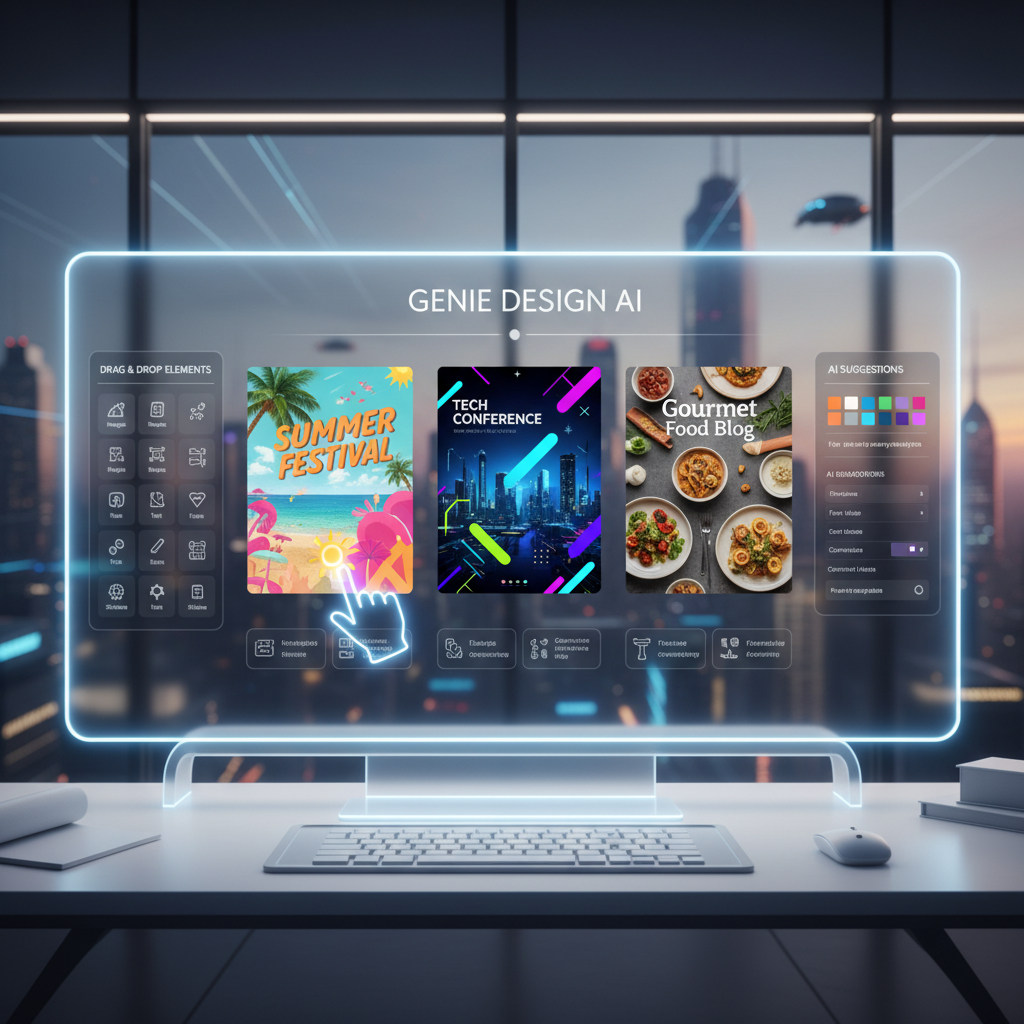
- Overview: Canva, the popular online graphic design tool, has integrated its own generative AI features under the “Magic Media” umbrella, including text-to-image and text-to-video.
- Accessibility for Beginners: Extremely high. If you can use Canva, you can use Magic Media. It’s designed to be instantly understandable and functional within the drag-and-drop design environment.
- Strengths:
- Seamless Integration: Directly built into the Canva design workflow, allowing users to generate images and immediately incorporate them into presentations, social media posts, or other designs.
- Simplicity: Minimal options, focusing on ease of use rather than extensive control.
- Quick Content Creation: Perfect for generating quick placeholder images, unique icons, or background elements for design projects.
- Wide User Base: Accessible to millions of existing Canva users without learning a new platform.
- Limitations:
- Limited Control: Offers the least amount of granular control over image generation compared to the other tools mentioned.
- Variable Quality: While improving, the output quality might not consistently match the artistic fidelity of Midjourney or the customizability of Stable Diffusion.
- Generic Outputs: Can sometimes produce more generic-looking images due to the simpler prompting and fewer style options.
- Best For: Non-designers and small business owners who primarily use Canva for their design needs and want to quickly add unique AI-generated elements without leaving the platform.
Mastering Prompt Engineering: Your Key to AI Art
Think of prompt engineering as having a conversation with a highly creative, yet literal, assistant. The better you articulate your vision, the more accurately it will be translated into an image. It’s a skill that develops with practice, but understanding the core components will give you a significant head start.
1. Be Descriptive and Specific
Avoid vague terms. Instead of “a forest,” try “a dense, ancient redwood forest at dusk, with mist rising from the undergrowth, sunbeams piercing through the canopy.” Add sensory details, emotions, and atmosphere.
2. Define the Subject
Clearly state the main subject of your image. Include details about its appearance, action, and any specific characteristics. For example, “a grizzled pirate captain with a feathered hat and a parrot on his shoulder, laughing heartily.”
3. Specify the Style
This is where you can dramatically influence the outcome. Use keywords related to art movements, artistic mediums, or even specific artists.
- Art Movements: “Impressionist painting,” “Surrealism,” “Art Deco,” “Cyberpunk.”
- Mediums: “Oil painting,” “watercolor,” “charcoal sketch,” “digital art,” “photorealistic,” “3D render,” “pixel art.”
- Artists: “by Van Gogh,” “in the style of Hayao Miyazaki,” “inspired by Zdzisław Beksiński.”
- Aesthetics: “Steampunk,” “Gothic,” “minimalist,” “dreamy,” “futuristic.”
4. Control Composition and Perspective
Guide the AI on how the scene should be framed.
- Camera Angles: “Close-up,” “wide shot,” “aerial view,” “worm’s-eye view,” “dutch angle.”
- Composition: “Rule of thirds,” “leading lines,” “symmetrical composition.”
- Depth: “Shallow depth of field,” “bokeh background.”
5. Light and Color
Lighting can completely change the mood of an image.
- Lighting Types: “Golden hour,” “blue hour,” “moonlight,” “neon glow,” “dramatic volumetric lighting,” “studio lighting.”
- Color Palettes: “Monochromatic,” “vibrant colors,” “muted tones,” “pastel palette,” “sepia.”
6. Add Quality Modifiers
These terms help refine the technical quality and detail.
- “High detail,” “8k,” “4k,” “highly intricate,” “hyperrealistic,” “photorealistic,” “masterpiece,” “award-winning,” “trending on ArtStation.”
7. Use Negative Prompts (or “Undesired Content”)
Many tools allow you to specify what you don’t want to see in the image. This is incredibly powerful for refining results and eliminating common AI artifacts. Common negative prompts include: “deformed, blurry, ugly, disfigured, poor quality, bad anatomy, extra limbs, watermark, text, out of frame.”
8. Iteration is Key
Your first prompt rarely yields the perfect image. Start with a basic idea, generate some results, then refine your prompt based on what you see. Add more detail, adjust styles, remove unwanted elements, and experiment with different keywords. It’s an iterative dance between your imagination and the AI’s interpretation.
For example, if you prompt “a dragon” and get a generic green one, you might refine it to “a fierce red dragon, scales shimmering, perched atop a volcanic peak, spewing fire, fantasy art, dramatic lighting.” Then, perhaps you realize the face isn’t quite right, so you add “close-up of dragon’s head, sharp eyes, smoke from nostrils.” Mastering this iterative process is the true art of prompt engineering.
Beyond Text-to-Image: Exploring Advanced AI Art Techniques
While text-to-image generation is the gateway to AI art, many tools offer sophisticated techniques that allow for greater artistic control, refinement, and expansion of your creative output. These advanced features blur the lines between pure generation and traditional digital art editing.
Image-to-Image Transformation
Image-to-image (img2img) allows you to use an existing image – either one you generated with AI or even a photograph – as a starting point. You then provide a new text prompt to guide the AI in transforming that image while retaining some aspects of its original composition or content. The “strength” or “denoising strength” parameter (common in Stable Diffusion tools) determines how much the AI adheres to the original image versus how much it reinterprets it based on the new prompt.
- Style Transfer: Apply the style of one image (or a textual description of a style) to the content of another. Imagine turning a photograph of your cat into an oil painting in the style of Van Gogh.
- Variations: Generate multiple stylistic or compositional variations of an existing image, exploring different interpretations of the same core idea.
- Sketch-to-Image: Start with a simple sketch or doodle, then use a descriptive prompt to turn it into a fully rendered, detailed image. This is a powerful tool for concept artists.
Inpainting and Outpainting
These techniques are like magic wands for editing and expanding your AI art, or even your own photos.
- Inpainting: This involves selectively editing a specific area within an image. You mask off a portion of the image and then provide a prompt describing what you want to appear in that masked area. The AI will intelligently fill in the space, matching the surrounding context. Need to add a hat to your character? Inpaint it! Want to remove an unwanted object? Mask it and prompt for “empty space” or “seamless background.”
- Outpainting: The opposite of inpainting, outpainting allows you to extend the canvas beyond the original image boundaries. You select an area outside the existing image and the AI generates new content to seamlessly expand the scene. This is fantastic for creating wider landscapes, adding more context to a portrait, or simply experimenting with larger compositions.
ControlNet (Primarily Stable Diffusion)
ControlNet is a groundbreaking neural network structure that provides unprecedented control over generative models like Stable Diffusion. Instead of relying solely on text prompts, ControlNet allows you to feed the AI an additional input image that dictates specific aspects of the output, such as pose, depth, or edge detection. This is a game-changer for artists who need precise compositional control.
- Pose Estimation (OpenPose): Provide a stick-figure image or a photo with estimated human poses, and the AI will generate a new image with a character in that exact pose, guided by your text prompt.
- Canny Edge Detection: Feed the AI a black-and-white image highlighting the edges of objects, and it will generate a new image respecting those edges, while filling in the details based on your prompt. Perfect for coloring line art or creating consistent outlines.
- Depth Maps: Use a depth map (an image where brightness indicates distance) to guide the AI on the 3D structure and perspective of the scene.
- Segmentation Maps: Provide a map indicating different object categories (e.g., sky, tree, person), and the AI will generate an image with those elements in their specified locations.
While ControlNet requires a bit more technical understanding and is often found in more advanced Stable Diffusion UIs (like Automatic1111 or ComfyUI), its capabilities are slowly being integrated into more user-friendly platforms, making precise AI art creation accessible to a wider audience.
Upscaling and Refinement
Many initial AI generations are not at a very high resolution. Upscaling tools, often built into the AI platforms themselves or available as standalone services, use AI to intelligently increase the resolution of an image without losing detail, and sometimes even adding more. Furthermore, some platforms offer refinement steps where the AI can enhance details, sharpen features, or add subtle textures to an already generated image, elevating its quality to a professional standard.
By exploring these advanced techniques, beginners can quickly move beyond simple prompt-to-image generation and engage in a more interactive, controlled, and artistically fulfilling creative process with AI.
Ethical Considerations and the Future of AI Art
As AI art rapidly evolves, so too do the ethical questions and societal implications surrounding it. Understanding these aspects is crucial for any responsible AI artist or enthusiast.
Copyright and Ownership
One of the most debated topics is copyright. Who owns the AI-generated art? Is it the user who created the prompt, the company that developed the AI model, or the artists whose works were used in the training data? Currently, legal frameworks are still catching up. In the US, the Copyright Office has stated that AI-generated works without human authorship are not copyrightable, but works where AI is merely a tool under significant human creative control might be. Other countries have different interpretations. This ambiguity can be challenging for artists looking to commercialize their work.
Training Data and Artist Compensation
Most powerful AI art models are trained on massive datasets scraped from the internet, which often include copyrighted works by human artists without their explicit consent or compensation. This raises concerns about exploitation, devaluing human art, and fair use. Some artists are actively protesting this, while companies like Adobe Firefly are taking steps to train their models on ethically sourced data (Adobe Stock, public domain, or licensed content) and even exploring compensation models for contributors to their training data.
The Definition of “Art” and Human Creativity
The rise of AI art has sparked philosophical debates about the very definition of art. If a machine can create stunning visuals from a few words, does it diminish the value of human skill and creativity? Many argue that AI is a tool, much like a camera or a Photoshop brush, and the true art lies in the human’s ability to conceptualize, prompt, and refine the AI’s output. It shifts the focus from manual execution to conceptualization and curation. AI becomes a collaborator, augmenting human creativity rather than replacing it.
Deepfakes and Misinformation
The ability of AI to generate highly realistic images also carries the risk of misuse, particularly in creating deepfakes or spreading misinformation. Manipulated images can be used to impersonate individuals, create propaganda, or sow discord. Developing robust detection methods and promoting media literacy are crucial countermeasures.
The Future of Creative Professions
Will AI replace artists, designers, and illustrators? Most experts believe that AI will transform rather than replace these roles. Artists who embrace AI as a tool can become more efficient, experiment with new styles, and take on more projects. The demand will likely shift towards artists who can effectively leverage AI, master prompt engineering, and integrate AI into their creative workflows, focusing on concept development, curation, and adding a unique human touch.
The future of AI art is dynamic and promises even more sophisticated tools and integration. As beginners step into this realm, an awareness of these ethical considerations ensures they contribute to a responsible and equitable development of this powerful technology.
Comparison Tables
Table 1: Comparison of Popular Beginner-Friendly AI Art Tools
| Tool Name | Ease of Use for Beginners | Primary Strengths | Key Limitations | Cost Model (Approx.) | Best For |
|---|---|---|---|---|---|
| DALL-E 3 (via ChatGPT/Copilot) | Very High (Conversational) | Complex prompt understanding, natural language interface, text rendering, coherence. | Less direct artistic control, default aesthetic, potentially subscription-gated. | Free (Copilot basic), Subscription (ChatGPT Plus) | Quick, accurate concept art; users preferring conversational interaction; content creators. |
| Midjourney | Moderate (Discord-based) | High artistic quality, unique aesthetic, rapid variations, strong community. | Discord interface, no free trial for new users, learning curve for advanced control. | Subscription-only (starts ~$10/month) | Artists and designers prioritizing high aesthetic quality; users comfortable with Discord; seeking inspiration. |
| Stable Diffusion (e.g., Leonardo.ai, Playground AI) | High (Web UIs) to Low (Local) | Max customization, vast model ecosystem, advanced features (img2img, inpaint, ControlNet), generous free tiers. | Can be overwhelming with options, quality varies by model, local setup is technical. | Free tiers available, various subscription plans for credits | Users wanting maximum control and customization; exploring niche styles; budget-conscious creators. |
| Adobe Firefly | High (Web/Adobe Integration) | Ethically sourced training data, Adobe CC integration, good for design elements, text effects. | General aesthetic may be less “artistic” than Midjourney, features still evolving. | Free tier, Subscription (Adobe Creative Cloud) | Graphic designers, marketers, existing Adobe users; commercial-safe use. |
| Canva’s Magic Media | Extremely High (Integrated) | Seamless integration into Canva workflow, ultimate simplicity, quick content creation. | Very limited control, quality can be variable, generic outputs. | Free basic use, Subscription (Canva Pro) | Non-designers, small businesses using Canva, quick placeholder images, social media content. |
Table 2: Key Prompt Engineering Elements and Their Impact
| Element Type | Description | Example Keywords/Phrases | Impact on Output |
|---|---|---|---|
| Subject & Scene | What is in the image? Specific details about characters, objects, and environment. | “A fierce dragon,” “elderly wizard,” “serene mountain lake,” “bustling cyberpunk city.” | Defines the core content, characters, and setting of the image. |
| Style & Medium | How should the image look artistically? Influences visual aesthetic and technique. | “Oil painting,” “photorealistic,” “watercolor,” “cyberpunk art,” “by Studio Ghibli,” “pixel art.” | Determines the overall artistic style, texture, and visual fidelity. |
| Lighting & Atmosphere | Sets the mood and visual tone of the scene. | “Golden hour,” “dramatic volumetric lighting,” “neon glow,” “soft ambient light,” “eerie,” “dreamy.” | Controls shadows, highlights, color temperature, and emotional feel. |
| Composition & Camera | Dictates the framing, perspective, and arrangement of elements. | “Wide shot,” “close-up portrait,” “aerial view,” “Dutch angle,” “rule of thirds,” “symmetrical.” | Shapes the layout, perspective, and visual balance within the image. |
| Quality Modifiers | Keywords to enhance the perceived technical quality and detail. | “8k,” “ultra detailed,” “masterpiece,” “intricate,” “award-winning,” “trending on ArtStation.” | Improves resolution, complexity of details, and overall professional appearance. |
| Negative Prompts | Specifies elements or characteristics to avoid in the generation. | “Deformed,” “blurry,” “ugly,” “bad anatomy,” “extra limbs,” “watermark,” “text.” | Helps eliminate unwanted artifacts, improve realism, and refine specific features. |
Practical Examples: Real-World Use Cases and Scenarios
The versatility of AI art extends far beyond simple novelty. From individual hobbyists to large enterprises, generative AI tools are finding practical applications across a multitude of industries and creative endeavors. Here are a few real-world scenarios where AI art can be truly transformative:
1. Content Creation for Blogs and Social Media
Scenario: A small business owner runs a blog and several social media channels, but lacks the budget for a dedicated graphic designer. They need unique, eye-catching visuals to accompany their articles and posts.
AI Solution: Using DALL-E 3 via Copilot, they can quickly generate highly relevant images for each blog post. For an article on “The Future of Remote Work,” they might prompt: “A futuristic office setup with holographic screens, a person comfortably working from a scenic balcony overlooking a bustling city, digital art, vibrant colors, optimistic mood.” For social media, they could use Canva’s Magic Media to create quick, branded graphics with AI-generated elements, ensuring visual consistency and engagement without external design help.
2. Game Development and Concept Art
Scenario: An independent game developer is prototyping a new fantasy RPG. They need hundreds of unique concept art pieces for characters, creatures, environments, and items, but their art team is small and time is limited.
AI Solution: Midjourney or Stable Diffusion (e.g., Leonardo.ai) become invaluable. For character designs, they can start with prompts like: “Elven archer, stealthy pose, ancient forest background, detailed armor, fantasy art, cinematic lighting, by Frank Frazetta.” Then, using image-to-image or variations, they can generate dozens of iterations of the same character or creature, exploring different armor styles, facial features, or poses. Stable Diffusion’s ControlNet can even help maintain consistent character poses across different scenes, dramatically accelerating the concept art phase.
3. Graphic Design and Marketing Materials
Scenario: A marketing agency needs to create a series of advertisements for a new eco-friendly product. They require unique visual assets, banner designs, and compelling text overlays that reflect the brand’s aesthetic.
AI Solution: Adobe Firefly is ideal here due to its ethical training and integration with Adobe Creative Cloud. They can use Firefly to generate custom product mockups, unique background textures, or vector elements (like “sustainable energy icon, flat design, green and blue palette“). Firefly’s text effects feature allows them to quickly generate stylized text for headlines (“glowing green text, natural leaf texture, for ‘Green Future’“), which can then be seamlessly integrated into Photoshop or Illustrator for final composition, ensuring commercial viability and speed.
4. Architecture and Interior Design Visualization
Scenario: An architect wants to quickly visualize different material palettes and furniture arrangements for a client’s living room design, or explore various exterior landscaping options for a building.
AI Solution: Using Stable Diffusion with image-to-image or inpainting, they can upload a basic 3D render or even a sketch of the space. They might prompt: “Modern living room, floor-to-ceiling windows, minimalist design, concrete walls, plush velvet sofa, natural light, Scandinavian aesthetic.” They can then iterate by changing “concrete walls” to “warm wooden panels” or “plush velvet sofa” to “sleek leather sectional,” instantly generating new visualizations to present to the client, saving hours of manual rendering.
5. Personalized Gifts and Merchandise
Scenario: An individual wants to create a truly unique, personalized gift for a friend who loves cats and sci-fi, or design custom T-shirts for a local club.
AI Solution: Midjourney or DALL-E 3 are perfect for this. For the friend, they might prompt: “A fluffy tabby cat wearing an astronaut helmet, floating in space surrounded by nebulae and distant planets, highly detailed, whimsical, digital painting.” The resulting high-quality image can then be printed on a mug, canvas, or T-shirt. For the club merchandise, they could generate various logo ideas or mascots based on themes and styles, providing a unique and cost-effective way to create custom apparel.
These examples highlight how AI art tools are not just generating pretty pictures; they are becoming indispensable accelerators for creativity, ideation, and production across diverse fields. For beginners, this means a lower barrier to entry for realizing complex visual concepts and a powerful new ally in their creative endeavors.
Frequently Asked Questions
Q: What is AI art, and how is it different from traditional digital art?
A: AI art refers to images, videos, or other media generated by artificial intelligence models based on text prompts or other input. The key difference from traditional digital art is that the AI algorithm creates the image autonomously from your instructions, rather than you manually painting, drawing, or manipulating pixels with software like Photoshop or Procreate. While traditional digital artists have full control over every stroke, AI art relies on your ability to “prompt engineer” and guide the AI’s creative process.
Q: Do I need to be a coder or an artist to create AI art?
A: Absolutely not! The beauty of today’s AI art tools is their user-friendliness. You don’t need any coding knowledge, and while an artistic eye helps in crafting prompts and refining results, you certainly don’t need traditional art skills. Many platforms allow you to simply type a description, and the AI does the rest. It democratizes art creation for everyone.
Q: Is AI art truly “art”?
A: This is a widely debated philosophical question. Many argue that if art is about expression, intent, and evoking emotion, then AI-generated images, guided by human prompts and refined by human choices, can indeed be considered art. The AI acts as a sophisticated tool, much like a camera or a synthesizer. The “art” then lies in the human’s vision, creativity, and skill in using the tool, rather than purely in manual execution. It shifts the focus from the hand to the mind.
Q: Is AI art free to use?
A: Many AI art tools offer free tiers or trials, but these often come with limitations on usage, resolution, or access to advanced features. For more extensive or commercial use, most platforms like Midjourney, DALL-E 3 (via ChatGPT Plus), Stable Diffusion (via advanced platforms), and Adobe Firefly operate on a subscription or credit-based model. Free options like Microsoft Copilot (for DALL-E 3) or generous free tiers on Leonardo.ai exist but might have daily limits.
Q: Can I sell AI-generated art? What about copyright?
A: This is a complex and evolving legal area. Many platforms allow you to sell art generated with a paid subscription (e.g., Midjourney, DALL-E 3, Adobe Firefly with their ethical training). However, copyright laws vary by country. In the U.S., purely AI-generated works without significant human creative input are currently not eligible for copyright protection. If your AI art involves substantial human modification or specific creative direction, it might be. Always check the terms of service for the specific AI tool you are using and consult legal advice if you plan to commercialize seriously.
Q: How do I avoid creating generic-looking AI art?
A: The key is detailed and creative prompt engineering. Go beyond simple descriptions. Specify unique styles, artists, lighting, composition, mood, and even obscure details. Experiment with blending different concepts, use negative prompts to remove unwanted elements, and iterate on your prompts. The more unique and specific your vision, the less generic your output will be. Think of the AI as a highly literal assistant; the more context you give it, the better it understands your specific desires.
Q: What is “prompt engineering” and why is it important?
A: Prompt engineering is the art and science of crafting effective text commands (prompts) to guide an AI model to generate desired images. It’s crucial because the quality and relevance of the AI’s output are directly proportional to the clarity, specificity, and creativity of your prompt. Mastering prompt engineering allows you to move from generic images to highly specific, artistic, and nuanced visual creations, turning the AI from a simple generator into a powerful artistic collaborator.
Q: What are “negative prompts” and how do they help?
A: Negative prompts are instructions given to the AI about what you explicitly *don’t* want to see in the generated image. They are incredibly useful for refining outputs and eliminating common AI artifacts or undesirable features. For example, if your AI often generates images with distorted faces, you could include “bad anatomy, ugly, deformed, extra limbs” in your negative prompt. This helps the AI understand boundaries and produce cleaner, more consistent results.
Q: Can AI art mimic specific artists’ styles? Is that ethical?
A: Yes, AI models can often mimic specific artists’ styles, as they’ve learned patterns from vast datasets that include their work. While technically possible, the ethics are debated. Some consider it derivative or even disrespectful to the original artist, especially if their work was used in training without consent. Others view it as a homage or a new form of appropriation. From a legal standpoint, directly copying an artist’s signature style for commercial gain might lead to copyright or intellectual property disputes, depending on jurisdiction and the degree of similarity.
Q: How do I choose the right AI art tool for my needs as a beginner?
A: Consider your priorities:
- For ultimate simplicity and conversational interaction: DALL-E 3 (via ChatGPT Plus or Copilot).
- For high artistic quality and unique aesthetic, if you’re comfortable with Discord: Midjourney.
- For maximum control, customization, and free options (with a slight learning curve): Stable Diffusion on web platforms like Leonardo.ai or Playground AI.
- For commercial use and integration with design workflows, with ethical sourcing: Adobe Firefly.
- For quick visuals directly within a design tool: Canva’s Magic Media.
Start with a free trial or tier, experiment, and see which interface and output best align with your creative vision.
Key Takeaways
- AI art has democratized creativity, making visual generation accessible to anyone, regardless of artistic skill.
- Generative models like Diffusion Models (DALL-E, Midjourney, Stable Diffusion) are the backbone of modern AI art, turning text into stunning visuals.
- User-friendly tools like DALL-E 3, Midjourney, Stable Diffusion (via web UIs), Adobe Firefly, and Canva Magic Media offer diverse entry points for beginners.
- Prompt engineering is the crucial skill for directing AI, requiring descriptive language, style cues, lighting, composition, and negative prompts.
- Beyond basic text-to-image, advanced techniques like image-to-image, inpainting, outpainting, and ControlNet offer greater artistic control and refinement.
- Ethical considerations regarding copyright, training data, and the definition of art are vital for responsible AI art creation.
- AI acts as a powerful collaborator, augmenting human creativity and transforming creative workflows across various industries.
- Experimentation, iteration, and a willingness to learn are key to mastering AI art creation and unlocking its full potential.
Conclusion
The journey into AI art creation is an exciting exploration of imagination and technology. As we’ve seen, the tools available today are more powerful and accessible than ever before, empowering beginners to translate abstract ideas into tangible, captivating visuals with surprising ease. From the conversational prowess of DALL-E 3 to the artistic finesse of Midjourney, the customizable depth of Stable Diffusion, the ethical design focus of Adobe Firefly, and the integrated simplicity of Canva’s Magic Media, there is a tool perfectly suited to every creative aspiration.
Remember, the AI is a sophisticated brush, but your imagination is the artist. Mastering prompt engineering is your key to unlocking its full potential, transforming vague concepts into intricate masterpieces. Embrace the iterative process, experiment fearlessly, and don’t shy away from exploring the advanced techniques that can elevate your creations to new heights. While ethical considerations remain a crucial dialogue, the overwhelming potential of AI to augment human creativity and foster new forms of artistic expression is undeniable.
The barrier to entry for creating breathtaking art has never been lower. So, take the leap. Dive into these essential generative tools, let your ideas flow freely, and witness your artistic styles come to life in ways you never thought possible. The future of art is here, and it’s inviting you to be a part of it. Start your effortless AI art creation journey today!


















Leave a Reply