
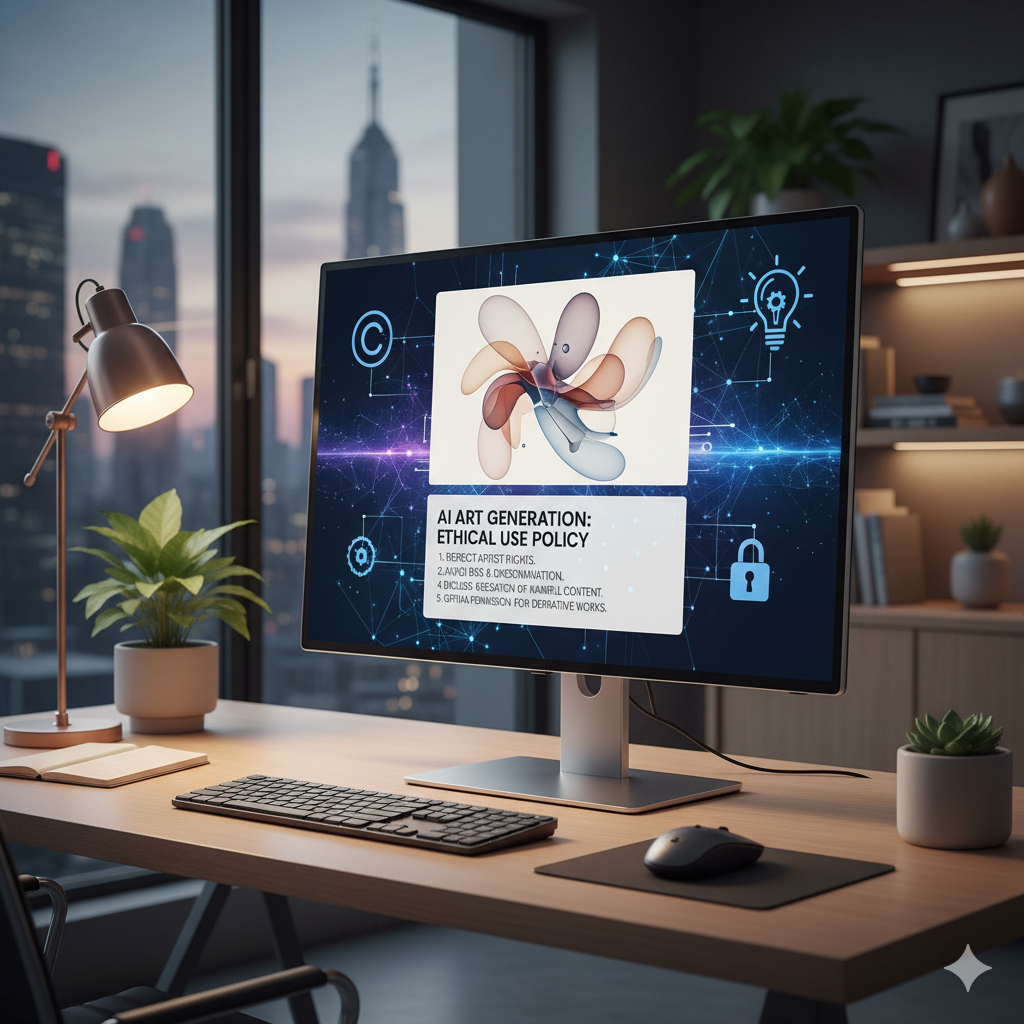
In the rapidly evolving landscape of digital creation, Artificial Intelligence (AI) has emerged as a transformative force, revolutionizing how art is conceived, produced, and consumed. AI image generation tools, once confined to academic research, are now accessible to anyone with an internet connection, empowering individuals to create stunning visuals with unprecedented ease and speed. From breathtaking landscapes to abstract masterpieces, AI can conjure nearly any image imaginable from a simple text prompt. This technological marvel, however, comes with a labyrinthine set of ethical, legal, and practical challenges, particularly concerning intellectual property (IP) and copyright. For digital creators, understanding these complexities is not merely advantageous; it is absolutely essential for responsible creation and self-protection.
The intersection of AI and art throws traditional copyright law into a state of flux. Who owns the copyright to an image generated by an AI? Is the AI itself an author, or is it merely a tool? What constitutes infringement when an AI model is trained on millions of existing copyrighted works? These are not hypothetical questions but pressing concerns that artists, developers, lawyers, and policymakers are grappling with right now. Recent legal battles and evolving stances from copyright offices worldwide underscore the urgency of these discussions.
This comprehensive guide aims to demystify the complex world of intellectual property and copyright in AI-generated art. We will explore the fundamental principles of copyright, delve into the hotly debated issue of AI authorship, examine the implications of AI training data, and provide practical strategies for creators to navigate this new frontier responsibly. Whether you are an artist experimenting with AI tools, a designer incorporating AI elements into your workflow, or simply curious about the future of creativity, this article will equip you with the essential rules and insights needed for ethical engagement with AI-generated art. Prepare to embark on a journey through the legal and ethical considerations that are reshaping the very definition of creativity in the digital age.
The Rise of AI-Generated Art and its Legal Quagmire
The proliferation of sophisticated AI image generation models like Midjourney, DALL-E 3, Stable Diffusion, and Adobe Firefly has ushered in an era where high-quality visual content can be created almost instantly. These tools leverage deep learning algorithms, particularly generative adversarial networks (GANs) and diffusion models, to synthesize novel images based on text prompts, existing images, or a combination thereof. The artistic outputs range from photorealistic depictions to highly stylized illustrations, pushing the boundaries of what was previously possible for individual creators. This technological leap has democratized art creation, allowing individuals without traditional artistic training to produce compelling visuals, while also empowering professional artists to augment their creative processes.
However, this rapid advancement has outpaced the development of legal frameworks designed to govern such creations. Traditional copyright law, largely conceived in an era of human-centric creation, struggles to accommodate the nuances of AI involvement. The core tenets of copyright – originality, human authorship, and fixation – are challenged when an AI system plays a significant, or even primary, role in generating an artwork. This creates a legal quagmire where ownership, attribution, and infringement become incredibly difficult to determine. The lack of clear legal precedent and the ongoing evolution of both the technology and legislative discussions contribute to a significant degree of uncertainty for all stakeholders.
One of the central debates revolves around the concept of authorship. If an AI generates an image, is the human who provided the prompt the author? Is the company that developed the AI model the author? Or, more controversially, can an AI itself be considered an author? Different jurisdictions and legal scholars are proposing various answers, leading to a patchwork of interpretations that can be confusing for global digital creators. Moreover, the vast datasets used to train these AI models often consist of billions of images scraped from the internet, many of which are copyrighted. This raises serious questions about whether the training process itself constitutes copyright infringement, and whether the outputs generated by such models carry a risk of derivative infringement.
The speed at which these issues have surfaced has caught many off guard. What began as a fascinating technological experiment has quickly evolved into a critical legal and ethical challenge that requires thoughtful consideration and proactive measures from creators and policymakers alike. Understanding the current state of this legal quagmire is the first step toward navigating it responsibly.
Fundamental Copyright Principles and AI
To understand the challenges posed by AI-generated art, it is crucial to revisit the fundamental principles of copyright law. Copyright is a form of intellectual property that grants the creator of an original work of authorship an exclusive legal right to determine whether, and under what conditions, their original work may be used by others. Key elements of copyright include:
- Originality: The work must be independently created by a human author and possess at least a minimal degree of creativity. It does not need to be novel or unique, just not copied from another source.
- Authorship: Traditionally, copyright vests in a human author. This is a cornerstone principle in most jurisdictions, including the United States, the European Union, and the United Kingdom.
- Fixation: The work must be fixed in a tangible medium of expression, meaning it must exist in a form that can be perceived, reproduced, or otherwise communicated. For digital art, this includes files stored on a computer.
The advent of AI-generated art fundamentally challenges the principles of originality and, most significantly, human authorship. When an AI system, rather than a human hand or mind, directly produces an image, the concept of a “human author” becomes ambiguous. Consider the following scenarios:
- Scenario 1: Purely AI-Generated Work: An AI system, given a high-level command like “create an abstract painting in the style of Kandinsky,” generates an image without specific human creative input beyond the initial prompt. Who is the author?
- Scenario 2: AI-Assisted Work: A human artist uses AI tools as a brush or filter, making significant creative decisions and modifications to the AI’s output. Here, the human artist’s input is clear, but the AI’s contribution is also substantial.
- Scenario 3: AI Training Data: An AI model is trained on millions of existing images, including copyrighted works. Does the AI “learn” styles and elements, or does it “copy” them in a transformative way?
Most copyright offices around the world currently maintain that copyright protection requires human authorship. For instance, the U.S. Copyright Office has explicitly stated that it will not register works produced solely by AI without human creative input. Their guidelines suggest that for a work incorporating AI-generated material to be registrable, a human must have significantly contributed to the work beyond merely providing a prompt, such as by arranging, modifying, or creatively selecting AI-generated elements. This stance aligns with the traditional view that copyright aims to incentivize human creativity.
However, this interpretation creates practical difficulties. What level of human input is “significant”? Is a highly detailed prompt sufficient? What if an artist iteratively refines a prompt over hundreds of generations, making complex aesthetic choices? The lines blur rapidly, making it challenging for creators to ascertain the copyright status of their AI-assisted or AI-generated works. Moreover, without clear copyright protection, creators may struggle to defend their AI-generated outputs against unauthorized use, potentially stifling innovation rather than fostering it.
Understanding these fundamental principles and how they interact with AI is the bedrock upon which responsible creation must be built. The current legal landscape is characterized by uncertainty, demanding vigilance and careful consideration from all digital creators.
Who Owns AI-Generated Art? The Authorship Debate
The question of ownership in AI-generated art is perhaps the most contentious and legally complex issue facing digital creators today. Traditional copyright law unequivocally states that copyright vests in the human creator of an original work. With AI, identifying that human creator, or even if one exists in the traditional sense, becomes a monumental challenge. Several parties could potentially lay claim to authorship or ownership, each with their own legal arguments.
The Human Creator (Prompt Engineer)
Many argue that the human user who crafts the prompt and directs the AI’s output should be considered the author. This perspective posits that the AI is merely a tool, akin to a paintbrush or a camera, and the creative decisions inherent in crafting an effective prompt – selecting styles, subjects, moods, and refining iterations – constitute the necessary creative spark. A sophisticated prompt engineer might spend hours, even days, iterating on prompts, curating outputs, and making artistic choices that guide the AI towards a desired vision. From this viewpoint, the human’s intellectual contribution and artistic intent are paramount, much like a photographer’s choices of framing, lighting, and composition make them the author of a photograph, not the camera manufacturer.
However, critics counter that the “creativity” in prompting is often limited to textual instructions, and the AI itself performs the bulk of the creative synthesis. If the prompt is too generic, or if the AI output is largely unpredictable and unique to the AI’s internal processes, can the human truly claim authorship over something they did not directly “create” in a traditional sense? The level of control and predictability over the AI’s output is a critical factor here. If the AI is highly deterministic, responding precisely to specific inputs, the human’s claim to authorship might be stronger. If the AI is more autonomous and generates unexpected results, the claim becomes weaker.
The AI Developer (Model Owner)
Another perspective suggests that the company or individual who developed and trained the AI model should hold some form of ownership or intellectual property rights. This argument is based on the significant investment in research, development, data acquisition, and computational resources required to build and maintain these sophisticated AI systems. Without the underlying AI model, the art would not exist. Therefore, the developers’ creative and technical contributions are foundational.
However, granting full copyright to the AI developer for every output generated by their model could stifle creativity and create a monopoly on AI art. Furthermore, the outputs are often distinct from the AI model itself, and direct copyright over the output would typically require direct creative input into that specific work, not just the tool. Most AI developers prefer to license their models or assert ownership through their terms of service, rather than claiming authorship of every generated image.
The Training Data Provider
A more complex argument involves the artists and creators whose works were used to train the AI model. Many AI models are trained on massive datasets scraped from the internet, often without the explicit consent or compensation of the original creators. If the AI’s output is seen as a derivative work or heavily influenced by the styles and content of the training data, then the original artists whose work forms the foundation of the AI’s “knowledge” could argue for a claim. This perspective underpins many of the ongoing lawsuits against AI companies.
While the training data is undoubtedly crucial, current copyright law generally does not grant ownership of an output based on the input data alone, unless the output is a direct copy or a substantially similar derivative work. The transformation argument – that the AI transforms the input data into something new – is central to defending the legality of training. Nevertheless, the ethical implications of using copyrighted works without consent remain a significant concern.
Current Legal Stances and Interpretations
The U.S. Copyright Office (USCO) has provided some of the clearest guidance on this matter. They emphasize that copyright protection extends only to the creative contributions of a human author. While works containing AI-generated material may be registrable, the human author must “select, arrange, or otherwise modify the AI-generated material in a sufficiently creative way that the resulting work as a whole constitutes an original work of human authorship.” Simply providing a text prompt is generally not enough. This stance effectively denies copyright to purely AI-generated works where human creative input is minimal.
Other jurisdictions are still debating these issues. The EU, for example, is exploring various options, including potential new intellectual property rights for AI-generated works that might not meet traditional human authorship criteria. The UK’s Intellectual Property Office has also acknowledged the complexity, suggesting that existing laws might need adaptation or new legislative solutions. This global divergence creates a challenging environment for creators who operate across borders.
In essence, for creators seeking copyright protection for their AI-generated art, the current consensus leans heavily towards demonstrating significant human creative involvement in the iterative process, selection, arrangement, or modification of the AI’s outputs. The less a human intervenes creatively, the less likely the work is to qualify for traditional copyright protection.
Copyright Infringement by AI Models: Training Data Issues
Beyond the authorship debate, one of the most pressing legal challenges surrounding AI-generated art is the issue of copyright infringement related to the training data used to build these models. Generative AI models, especially large language models (LLMs) and diffusion models, are trained on colossal datasets often comprising billions of images, texts, and other media scraped from the internet. A significant portion of this data is copyrighted material, collected without explicit consent or compensation to the original creators.
The “Fair Use” or “Fair Dealing” Defense
AI companies often argue that the use of copyrighted material for training constitutes “fair use” in the United States or “fair dealing” in other common law jurisdictions like the UK, Australia, and Canada. These doctrines provide exceptions to copyright infringement under certain conditions. In the U.S., fair use is determined by four factors:
- The purpose and character of the use (e.g., commercial vs. non-profit educational; transformative vs. reproductive).
- The nature of the copyrighted work.
- The amount and substantiality of the portion used in relation to the copyrighted work as a whole.
- The effect of the use upon the potential market for or value of the copyrighted work.
AI companies typically argue that training an AI model is a highly transformative use, as the model “learns” concepts, styles, and patterns rather than simply reproducing the original works. They contend that the input data is ingested to build a statistical model, not to create copies for direct consumption. Furthermore, they argue that the training process does not directly compete with the market for the original works.
Arguments Against Fair Use
Artists and copyright holders, however, strongly dispute the fair use claim. Their arguments typically center on:
- Commercial Use: Many AI models are developed by commercial entities and result in commercial products, weakening the fair use argument which often favors non-commercial or educational uses.
- Harm to Market: They argue that AI-generated art, especially if it mimics specific artists’ styles, can directly compete with and devalue the market for human-created art. If a client can get a “Picasso-style” image from an AI for a fraction of the cost, it directly impacts Picasso’s estate or artists working in similar styles.
- Non-Consensual Use: The fundamental objection is that artists’ works are being used to train a system that directly profits from their labor without their permission or compensation. This is seen by many as a form of digital expropriation.
- Output Similarity: In some cases, AI outputs have been shown to reproduce or highly resemble specific copyrighted images from the training data, raising direct infringement concerns.
Ongoing Lawsuits and Legal Developments
The debate is no longer purely academic. Several high-profile lawsuits have been filed against major AI art generators:
- Getty Images vs. Stability AI: Getty Images sued Stability AI, alleging that the company unlawfully copied and processed millions of its copyrighted images to train the Stable Diffusion model. Getty claimed direct infringement, trademark infringement, and unfair competition.
- Artists’ Class Action Lawsuits: Artists Sarah Andersen, Kelly McKernan, and Karla Ortiz filed a class-action lawsuit against Stability AI, Midjourney, and DeviantArt, alleging direct copyright infringement from the training data and derivative infringement from outputs that closely mimic their styles.
- New York Times vs. OpenAI/Microsoft: The New York Times sued OpenAI and Microsoft, alleging copyright infringement of its news articles used to train AI models, which then allegedly generate content that competes with the Times’ offerings.
These lawsuits are critical and could set precedents for how copyrighted material can be used in AI training. The outcomes will likely influence future AI development, licensing models, and potentially lead to new legislative actions. Some jurisdictions, like the EU, are exploring explicit “text and data mining” exceptions for AI training, but often with conditions, such as allowing copyright holders to “opt-out” their works from being used for training.
For digital creators, this means two things: firstly, be aware that the AI tools you use might be embroiled in legal disputes over their training data, which could affect their long-term viability or the legal status of your outputs. Secondly, if you are an artist whose work could be used in training datasets, understand your rights and explore any opt-out mechanisms offered by platforms or proposed by legislation to protect your intellectual property.
Licensing and Commercialization of AI Art
The commercialization of AI-generated art introduces another layer of complexity, particularly concerning licensing agreements and the terms of service (ToS) of the AI tools themselves. While the legal copyright status of purely AI-generated art remains murky, the practical reality is that many creators wish to use AI tools for commercial purposes, from generating marketing materials and book covers to selling prints and digital assets.
Terms of Service (ToS) of AI Art Tools
Crucially, the immediate “ownership” or commercial rights over AI-generated outputs often depend more on the specific terms of service of the AI model provider than on traditional copyright law. These ToS vary significantly between platforms:
- User Ownership: Many popular AI art platforms, such as Midjourney (for paid subscribers) and DALL-E 3 (OpenAI), explicitly state that users own the images they create with the tool, subject to compliance with their policies. This generally means you can use the images for personal or commercial purposes without requiring further permission from the AI developer.
- Developer Rights: Some platforms may retain a perpetual, irrevocable, worldwide, non-exclusive, royalty-free license to use, reproduce, modify, adapt, publish, and distribute any content generated on their platform, even if they grant you user ownership. This allows them to use your creations for marketing, improving their models, or other internal purposes.
- Open-Source Models: Tools based on open-source models like Stable Diffusion often come with more permissive licenses (e.g., Creative ML OpenRAIL-M license). These generally allow for broad commercial use and modification, provided you adhere to the specific terms of the open-source license, which may include attribution or ensuring ethical use.
- Free vs. Paid Tiers: Some services differentiate between free and paid tiers. Free users might have stricter commercial restrictions, such as non-commercial use only, while paid subscribers gain full commercial rights.
- Attribution Requirements: A few platforms or specific use cases might require attribution to the AI model or the platform itself.
It is absolutely essential for any digital creator to carefully read and understand the terms of service of the AI art generator they are using, especially if they intend to commercialize their outputs. Failure to comply can lead to account suspension, legal action from the platform, or the invalidation of your commercial rights.
Strategies for Commercial Use
Given the legal uncertainties surrounding copyright authorship, creators seeking to commercialize AI-generated art should adopt strategies that minimize risk:
- Significant Human Transformation: Focus on using AI as a powerful tool within a broader creative process. The more you modify, arrange, select, and creatively transform the AI’s output through traditional editing software (e.g., Photoshop, Illustrator) or by combining it with original human-created elements, the stronger your claim to human authorship and copyright protection will be. This makes the AI-generated component a “component” of a larger, human-authored work.
- Hybrid Creation: Integrate AI elements into traditional art. For example, use AI to generate concept art, textures, or background elements, and then painstakingly paint over them, adding unique details and a distinctive human artistic touch.
- Transparency: While not legally mandated in most cases, being transparent about the use of AI can build trust with your audience and clients. For certain commercial applications, disclosing AI involvement might become a best practice or even a regulatory requirement.
- Licensing from AI Companies: If your commercial project relies heavily on AI-generated content that lacks strong human authorship, consider directly licensing the content or the AI model’s output from the AI developer, if such options are available. This clarifies usage rights.
- Avoid Infringement Risks: Be mindful of prompting AI to create images “in the style of” specific, recognizable artists, especially living ones, or generating outputs that closely mimic existing copyrighted works. This increases the risk of derivative infringement claims, regardless of your platform’s ToS.
- Utilize Tools with Clear Commercial Rights: Prioritize AI tools that have explicitly clear and robust terms regarding user ownership and commercial use, particularly those that state you own the outputs for commercial purposes.
The commercial landscape for AI art is dynamic. As legal frameworks evolve and court cases establish precedents, creators will need to stay informed and adapt their practices. For now, a cautious approach emphasizing human creative input and adherence to platform ToS is the most prudent path for commercial success.
Protecting Your Original Work from AI Scrapers and Impersonation
As AI models become increasingly sophisticated, capable of generating art in specific styles or even mimicking individual artists, concerns about protecting original human-created work from AI scrapers and potential impersonation have grown exponentially. Artists rightly worry that their unique styles, developed over years, could be replicated by an AI trained on their oeuvre, potentially devaluing their craft and eroding their artistic identity. This section outlines strategies and considerations for artists to protect their intellectual property in the age of generative AI.
Understanding the Threat
The primary threat comes from AI models that have been trained on vast datasets containing copyrighted works, often without permission. When these models are prompted to generate art “in the style of” a specific artist, or when their outputs bear striking resemblance to existing works, it raises concerns about:
- Copyright Infringement: The AI output might be deemed a derivative work or a direct copy, infringing on the original artist’s rights.
- Impersonation/Passing Off: AI-generated art mimicking an artist’s style could be mistaken for their genuine work, potentially damaging their reputation or brand.
- Market Erosion: If AI can produce similar work quickly and cheaply, it could reduce demand and pricing for human artists.
Strategies for Protection
- Copyright Registration: The most fundamental step for protecting your original work is to register your copyrights in relevant jurisdictions (e.g., U.S. Copyright Office). While copyright exists from the moment of creation, registration provides stronger legal standing, allows you to sue for infringement, and can enable recovery of statutory damages and attorney’s fees.
- Opt-Out Mechanisms: Some platforms and AI developers are starting to offer “opt-out” mechanisms, allowing artists to request that their work not be included in AI training datasets. Examples include:
- ArtStation’s NoAI Tag: Following artist protests, ArtStation implemented a feature allowing artists to add a “NoAI” tag to their uploads, signaling that their work should not be used for AI training.
- DeviantArt’s ‘NoAI’ Flag: Similarly, DeviantArt introduced an ‘NoAI’ flag for its users to prevent their art from being included in training datasets for AI models.
- Adobe Firefly’s Approach: Adobe Firefly is explicitly trained on Adobe Stock content, public domain content, and licensed content, avoiding the controversial scraping of the open web. If you contribute to Adobe Stock, you are compensated if your work is used.
Actively look for and utilize such mechanisms on platforms where you share your art.
- Digital Watermarking and Metadata: While easily removable, embedding digital watermarks or specific metadata (e.g., C2PA standard for content authenticity) into your images can serve as a deterrent and provide proof of origin. Some watermarking techniques are designed to be more robust against AI model ingestion.
- Monitor and Enforce: Regularly monitor online platforms for potential unauthorized use or impersonation of your work by AI-generated content. If you find infringing material, be prepared to issue DMCA takedown notices (in the U.S.) or send cease and desist letters. Tools exist that can help artists track their images online.
- Educate and Advocate: Join artist organizations and advocacy groups that are actively lobbying for stronger artist protections in AI legislation. Collective action is proving to be a powerful force in shaping policy. Support initiatives that advocate for opt-in consent and fair compensation for artists whose work is used in AI training.
- Consider Licensing: Explore opportunities to license your work specifically for AI training, ensuring fair compensation and clear terms of use, rather than having it scraped without permission. This is an emerging area but could become a viable revenue stream.
- Blockchain and NFTs (Limited Application): While NFTs provide a record of ownership for a digital asset on a blockchain, they do not inherently protect against AI scraping of the underlying image. However, combining NFTs with other protective measures and robust licensing could play a future role in managing and tracking digital IP.
The fight against AI infringement is ongoing and complex. There is no single bulletproof solution, but a multi-faceted approach combining legal protections, technological measures, and active advocacy offers the best defense for digital creators.
Ethical Guidelines for Responsible AI Art Creation
Beyond the legal framework, the ethical dimensions of AI-generated art are equally, if not more, critical for fostering a sustainable and respectful creative ecosystem. Responsible creation in this new era requires thoughtful consideration of AI’s impact on artists, authenticity, and societal norms. Adhering to ethical guidelines is not just about avoiding legal pitfalls; it is about contributing positively to the future of art and technology.
1. Transparency and Disclosure
- Disclose AI Use: Be transparent when an artwork has been generated or significantly assisted by AI. Clearly label AI-generated components or the overall work as “AI-generated,” “AI-assisted,” or “AI augmented.” This prevents misrepresentation, manages audience expectations, and fosters an honest dialogue about the role of AI in creative processes.
- Avoid Impersonation: Never present AI-generated work as if it were entirely human-made, especially if it mimics a specific artist’s style, without clear attribution to the AI and the process. This maintains artistic integrity and avoids deceiving audiences or clients.
2. Respect for Human Artists and Training Data Sources
- Acknowledge Sources (where possible): While often technically impossible to track every source, be mindful that AI models are built upon the creative labor of countless human artists. Support initiatives that advocate for fair compensation and consent for artists whose work is used in training datasets.
- Avoid Direct Style Mimicry for Commercial Gain: Ethically, it is questionable to prompt an AI to create works “in the style of” a living artist, especially for commercial purposes, without their permission. This undermines their unique artistic identity and potential livelihood. While technically challenging to regulate, conscious avoidance is an ethical stance.
- Consider Opt-Out Preferences: Respect artists’ choices to opt out of having their work used for AI training where platforms provide such mechanisms.
3. Responsible Use of AI Tools
- Prevent Misinformation and Deepfakes: Be acutely aware of the potential for AI image generation to create realistic but fabricated images. Do not use AI to generate misleading content, promote harmful stereotypes, or create “deepfakes” that could damage reputations or spread disinformation. Prioritize factual integrity and ethical communication.
- Avoid Harmful Content: Refrain from using AI tools to generate content that is hateful, violent, discriminatory, sexually explicit (without proper consent and context), or otherwise harmful. Adhere to ethical content policies of the platforms you use.
- Promote Diversity and Inclusivity: Actively use AI to generate diverse and inclusive imagery, challenging biases that might be present in training data. Be aware that AI models can perpetuate societal biases found in their training data; consciously work against this.
4. Prioritize Human Creativity and Agency
- AI as a Tool, Not a Replacement: View AI as an enhancement to human creativity, a collaborator, or a powerful tool, rather than a substitute for human artistic input. Focus on how AI can expand your creative possibilities, not diminish the value of human skill.
- Develop Your Unique Voice: Use AI to explore new ideas and accelerate workflows, but always strive to inject your unique artistic vision and human touch into the final product. The most compelling AI art often results from a symbiotic relationship between human creativity and AI capability.
- Continuous Learning and Adaptation: The field of AI is evolving rapidly. Stay informed about new ethical guidelines, technological advancements, and community best practices to ensure your creative process remains responsible and forward-thinking.
By integrating these ethical guidelines into their creative practice, digital creators can leverage the incredible power of AI image generation while upholding the values of fairness, respect, and responsibility within the broader artistic community and society.
Emerging Legal Frameworks and Future Outlook
The legal landscape surrounding AI-generated art is not static; it is a dynamic field undergoing rapid development. Governments and international bodies worldwide are grappling with how to adapt existing intellectual property laws or formulate entirely new frameworks to address the unique challenges posed by artificial intelligence. The future outlook suggests a combination of legislative action, judicial precedents, and industry self-regulation shaping the environment for digital creators.
Legislative Efforts and Policy Discussions
- European Union’s AI Act: The EU is at the forefront of AI regulation with its proposed AI Act, which includes provisions related to intellectual property. While primarily focused on safety and fundamental rights, it addresses transparency requirements for generative AI, potentially impacting disclosure obligations for AI-generated content. There are also ongoing discussions about specific IP reforms, such as allowing opt-out mechanisms for data used in text and data mining (TDM) and potential new categories of IP rights for certain AI-generated works.
- United States Copyright Office Guidance: As discussed, the USCO has issued guidance emphasizing human authorship for copyright registration of AI-generated works. While not legislative, this guidance sets a clear administrative policy that reflects the current interpretation of existing law and signals future legislative directions. Bills have been introduced in Congress attempting to clarify AI copyright and address training data issues, though none have passed into law yet.
- United Kingdom and Other Jurisdictions: The UK’s Intellectual Property Office has engaged in consultations on AI and IP, exploring whether existing laws are sufficient or if new legislative instruments are needed. Similarly, countries like Canada, Australia, and Japan are actively reviewing their IP laws in the context of AI, with some, like Japan, historically having a more permissive stance on data use for AI training.
A common thread in these discussions is the tension between fostering AI innovation and protecting the rights of human creators. Legislators are attempting to strike a balance that supports technological progress while preventing exploitation and ensuring fair compensation.
Potential for New Categories of Intellectual Property
Some legal scholars and policymakers propose the creation of entirely new categories of intellectual property rights specifically designed for AI-generated works that do not fit neatly into traditional copyright. These could include:
- “Related Rights” or “Sui Generis” Rights: Similar to database rights, these could offer protection for AI-generated outputs based on the investment of resources in developing the AI, even if human authorship criteria are not met. This could provide a legal basis for commercializing purely AI-generated art.
- “Prompter’s Rights”: A form of limited protection for the unique and creative intellectual effort involved in crafting complex prompts, acknowledging the human input even if the output itself lacks traditional human authorship.
These concepts are still largely theoretical and face challenges in terms of definition, scope, and international harmonization. However, they indicate a recognition that existing frameworks might be insufficient for the long term.
Challenges in International Harmonization
Intellectual property laws often vary significantly between countries. As AI-generated art is inherently global, facilitated by online platforms, differing national approaches create a complex environment. A work considered copyrightable in one country might not be in another. This makes it challenging for creators to protect their rights and for AI developers to ensure compliance across all markets. International treaties and organizations like the World Intellectual Property Organization (WIPO) are beginning to address these issues, but harmonization will be a slow and arduous process.
Industry Self-Regulation and Best Practices
Beyond government action, the AI industry itself is developing best practices and ethical guidelines. This includes:
- Opt-out Mechanisms: As seen with ArtStation and DeviantArt, platforms are responding to artist concerns by providing ways to prevent their work from being used in AI training.
- Transparent Sourcing: Some AI developers, like Adobe Firefly, are proactively training their models on ethically sourced data to avoid infringement lawsuits and build trust.
- Content Authenticity Initiatives: The Coalition for Content Provenance and Authenticity (C2PA) is developing open technical standards for certifying the origin and history of digital media, which could help identify AI-generated content and combat deepfakes.
The future of AI-generated art and its legal standing will likely be a dynamic interplay of these forces. For digital creators, staying informed, advocating for fair policies, and adapting to evolving guidelines will be crucial for navigating this exciting but uncertain terrain successfully.
Comparison Tables
Table 1: Comparison of Copyright Policies for Popular AI Art Generators
| AI Tool / Platform | Default User Ownership of Output | Training Data Source Approach | Commercial Use Allowed (for paid users) | Key Copyright Stance / Caveat |
|---|---|---|---|---|
| Midjourney | User owns all assets created. | Massive dataset from the public internet (including copyrighted works). | Yes, for paid subscribers. Free users may have restrictions. | Outputs generally considered owned by user, but legal status of source data is under dispute. |
| DALL-E 3 (OpenAI) | User owns the outputs they create. | Mixture of publicly available data, licensed data, and proprietary datasets. | Yes, for all users who adhere to content policies. | Clear user ownership, but AI’s specific attribution and direct influence on output are noted. |
| Stable Diffusion (Stability AI) | User owns the output. Open-source model. | LAION-5B dataset (publicly available but contains copyrighted works). | Yes, with adherence to the CreativeML OpenRAIL-M License. | Highly flexible due to open-source nature, but company is facing lawsuits over training data. |
| Adobe Firefly | User owns the output. | Adobe Stock content, public domain content, and licensed content. | Yes, for all users. | Emphasizes “ethically sourced” training data; aims to avoid infringement controversies. |
| Google Imagen | Typically user owns outputs. | Proprietary dataset. | Varies; often used for internal products or specific licensed applications. | Focus on responsible AI development; often integrated into other Google products (e.g., Bard, Search). |
Table 2: Key Differences: Human-Created vs. AI-Assisted vs. AI-Generated Art
| Aspect | Human-Created Art | AI-Assisted Art | AI-Generated (Fully) Art |
|---|---|---|---|
| Primary Creator / Author | Human artist. | Human artist (with AI as a tool). | AI system (guided by human prompt). |
| Creative Intent / Vision | Entirely from human. | Human provides primary intent, AI helps execute or inspire. | Human provides initial prompt/direction, AI synthesizes the vision. |
| Degree of Human Control | High (direct control over execution). | Moderate to high (human directs AI, modifies output). | Low to moderate (human provides prompt, AI generates output autonomously). |
| Copyright Status (General) | Clear human authorship, copyrightable. | Potentially copyrightable, depending on human’s creative contribution/transformation. | Generally not copyrightable under current USCO guidelines (lacks human authorship). |
| Legal Precedent | Well-established. | Emerging, with focus on human transformative elements. | Limited, mostly denying copyright based on current human authorship requirements. |
| Example | A painting hand-drawn and colored by an artist. | An artist sketches an idea, uses AI to generate variations, then paints over and refines the AI output. | A text prompt “A cosmic landscape with neon trees and floating islands” yields an image from Midjourney without further human editing. |
Practical Examples
Understanding the theoretical and legal aspects of AI-generated art is crucial, but real-world examples and scenarios help solidify these concepts for digital creators. Here are a few practical instances illustrating the complexities discussed:
Case Study 1: Zarya of the Dawn and the US Copyright Office
One of the most widely cited examples is Kristina Kashtanova’s graphic novel, “Zarya of the Dawn.” Kashtanova used Midjourney to generate the illustrations for her book. Initially, the U.S. Copyright Office (USCO) granted copyright registration for the entire work. However, after further review, the USCO modified its decision. It maintained copyright protection for the text of the graphic novel and the arrangement/selection of the images by Kashtanova, but explicitly denied copyright for the individual AI-generated images themselves. The reasoning was that the individual images lacked sufficient human authorship, as they were generated by Midjourney based on prompts, without “human creative input into the image itself.” This case underscores the USCO’s firm stance on human authorship and the distinction between a human selecting and arranging AI-generated elements versus claiming authorship of the raw AI output.
Scenario 1: Using AI for Concept Art and Licensing
A video game studio needs to quickly generate thousands of concept art variations for alien creatures, futuristic vehicles, and fantastical environments. They use an AI art generator like Stable Diffusion to produce initial ideas based on detailed prompts. The studio’s in-house artists then take these AI-generated concepts, modify them significantly, combine elements, paint over details, and ultimately integrate them into the game’s aesthetic. In this scenario, the final assets, having undergone substantial human creative transformation, would likely be copyrightable by the studio. The AI serves as a powerful brainstorming and production accelerator, but the human artists retain authorship over the developed and modified final artworks. The studio would also ensure their use of Stable Diffusion complies with its open-source license, typically allowing commercial use of outputs.
Scenario 2: Commercializing AI-Generated Prints
An individual uses Midjourney to create stunning, abstract images and decides to sell prints online. They subscribe to Midjourney’s paid tier, which grants them commercial rights to their creations. However, their process involves simply entering a few prompts, generating an image, selecting the best one, and printing it without further modification. While Midjourney’s terms of service might allow them to commercialize these prints, the legal copyright protection for those specific images in jurisdictions like the U.S. remains questionable. If another artist were to copy and sell similar prints, the Midjourney user might struggle to enforce copyright, as their claim to human authorship over the raw AI output is weak. To strengthen their position, they would need to demonstrate significant creative input beyond just the prompt, perhaps through extensive post-processing, combining multiple AI outputs, or adding unique human-designed elements.
Scenario 3: Avoiding Infringement with Style Mimicry
An independent illustrator is commissioned to create artwork for a children’s book. They want to use an AI tool to generate background elements, but they are keenly aware of avoiding potential infringement. Instead of prompting “a magical forest in the style of Dr. Seuss,” which could lead to legal issues due to stylistic similarity to a copyrighted artist, they opt for more generic and descriptive prompts like “a whimsical forest with tall, swirling trees, bright, oversized flowers, and friendly, fantastical creatures, drawn in a watercolor storybook style.” They then take the AI-generated elements and extensively modify them, incorporating their unique artistic flair and ensuring no direct resemblance to any specific existing artwork. This responsible approach leverages AI’s capabilities while respecting existing intellectual property and artistic integrity.
Case Study 2: The Stability AI and Getty Images Lawsuit
Getty Images, a prominent stock photography agency, filed a lawsuit against Stability AI, the creator of Stable Diffusion. Getty alleged that Stability AI unlawfully copied and processed millions of its copyrighted images to train the Stable Diffusion model. Getty claimed direct copyright infringement, trademark infringement (as some AI-generated images contained distorted Getty watermarks), and unfair competition. This case highlights the legal battles over the training data itself. If Getty prevails, it could set a precedent that severely restricts how AI models can be trained on copyrighted material without explicit licensing, potentially forcing AI developers to negotiate licenses or use only public domain/opt-in datasets. This directly impacts the creators using these tools, as the legality of the underlying model could influence the status of their outputs.
These practical examples illustrate that while AI tools offer immense creative potential, digital creators must navigate a complex web of terms of service, copyright laws, and ethical considerations to protect their work and create responsibly.
Frequently Asked Questions
Q: Can I copyright art generated solely by an AI?
A: In most jurisdictions, including the United States, works created solely by an AI without significant human creative input are generally not eligible for copyright protection. Copyright typically requires human authorship. The U.S. Copyright Office explicitly states that it will only register works where a human has sufficiently selected, arranged, or modified the AI-generated material in a creative way.
Q: What level of human input is considered “significant” for AI-generated art to be copyrightable?
A: The definition of “significant” is still evolving and subject to interpretation. Generally, merely providing a text prompt is not enough. You need to demonstrate creative control and choices that go beyond basic instructions. This could include extensive editing and modification of the AI’s output, combining multiple AI outputs, adding human-created elements, or iteratively refining prompts with specific artistic intent that clearly shapes the final unique aesthetic of the work. The more your personal creative decisions contribute to the final form, the stronger your claim to authorship.
Q: Who owns the copyright to the images an AI model was trained on?
A: The original human creators or their assignees (e.g., stock photo agencies) own the copyright to the individual images used to train AI models, provided those images met copyright criteria at the time of their creation. The act of training an AI model on these copyrighted images without permission is the core of many ongoing legal disputes, with AI companies often arguing “fair use” or “fair dealing.”
Q: Is it copyright infringement if an AI generates an image in the “style of” a famous artist?
A: This is a complex area. While “style” itself is generally not copyrightable, if the AI-generated image is substantially similar to a specific copyrighted work by that artist, or if it’s so close to their distinctive style that it could be considered a derivative work or create market confusion, it could lead to an infringement claim. Ethically, mimicking a living artist’s style for commercial gain without their permission is highly controversial. It is safer to use broad stylistic descriptors rather than specific artist names in prompts.
Q: Can I commercialize AI-generated art?
A: Yes, you can commercialize AI-generated art, but with important caveats. Your ability to do so depends heavily on the terms of service (ToS) of the specific AI tool you used. Many popular platforms (e.g., Midjourney, DALL-E 3 for paid users) grant you ownership or commercial rights to the outputs you create. However, be aware that while the platform’s ToS might permit commercial use, the underlying copyright protection for purely AI-generated elements in court might be weak due to the human authorship requirement. For stronger protection, ensure significant human creative input into the final commercial product.
Q: What if my original artwork is used to train an AI model without my consent?
A: If your copyrighted artwork was used without your consent to train an AI model, and that model’s output infringes upon your copyright (e.g., by reproducing your work or creating a substantially similar derivative), you might have grounds for a lawsuit. Several artists have filed class-action lawsuits against AI companies for this very reason. You can also explore opt-out mechanisms offered by platforms where you share your art, or lobby for legislative changes that require consent or compensation.
Q: How can I protect my own artwork from being scraped and used for AI training?
A: You can protect your work by registering your copyrights, utilizing opt-out mechanisms on platforms (like ArtStation’s “NoAI” tag), embedding metadata or subtle watermarks, and actively monitoring for unauthorized use. Advocating for stronger legal protections and ethical sourcing of training data is also crucial. Some artists choose not to upload high-resolution images of their work publicly to make scraping more difficult, though this is not foolproof.
Q: Will AI-generated art ever be fully copyrightable in the same way as human art?
A: The future is uncertain. Current legal trends strongly favor human authorship. However, as AI technology advances, and as legal frameworks evolve, there might be new forms of intellectual property rights or adaptations to existing laws that could grant some form of protection to certain AI-generated works. This could involve “related rights” or protection based on the investment in the AI system itself, rather than traditional human authorship.
Q: Should I disclose when I’ve used AI to create art?
A: Ethically, yes, it is highly recommended to disclose when an artwork has been generated or significantly assisted by AI. Transparency builds trust with your audience and clients, prevents misrepresentation, and contributes to an honest dialogue about AI’s role in creativity. While not always legally mandated, it’s becoming a best practice and may become a regulatory requirement in certain contexts (e.g., combating deepfakes).
Q: What are the ethical considerations beyond copyright in AI art?
A: Beyond copyright, ethical considerations include preventing misinformation and deepfakes, avoiding the generation of harmful or biased content, ensuring responsible use of AI tools (e.g., not generating violent or discriminatory imagery), promoting diversity in AI outputs, respecting the creative labor of artists whose work formed the training data, and maintaining human creative agency by using AI as a tool rather than a replacement for human skill and vision.
Key Takeaways
- Human Authorship is Paramount (for now): Most copyright offices, notably the U.S. Copyright Office, emphasize that copyright protection requires significant human creative input. Purely AI-generated works without substantial human modification or arrangement are generally not copyrightable.
- Understand AI Tool Terms of Service (ToS): Your immediate rights to use and commercialize AI-generated art are often dictated by the specific ToS of the AI platform. Always read them carefully.
- Training Data is a Legal Battleground: Many AI models are trained on copyrighted works without explicit consent, leading to ongoing lawsuits. This impacts the legal standing of the AI tools themselves and, by extension, the outputs.
- Commercial Use Requires Caution: While platforms may grant commercial rights, the lack of traditional copyright for purely AI-generated art means your ability to legally defend your work might be limited. Maximize human creative transformation.
- Protect Your Own Work: Register your copyrights, utilize opt-out mechanisms on platforms, and be vigilant about potential AI scraping and impersonation of your unique style.
- Embrace Ethical Guidelines: Be transparent about AI use, respect existing artists, avoid generating harmful content, and use AI as a tool to augment, rather than replace, human creativity.
- Stay Informed: The legal and ethical landscape of AI art is rapidly evolving. Legislative efforts, court decisions, and industry best practices are constantly changing, so continuous learning is essential for responsible creation.
- AI as a Collaborator, Not an Autonomous Creator: The most legally robust and ethically sound approach to AI art often involves viewing the AI as a powerful assistant that works under your creative direction, with your unique artistic vision being the driving force behind the final product.
Conclusion
The journey through the intricate world of intellectual property and copyright in AI-generated art reveals a landscape brimming with both immense creative potential and formidable challenges. For digital creators, the ability to harness AI’s power is transformative, yet it comes with a profound responsibility to understand and navigate the complex legal and ethical currents that define this new frontier. The traditional pillars of copyright – originality, authorship, and fixation – are being re-evaluated, leading to legal ambiguities that require careful consideration.
We have seen that while AI tools can generate astonishing visuals, the question of who owns these creations, and whether they are even eligible for traditional copyright, remains a hotly debated topic. Current legal interpretations lean heavily towards requiring significant human creative input for copyright protection, making the role of the “prompt engineer” or the human modifier more critical than ever. Simultaneously, the contentious issue of AI models being trained on vast datasets of copyrighted works without explicit consent has sparked numerous lawsuits, signaling a potential shift in how data is acquired and utilized for AI development.
As digital creators, your proactive engagement with these issues is paramount. By diligently understanding the terms of service of the AI tools you use, maximizing your human creative contribution to outputs you wish to commercialize, and actively protecting your original artwork from unauthorized use, you can better safeguard your intellectual property. Moreover, embracing ethical guidelines such as transparency, respect for human artists, and responsible content generation is not just about compliance; it is about fostering a sustainable, equitable, and vibrant creative ecosystem where both human and artificial intelligence can thrive.
The future of AI-generated art will undoubtedly be shaped by ongoing legislative developments, landmark court decisions, and the collective ethical choices made by creators and developers alike. It is a future that calls for vigilance, adaptation, and a deep commitment to responsible creation. By adhering to the essential rules outlined in this guide, digital creators can confidently navigate the complexities of AI-generated art, pushing the boundaries of creativity while upholding the integrity and value of artistic endeavor in the digital age.


































Leave a Reply