

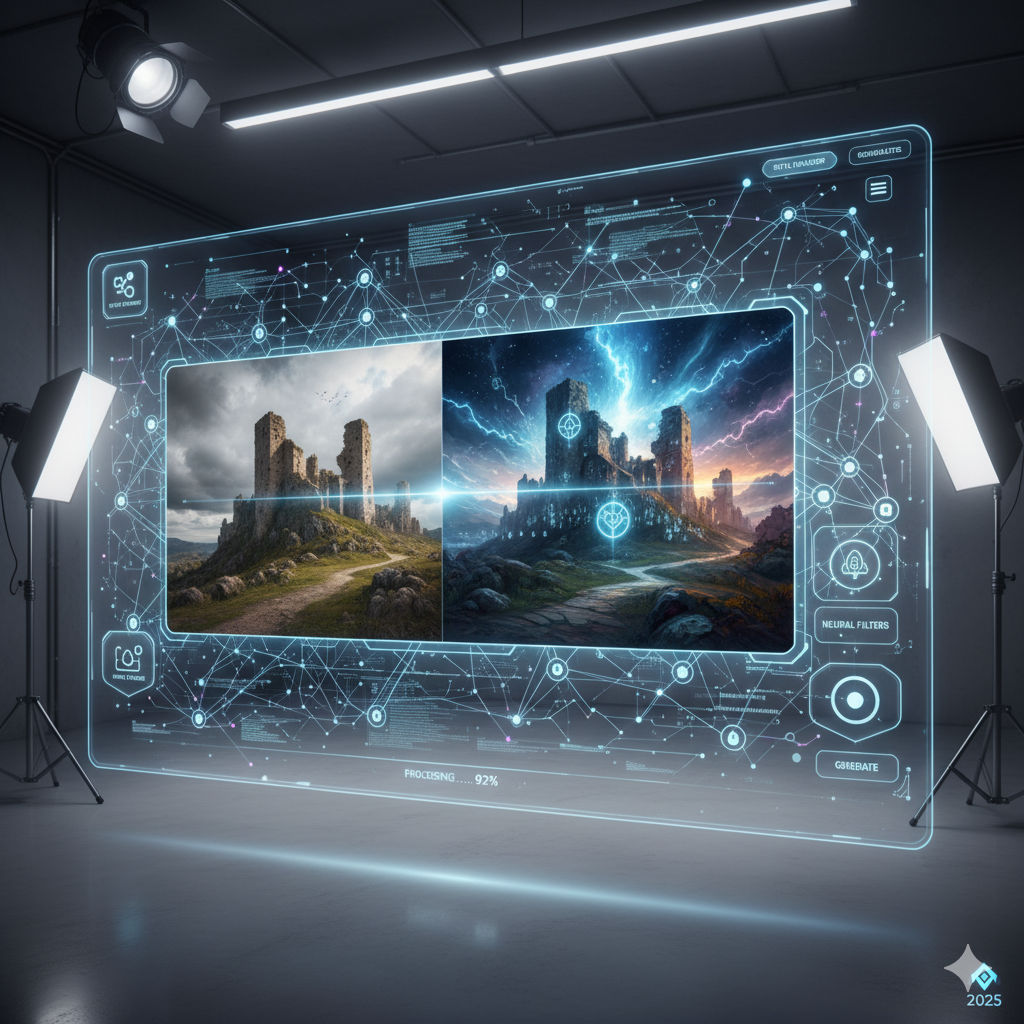
Introduction: Beyond Filters – The Dawn of AI-Powered Photo Transformation
In an era where digital imagery saturates every corner of our lives, from social media feeds to professional portfolios, the desire to create visually compelling and unique photographs has never been stronger. For years, photo editing software offered tools for basic adjustments, color correction, and artistic filters. While effective, these methods often felt like mere tweaks to existing pixels rather than true transformations.
Enter the revolutionary world of Artificial Intelligence, specifically Image-to-Image (I2I) generation. This cutting-edge field of AI is fundamentally altering how we perceive and interact with digital images. It’s no longer just about enhancing a photo; it’s about giving it an entirely new identity, changing its style, content, or even reconstructing missing parts, all guided by intelligent algorithms. Imagine turning a rough sketch into a photorealistic landscape, transforming a daytime scene into a dramatic night shot, or even de-aging a portrait with astonishing accuracy. These were once the realm of science fiction or painstaking manual artistry; now, they are becoming increasingly accessible thanks to advanced AI.
This blog post will serve as your comprehensive guide to understanding and leveraging these advanced AI image-to-image techniques. We will delve into the core technologies that power these transformations, explore the myriad applications across various industries, and uncover the practical tools and methods you can use today to unlock unprecedented creative potential. Prepare to look at your photos not just as fixed compositions, but as malleable canvases awaiting AI-driven artistry.
Understanding the Core: What is Image-to-Image (I2I) Generation?
At its heart, image-to-image (I2I) generation refers to a class of artificial intelligence models designed to take an input image and transform it into a different output image, based on a specific learned mapping or instruction. Unlike simple image filters that apply a fixed set of operations, I2I models learn complex patterns and relationships from vast datasets of paired images (e.g., blurry image vs. sharp image, sketch vs. photo, day scene vs. night scene). This learning allows them to generate new pixels intelligently, rather than just manipulating existing ones.
The magic behind I2I lies in its ability to understand the content and context of the input image and translate it into a desired output style or format. Think of it as an artist who has studied thousands of examples of how to convert a pencil sketch into a vibrant oil painting. The AI acts as this incredibly fast and versatile artist, capable of applying its learned knowledge to any new input it receives.
The Pillars of I2I: Generative Adversarial Networks (GANs) and Diffusion Models
Two primary architectural paradigms have dominated the I2I landscape: Generative Adversarial Networks (GANs) and, more recently, Diffusion Models.
Generative Adversarial Networks (GANs)
GANs, introduced by Ian Goodfellow and his colleagues in 2014, revolutionized generative AI. They consist of two competing neural networks:
- The Generator: This network’s job is to create new data instances (in our case, images) that resemble the real data in the training set. It takes a random noise vector or an input image and tries to transform it into the target domain.
- The Discriminator: This network acts as a critic. It receives both real images from the training dataset and synthetic images produced by the Generator. Its task is to distinguish between real and fake images.
The two networks are trained simultaneously in a zero-sum game. The Generator tries to produce images convincing enough to fool the Discriminator, while the Discriminator strives to become better at detecting fakes. This adversarial process drives both networks to improve, resulting in a Generator capable of producing incredibly realistic and novel images. For I2I, the input image guides the Generator’s output, transforming it according to the learned mapping.
Diffusion Models
Diffusion Models represent a more recent and increasingly powerful class of generative models that have gained significant traction, especially with models like DALL-E 2, Midjourney, and Stable Diffusion. They work on a fundamentally different principle:
- Forward Diffusion Process: This involves gradually adding Gaussian noise to an image over several steps, slowly destroying its information content until it becomes pure noise.
- Reverse Diffusion Process: The model is trained to learn how to reverse this noise process. Starting from pure noise, it progressively denoises the image step-by-step, predicting and removing a small amount of noise at each stage, eventually reconstructing a coherent and realistic image.
For I2I tasks, the input image can be partially noised and then the diffusion model is tasked with denoising it while also guided by specific conditions (e.g., text prompts, semantic maps, or even the original image itself) to achieve the desired transformation. Diffusion models excel at generating high-quality, diverse, and coherent images, often surpassing GANs in terms of fidelity and ease of training for certain tasks.
Advanced I2I Techniques: A Deep Dive into Practical Applications
The underlying power of GANs and Diffusion Models manifests in a multitude of specialized image-to-image techniques, each designed for distinct creative or practical purposes.
1. Style Transfer: Imbuing New Artistic Flair
Style transfer is perhaps one of the most visually stunning applications of I2I. It allows you to take the artistic style from one image (e.g., a painting by Van Gogh) and apply it to the content of another image (e.g., your photograph), creating a new image that retains the original content but is rendered in the chosen style. Early methods involved complex optimization, but modern deep learning approaches, particularly using neural style transfer networks, can perform this transformation in real-time. This is widely used by artists to explore new aesthetics and by apps to offer creative filters.
2. Inpainting and Outpainting: Seamless Image Reconstruction and Expansion
- Inpainting: This technique addresses the problem of filling in missing or corrupted parts of an image. If a portion of an image is obscured, damaged, or you simply want to remove an unwanted object, inpainting algorithms can intelligently synthesize new pixels that seamlessly blend with the surrounding content, effectively “healing” the image. Modern AI models can even understand the context to generate plausible objects or backgrounds.
- Outpainting: The inverse of inpainting, outpainting extends an image beyond its original boundaries. Given a photo, an outpainting model can intelligently generate new content that expands the scene, predicting what might lie beyond the frame. This is incredibly useful for adjusting aspect ratios, creating wider panoramic views, or simply adding more context to an existing shot.
3. Semantic Image Synthesis and Segmentation: From Maps to Masterpieces
Semantic image synthesis involves converting a semantic layout (a map where different colors represent different object categories like “road,” “tree,” “building”) into a photorealistic image. This allows designers and urban planners to quickly visualize proposed changes. Conversely, semantic segmentation takes a photograph and labels each pixel according to the object it belongs to, effectively creating the semantic map. This foundational technology aids in more precise image manipulation, allowing targeted edits to specific objects within a scene.
4. Image Enhancement: Denoising, Super-Resolution, and Colorization
I2I techniques are also instrumental in enhancing image quality:
- Denoising: AI can effectively remove various types of noise (e.g., grain from low-light photography, compression artifacts) while preserving important image details, leading to cleaner, sharper results.
- Super-Resolution: This technique increases the resolution of an image, making low-resolution photos appear sharper and more detailed. Instead of simply interpolating pixels, AI models hallucinate plausible details based on their training, often achieving results far superior to traditional upscaling methods.
- Colorization: For black and white photographs or historical footage, AI can intelligently add realistic colors, bringing old memories to life by inferring natural colors from the grayscale values and surrounding context.
5. Image Editing and Manipulation: Beyond Conventional Tools
Advanced I2I models offer unprecedented control over image content:
- Object Replacement/Modification: Change the type of car in a street scene, alter a person’s hairstyle, or modify facial expressions.
- Environmental Transformations: Convert day to night, summer to winter, or change weather conditions in a photo.
- Facial Attributes Transfer: Modify age, gender, or specific facial features while maintaining identity.
- Portrait Generation from Sketches: Turn rough sketches or simple line drawings into highly realistic human portraits.
Recent Developments and Tools in I2I
The field of AI image-to-image generation is rapidly evolving, with new models and tools emerging regularly. Here are some of the most impactful recent developments:
Stable Diffusion img2img and ControlNet
Stable Diffusion, an open-source latent diffusion model, has democratized high-quality image generation. Its img2img capability is a cornerstone of modern AI photo transformation. Instead of generating an image from scratch with a text prompt, you provide an initial image and a text prompt. The model then uses the image as a strong starting point, incorporating elements from the prompt to transform it. This allows for controlled transformations like:
- Changing the style of an existing photo (e.g., “a photo of a cat” + “oil painting style” -> stylized cat painting).
- Modifying elements within a scene (e.g., “a person walking” + “futuristic cyberpunk city” -> person walking in a cyberpunk city).
- Applying specific artistic directions to a photograph.
ControlNet, an extension for Stable Diffusion and similar diffusion models, represents a significant leap in fine-grained control. It allows users to impose additional spatial conditioning on the generated image. Instead of just a text prompt and an initial image, ControlNet takes an “input condition” image, such as:
- Canny Edge Maps: Preserve the precise edge structure of the input image.
- Depth Maps: Maintain the 3D structure and depth perception.
- Normal Maps: Control surface orientation and lighting.
- Segmentation Maps: Define specific object regions.
- Pose Estimation (OpenPose): Transfer human poses from one image to another.
This allows for unprecedented creative control, enabling artists to guide the AI with incredible precision, transforming images while strictly adhering to specific compositional or structural elements from the input.
CLIP and Latent Space Exploration
The integration of Contrastive Language–Image Pre-training (CLIP) with generative models has enhanced the ability of AI to understand and respond to natural language prompts. CLIP allows models to evaluate how well an generated image matches a given text description, which is crucial for guiding the image-to-image transformation process with semantic accuracy. Exploring the “latent space” (the abstract mathematical representation where the AI learns to store concepts) of these models allows for subtle and controlled interpolation between different image attributes or styles.
Commercially Available Tools and APIs
Beyond open-source models, numerous platforms offer I2I capabilities through user-friendly interfaces or APIs:
- Adobe Photoshop (Neural Filters): Integrates AI-powered features for style transfer, portrait adjustments, and smart inpainting directly into the professional workflow.
- Luminar AI/Neo: Offers AI-driven enhancements for skies, portraits, and scene relighting.
- RunwayML: Provides a suite of AI magic tools, including background removal, text-to-image, and image-to-image transformations.
- Midjourney/DALL-E 3: While primarily text-to-image, their advanced understanding of prompts and image editing features (e.g., inpainting/outpainting in DALL-E 3) allow for powerful image transformations when used creatively.
- Many online AI art generators: Offer an img2img mode where you upload an image and provide a prompt to guide its transformation.
Comparison Tables: GANs vs. Diffusion Models & I2I Techniques
To further illustrate the distinct characteristics and applications, let’s compare the two primary architectural approaches and highlight the benefits of different I2I techniques.
Table 1: Generative Adversarial Networks (GANs) vs. Diffusion Models for I2I
| Feature/Characteristic | Generative Adversarial Networks (GANs) | Diffusion Models |
|---|---|---|
| Training Stability | Often challenging; prone to mode collapse (generating limited diversity) and training instabilities. | Generally more stable and robust to train, less prone to mode collapse. |
| Image Quality | Can achieve very high fidelity, especially on specific tasks. Output can sometimes be repetitive or contain artifacts if not trained well. | Excellent for generating high-fidelity, diverse, and novel images with strong coherence. |
| Diversity of Output | Can suffer from mode collapse, leading to less diverse outputs for a given input/condition. | Known for producing a wide range of diverse and creative outputs, exploring the full latent space. |
| Computational Cost (Training) | Moderately high, but often faster inference once trained. | Very high computational cost for training, but efficient during inference once reverse process is learned. |
| Control Mechanisms | Conditional GANs (cGANs) allow control through labels, sketches, or other inputs. | Highly controllable via conditioning (text, images, control signals like ControlNet), allowing for fine-grained guidance. |
| Common I2I Use Cases | Style transfer (early methods), specific facial manipulation, simple semantic synthesis. | Broad range: complex style transfer, high-fidelity inpainting/outpainting, super-resolution, sophisticated image editing, creative transformations. |
| Recent Dominance | Still relevant for specific niche applications, but largely superseded by Diffusion for general-purpose high-quality generation. | Currently the dominant architecture for state-of-the-art text-to-image and complex image-to-image tasks. |
Table 2: Comparison of Advanced I2I Techniques and Their Strengths
| Technique | Primary Goal | Key Strength | Typical Use Case |
|---|---|---|---|
| Style Transfer | Apply artistic style of one image to content of another. | Transforms aesthetic quickly, offers diverse artistic interpretations. | Artistic photo filters, generating creative content, branding. |
| Inpainting / Outpainting | Fill missing parts or expand image boundaries. | Seamlessly reconstructs/generates contextual content. | Object removal, photo restoration, aspect ratio adjustment, panoramic creation. |
| Super-Resolution | Increase image resolution and detail. | Enhances image clarity and sharpness beyond simple interpolation. | Restoring old photos, improving surveillance footage, upscaling web images. |
| Semantic Synthesis | Generate realistic image from semantic labels/sketches. | Rapid visualization from abstract inputs, precise content control. | Architectural visualization, game asset creation, virtual reality environments. |
| Image Denoising | Remove noise while preserving details. | Cleaner, sharper images, especially from low-light or compressed sources. | Improving photographic quality, preparing images for printing or display. |
| Controlled Image Generation (e.g., ControlNet) | Transform image while maintaining specific structural/compositional elements. | Unprecedented creative control over AI generation. | Character pose transfer, scene recomposition, consistent stylization. |
Practical Examples: Real-World Use Cases and Scenarios
The transformative power of advanced AI image-to-image techniques extends across numerous industries and creative pursuits. Here are a few compelling practical examples:
-
Digital Art and Photography:
Artists can use style transfer to experiment with different aesthetics, applying the brushstrokes of a famous painter to their own photographs or illustrations. Photographers can effortlessly remove unwanted elements from a shot using inpainting, or expand a landscape photo to a wider aspect ratio with outpainting, saving hours of manual editing. Consider a wedding photographer who needs to remove a distracting background element or adjust a guest’s expression; AI can do this with remarkable realism and speed.
-
Fashion and E-commerce:
For fashion brands, AI I2I can virtually dress models in new outfits, changing colors, textures, or even the entire garment without costly photoshoots. Imagine a customer uploading a photo of themselves and seeing how a new dress looks on their body, or a retailer generating diverse model poses for a single product image. This significantly reduces production costs and speeds up content creation.
-
Architecture and Interior Design:
Architects and interior designers can convert rough sketches or 2D floor plans into photorealistic 3D renderings in moments using semantic image synthesis. This allows clients to visualize spaces more effectively, accelerating the design and approval process. Changes to materials, lighting, or furniture can be rendered instantly, providing immediate feedback.
-
Gaming and Virtual Reality (VR):
Game developers can rapidly generate diverse textures, environments, and character variations from simple inputs, significantly reducing asset creation time. AI can generate variations of vegetation, create realistic terrains from elevation maps, or even upscale low-resolution game assets to 4K quality for modern displays. For VR experiences, I2I can aid in creating immersive and dynamic virtual worlds.
-
Film and Television Production:
Visual effects (VFX) artists can utilize inpainting to remove wires or unwanted objects from footage, super-resolution to enhance archival material, or style transfer to achieve unique cinematic looks. AI can also help in tasks like de-aging actors, changing weather conditions in a scene, or reconstructing damaged film frames, streamlining post-production workflows.
-
Medical Imaging:
While still an emerging field, I2I has potential in medical imaging for tasks like denoising MRI scans to improve clarity, reconstructing missing data, or even translating images from one modality to another (e.g., converting a low-dose CT scan into a standard-dose equivalent for better diagnostic quality).
-
Advertising and Marketing:
Marketers can quickly adapt product images for different campaigns, changing backgrounds, seasons, or even cultural contexts to appeal to diverse audiences. Generating multiple ad variations with distinct visual styles becomes effortless, allowing for faster A/B testing and optimized campaign performance.
Frequently Asked Questions
Frequently Asked Questions
Q: What is the fundamental difference between traditional photo editing and AI image-to-image transformation?
A: Traditional photo editing largely involves manual manipulation of pixels, layers, and adjustments (e.g., cropping, color correction, dodging and burning). While powerful, it requires human skill and effort for every specific change. AI image-to-image transformation, on the other hand, uses neural networks trained on vast datasets to “understand” images and generate new content or significantly alter existing content based on learned patterns and instructions (like text prompts or control images). It goes beyond simple pixel manipulation to intelligent content generation and contextual transformation, often automating complex artistic tasks.
Q: Do I need to be a programmer or AI expert to use these techniques?
A: Not at all for many applications! While the underlying technology is complex, many user-friendly tools and platforms have emerged. Software like Adobe Photoshop’s Neural Filters, Luminar AI, RunwayML, and various online AI art generators provide intuitive graphical interfaces that allow users to apply advanced I2I techniques without writing a single line of code. However, for more advanced control or custom model training, some technical knowledge might be beneficial.
Q: What are the ethical considerations surrounding AI image-to-image generation?
A: Ethical concerns are significant. These include the potential for creating deepfakes (realistic synthetic media that depict individuals saying or doing things they never did), copyright infringement (if models are trained on copyrighted art without permission), exacerbating biases present in training data (leading to stereotypical or harmful outputs), and the question of authenticity and trust in digital media. Responsible development and usage, along with clear disclosure of AI-generated content, are crucial.
Q: Can AI image-to-image tools perfectly replicate human artistic style?
A: AI tools can mimic and apply styles from existing artworks with remarkable fidelity, often generating aesthetically pleasing results. However, whether they can “perfectly replicate” human artistic style in its nuanced, emotional, and evolving sense is a philosophical debate. AI excels at pattern recognition and generation, but true artistic intent and novel conceptualization often remain uniquely human domains. AI can be a powerful co-creator or tool, but it doesn’t necessarily possess the consciousness or lived experience that informs human art.
Q: What kind of hardware is required to run advanced I2I models?
A: For training state-of-the-art I2I models (especially diffusion models), significant computational resources are needed, typically involving high-end GPUs (e.g., NVIDIA A100, H100) and substantial memory. However, for running inference (i.e., using a pre-trained model to transform images), the requirements are more modest. Many consumer-grade GPUs (e.g., NVIDIA RTX series) can run models like Stable Diffusion locally. Cloud-based services also allow users to leverage powerful hardware without local investment.
Q: How do Stable Diffusion img2img and ControlNet differ in their approach to transformation?
A: Stable Diffusion’s basic img2img mode takes an input image, noises it to a certain degree, and then denoises it while being guided by a text prompt. This allows for significant stylistic or content changes. ControlNet, on the other hand, adds an extra layer of precise structural guidance. It processes a *control map* (like an edge map, depth map, or pose estimation) derived from your input image, ensuring that the generated output strictly adheres to that specific structural information, even as the style or other content is changed by the text prompt and denoising process. ControlNet offers much finer control over the composition.
Q: Is it possible to use I2I techniques for animation or video?
A: Yes, absolutely! Many I2I techniques can be applied to video by processing each frame sequentially. This can be used for tasks like style transfer of entire video clips, de-noising old footage, upscaling low-resolution video, or even generating new frames to smooth out motion (interpolation). More advanced methods involve temporal consistency mechanisms to ensure smooth transitions between frames, preventing flickering or jarring changes. Recent advancements in video diffusion models are also directly enabling video-to-video transformation.
Q: What is ‘mode collapse’ in the context of GANs?
A: Mode collapse is a common issue during GAN training where the generator network starts producing a limited variety of outputs, often repetitive or highly similar images, because it finds a few patterns that reliably fool the discriminator, and then stops exploring the full diversity of the target data distribution. This results in less creative and less diverse output compared to what the training data might offer, and it’s one of the reasons Diffusion Models have gained popularity for their greater output diversity.
Q: How do I choose the right AI tool for my image transformation needs?
A: The choice depends on your specific needs, skill level, and budget. For simple artistic filters or quick edits, user-friendly apps with pre-built AI features are great (e.g., consumer photo editors). For more creative control and complex transformations, open-source models like Stable Diffusion with extensions like ControlNet offer immense flexibility but might require a bit more technical setup. Commercial platforms like RunwayML or Midjourney provide a balance of power and ease of use, often with subscription models. Evaluate the quality of output, ease of use, cost, and the specific features you require (e.g., style transfer, inpainting, precise control) before making a decision.
Q: Can I use my own datasets to train an I2I model?
A: Yes, training an I2I model on your own dataset is definitely possible, especially with open-source frameworks. This is particularly useful for niche applications where generic models might not perform well. For example, an artist might train a model on their specific style or a company on their unique product imagery. This process, often called fine-tuning or training a LoRA (Low-Rank Adaptation) for diffusion models, requires a significant amount of paired data (input images and desired output images), computational resources, and a good understanding of AI training principles.
Key Takeaways: Mastering AI Image Transformation
- AI I2I is a Game-Changer: Moving beyond basic filters, AI image-to-image techniques enable genuine content and style transformations, opening new creative avenues.
- GANs and Diffusion Models are Core: Generative Adversarial Networks (GANs) and Diffusion Models are the foundational architectures driving most advanced I2I capabilities, with Diffusion Models currently leading in quality and control for many tasks.
- Diverse Techniques for Diverse Needs: Whether it’s style transfer, inpainting, super-resolution, or semantic synthesis, specific AI techniques cater to a wide array of image manipulation challenges.
- Control is Evolving: Recent advancements like Stable Diffusion’s img2img and ControlNet provide unprecedented levels of creative control, allowing users to guide AI transformations with remarkable precision.
- Tools are Becoming Accessible: From professional software integrations (Adobe Photoshop) to user-friendly online platforms and open-source models, AI I2I is increasingly available to everyone.
- Real-World Impact is Broad: These techniques are revolutionizing workflows in digital art, photography, fashion, architecture, gaming, film, and marketing, saving time and unlocking new possibilities.
- Ethical Awareness is Crucial: The power of AI image transformation comes with responsibilities, particularly concerning deepfakes, copyright, and bias, necessitating thoughtful and ethical application.
Conclusion: The Future is Visually Limitless
The journey into advanced AI image-to-image techniques reveals a landscape where the boundaries of visual creation are continuously being pushed. What once required hours of meticulous manual work or was deemed impossible, is now achievable with a few clicks or carefully crafted prompts. From transforming mundane photos into artistic masterpieces, seamlessly extending scenes beyond their original frames, to breathing new life into historical black-and-white images, AI is empowering creators with tools that redefine what’s possible.
As Diffusion Models continue to evolve and new control mechanisms like ControlNet become more sophisticated, the precision and artistic freedom offered by AI will only grow. This isn’t merely about automating existing tasks; it’s about fostering new forms of creativity and enabling individuals and industries to visualize, design, and communicate in ways previously unimaginable.
The future of digital imagery is undeniably intertwined with AI. By understanding these advanced techniques, embracing the available tools, and engaging with the ethical considerations, we can all participate in shaping a visually richer, more imaginative, and incredibly exciting digital world. Your photos are no longer static memories; they are dynamic canvases waiting for the touch of artificial intelligence to unveil their limitless potential.

































Leave a Reply