
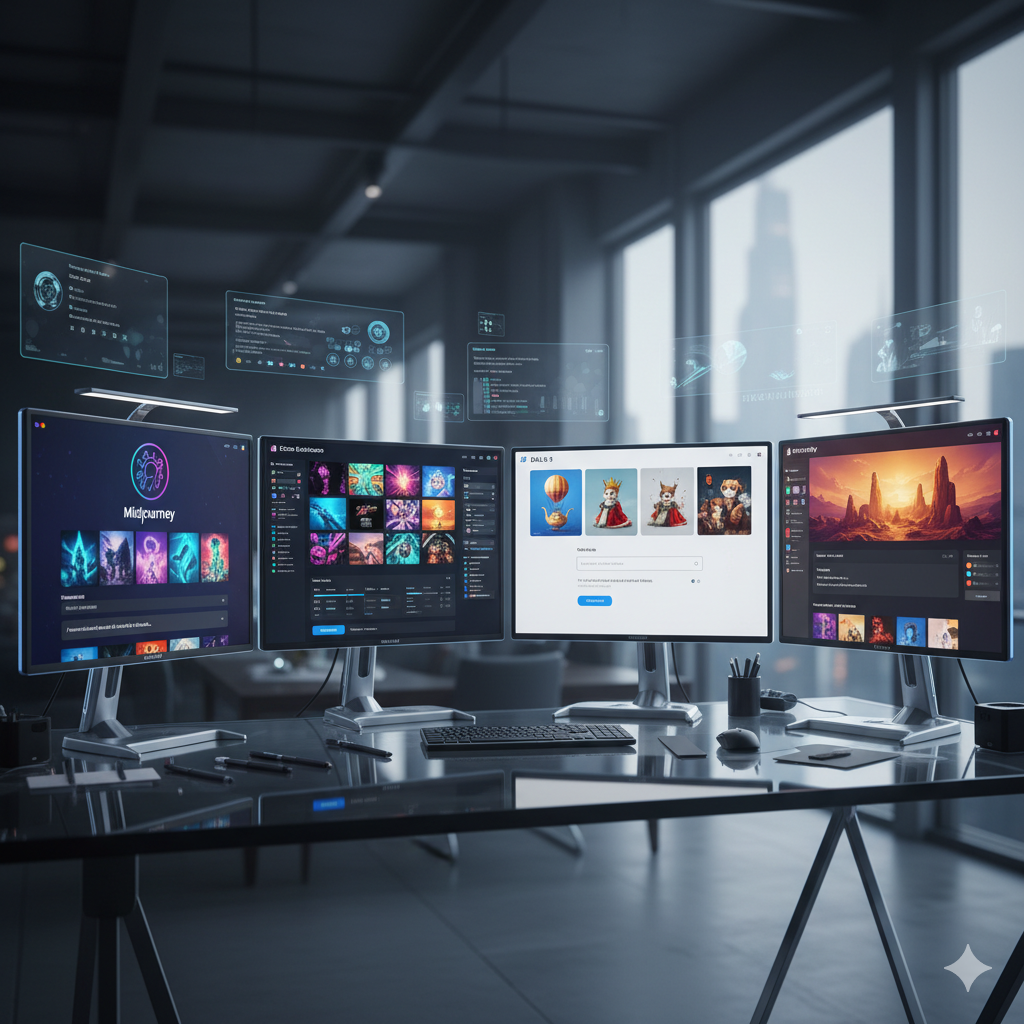
The world of art and design is undergoing a profound transformation, powered by the incredible advancements in Artificial Intelligence. What once seemed like science fiction is now a tangible reality: machines capable of generating breathtaking, original images from simple text descriptions. AI image generators have democratized art creation, offering a gateway to boundless creativity for artists, designers, marketers, and hobbyists alike. However, with a rapidly expanding ecosystem of tools, each boasting unique strengths, features, and underlying philosophies, the choice can feel overwhelming. How do you navigate this exciting new landscape to find the AI companion that truly aligns with your specific artistic vision and workflow?
This comprehensive guide is designed to cut through the noise, providing you with the insights and practical knowledge needed to make an informed decision. We will delve into the nuances of leading AI image generation platforms, explore their distinctive characteristics, discuss critical factors for selection, and offer real-world examples to illustrate their practical applications. By the end of this article, you will not only understand the current state of AI art but also possess a clear roadmap for choosing the tool that empowers you to unleash your unique creative potential and bring your imaginative concepts to life with unprecedented ease and power.
The Dawn of a New Artistic Era: Understanding AI Image Generation
For centuries, the creation of visual art was considered a uniquely human endeavor, a testament to imagination, skill, and emotional expression. While the human element remains paramount, AI image generators have introduced a revolutionary paradigm shift. These tools, often based on sophisticated machine learning models, interpret textual prompts and synthesize entirely new visual content, from photorealistic landscapes to abstract fantasies, character designs, architectural renderings, and everything in between.
The core technology driving many of today’s most popular AI image generators is known as diffusion models. Unlike earlier generative adversarial networks (GANs) which often struggled with diversity and mode collapse, diffusion models work by learning to reverse a process of gradually adding noise to an image. They start with pure noise and iteratively “denoise” it, guided by a text prompt, until a coherent image emerges. This iterative refinement allows for exceptional detail, compositional understanding, and a remarkable ability to interpret complex and abstract concepts embedded within natural language.
The impact of this technology is multifaceted. For professional artists, AI serves as a powerful co-creator, accelerating ideation, generating mood boards, exploring variations, and even filling in missing elements in their existing work. For designers, it can quickly prototype visuals for branding, UI/UX, and marketing campaigns. For content creators, it provides a seemingly endless supply of unique visuals to enhance stories, social media posts, and presentations. And for hobbyists, it opens up a world of artistic exploration without the need for traditional art skills or expensive equipment. This accessibility is both its greatest strength and a point of ongoing discussion regarding authorship, originality, and the future of creative professions. Understanding these foundational aspects is the first step in leveraging AI to its fullest potential in your creative practice.
Decoding Your Artistic DNA: What’s Your Vision?
Before diving into the specifics of each AI image generator, it is crucial to first understand your own artistic needs, preferences, and goals. Just as a painter chooses between oils, acrylics, or watercolors based on their desired effect, you must identify what kind of digital brush stroke you are looking for. Self-reflection at this stage will significantly streamline your selection process and prevent potential frustration.
Consider the following questions to clarify your artistic vision and requirements:
- What kind of aesthetics do you prefer? Are you drawn to hyper-realism, painterly impressions, stylized illustrations, abstract forms, or specific artistic movements (e.g., cyberpunk, fantasy art, renaissance)? Some AI models excel in certain styles more than others.
- How much creative control do you need? Do you want to guide every aspect of the image, from composition and lighting to specific elements, or are you happy with more interpretative, serendipitous results? Tools vary wildly in their degree of granular control.
- What is your primary use case? Are you generating images for personal enjoyment, professional client work, game asset creation, concept art, marketing materials, or fine art prints? Commercial rights and model biases can be crucial here.
- What is your technical proficiency? Are you comfortable with command-line interfaces, intricate settings, and fine-tuning models, or do you prefer a user-friendly, intuitive graphical interface?
- What is your budget? Are you looking for free options, willing to pay a monthly subscription, or considering investing in powerful local hardware?
- How important is speed and iteration? Do you need to generate many variations quickly, or are you focused on crafting a single, perfect image over time?
- Do you require specific features? Are inpainting (modifying parts of an image), outpainting (extending an image), image-to-image transformations, or upscaling critical to your workflow?
- What ecosystem do you work within? Do you need integration with existing design software like Adobe Creative Suite?
By answering these questions honestly, you will develop a clear profile of your ideal AI image generation tool, making the subsequent exploration of specific platforms much more targeted and effective. Your artistic DNA is unique; your AI creative partner should be too.
A Deep Dive into Leading AI Image Generators
The landscape of AI image generators is dynamic and constantly evolving, with new features and models emerging regularly. Here, we explore the frontrunners that currently define the industry, highlighting their unique strengths, ideal use cases, and any notable considerations.
Midjourney: The Master of Aesthetic and Impressionistic Art
Midjourney has rapidly established itself as a leading force in AI art, renowned for its unparalleled aesthetic quality and often dreamlike, painterly, or illustrative outputs. It excels at generating images with a distinctive artistic flair, often producing results that are immediately visually striking and compelling.
- Strengths:
- Exceptional Aesthetics: Midjourney consistently produces images that are beautiful, well-composed, and often possess a unique artistic signature. It excels at understanding abstract concepts and translating them into visually rich compositions.
- Ease of Use: Primarily accessed via Discord, its command-based interface is relatively straightforward for beginners to pick up, although mastering prompt engineering takes practice.
- Rapid Iteration: The system encourages exploration by quickly generating four variations for each prompt, allowing users to select and refine their preferred direction.
- Community Focus: The Discord server fosters a vibrant and inspiring community where users share prompts, tips, and their stunning creations.
- Stylistic Consistency: Newer versions, like V6, offer improved coherence and the ability to maintain character consistency across multiple images, alongside enhanced prompt understanding.
- Weaknesses:
- Less Granular Control: While recent versions have added more control parameters, Midjourney historically offers less precise control over specific elements, composition, or exact poses compared to tools like Stable Diffusion. Achieving very specific, pixel-perfect results can be challenging.
- Discord Dependency: For some, being confined to a Discord interface can be a drawback, as it’s not a standalone web application or desktop client.
- Subscription-Based: There is no free tier; access requires a monthly subscription.
- Stylistic Bias: While versatile, Midjourney does have a noticeable underlying aesthetic preference, which might not suit every artistic vision.
- Ideal For: Concept artists seeking aesthetic inspiration, illustrators needing unique styles, hobbyists exploring beautiful imagery, marketing professionals requiring visually engaging content, and anyone prioritizing artistic quality and stunning visuals over absolute control.
Stable Diffusion: The Open-Source Powerhouse for Control and Customization
Stable Diffusion stands in stark contrast to Midjourney, offering an open-source, highly customizable, and immensely powerful framework for image generation. Its strength lies in its flexibility, allowing users unprecedented control and the ability to run it locally on their own hardware.
- Strengths:
- Unrivaled Control: Through various techniques like ControlNet, img2img, inpainting, outpainting, and intricate parameter adjustments, Stable Diffusion offers the most granular control over composition, pose, style, and content.
- Open-Source and Customizable: Being open-source, it boasts a massive community creating and sharing custom models (checkpoints), LoRAs (Low-Rank Adaptation models for specific styles or characters), and extensions. This allows for hyper-specialized outputs.
- Local Execution: Users with sufficient GPU power can run Stable Diffusion locally, ensuring privacy, no subscription fees (after initial hardware investment), and virtually unlimited generations.
- Versatility: Capable of generating a vast array of styles, from photorealism to anime, digital painting, and more, limited only by the available models and user skill.
- Integration: Many tools and GUIs (like Automatic1111’s WebUI, ComfyUI, Fooocus) have been built around Stable Diffusion, enhancing its usability and feature set.
- Weaknesses:
- Steep Learning Curve: Mastering Stable Diffusion, especially with its advanced features and custom models, requires significant time, effort, and technical understanding.
- Hardware Requirements: Running locally demands a powerful GPU (NVIDIA RTX 3060/4060 or better with at least 8GB VRAM is recommended for a good experience). Cloud-based services alleviate this but come with costs.
- Inconsistent Quality (initially): Without proper prompting, model selection, and parameter tuning, initial results can be less aesthetically polished than Midjourney’s default outputs. It requires more user effort to achieve stunning results.
- Ethical Concerns: The open-source nature means fewer built-in content filters, raising ethical considerations regarding misuse, although many model providers do implement their own safeguards.
- Ideal For: Advanced artists and developers, concept artists needing precise control, 3D artists creating textures or base models, researchers, those who prioritize customization and ownership, and users with powerful local hardware who want full creative freedom.
DALL-E 3 (via ChatGPT Plus/Copilot): The Text-to-Image Virtuoso with Contextual Understanding
OpenAI’s DALL-E 3 represents a significant leap in understanding natural language prompts. Integrated primarily through ChatGPT Plus or Microsoft Copilot, it excels at interpreting complex, multi-layered descriptions and translating them into highly coherent and contextually accurate images.
- Strengths:
- Superior Prompt Understanding: DALL-E 3 is exceptionally good at understanding nuanced, long, and complex prompts, often translating them with remarkable accuracy, including text within images.
- Contextual Coherence: Its integration with large language models (like those behind ChatGPT) means it can engage in a dialogue, refine prompts based on feedback, and ensure the generated image aligns perfectly with the user’s intent.
- Safety and Content Moderation: OpenAI implements robust safety measures and content policies, making it a safer choice for generating family-friendly or commercially compliant content.
- Ease of Access: Accessible through user-friendly interfaces like ChatGPT Plus or Microsoft Copilot, making it very approachable for non-technical users.
- Image Consistency: Better at maintaining character and stylistic consistency across a series of images compared to previous DALL-E versions.
- Weaknesses:
- Less Direct Control: While great at interpretation, DALL-E 3 offers fewer direct parameters for granular control over artistic style, camera angles, or specific lighting compared to Stable Diffusion.
- Subscription Dependent: Requires a subscription to ChatGPT Plus or access via Microsoft Copilot (which has free tiers but potentially limitations).
- Stylistic Limitations: While versatile, its default outputs often lean towards a clean, illustrative, or photorealistic style, and it might be harder to push into highly experimental or abstract aesthetics than Midjourney or specialized Stable Diffusion models.
- Resolution Limitations: Generated images often have a fixed resolution, and while good, might require external upscaling for very large prints.
- Ideal For: Content creators, marketers, writers illustrating stories, educators, and anyone who values precise interpretation of complex ideas through text, ease of use, and a strong emphasis on safety and coherence.
Adobe Firefly: The Creative Professional’s Integrated AI Companion
Adobe Firefly is Adobe’s suite of generative AI models, deeply integrated within the Adobe Creative Cloud ecosystem. Its primary appeal lies in its seamless workflow for professionals already using Photoshop, Illustrator, and other Adobe applications.
- Strengths:
- Creative Cloud Integration: Firefly’s generative features (Generative Fill, Generative Expand, Text to Image) are directly accessible within Photoshop, Illustrator, Adobe Express, and other Creative Cloud apps, streamlining professional workflows.
- Commercial Safety: Trained on Adobe Stock’s extensive library of licensed content, Firefly aims to be commercially safe, meaning images generated are less likely to infringe on existing copyrights, a significant concern for professionals.
- User-Friendly Interface: Adobe emphasizes intuitive interfaces and controls, making it easy for existing Adobe users to pick up and utilize AI capabilities.
- Targeted Features: Excels in specific tasks like generative fill (for seamlessly adding or removing objects), generative expand (outpainting), text effects, and vector graphic generation.
- Ethical Sourcing: Adobe is committed to ethical AI development, including artist compensation models and Content Authenticity Initiative integration.
- Weaknesses:
- Still Evolving: While powerful, Firefly is newer to the scene and its general “text-to-image” capabilities might not yet match the raw aesthetic power of Midjourney or the ultimate control of Stable Diffusion for certain highly specialized tasks.
- Subscription Dependent: Requires an Adobe Creative Cloud subscription to fully leverage its integrated features.
- Focus on Utility: While it can generate beautiful images, its core strength often lies in enhancing existing creative workflows rather than purely generating art from scratch in the same way as Midjourney.
- Ideal For: Graphic designers, photographers, illustrators, and other creative professionals already embedded in the Adobe Creative Cloud ecosystem who need AI tools to augment and accelerate their existing workflows, with a strong emphasis on commercial viability and ethical sourcing.
Leonardo.Ai: User-Friendly and Feature-Rich for Game Assets and More
Leonardo.Ai has quickly gained popularity as a user-friendly and feature-rich platform, particularly favored by game developers, concept artists, and digital creators looking for intuitive controls and diverse model options. It aims to bridge the gap between ease of use and powerful customization.
- Strengths:
- User-Friendly Interface: Offers a clean, intuitive web interface that simplifies many of the complex parameters found in tools like Stable Diffusion.
- Extensive Model Library: Hosts a vast collection of fine-tuned Stable Diffusion models and custom community models, allowing users to select specific aesthetic styles for various needs (e.g., game assets, illustrations, photography).
- Powerful Features: Includes image-to-image capabilities, inpainting, outpainting, control over prompt weights, depth maps, and a dedicated 3D texture generator.
- Community and Learning: Strong community features and resources make it easier for new users to learn and grow.
- “Alchemy” Upscaler: Offers an advanced upscaling and refinement process for higher quality outputs.
- Freemium Model: Provides a generous free tier with daily token allowances, making it accessible for experimentation.
- Weaknesses:
- Credit System: While offering a free tier, heavy usage requires purchasing credits or a subscription.
- Cloud-Based: Not runnable locally; dependent on their servers.
- Quality Variability: As with many platforms leveraging various models, output quality can vary depending on the chosen model and prompt expertise.
- Ideal For: Game artists, concept artists, illustrators, graphic designers, and hobbyists who want powerful features and model variety within a highly accessible and user-friendly web environment, especially for creating assets.
Other Notable Contenders
- Fooocus: A simplified, open-source user interface for Stable Diffusion, designed to achieve high-quality results with minimal prompting effort, bridging the gap between complexity and ease.
- InvokeAI: Another powerful, open-source implementation of Stable Diffusion with a robust API and a user-friendly GUI, offering advanced features like canvas editing and model merging.
- NightCafe Creator: A versatile, cloud-based platform supporting various AI models (including Stable Diffusion, DALL-E 2, VQGAN+CLIP) with strong community features and print options.
- Artbreeder: Focuses on blending and cross-pollinating existing images to create variations, particularly strong for character and creature design.
- Bing Image Creator (Microsoft Copilot): Powered by DALL-E 3, offering free access to powerful image generation capabilities for everyday users, integrated into Microsoft’s ecosystem.
Key Factors to Consider When Choosing Your AI Art Tool
The perfect AI image generator is not a one-size-fits-all solution. Your choice should be a thoughtful intersection of your artistic goals, technical comfort, and practical requirements. Here are the paramount factors to weigh:
- Artistic Style and Aesthetic Output:
Each generator has a distinct “personality” or default aesthetic. Midjourney leans towards the artistic and often surreal. Stable Diffusion is a chameleon, adapting to the style of its chosen models. DALL-E 3 is strong on coherence and natural language understanding, often producing clean, illustrative, or photorealistic results. Firefly integrates seamlessly into Adobe’s professional creative aesthetic. Consider which tool’s native style most closely matches your preferred artistic output, or which offers the greatest flexibility to achieve diverse styles.
- Level of Control and Customization:
Do you need to dictate precise camera angles, specific character poses, exact color palettes, or intricate environmental details? If so, tools offering granular control like Stable Diffusion (with ControlNet) are essential. If you prefer to provide a general idea and let the AI interpret and surprise you with aesthetically pleasing results, Midjourney or DALL-E 3 might be more suitable. Customization through fine-tuned models (LoRAs, checkpoints) is primarily a Stable Diffusion domain.
- Ease of Use and Learning Curve:
Some platforms, like DALL-E 3 via ChatGPT or Leonardo.Ai, offer highly intuitive interfaces that are welcoming to beginners. Others, particularly local Stable Diffusion setups, demand a significant investment of time to learn prompting techniques, understand parameters, and manage models. Factor in your patience for technical exploration versus your desire for immediate, effortless creation.
- Cost and Accessibility:
Pricing models vary widely. Some offer generous free tiers (Leonardo.Ai, Bing Image Creator), while others are purely subscription-based (Midjourney, ChatGPT Plus for DALL-E 3). Running Stable Diffusion locally requires an upfront hardware investment but offers free generation after that. Cloud-based Stable Diffusion services charge per generation or by compute time. Consider your budget and how frequently you anticipate generating images.
- Commercial Rights and Licensing:
This is a critical consideration for professionals. Understand the terms of service for each generator regarding the commercial use of your outputs. Adobe Firefly, for instance, emphasizes commercial safety due to its training data. Midjourney and Stable Diffusion generally allow commercial use with paid subscriptions, but the specifics can vary. Always read the fine print to ensure your creations can be legally used for your intended purpose.
- Community and Resources:
A strong, active community can be an invaluable asset for learning, troubleshooting, and finding inspiration. Midjourney’s Discord community and Stable Diffusion’s myriad forums and model repositories (e.g., Civitai) offer rich ecosystems. Access to tutorials, documentation, and prompt examples can significantly accelerate your learning process.
- Integration with Existing Workflows:
If you are a professional designer, photographer, or artist, how well does the AI tool integrate with your existing software stack? Adobe Firefly excels here, seamlessly fitting into the Creative Cloud. For others, standalone web applications or desktop clients might require exporting and importing assets, adding steps to your workflow.
- Hardware Requirements (for local execution):
If you’re considering a local installation of Stable Diffusion, assess whether your computer’s GPU meets the minimum and recommended specifications. Insufficient VRAM can severely limit performance and image size. Cloud-based alternatives mitigate this but introduce ongoing costs.
Comparison Tables
Table 1: Feature Comparison of Leading AI Image Generators
| Feature | Midjourney | Stable Diffusion (e.g., Automatic1111) | DALL-E 3 (via ChatGPT/Copilot) | Adobe Firefly | Leonardo.Ai |
|---|---|---|---|---|---|
| Primary Strength | Aesthetic appeal, artistic quality | Control, customization, open-source | Prompt understanding, coherence | Adobe CC integration, commercial safety | User-friendly, diverse models, game assets |
| Ease of Use | Medium (Discord commands) | High (steep learning curve) | Very High (natural language chat) | High (integrated UI) | High (intuitive web app) |
| Artistic Styles | Highly artistic, illustrative, varied | Limitless (via custom models) | Clean, illustrative, photorealistic | Professional, clean, Adobe aesthetic | Wide range (via diverse models) |
| Level of Control | Medium (parameters improving) | Very High (ControlNet, img2img) | Low-Medium (prompt refinement) | Medium-High (Generative Fill, Expand) | High (model selection, parameters) |
| Prompt Interpretation | Excellent for artistic intent | Good (depends on model/skill) | Exceptional (natural language) | Good | Good (with model selection) |
| Local Installation | No (cloud-only) | Yes (with powerful GPU) | No (cloud-only) | No (cloud-only) | No (cloud-only) |
| Community / Resources | Very strong (Discord) | Massive (forums, Civitai, GitHub) | Strong (ChatGPT/Copilot users) | Growing (Adobe community) | Strong (Discord, platform resources) |
Table 2: Pricing and Accessibility Overview
| Generator | Free Tier Available? | Subscription/Credit Model | Platform Access | Commercial Use | Typical Output Resolution |
|---|---|---|---|---|---|
| Midjourney | No (was limited trial, now paid) | Monthly subscription ($10-$120+) | Discord Bot | Yes (with paid subscription) | ~1024×1024 (upscaled options) |
| Stable Diffusion | Yes (if run locally) | Varies (cloud services, hardware cost) | Local, Cloud GUIs (e.g., Automatic1111) | Generally Yes (depends on model license) | Highly variable (user-defined) |
| DALL-E 3 | Limited via Microsoft Copilot | ChatGPT Plus subscription ($20/month) | ChatGPT web, Microsoft Copilot | Yes (with paid access) | 1024×1024, 1792×1024, 1024×1792 |
| Adobe Firefly | Limited free credits | Creative Cloud subscription ($9.99-$59.99+) | Web, integrated in Adobe CC apps | Yes (focus on commercial safety) | Variable (context-dependent) |
| Leonardo.Ai | Yes (daily free tokens) | Credit bundles / Monthly subscription ($10-$50+) | Web Application | Yes (with token usage / subscription) | Up to 1536×1536 (upscaled options) |
Practical Examples: Real-World Use Cases and Scenarios
To further illustrate how different AI image generators align with specific needs, let’s explore a few practical scenarios and identify the most suitable tools.
Scenario 1: The Concept Artist Developing Game Environments
Imagine a concept artist tasked with designing a sprawling cyberpunk city, complete with gritty alleys, neon-lit skyscrapers, and futuristic vehicles. They need to rapidly iterate on environmental layouts, architectural styles, and lighting moods, often requiring specific camera angles and object placements.
- Best Fit: Stable Diffusion.
- Why: Stable Diffusion, especially with tools like ControlNet, offers unparalleled control over composition and structure. The artist can provide a rough sketch or a wireframe (using ControlNet’s Canny or Depth map features) and guide the AI to render it in various cyberpunk styles. They can use specific custom models trained on cyberpunk art to maintain aesthetic consistency and generate thousands of variations quickly. The ability to fine-tune prompts for specific elements like “grimy wet streets” or “holographic billboards” gives them the precision needed for complex world-building. Furthermore, local installation ensures privacy for unreleased concepts.
- Example Prompting Strategy: Combine a detailed textual prompt (e.g., “ultra-detailed cyberpunk city at night, rain-slicked streets reflecting neon, volumetric fog, flying vehicles, dystopian atmosphere, cinematic lighting”) with a ControlNet input image that defines the basic layout or perspective. Experiment with different checkpoints (models) known for cyberpunk art.
Scenario 2: The Illustrator Seeking Unique Character Designs
An illustrator is working on a new graphic novel and needs to generate a series of unique character portraits for their main cast. They want distinctive facial features, specific expressions, and consistent attire across different poses and scenes, aiming for an imaginative yet cohesive visual style.
- Best Fit: Midjourney or DALL-E 3.
- Why Midjourney: Midjourney excels at generating aesthetically pleasing and highly imaginative characters. Its understanding of nuanced descriptors for style (e.g., “ink wash style,” “Art Nouveau illustration”) and emotional expressions is strong. With its newer features like character reference (–cref), it is significantly improving consistency across multiple images, making it viable for character design where a strong, evocative style is paramount.
- Why DALL-E 3: DALL-E 3’s superior prompt comprehension means the illustrator can describe intricate details about personality, background, and specific clothing elements, knowing the AI will likely translate them accurately. Its ability to iterate and refine through conversational prompts in ChatGPT also helps in developing a character’s look step-by-step, ensuring the AI captures the essence. It handles text within images very well, which can be useful for character names or attributes.
- Example Prompting Strategy (Midjourney): “detailed portrait of a cunning elven rogue, long silver hair, emerald eyes, leather armor with intricate engravings, serious expression, moonlit forest background, fantasy art style, –cref [URL of initial character image] –ar 2:3“
- Example Prompting Strategy (DALL-E 3): “Generate a full-body illustration of a wise old wizard. He has a long white beard, wears a deep blue robe adorned with celestial patterns, and holds a gnarled staff. He has kind but stern eyes. Make it in a whimsical storybook illustration style.” Then, “Now, show him looking surprised, dropping his staff.”
Scenario 3: The Marketing Professional Needing Eye-Catching Social Media Graphics
A social media manager needs to create a constant stream of visually appealing, brand-consistent graphics for various campaigns. They require quick turnaround times, the ability to generate images for diverse themes (e.g., product launches, motivational quotes, seasonal promotions), and often need to incorporate text or logo elements. Commercial safety is a priority.
- Best Fit: Adobe Firefly or DALL-E 3 (via Copilot/ChatGPT).
- Why Adobe Firefly: Firefly’s seamless integration with Adobe Express and Photoshop is a massive advantage. The generative fill can quickly alter backgrounds or add product mockups. Its text effects feature is invaluable for creating stylized headlines. Critically, its focus on commercially safe content trained on Adobe Stock provides peace of mind regarding copyright for marketing materials.
- Why DALL-E 3: For sheer ease of use and accurate interpretation of diverse marketing concepts, DALL-E 3 is excellent. The ability to specify text within images (e.g., “a banner image with ‘Summer Sale!’ written on it”) and iterate quickly through conversational prompts makes it very efficient for dynamic social media content. Its accessibility through Copilot offers a free entry point for many.
- Example Prompting Strategy (Adobe Firefly): “Generate a vibrant beach scene with a subtle empty space in the center, suitable for a summer campaign. Make it feel energetic and warm.” Then, use Generative Fill in Photoshop to add a product or text. Or, use “Text to image” directly for a specific mood.
- Example Prompting Strategy (DALL-E 3): “Create a cheerful social media graphic for a coffee shop, featuring a steaming latte, a cozy bookstore atmosphere, and the text ‘Monday Motivation: Coffee & Books’.”
Scenario 4: The Hobbyist Exploring Personal Art Projects
A hobbyist wants to explore different art styles, create unique wallpapers, or simply experiment with imaginative concepts without a steep learning curve or significant financial investment. They value accessibility, variety, and a fun, exploratory experience.
- Best Fit: Leonardo.Ai or Midjourney.
- Why Leonardo.Ai: Its generous free tier, user-friendly interface, and vast library of community-trained models make it incredibly appealing for hobbyists. They can easily switch between styles (anime, fantasy, photography) and experiment with image-to-image without getting bogged down in complex settings. The community aspects also provide inspiration and learning opportunities.
- Why Midjourney: For hobbyists who prioritize stunning, often surprising, and consistently high-quality artistic output, Midjourney is an excellent choice. Its ability to produce beautiful images with relatively simple prompts makes the creative process highly rewarding. While it requires a subscription, the sheer joy of discovery and the aesthetic quality often justify the cost for dedicated hobbyists.
- Example Prompting Strategy (Leonardo.Ai): Select a “fantasy art” model. Prompt: “A majestic dragon flying over a shimmering crystal lake at sunset, glowing scales, ethereal light, highly detailed.” Then try a different model and style.
- Example Prompting Strategy (Midjourney): “Dreamy celestial garden, floating islands, bioluminescent plants, soft pastel colors, ethereal glow, intricate details, highly aesthetic –ar 16:9“
Mastering the Art of Prompt Engineering for Each Generator
While each AI image generator has its unique strengths, the common thread to unlocking their full potential is mastering prompt engineering. This is the art and science of crafting effective text prompts that guide the AI to generate the desired image. Different generators respond to prompts in subtly different ways, making it crucial to tailor your approach.
Prompting for Midjourney
Midjourney thrives on evocative, descriptive, and often artistic language. It understands aesthetic terms well. Start broad, then add details. Use commas to separate concepts.
- Keywords: Focus on adjectives, art styles (e.g., “cinematic,” “octane render,” “anime style,” “Impressionist painting”), lighting (e.g., “volumetric lighting,” “golden hour”), mood, and camera angles.
- Parameters: Utilize parameters like –ar (aspect ratio), –style raw (for less Midjourney influence), –stylize [number] (to control artistic intensity), –v [version], and newer features like –cref (character reference) and –sref (style reference).
- Negative Prompts: Use –no [undesired element] to guide the AI away from specific things.
- Example: “A majestic lion standing proudly on a savanna at sunset, cinematic lighting, golden hour, highly detailed fur, bokeh background, photorealistic, –ar 16:9 –v 6.0“
Prompting for Stable Diffusion
Stable Diffusion, especially with its various GUIs (like Automatic1111) and models, offers immense control but requires more explicit instructions. Break down your prompt into positive and negative components.
- Keywords: Be specific. Use clear nouns, verbs, and detailed adjectives. Break down complex scenes into components.
- Weights: Use parentheses (word:1.2) to increase emphasis or (word:0.8) to decrease it.
- Negative Prompts: This is critical for Stable Diffusion. Always include a strong negative prompt (e.g., “low quality, blurry, distorted, extra limbs, bad anatomy, deformed, text, watermark”) to improve output quality.
- Models and LoRAs: The choice of base model (checkpoint) and LoRA (for specific styles or subjects) is as important as the prompt itself.
- ControlNet: For ultimate control over pose, composition, or depth, use ControlNet to input external images (sketches, depth maps, openpose figures) alongside your text prompt.
- Example: “masterpiece, best quality, (ultra detailed skin:1.2), beautiful eyes, a portrait of a young woman, cyberpunk street background, neon glow, dynamic pose, looking at viewer” Negative Prompt: “lowres, bad anatomy, bad hands, text, error, missing fingers, extra digit, fewer digits, cropped, worst quality, low quality, normal quality, jpeg artifacts, signature, watermark, username, blurry”
Prompting for DALL-E 3
DALL-E 3 excels at understanding natural, conversational language. You can be descriptive and even conversational, as it leverages large language models to interpret your intent.
- Conversational Approach: Treat it like a dialogue. Start with a general idea, then refine or add details. ChatGPT can help generate and expand your prompts.
- Specificity: Be specific about objects, actions, styles, and emotions. DALL-E 3 handles complex relationships between elements very well.
- Text within Images: DALL-E 3 is uniquely good at rendering specific text accurately within an image.
- Safety Filters: Be aware of its strong content moderation.
- Example: “I need an image of an astronaut playing guitar on the moon, with Earth visible in the background, in a retro sci-fi comic book style. The text ‘Space Jam!’ should be subtly integrated into the cosmic dust trails.”
Prompting for Adobe Firefly
Firefly is also designed for intuitive, natural language prompting, often with a professional, clean aesthetic in mind. Its strength lies in specific generative tasks within the Adobe ecosystem.
- Descriptive Phrases: Use clear, concise language to describe what you want.
- Style References: Firefly often provides style and effect options you can select from a dropdown, complementing your text prompt.
- Focus on Utility: When using Generative Fill or Expand, the prompt is about what you want to add or how you want to extend. “Add a vintage armchair,” or “Extend the forest upwards.”
- Example: “A minimalist living room with a large window overlooking a serene mountain landscape, modern furniture, warm lighting, clean lines. Style: ‘Studio Photography’.”
Regardless of the tool, continuous experimentation, observing how others prompt, and understanding the AI’s “personality” are key to becoming a proficient prompt engineer.
Overcoming Challenges and Ethical Considerations
While the promise of AI image generation is immense, it’s not without its challenges and ethical dilemmas. Understanding these aspects is crucial for responsible and effective use of these powerful tools.
Common Challenges:
- The “AI Hand” Problem: Despite rapid improvements, AI models can still struggle with rendering anatomically correct hands, feet, or complex object interactions, often producing distorted or extra appendages.
- Consistency Issues: Maintaining character or object consistency across multiple images can be challenging, although tools like Midjourney’s –cref and Stable Diffusion’s LoRAs are making strides.
- Prompt Precision: Even with advanced models, translating highly specific, nuanced ideas into a prompt that the AI fully understands can require significant trial and error.
- Bias in Training Data: AI models are trained on vast datasets of existing images, which inevitably contain biases reflecting real-world demographics, stereotypes, or artistic trends. This can lead to skewed outputs (e.g., overrepresentation of certain demographics, lack of diversity).
- “Hallucinations”: The AI might generate elements that don’t make logical sense or weren’t explicitly requested, a phenomenon often referred to as hallucination.
- Technical Demands: For advanced open-source tools, the initial setup and ongoing management can be technically demanding for non-programmers.
Ethical Considerations:
- Copyright and Intellectual Property: A contentious issue is the training of AI models on copyrighted material without explicit permission or compensation to the original creators. This raises questions about the originality of AI-generated art and the rights of artists whose work informed the AI.
- Deepfakes and Misinformation: The ability to generate highly realistic images of people and events poses a significant risk for creating deepfakes, spreading misinformation, and potentially harming individuals or public trust.
- Job Displacement: There are concerns that AI image generators could displace traditional artists and designers, particularly in entry-level or repetitive tasks.
- Artistic Value and Authenticity: Philosophical debates arise about whether AI-generated images constitute “art” in the human sense and what it means for the authenticity of creative expression.
- Generative Content Ownership: Who owns the copyright to an AI-generated image? The user, the AI developer, or is it uncopyrightable? Legal frameworks are still catching up.
- Content Moderation: Balancing freedom of expression with preventing the generation of harmful, illegal, or unethical content (e.g., hate speech, explicit material) is an ongoing challenge for AI developers.
Navigating these challenges requires both technical skill and a strong ethical compass. Developers are actively working on solutions, from improved models to transparency tools and artist compensation initiatives. Users, too, have a responsibility to use these tools ethically and thoughtfully.
Frequently Asked Questions
Q: What is the best AI image generator for beginners?
A: For beginners, ease of use and immediate gratification are key. Leonardo.Ai offers a very intuitive web interface, a generous free tier, and a wide variety of models, making it excellent for exploration. DALL-E 3, accessible through ChatGPT Plus or Microsoft Copilot, is also incredibly user-friendly due to its natural language understanding and conversational interface, requiring no complex technical setup. Midjourney, while requiring Discord, produces consistently stunning results even with simple prompts, which can be very encouraging for new users.
Q: Can I use AI-generated images for commercial purposes?
A: Generally, yes, but it depends on the specific AI image generator and your subscription level. Most paid tiers of Midjourney, DALL-E 3, Adobe Firefly, and Leonardo.Ai grant commercial rights to the images you generate. For Stable Diffusion, if you run it locally, the commercial rights typically adhere to the license of the specific model you use (most are open for commercial use, but always check). Adobe Firefly explicitly emphasizes commercial safety due to its training data. Always review the terms of service for the specific platform you are using to ensure compliance.
Q: Do I need a powerful computer to run AI image generators?
A: It depends. If you use cloud-based services like Midjourney, DALL-E 3, Adobe Firefly, or Leonardo.Ai, you do not need a powerful computer as all the processing is done on their servers. You just need a stable internet connection. However, if you want to run Stable Diffusion locally on your own machine, you will need a powerful graphics card (GPU) with sufficient VRAM (8GB or more is a good starting point) for a smooth experience and to generate larger, higher-quality images.
Q: What is “prompt engineering” and why is it important?
A: Prompt engineering is the art and science of crafting effective text descriptions (prompts) to guide an AI image generator to produce the desired visual output. It’s crucial because the AI interprets your words to create an image. A well-engineered prompt is clear, specific, and often includes details about style, composition, lighting, and mood. Mastering it allows you to consistently achieve high-quality, relevant results and unlocks the full creative potential of the AI tool. Different generators respond better to different prompting styles.
Q: How do I choose between Midjourney and Stable Diffusion?
A: Choose Midjourney if you prioritize aesthetic quality, a distinct artistic style, and ease of use in generating stunning images quickly, even if it means less granular control. It’s great for artistic inspiration and illustrative outputs. Choose Stable Diffusion if you need maximum control, customization, privacy (with local runs), and are willing to invest time in learning its complexities and managing custom models. It’s ideal for precise concept art, specific poses, and highly tailored projects.
Q: Are AI image generators stealing from artists?
A: This is a highly debated and complex ethical question. Many AI models were trained on vast datasets of images scraped from the internet, which included copyrighted works without the explicit permission or compensation of artists. This has led to lawsuits and significant ethical concerns from the artistic community. Some platforms, like Adobe Firefly, are making efforts to train on commercially licensed content and explore artist compensation models. Users should be aware of these debates and consider the source and training data of the tools they use.
Q: Can AI image generators create consistent characters or objects across multiple images?
A: Historically, this has been a significant challenge, often referred to as “character consistency” or “style consistency.” However, recent advancements have made it much easier. Midjourney now has features like –cref (character reference) and –sref (style reference). Stable Diffusion achieves this through specific LoRAs (Low-Rank Adaptation models) trained on particular characters or styles, or using control methods like IP-Adapter. DALL-E 3, with its strong contextual understanding, also shows improved consistency, especially when prompted conversationally. While not perfect, consistency is rapidly improving.
Q: What are the main differences between DALL-E 3 and Adobe Firefly?
A: DALL-E 3 (accessed via ChatGPT/Copilot) excels at understanding highly complex natural language prompts, producing coherent and contextually accurate images, and is great at embedding text. Its strength is in translating intricate textual ideas into visuals. Adobe Firefly, on the other hand, is primarily designed for professionals already using Adobe Creative Cloud. Its unique value lies in its seamless integration with tools like Photoshop (Generative Fill, Generative Expand) and its focus on commercially safe content. While both generate images, Firefly is more about augmenting existing creative workflows within the Adobe ecosystem, whereas DALL-E 3 is about bringing complex text concepts to life with high fidelity.
Q: How does the ethical sourcing of AI training data affect my choice of generator?
A: Ethical sourcing impacts commercial viability and personal values. Tools like Adobe Firefly, trained on Adobe Stock and public domain content, offer more assurance regarding commercial use and reduced copyright infringement risks. Other models, particularly open-source ones, have less controlled training data, which might pose higher legal risks for commercial projects and raise ethical concerns about supporting models trained on uncompensated artists’ work. If ethical AI and commercial safety are paramount, research the training data and licensing policies of each generator thoroughly.
Q: Can AI generators create 3D models or animations directly?
A: While the core function of most AI image generators is 2D image creation, the field is rapidly expanding. Some generators, like Leonardo.Ai, offer features for generating 3D textures. More broadly, there are specialized AI tools and research efforts dedicated to 3D model generation (e.g., text-to-3D, image-to-3D) and animation (e.g., text-to-video, image-to-video). Often, 2D AI image generators serve as excellent ideation tools for concept art, which then informs the creation of 3D models or animations in traditional software. The integration between 2D and 3D AI generation is a hot area of development.
Key Takeaways for Your Creative Journey
- Know Thyself (and Your Vision): Understand your artistic style, desired control level, and specific use cases before choosing a tool.
- No Single “Best” Tool: The ideal AI image generator depends entirely on your unique needs. Different tools excel in different areas.
- Midjourney for Aesthetics: If beautiful, artistic, and often impressionistic visuals are your priority, Midjourney is a strong contender.
- Stable Diffusion for Control: For maximum customization, granular control, and specialized workflows (with powerful local hardware), Stable Diffusion is unmatched.
- DALL-E 3 for Prompt Understanding: For translating complex, conversational ideas into coherent images, DALL-E 3 is exceptionally intuitive.
- Adobe Firefly for Professionals: For seamless integration into existing Adobe Creative Cloud workflows and commercial safety, Firefly is the go-to.
- Leonardo.Ai for User-Friendly Power: For a balance of ease of use, diverse models, and powerful features, especially for asset creation, Leonardo.Ai stands out.
- Master Prompt Engineering: Learning how to effectively communicate with the AI through prompts is paramount to unlocking any generator’s full potential.
- Stay Informed on Ethics and Rights: Be aware of the ongoing discussions around copyright, bias, and commercial use. Choose tools that align with your ethical stance and professional needs.
- Experiment and Iterate: The AI landscape is dynamic. Don’t be afraid to try different tools, learn new techniques, and continuously refine your approach.
Conclusion: Your AI Artistic Adventure Awaits
The advent of AI image generators marks a pivotal moment in human creativity, offering tools that can amplify artistic potential in ways previously unimaginable. From generating concept art in seconds to visualizing complex ideas with unprecedented fidelity, these technologies are not just instruments; they are collaborators that push the boundaries of what is possible. The journey to unleashing your creativity with AI begins with a thoughtful selection of the right partner, one that resonates with your unique artistic vision and practical requirements.
Whether you are an experienced professional seeking to optimize your workflow, an aspiring artist exploring new mediums, or a curious hobbyist embarking on a digital adventure, there is an AI image generator perfectly suited for you. By understanding the distinct personalities of tools like Midjourney, Stable Diffusion, DALL-E 3, Adobe Firefly, and Leonardo.Ai, by considering factors like control, style, cost, and ethical implications, and by mastering the art of prompt engineering, you can transform your imaginative concepts into stunning visual realities. Embrace the power of AI, experiment fearlessly, and let your unique artistic voice soar in this thrilling new era of digital creation. The canvas is limitless, and your next masterpiece is just a prompt away.



























Leave a Reply