
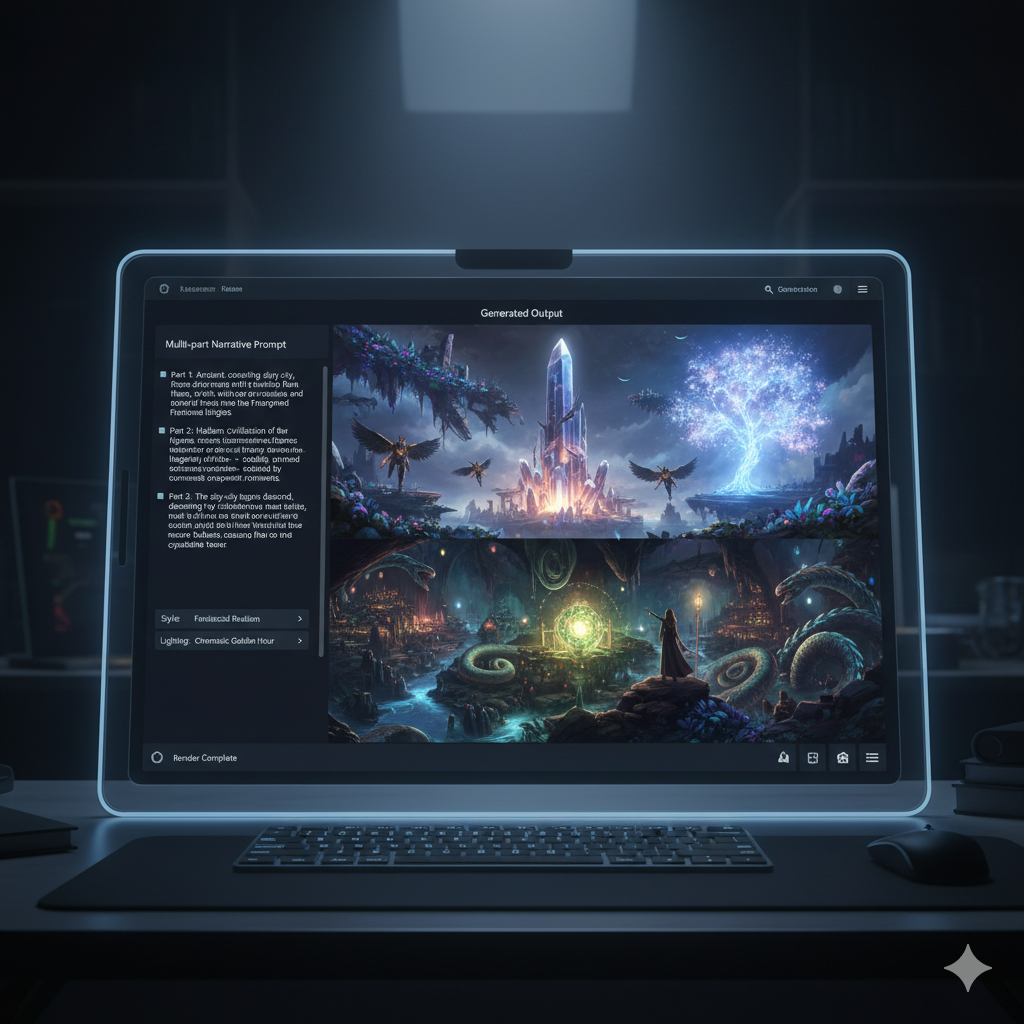
In the rapidly evolving landscape of artificial intelligence, text-to-image generators have transformed from mere novelty tools into sophisticated instruments for artistic expression. We’ve moved beyond simple prompts like “a cat in space” to generating incredibly detailed, atmospheric, and often emotionally resonant images. However, creating truly intricate, story-driven AI art that conveys a specific narrative or builds a cohesive world requires more than just a list of keywords. It demands an advanced approach: multi-part prompting.
This comprehensive guide delves deep into the art and science of multi-part prompting, an advanced prompt engineering technique designed to unlock the full narrative potential of AI art models. Whether you’re a seasoned prompt engineer looking to push boundaries or a creative individual eager to tell richer visual stories, this article will equip you with the knowledge and strategies to build complex worlds and intricate narratives, one carefully constructed prompt segment at a time. Get ready to transform your ideas from fleeting concepts into stunning visual sagas.
The Evolution of AI Art: Beyond Simple Prompts
Early iterations of AI art models were remarkable for their ability to interpret even basic textual descriptions and conjure images from them. A prompt like “a majestic dragon flying over a medieval castle at sunset, fantasy art, volumetric lighting” might yield an impressive standalone image. However, the limitation of such single-part prompts quickly became apparent when artists sought to tell a continuous story, depict evolving characters, or establish a coherent world. Each generation was a discrete event, lacking the connective tissue needed for narrative depth.
The challenge lay in communicating complex ideas, relationships, and sequential events to an AI that primarily processes each prompt as an independent request. Artists yearned to create not just isolated scenes, but entire visual sagas – a hero’s journey, a city’s growth, or the subtle shift in a character’s emotional state over time. This aspiration spurred the development and adoption of more nuanced prompting strategies, paving the way for what we now recognize as multi-part prompting. It’s about moving from generating snapshots to constructing elaborate visual tapestries, allowing creators to act as true digital architects of their imagined realities.
Understanding Multi-Part Prompting: The Core Concept
At its heart, multi-part prompting is the strategic division of a complex narrative or visual concept into several distinct, yet interconnected, prompt segments. Instead of attempting to cram every detail into a single, unwieldy text block, you break down your vision into manageable components, each designed to guide the AI towards a specific aspect of the overall scene or story. This approach is akin to a film director breaking down a script into individual shots, or a novelist outlining chapters and scenes.
The fundamental idea is that AI models, particularly the more advanced ones, can better synthesize information when it’s presented in a structured, hierarchical, or weighted manner. Multi-part prompting leverages this by allowing you to define different elements—characters, settings, actions, moods, artistic styles—either in distinct clauses within a single prompt, or by chaining together prompts, feeding generated images back into the system, or employing advanced techniques like image-to-image transformations. This granular control empowers artists to build narratives that evolve and maintain consistency across multiple images, thereby achieving a level of complexity and coherence previously unattainable.
Key advantages of adopting a multi-part prompting strategy include:
- Enhanced Consistency: By defining core elements (e.g., character appearance, architectural style) in early parts of your prompt structure, you can maintain these features across a series of images, crucial for narrative continuity.
- Greater Control and Precision: You can meticulously sculpt specific details, ensuring that intricate elements of your world or story are accurately represented without overwhelming the AI with a monolithic prompt.
- Facilitated Iteration: When a particular aspect isn’t quite right, you can isolate and modify just that part of the prompt without disrupting the entire vision, making the refinement process much more efficient.
- Deeper Narrative Expression: It allows for the subtle interplay of various elements, enabling the AI to generate images that convey complex emotions, sequential actions, and evolving themes.
- Reduced Prompt Confusion: Breaking down a complex idea into logical parts helps the AI parse and prioritize information more effectively, leading to fewer misinterpretations and more accurate outputs.
Ultimately, multi-part prompting transforms the act of AI art generation from a guessing game into a deliberate, architectural process, where each word and phrase serves a specific purpose in the grand design of your visual story.
Deconstructing Narrative: Elements of a Story-Driven Prompt
To effectively build intricate narratives with AI art, one must first understand the fundamental components of any story. By deconstructing your narrative vision into these core elements, you can then translate them into actionable, multi-part prompts. This methodical approach ensures that no critical aspect of your world or plot is left to chance.
Characters: Giving Life to AI Creations
Characters are the heart of many narratives, and conveying their appearance, personality, and emotional state through AI art is paramount. With multi-part prompting, you define your character’s attributes comprehensively and consistently. Consider:
- Physical Description: Detailed descriptions of their appearance (age, gender, ethnicity, hair color, eye color, build, distinctive features like scars or tattoos). For example, “a grizzled old wizard, long silver beard, piercing blue eyes, flowing crimson robes, a gnarled staff adorned with glowing runes.”
- Attire: Specifics about their clothing (style, fabric, color, accessories). “Wearing worn leather armor, a cloak of deep forest green, and a rusted iron amulet.”
- Expression and Pose: How they are feeling or what they are doing. “A look of weary determination on his face, standing defiantly, shoulders hunched.”
- Consistency Keywords: For continuity across multiple images, use unique descriptors or even a consistent reference image if your model supports it.
By dedicating a distinct part of your prompt to character details, you establish a visual identity that the AI can repeatedly draw upon, allowing for their evolution across a story arc.
Setting: Crafting Immersive Environments
The environment in which your story unfolds profoundly impacts its mood and context. Multi-part prompting allows for rich, layered descriptions of settings:
- Location: Specific geographical or architectural details (e.g., “a dimly lit subterranean cavern,” “a bustling futuristic cityscape,” “an ancient temple overgrown with vines”).
- Atmosphere and Weather: How the environment feels (e.g., “eerie, swirling mist,” “blazing desert sun,” “heavy rain cascading down”).
- Time of Day/Lighting: Crucial for mood. “Twilight glow filtering through dense canopy,” “harsh midday light casting sharp shadows,” “bioluminescent fungi illuminating the cave walls.”
- Architectural/Natural Details: Specific elements that define the space. “Towering Gothic spires, intricate stained glass,” or “ancient, colossal trees, glowing flora, winding roots.”
A well-defined setting provides the backdrop for your narrative, making the world feel tangible and lived-in. Consistency in environmental elements is key to world-building.
Plot and Action: Dynamic Storytelling
What happens in your story is conveyed through action. This is where multi-part prompting shines in depicting dynamic events:
- Specific Actions: What characters are doing (e.g., “wielding a glowing sword,” “whispering secrets,” “fleeing from a monstrous shadow”).
- Interaction: How characters interact with each other or their environment. “Two figures locked in intense debate,” “a hand reaching out to touch an ancient artifact.”
- Perspective and Framing: Camera angles and composition. “Close-up shot of his intense gaze,” “wide-angle view showing the vastness of the battlefield.”
- Sequential Events: For a true narrative, you’ll craft a series of prompts, each building on the last, depicting the progression of events.
By isolating actions, you can guide the AI to focus on the dynamism of a scene, ensuring the core narrative beats are visually emphasized.
Theme and Mood: Injecting Emotion and Purpose
Beyond literal descriptions, multi-part prompting allows you to infuse your art with deeper meaning and emotional resonance:
- Overall Mood: Adjectives describing the emotional tone (e.g., “somber,” “hopeful,” “menacing,” “serene,” “epic”).
- Artistic Style: Specifying the aesthetic (e.g., “oil painting by Rembrandt,” “cyberpunk anime style,” “photorealistic,” “art nouveau illustration”). Consistency here is vital for a unified visual language.
- Symbolism: Incorporating elements that carry deeper meaning. “A broken clock symbolizing lost time,” “a solitary bird representing freedom.”
- Color Palette: Suggesting specific colors or color schemes that evoke certain feelings (e.g., “monochromatic, dark blues and greys,” “vibrant, warm hues of a sunset”).
These elements provide the emotional and stylistic context, elevating your AI art from a mere depiction to a piece with genuine artistic intent and narrative depth.
Advanced Prompting Strategies for Intricate Narratives
Once you understand the narrative components, it’s time to explore the techniques that transform these elements into powerful AI art prompts. These strategies move beyond simple concatenation, embracing the nuanced capabilities of modern AI models.
The “Scene-by-Scene” Approach
This is arguably the most straightforward yet powerful multi-part strategy for narrative creation. Instead of one mega-prompt, you create a sequence of prompts, each describing a distinct scene or moment in your story. The key is maintaining consistency across these scenes.
- Establish Core Elements: Start with prompts that define your characters, primary settings, and overarching aesthetic style. For example: “A young elven sorceress, emerald eyes, braided auburn hair, flowing silk robes, holding a luminous crystal, detailed fantasy art.”
- Generate Initial Image/References: Use this initial prompt to generate a character or environment. Save these images.
- Progress the Narrative: For subsequent scenes, modify the prompt to describe the new action, expression, or slight change in environment, while retaining key descriptors for consistency. You might even feed the previous image back into the AI as an image-to-image input (if supported by your model) to guide the next generation. For example: “The young elven sorceress (referencing previous image), now with a look of surprise, crystal glowing brighter, surrounded by ancient glowing runes on stone walls, ominous atmosphere, detailed fantasy art.”
- Iterate and Refine: Each scene is a chance to refine elements. If the sorceress’s robes change too much, re-emphasize their description in the next prompt.
This method works exceptionally well for building sequential narratives or illustrating different facets of a character or location.
Weighted Prompting and Blending Techniques
Many AI models, particularly Stable Diffusion and Midjourney, allow you to assign weights or blend different parts of a prompt, giving you fine-tuned control over their influence:
- Prompt Weights: Using syntax like “
(concept A:1.2) and (concept B:0.8)” (Stable Diffusion) or “concept A::1.2, concept B::0.8” (Midjourney) lets you tell the AI which parts of your prompt are more important. This is invaluable for emphasizing a character’s defining feature or a crucial plot element. For instance, “a medieval knight, (shining full plate armor:1.5), (battle-scarred face:1.0), standing on a windswept cliff, storm clouds gathering, epic fantasy art” ensures the armor is prominent while still depicting the knight’s ruggedness. - Concept Blending: Some models allow direct blending of concepts. This is useful for merging character traits or stylistic elements. For example, creating a creature that is “part wolf, part dragon” can be achieved more effectively with blending or weighted syntax than a simple comma-separated list.
- Multi-Prompting (Midjourney V5.2+ / Niji): Midjourney allows for separating prompt parts with “
AND” or “::” which treats them as separate concepts that the AI tries to incorporate. This can create powerful juxtapositions or ensure different narrative elements are all present without confusing the model. For instance, “A lone astronaut standing on a desolate alien planet AND a crashed spaceship in the background AND twin suns on the horizon” can ensure all three distinct elements appear.
Negative Prompting for Precision
Just as important as telling the AI what you want is telling it what you don’t want. Negative prompting allows you to exclude undesirable elements, maintaining purity and focus in your narrative:
- Removing Distractions: Use negative prompts to eliminate common AI artifacts, unwanted objects, or stylistic inconsistencies. Examples: “
ugly, blurry, deformed, extra limbs, poor quality, watermark, text” are common general negative prompts. - Refining Narrative Elements: If your character keeps appearing with a smile when they should be serious, add “
--no smile, happy” (Midjourney) or include “smile, happy” in your negative prompt for other models. This is particularly useful for controlling emotions and specific actions. - Maintaining Artistic Cohesion: If you’re aiming for a photorealistic style, you might negatively prompt “
cartoon, illustration, painting, sketch” to prevent stylistic drift.
Mastering negative prompting is crucial for polishing your AI art and ensuring it aligns perfectly with your narrative vision.
Using Reference Images and ControlNets
For unparalleled consistency in characters, poses, or architectural structures, integrating reference images is a game-changer:
- Image-to-Image (Img2Img): Many models allow you to input an existing image alongside a text prompt. The AI then uses the image as a structural or stylistic guide, transforming it based on your new text description. This is invaluable for evolving a character’s pose or expression while retaining their core appearance.
- ControlNets (Stable Diffusion): ControlNets are a revolutionary development, offering precise control over composition, pose, depth, and even specific edge details from a reference image. You can provide a sketch (Canny), a stick figure (OpenPose), or a depth map to guide the AI’s generation. This is perfect for maintaining consistent character poses across multiple scenes, or ensuring buildings have a specific silhouette. For narrative purposes, you can generate a base pose with OpenPose and then apply various textual descriptions to it, creating different scenes with the same character posture.
- IP-Adapters (Stable Diffusion): IP-Adapters allow you to transfer the “style” or “identity” from one image to a new generation, without necessarily copying the structure. This is incredibly useful for maintaining a consistent character likeness or artistic aesthetic across a series of diverse scenes.
These tools bridge the gap between abstract textual commands and concrete visual guidance, offering a level of control previously thought impossible.
Iterative Refinement: The Loop of Creation
Creating intricate AI art narratives is rarely a one-shot process. It’s an iterative loop of generation, evaluation, and refinement. Think of it as sculpting: you lay down the broad strokes, then slowly chip away and add details until your vision is fully realized.
The iterative refinement process involves:
- Initial Prompting: Begin with your first multi-part prompt, focusing on the most critical elements of your scene or character. Generate a set of images.
- Evaluation: Critically analyze the generated images. Ask yourself:
- Does it accurately represent the character, setting, or action?
- Is the mood or theme conveyed effectively?
- Are there any unexpected or undesirable elements?
- How does it align with your overall narrative vision?
- Refinement: Based on your evaluation, modify your prompt. This might involve:
- Adding more descriptive words for clarity.
- Adjusting prompt weights to emphasize or de-emphasize elements.
- Introducing negative prompts to remove unwanted features.
- Changing artistic styles or lighting cues.
- If using image-to-image, adjusting the ‘strength’ or ‘denoising’ parameters to control how much the AI deviates from the input image.
- Re-generation: Submit your refined prompt and generate new images.
- Repeat: Continue this loop until you achieve the desired result for that particular scene or narrative beat.
This process is not just about fixing errors; it’s about discovering new possibilities. Often, the AI will present unexpected interpretations that can inspire new directions for your narrative. Embrace this serendipity, but always guide it back towards your overarching vision. Documenting your prompts and the resulting images is also crucial, especially when working on a long narrative, to maintain a consistent style and character appearance across many generations.
Navigating Specific AI Art Models: Strengths and Nuances
While the principles of multi-part prompting are universal, the implementation and effectiveness can vary significantly between different AI art models. Understanding the unique characteristics of popular models like Midjourney, Stable Diffusion, and DALL-E 3 is key to optimizing your narrative generation process.
Midjourney’s Intuitive Storytelling
Midjourney excels at producing aesthetically pleasing, often painterly, and highly imaginative images with less explicit prompting. Its strength lies in its ability to interpret abstract concepts and combine them harmoniously. For multi-part prompting, Midjourney offers:
- Simplified Syntax: It often requires less technical jargon, focusing more on descriptive language. You can separate prompt parts with “
::” to treat them as distinct concepts or use “AND” to ensure multiple high-level ideas are present. - Aesthetic Cohesion: Midjourney is very good at maintaining a consistent aesthetic across many generations, making it excellent for long-form visual narratives where style continuity is paramount.
- Parameter Control: While not as granular as Stable Diffusion, parameters like
--stylize,--chaos,--ar(aspect ratio), and--seedcan be used to control the visual output and maintain consistency. Using the same--seedcan help maintain similar compositions for sequential scenes. - Creative Interpretation: It often injects its own creative flair, which can be a double-edged sword. While it might lead to unexpected beauty, it can sometimes deviate from very precise instructions, requiring more iterative refinement for exact narrative matches.
Midjourney is ideal for artists who prefer to guide rather than command, allowing the AI to co-create the visual story with a distinct artistic voice.
Stable Diffusion’s Granular Control
Stable Diffusion, being open-source and highly customizable, offers unparalleled control and flexibility, making it a powerhouse for intricate multi-part prompting, especially for users willing to delve into technical details:
- Explicit Weighting: Its ability to precisely weight prompt elements (e.g., “
(concept:weight)“) allows for meticulous balancing of narrative components. This is crucial for ensuring specific characters or objects are prominent without losing other details. - Advanced ControlNets and IP-Adapters: This is where Stable Diffusion truly shines for narrative consistency. ControlNets allow artists to maintain character poses, compositional layouts, and structural integrity across dozens of images. IP-Adapters ensure character likeness and stylistic continuity. These tools are indispensable for creating sequential art or comics.
- Model Variety: The vast ecosystem of custom Stable Diffusion models (checkpoints) means you can select models specifically trained for certain styles (e.g., anime, photorealism, fantasy) or even character generation, further enhancing narrative precision.
- Negative Prompting Power: Stable Diffusion’s negative prompting capabilities are very robust, allowing for detailed exclusion of unwanted features, vital for maintaining a clean and focused narrative.
Stable Diffusion is the choice for prompt engineers who demand maximum control, are comfortable with technical parameters, and want to meticulously craft every aspect of their visual narrative.
DALL-E 3’s Textual Understanding
DALL-E 3, particularly through interfaces like ChatGPT or Copilot, distinguishes itself with its exceptional understanding of natural language and context. It’s often praised for its ability to interpret complex, conversational prompts and produce highly accurate results:
- Superior Language Interpretation: DALL-E 3 can parse much longer and more complex sentences than its predecessors, making it excellent for directly inputting narrative descriptions. It understands nuances and relationships between objects in a way that feels more intuitive.
- Built-in Cohesion: When prompted conversationally, DALL-E 3 often does a better job of generating cohesive scenes from a single, descriptive multi-part prompt without needing explicit weighting syntax, although it does have its own internal weighting mechanisms.
- Ideal for “Prompt Chaining” via Chatbots: When accessed through a chatbot interface, DALL-E 3 excels at prompt chaining. You can describe a scene, ask for variations, then refine specific elements in subsequent turns, allowing the AI to remember context and build upon previous generations. This mimics a true narrative progression.
- Less Direct Control over Style Parameters: While its output is often stunning, DALL-E 3 offers fewer direct numerical parameters for fine-tuning style or compositional elements compared to Midjourney or Stable Diffusion. Its control comes more from the specificity and clarity of your language.
DALL-E 3 is an excellent tool for those who prefer to communicate their narrative visions in plain, expressive language, relying on the AI’s advanced understanding to translate complex descriptions into compelling visuals.
Ethical Considerations and Responsible World-Building
As we gain increasing power to build worlds with AI, it becomes paramount to address the ethical considerations inherent in this technology. Responsible multi-part prompting for intricate narratives means being mindful of the origins of AI training data, the potential for bias, and the impact of the content we create.
- Bias in Training Data: AI models are trained on vast datasets of existing images and text. These datasets often reflect societal biases in terms of gender, race, culture, and representation. When crafting characters and worlds, be aware that the AI might default to stereotypical depictions. Actively counteract this by explicitly prompting for diverse representations, unique character designs, and varied cultural contexts. For example, instead of “a warrior,” specify “a female East African warrior with intricate tribal markings.”
- Intellectual Property and Style Mimicry: While AI can generate art in the “style of” famous artists, there are ongoing debates about intellectual property and fair use. When creating narratives, aim for originality and inspiration rather than direct imitation. Phrase prompts to evoke a style (e.g., “in a painterly, impressionistic style”) rather than directly naming specific living artists, especially if the art is for commercial use.
- Content Moderation and Harmful Narratives: Be responsible with the content you generate. Avoid creating or propagating harmful stereotypes, hateful imagery, or non-consensual content. Most AI art platforms have robust content filters for good reason. Use your power to build positive, inclusive, and thought-provoking narratives.
- Transparency and Attribution: When sharing your AI-generated art, it’s good practice to be transparent about its creation. Acknowledge that AI tools were used, and credit the specific models if possible. This helps foster understanding and prevents misrepresentation.
- Environmental Impact: Training and running large AI models consume significant energy. While individual prompting doesn’t have a massive footprint, being mindful of the technology’s overall energy demands and advocating for more efficient models is part of responsible tech use.
Building worlds with words is not just a creative act; it is a responsibility. By being conscious of these ethical dimensions, we can ensure that AI art narratives contribute positively to the broader cultural and artistic landscape.
Comparison of Prompting Techniques
Understanding the nuances between different prompting approaches is crucial for choosing the right strategy for your narrative goals. Here, we compare the traditional single-part prompting with the more advanced multi-part technique.
| Feature | Single-Part Prompting | Multi-Part Prompting | Key Advantage for Narratives |
|---|---|---|---|
| Prompt Length/Complexity | Typically shorter, concise, often a list of keywords. | Longer, structured into segments, potentially with weights or separations. | Allows for granular detail and complex relationships. |
| Level of Control | Limited; AI interprets the entire prompt as one block. Difficult to emphasize specific elements. | High; individual elements can be weighted, separated, or refined independently. | Precise guidance for characters, settings, actions, and emotions. |
| Consistency Across Generations | Low; difficult to maintain character likeness, style, or specific details across multiple images without constant re-prompting. | Moderate to High; easier to carry over core elements using consistent descriptors, seeds, or image references. | Essential for sequential storytelling and world cohesion. |
| Narrative Depth Potential | Limited to single, static scenes or isolated concepts. Storytelling is often implied rather than explicit. | High; enables explicit sequential storytelling, character development, and complex world-building. | Facilitates the creation of visual sagas and rich character arcs. |
| Iteration & Refinement | Requires significant re-writing of the entire prompt for changes, often leading to unintended shifts in other elements. | More efficient; specific parts of the prompt can be adjusted without disrupting the whole, leading to faster refinement. | Streamlines the creative process, allowing for focused improvements. |
| Best Use Case | Quick concept generation, standalone images, simple ideas. | Elaborate visual stories, consistent character/world design, comic panels, animations (with further tools). | Unlocking the full potential of AI for storytelling. |
As evident from the table, while single-part prompting serves well for immediate gratification and simple ideas, multi-part prompting is the indispensable tool for anyone serious about crafting intricate and coherent narratives with AI art.
AI Model Capabilities for Multi-Part Prompting
Different AI models interpret and execute multi-part prompts with varying degrees of success and through different syntaxes. This table highlights their general capabilities.
| Feature/Capability | Midjourney | Stable Diffusion (e.g., Automatic1111/ComfyUI) | DALL-E 3 (via ChatGPT/Copilot) |
|---|---|---|---|
| Prompt Weighting Syntax | :: (e.g., concept A::1.5 concept B::0.8) for conceptual separation and importance. |
(concept:weight) (e.g., (concept A:1.2), (concept B:0.8)). |
Primarily through natural language emphasis and sentence structure. Less explicit numerical weighting. |
| Negative Prompting | --no parameter (e.g., --no blurry, text). |
Dedicated negative prompt field (e.g., ugly, deformed, extra fingers). Highly effective. |
Can be implicitly included in conversational prompts (e.g., “ensure there are no…”). |
| Image-to-Image (Img2Img) | By adding an image URL at the start of the prompt. Influences style/composition. | Core feature, highly customizable with denoising strength. Excellent for transformation. | Often used implicitly when refining an image in a conversational flow; less direct parameter control. |
| Structural/Pose Control | Limited direct control, relies on prompt detail or seed consistency. | Advanced: ControlNets (OpenPose, Canny, Depth, Normal, etc.) offer unparalleled structural control. | Relies on highly detailed natural language descriptions of poses and composition. |
| Character Consistency | Can be challenging; benefits from consistent seed and detailed initial prompt. Image prompts help. | Advanced: IP-Adapters, LoRAs, Dreambooth models for specific character likeness. ControlNets for poses. | Strong language understanding helps, but still requires careful prompting to avoid drift. Conversational flow aids consistency. |
| Narrative Flow & Chaining | Effective with consistent seeds and careful prompt evolution for sequential images. | Highly effective due to explicit control, ControlNets, and ability to build on previous generations. | Excellent through conversational prompting in chat interfaces, allowing for contextual memory. |
This comparison highlights that while all major AI art models can be used for multi-part prompting, Stable Diffusion currently offers the deepest and most granular control for truly intricate narrative construction, particularly for maintaining consistency. Midjourney and DALL-E 3, however, offer more intuitive and natural language-driven pathways to complex visual stories.
Practical Examples: Bringing Narratives to Life
To truly grasp the power of multi-part prompting, let’s explore some real-world scenarios and breakdown how they might be constructed.
Case Study 1: The Whispering Forest of Eldoria
Narrative Goal: To depict a journey through an ancient, magical forest, showcasing its changing atmosphere and a hidden, mystical guardian.
- Scene 1: Entering the Forest
Prompt Elements: Start of journey, hopeful, ancient trees, dappled light, sense of wonder.
Example Prompt (General AI Model):
A lone adventurer, young woman with fiery red hair, leather armor, determined expression, walking into an ancient forest, giant oak trees, sunlight filtering through dense canopy, ethereal mist, vibrant green moss, fantasy art, volumetric lighting, wide shot. - Scene 2: Encountering the Mystical Guardian
Prompt Elements: Same adventurer, deeper in forest, darker, mysterious, glowing guardian appearing, surprise, slight apprehension.
Example Prompt (Midjourney):
The lone adventurer::1.2 (from previous scene, consistent seed), deeper in the ancient forest, now with a slightly wary expression, thick twisting vines, bioluminescent flora, a majestic forest guardian emerging from the mist, tall and slender with glowing antlers, eyes like amber, ancient magic, intricate details, dark fantasy, medium shot, --ar 16:9 --seed [same seed as scene 1] - Scene 3: A Moment of Connection
Prompt Elements: Adventurer and guardian together, peaceful, understanding, glowing magic, close-up, warm light.
Example Prompt (Stable Diffusion with Img2Img and OpenPose):
(Input Reference: A rough sketch of two figures facing each other, one slightly taller, with an OpenPose ControlNet enabled.)
Prompt: A young woman (consistent appearance from previous), standing gently beside a tall forest guardian (consistent appearance), a warm, soft glow emanating from both, their hands almost touching, conveying peace and ancient understanding, intricate details, ethereal fantasy art, close-up, warm golden light, depth of field.Negative Prompt: ugly, deformed, extra limbs, dark, scary, aggressive.
This sequence allows for a clear narrative progression, maintaining character and environmental consistency while evolving the emotional tone and action.
Case Study 2: The Steampunk Detective’s Dilemma
Narrative Goal: To illustrate a steampunk detective in a retro-futuristic city, solving a case that involves a mysterious, complex machine.
- Scene 1: The Detective’s Office
Prompt Elements: Detective introduction, steampunk aesthetic, cluttered office, clues, thoughtful mood.
Example Prompt (General AI Model):
A grim steampunk detective, male, trench coat, goggles pushed up on his top hat, intricate brass mechanical arm, sitting at a cluttered desk filled with gears and maps, light from a gas lamp, foggy Victorian city visible through window, intricate details, film noir style, wide shot. - Scene 2: Discovering the Mysterious Device
Prompt Elements: Same detective, in a different, darker setting, focus on a strange, glowing machine, expression of curiosity and urgency.
Example Prompt (DALL-E 3 via ChatGPT):
User: “Now show the same steampunk detective in a dimly lit, abandoned factory. He’s standing over a large, glowing, intricate brass and copper machine that pulses with a strange blue light. His expression should be one of intense curiosity mixed with a hint of dread. Keep the steampunk, Victorian noir style consistent.”
- Scene 3: A Chase Through the City Streets
Prompt Elements: Detective in action, dynamic, running through city, steam, flying vehicles, urgency.
Example Prompt (Midjourney):
The grim steampunk detective (consistent features), running desperately through a rain-slicked steampunk city street at night, towering clockwork buildings, steam vents erupting, dirigibles flying overhead, dynamic action shot, motion blur, dramatic lighting, Victorian aesthetic, --ar 3:2
These examples demonstrate how breaking down a narrative into sequential, descriptive prompts allows for the creation of rich, evolving visual stories, leveraging the specific strengths of each AI model.
Frequently Asked Questions
Q: What exactly is multi-part prompting?
A: Multi-part prompting is an advanced technique in AI art generation where a complex visual narrative or concept is broken down into several distinct, structured segments within a single prompt, or across a series of prompts. Instead of a single, monolithic description, you use various syntaxes, weights, or conversational turns to guide the AI on different aspects like characters, settings, actions, and styles, leading to more coherent and intricate visual stories.
Q: Why should I use multi-part prompting instead of a simple prompt?
A: Simple prompts are great for quick, isolated images. However, for intricate narratives, multi-part prompting offers superior control, consistency, and depth. It allows you to build complex worlds, maintain character likeness across scenes, depict sequential actions, and fine-tune specific elements without overwhelming the AI, resulting in richer, more story-driven art that would be impossible with a single, unsegmented prompt.
Q: How do I ensure character consistency across multiple images?
A: Ensuring character consistency is a key challenge and a primary benefit of multi-part prompting. Strategies include: 1) Using highly specific and consistent descriptive terms for the character in every prompt. 2) Employing the same seed number (if your model supports it) for similar poses or compositions. 3) Utilizing image-to-image (Img2Img) where you feed a previously generated character image as a reference. 4) For Stable Diffusion users, leveraging ControlNets (like OpenPose for pose consistency) or IP-Adapters/LoRAs trained on your character’s likeness offers the most robust solution.
Q: Can multi-part prompting be used for animation or comic book creation?
A: Absolutely! Multi-part prompting is foundational for these mediums. For comic books, each panel can be a distinct multi-part prompt, ensuring character and setting consistency while advancing the plot. For animation, you can generate keyframes using multi-part prompts and then use video interpolation or other AI tools to create the in-between frames, providing a structured approach to visual storytelling in motion.
Q: What’s the role of negative prompting in multi-part narratives?
A: Negative prompting is crucial for refining your narrative. It allows you to explicitly tell the AI what you don’t want in your images, thereby preventing unwanted elements, stylistic inconsistencies, or common AI artifacts. For narrative art, this is vital for maintaining a clean aesthetic, avoiding distractions, and ensuring that emotional expressions or specific actions are not misinterpreted by the AI (e.g., prompting for a serious look while negatively prompting for “smile, happy”).
Q: Is multi-part prompting model-specific, or are there universal principles?
A: While the underlying principles of deconstructing a narrative and providing structured input are universal, the specific syntax and optimal implementation of multi-part prompting vary significantly between AI models. Midjourney uses “::” for weighting and “AND” for concept separation, Stable Diffusion uses “(concept:weight)” and specialized ControlNets, and DALL-E 3 relies more on advanced natural language understanding within conversational interfaces. Learning the nuances of your preferred model is key.
Q: How long should my multi-part prompts be?
A: There’s no fixed rule, but generally, prompts should be as descriptive as necessary without becoming overly verbose or confusing. It’s often better to have several distinct, focused parts than one giant, rambling sentence. Some models (like DALL-E 3) handle longer, more conversational prompts well, while others (like Stable Diffusion) benefit from concise, weighted segments. The goal is clarity and precision for the AI, not maximum word count.
Q: What are common pitfalls to avoid when using multi-part prompting?
A: Common pitfalls include: 1) Over-prompting, where too many conflicting instructions confuse the AI. 2) Lack of consistency in terminology, leading to character or setting drift. 3) Neglecting negative prompts, resulting in unwanted elements. 4) Not iterating enough, settling for “good enough” instead of refining to “perfect.” 5) Forgetting the narrative arc, leading to visually stunning but narratively disconnected images. Planning and systematic refinement are key to overcoming these.
Q: Can I combine multi-part prompting with reference images?
A: Absolutely, and it’s highly recommended! Combining multi-part text prompts with reference images (using Img2Img or ControlNets) significantly enhances control and consistency. The text prompt defines the narrative, style, and details, while the reference image provides structural, compositional, or character likeness guidance, creating a powerful synergy for intricate art generation.
Q: What is the learning curve for mastering multi-part prompting?
A: The learning curve varies. Basic multi-part concepts are relatively easy to grasp. However, mastering it, especially for complex narratives and specific model syntaxes, requires practice, experimentation, and a willingness to iterate. It’s a skill that develops over time, much like any creative craft. Starting with simpler narrative ideas and gradually increasing complexity is a good approach.
Key Takeaways for Mastering Intricate AI Art Narratives
- Deconstruct Your Narrative: Break down your story into core elements: characters, settings, plot, and theme/mood. Each element informs a part of your prompt.
- Structure Your Prompts: Utilize multi-part prompting techniques such as scene-by-scene generation, weighted prompts, and explicit concept separation to guide the AI precisely.
- Embrace Iteration: AI art is a process of generation, evaluation, and refinement. Be prepared to adjust your prompts multiple times to achieve your vision.
- Leverage Model-Specific Strengths: Understand how Midjourney, Stable Diffusion, and DALL-E 3 interpret prompts and use their unique features (e.g., ControlNets, Img2Img, conversational AI) to your advantage.
- Prioritize Consistency: For ongoing narratives, consistent character descriptions, stylistic keywords, and the smart use of seeds or image references are paramount.
- Utilize Negative Prompting: Actively tell the AI what you don’t want to prevent visual clutter and maintain artistic focus.
- Combine Modalities: Integrate text prompts with image references (Img2Img, ControlNets) for unparalleled control over composition and likeness.
- Practice Ethical World-Building: Be mindful of biases, intellectual property, and responsible content creation when crafting your AI art narratives.
- Experiment and Document: The field is constantly evolving. Keep experimenting with new techniques and document your successful prompts for future reference.
Conclusion: Your Canvas Awaits
The journey from a single keyword to a sprawling, intricate AI art narrative is a testament to the rapid advancements in prompt engineering and the creative potential of artificial intelligence. Multi-part prompting is not merely a technical trick; it is a philosophy, a disciplined approach that empowers artists, writers, and storytellers to transcend the limitations of simple commands and truly build worlds with words.
By dissecting your vision into manageable, weighted segments, by understanding the nuanced capabilities of each AI model, and by embracing the iterative dance of creation and refinement, you gain unparalleled control over the visual output. The ability to craft consistent characters, evocative settings, and compelling plot points across a series of images transforms AI art from an interesting novelty into a powerful tool for sequential storytelling.
The canvas of the digital realm is vast, and with multi-part prompting, your imagination is the only true limit. Go forth, experiment, and meticulously craft the next breathtaking visual saga that captivates and inspires. The era of intricate AI art narratives has just begun, and you hold the key to unlocking its boundless possibilities.



































































Leave a Reply