
In a world increasingly dominated by visual content, the ability to create stunning, unique, and compelling images is more critical than ever. From social media feeds to professional portfolios, high-quality visuals capture attention, convey messages, and tell stories. For decades, achieving professional-grade imagery required specialized skills, expensive equipment, and significant time investment. However, a revolutionary technology is now democratizing this creative power: AI image-to-image generation.
This groundbreaking form of artificial intelligence doesn’t just create images from scratch based on a text prompt; it takes an existing image and intelligently transforms it, reinterpreting its essence according to new instructions. Imagine taking a simple sketch and turning it into a photorealistic rendering, changing the style of a photograph to mimic a famous painter, or seamlessly removing unwanted objects from a scene – all with remarkable ease and speed. AI image-to-image generation is not merely an enhancement; it’s a fundamental shift in how we approach photo creation, opening up unprecedented creative possibilities for artists, designers, marketers, and enthusiasts alike.
In this comprehensive guide, we will delve deep into the fascinating world of AI image-to-image generation. We will explore its underlying mechanics, dissect its various applications, compare popular tools, examine its profound impact on creative industries, and address the ethical considerations that accompany such powerful technology. Prepare to reimagine what’s possible with your visuals, as AI image-to-image generation is truly redefining the landscape of photo creation.
1. What is AI Image-to-Image Generation? The Core Concept
At its heart, AI image-to-image generation is a specialized branch of generative artificial intelligence focused on transforming one image into another. Unlike its sibling, text-to-image generation (where AI creates a visual from a textual description), image-to-image (often abbreviated as img2img) takes an existing visual input as its primary guide and then modifies, enhances, or completely reinvents it based on further instructions, typically in the form of a text prompt or another reference image.
Think of it as having an incredibly skilled digital artist who can take any photo you provide and reshape it according to your vision. You give them a landscape photo, and instruct them, “Make this look like a painting by Vincent van Gogh.” Or you provide a simple line drawing and say, “Turn this into a realistic architectural rendering during sunset.” The AI acts as an intelligent translator, understanding the content and context of the input image, and then generating a new output that adheres to both the original visual information and the new creative directive.
The process generally involves feeding an input image into an AI model, often accompanied by a text prompt (sometimes called a “conditioning” prompt) that describes the desired transformation. The AI then processes this information, leveraging its vast knowledge gained from training on millions of images, to produce a novel output image that retains certain characteristics of the original while incorporating the stylistic or structural changes requested.
This capability is incredibly powerful because it allows creators to work with existing assets, iterating and experimenting without starting from scratch. It bridges the gap between conceptualization and realization, turning vague ideas or rough drafts into polished, high-quality visuals with remarkable efficiency.
2. The Underlying Technology: How It Works Under the Hood
The magic behind AI image-to-image generation is a testament to significant advancements in deep learning. While various architectures exist, the two most prominent families of models that power these transformations are Generative Adversarial Networks (GANs) and, more recently and predominantly, Diffusion Models.
2.1. Generative Adversarial Networks (GANs)
Early breakthroughs in image-to-image translation were largely driven by GANs, introduced by Ian Goodfellow and his colleagues in 2014. GANs operate on an adversarial principle, pitting two neural networks against each other:
- The Generator: This network’s job is to create new images. In the context of image-to-image, it takes the input image and attempts to transform it into the desired output.
- The Discriminator: This network’s job is to distinguish between real images from the training dataset and fake images generated by the Generator.
The two networks engage in a continuous “game.” The Generator tries to produce images so realistic that the Discriminator can’t tell they’re fake, while the Discriminator tries to become better at identifying fakes. Through this iterative process, both networks improve, and eventually, the Generator becomes capable of producing highly convincing, often photorealistic, images. For image-to-image tasks, specific GAN architectures like CycleGAN were pivotal, allowing transformations between unpaired image collections (e.g., horse photos to zebra photos without needing perfectly matched pairs).
While powerful, GANs often face challenges such as training instability, mode collapse (where the generator produces only a limited variety of outputs), and difficulty in generating diverse images.
2.2. Diffusion Models
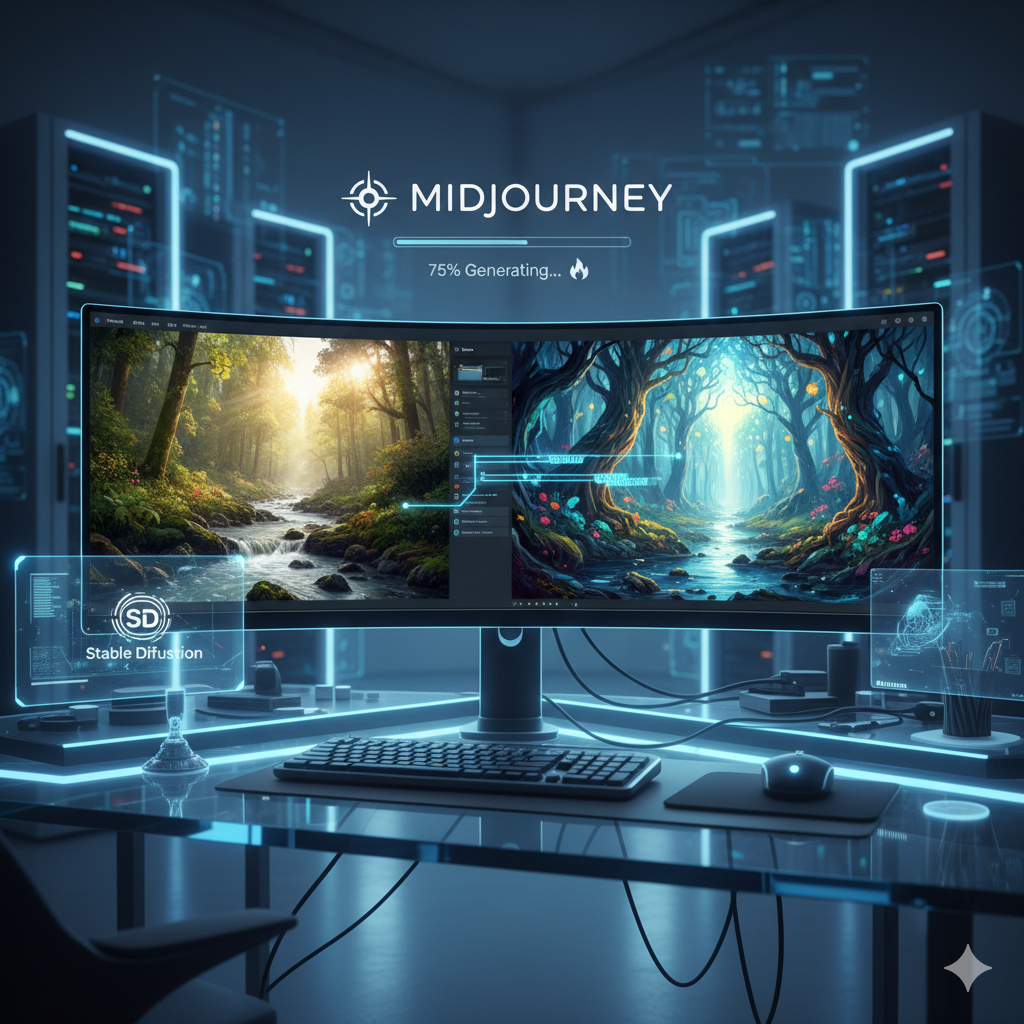
In recent years, Diffusion Models have emerged as the dominant architecture for state-of-the-art image generation, including image-to-image tasks. They overcome many of the limitations of GANs and are responsible for the impressive quality seen in tools like Stable Diffusion, Midjourney, and DALL-E 3.
Diffusion Models work by learning to reverse a process of gradually adding noise to an image. The training involves two main stages:
- Forward Diffusion (Noising Process): An original image is progressively corrupted by adding Gaussian noise over several steps, until it becomes pure noise.
- Reverse Diffusion (Denoising Process): The model learns to reverse this process. It’s trained to predict and remove the noise at each step, starting from a pure noise image and gradually reconstructing the original image.
For image-to-image generation, the input image can be incorporated into this denoising process in several ways. For instance, instead of starting from pure random noise, the process might start from a slightly noised version of the input image. A text prompt then guides the denoising process towards a specific target style or content. This is often achieved through a mechanism called conditioning, where the textual embedding (a numerical representation of the text prompt) influences the denoising steps, ensuring the generated image aligns with the prompt’s instructions.
Latent Diffusion Models, like Stable Diffusion, further enhance efficiency by performing the diffusion process not directly on the high-resolution pixel space of images, but on a lower-dimensional “latent space.” This significantly reduces computational costs while maintaining high quality, making it feasible to run these models on consumer-grade hardware or within web services.
2.3. Control Mechanisms and Conditioning
A crucial aspect of image-to-image is the ability to control the transformation. Modern AI models offer sophisticated control mechanisms:
- Text Prompts: The most common method, allowing users to describe the desired output in natural language (e.g., “turn this into an oil painting,” “add a futuristic cityscape in the background”).
- Image Strength/Denoising Strength: A parameter that determines how much the AI should deviate from the original image. A low strength retains much of the original, while a high strength allows for more drastic transformations.
- Masking: Users can select specific areas of an image (e.g., for inpainting to remove an object, or for outpainting to expand a scene).
- ControlNet: A groundbreaking addition, especially for Stable Diffusion, that allows unprecedented control over composition. ControlNet takes additional input maps (like pose skeletons, depth maps, edge detection, or segmentation maps) and uses them to guide the generative process, ensuring precise control over the structure and layout of the output image.
These underlying technologies, particularly diffusion models combined with advanced control mechanisms, empower AI image-to-image tools to perform incredibly nuanced and powerful transformations, making them indispensable for contemporary visual creation.
3. Key Applications and Versatile Use Cases
The versatility of AI image-to-image generation makes it a powerful tool across a multitude of domains. Its applications extend far beyond simple photo filters, enabling complex transformations and streamlining creative workflows.
3.1. Artistic Style Transfer and Creative Enhancement
- Artistic Transformation: Apply the visual style of famous painters (e.g., Van Gogh, Monet, Picasso) or any reference image to a photograph, turning a realistic scene into a unique piece of digital art.
- Concept Art Generation: Quickly generate multiple artistic interpretations of a single sketch or reference image, aiding artists in exploring different visual directions for games, films, or illustrations.
- Mood Board Creation: Effortlessly transform a collection of images into a cohesive aesthetic, creating instant mood boards for design projects.
3.2. Advanced Image Editing and Manipulation
- Inpainting (Object Removal/Filling Gaps): Selectively remove unwanted objects, blemishes, or even entire people from a photo. The AI intelligently fills the masked area with content consistent with the surroundings, making the removal appear seamless.
- Outpainting (Expanding Images): Extend the boundaries of an existing image, allowing the AI to generate new content that logically continues the scene beyond its original borders. This is incredibly useful for adapting images to different aspect ratios or creating wider vistas.
- Attribute Modification: Change specific elements within an image, such as hair color, clothing style, facial expressions, background scenery, or even the time of day and weather conditions, all based on textual prompts.
- Image Restoration: Breathe new life into old, damaged, or low-resolution photographs by upscaling them, adding color, and digitally repairing missing parts.
- Variations Generation: Create multiple alternative versions of an input image, each with subtle differences in composition, lighting, or style, ideal for A/B testing or diverse content creation.
3.3. Content Creation and Prototyping
- Product Visualization: Transform basic product photos into high-quality lifestyle shots, placing products in various realistic or imaginative environments without the need for expensive photoshoots.
- Architectural Rendering: Convert simple 2D sketches or wireframe models of buildings into photorealistic architectural renderings, complete with detailed textures, lighting, and landscaping.
- Fashion Design: Visualize garment designs on virtual models, experiment with different fabrics, patterns, and colors, and instantly generate variations of clothing items.
- Marketing Material Generation: Rapidly produce diverse visual assets for advertising campaigns, social media posts, and website content, tailored to specific demographics or themes.
3.4. Data Augmentation for AI Training
Beyond creative applications, image-to-image generation plays a vital role in training other AI models. By generating variations of existing images (e.g., rotating, cropping, adding noise, changing lighting), it creates larger and more diverse datasets, which significantly improves the robustness and accuracy of models used for tasks like object detection, facial recognition, and medical image analysis.
These diverse applications highlight the transformative potential of AI image-to-image technology, making it an invaluable asset across industries and creative pursuits.
4. Popular AI Image-to-Image Tools and Platforms
The landscape of AI image generation tools is rapidly evolving, with several platforms offering robust image-to-image capabilities. Each tool has its unique strengths, target audience, and feature set.
4.1. Stable Diffusion
Stable Diffusion stands out as a powerful, open-source latent diffusion model that has significantly democratized AI image generation. Its img2img capabilities are highly versatile:
- Open-Source and Customizable: Users can run it locally on their own hardware (with a capable GPU) or access it through various web interfaces and cloud services. This open nature fosters a massive community creating custom models (checkpoints), extensions, and workflows.
- High Control: Stable Diffusion, especially when combined with extensions like ControlNet, offers unparalleled control over the transformation process. You can use image prompts, text prompts, denoising strength, masking for inpainting/outpainting, and specific control maps (like Canny edges, depth maps, or pose estimation) to guide the generation precisely.
- Diverse Implementations: Popular user interfaces (UIs) like Automatic1111’s WebUI and ComfyUI provide extensive features for img2img, including batch processing, scripting, and advanced editing options.
- Flexibility: Ideal for artists, developers, and researchers who want deep customization and control over the output, or for commercial applications requiring specific, repeatable results.
4.2. Midjourney
Midjourney is renowned for its ability to produce highly aesthetic, artistic, and often surreal images. While primarily known for text-to-image, its image-to-image features are excellent for style transfer and generating variations:
- Artistic Quality: Midjourney excels at creating visually stunning outputs with a distinct artistic flair, often described as having a “painterly” or “cinematic” quality.
- User-Friendly (Discord-based): Access to Midjourney is primarily through a Discord bot, making it accessible to users who are comfortable with chat interfaces. Its prompt engineering can be simple or highly detailed.
- Image Prompts for Style/Composition: Users can upload an image and use it as an “image prompt” alongside a text prompt. This allows Midjourney to derive style, composition, or content cues from the uploaded image, blending it with the textual instructions to create variations or transformations.
- Fast Iteration: It’s great for quickly exploring numerous stylistic directions or creating variations of an initial concept.
4.3. DALL-E 3 (via ChatGPT Plus/API)
OpenAI’s DALL-E 3, particularly when integrated with ChatGPT Plus, offers a highly intuitive and powerful image generation experience:
- Natural Language Understanding: DALL-E 3, especially through ChatGPT, excels at interpreting complex, nuanced natural language prompts, often leading to more accurate and desired results without extensive prompt engineering.
- Inpainting/Outpainting Capabilities: Users can leverage its advanced editing features to modify specific parts of an image or expand its canvas, often facilitated by interactive tools within the interface.
- Contextual Generation: Its tight integration with ChatGPT allows for conversational refinement of image requests, making iterative editing and transformation very fluid.
- High Fidelity: DALL-E 3 generates high-quality, coherent images that often perfectly match the prompt’s intent.
4.4. Adobe Firefly
Adobe Firefly is Adobe’s suite of generative AI tools, deeply integrated into its Creative Cloud ecosystem. Its focus is on empowering creative professionals with ethical and commercially safe AI features:
- Generative Fill and Generative Expand: These are Firefly’s flagship image-to-image features, directly accessible within Photoshop and other Adobe applications. Generative Fill allows users to select an area and replace it with AI-generated content based on a text prompt, or simply remove it. Generative Expand seamlessly extends images beyond their original borders.
- Ethically Sourced Data: Firefly models are primarily trained on Adobe Stock content, openly licensed content, and public domain content, addressing copyright concerns for commercial use.
- Creator-Focused: Designed for graphic designers, photographers, and video editors, it aims to augment existing workflows rather than replace them, offering precise control and integration.
- Intuitive Interface: Leveraging the familiar Adobe UI, Firefly features are designed to be intuitive and easy for existing Adobe users to adopt.
4.5. RunwayML
While often associated with video generation and editing, RunwayML also provides robust image-to-image capabilities, particularly its “Image to Image” and “Inpainting” tools:
- Ease of Use: RunwayML features a very clean and intuitive web-based interface, making advanced AI tools accessible to users without deep technical knowledge.
- Variety of Models: It integrates various generative models, allowing users to experiment with different aesthetic outputs.
- Creative Suite: As part of a larger suite of AI creative tools, it allows for seamless transitions between image generation, video editing, and other creative tasks.
- Quick Prototyping: Excellent for rapid concept generation and exploration across different visual mediums.
These tools, among others, represent the forefront of AI image-to-image generation, each offering unique advantages depending on the user’s specific needs, skill level, and desired outcome.
5. The Creative Revolution: Empowering Artists and Designers
AI image-to-image generation is not just a technological advancement; it’s a creative revolution. It’s profoundly changing how artists, designers, photographers, and visual storytellers approach their craft, offering both new tools and entirely new mediums for expression.
5.1. Democratizing Creativity
For individuals without formal art training or access to expensive software and equipment, AI tools lower the barrier to entry for creating high-quality visuals. A compelling image that once required hours of Photoshopping or drawing skill can now be achieved with a few clicks and a well-crafted prompt. This democratizes the ability to express ideas visually, empowering a wider range of voices to participate in the creative landscape.
5.2. Supercharging Productivity and Iteration
One of the most immediate benefits for professionals is the dramatic increase in productivity. Imagine needing to create variations of a design element, explore different color palettes, or generate multiple conceptual ideas for a client presentation. Traditionally, this would involve significant manual effort. With AI image-to-image:
- Rapid Concept Generation: Artists can turn rough sketches into polished concepts in minutes, exploring dozens of styles and compositions before committing to one.
- Faster Iteration: Designers can quickly generate multiple versions of an image, tweaking elements like lighting, texture, or mood with simple text prompts, saving countless hours.
- Automated Repetitive Tasks: Tasks like background removal, image extension, or object replacement, which can be tedious and time-consuming, are now automated, freeing up creative energy for more complex challenges.
5.3. Breaking Creative Blocks and Inspiring New Directions
Every artist experiences creative blocks. AI image-to-image can act as a powerful muse. By feeding in an initial idea (an existing image) and experimenting with different prompts, creators can generate unexpected interpretations and fresh perspectives. The AI can suggest combinations, styles, or compositions that might not have occurred to a human, sparking new ideas and pushing creative boundaries. It’s like having a brainstorming partner who never tires and possesses an encyclopedic knowledge of visual aesthetics.
5.4. Blurring the Lines Between Art Forms
The technology enables unprecedented hybrid art forms. A photographer can combine a realistic portrait with the brushstrokes of an Impressionist painting. An illustrator can transform line art into stunning digital paintings with intricate details. A graphic designer can blend corporate branding with surreal landscapes. This fusion of techniques creates entirely new artistic expressions and allows creators to explore cross-disciplinary aesthetics.
5.5. Personalized and Adaptive Content
For artists creating content for diverse audiences, AI allows for rapid adaptation. An image can be transformed to appeal to different demographics, cultural contexts, or thematic requirements simply by adjusting prompts. This ability to generate highly personalized visuals at scale is a game-changer for storytelling and engagement.
While concerns about AI replacing human creativity exist, many artists view it as a sophisticated tool—an extension of their imagination—that empowers them to achieve more, experiment faster, and unlock creative potentials previously unimaginable. The creative revolution is here, and AI image-to-image is at its vanguard.
6. Beyond Aesthetics: Practical and Commercial Benefits
The impact of AI image-to-image generation extends far beyond the realms of fine art and digital design. Its practical and commercial benefits are transforming various industries, offering unprecedented efficiencies, cost savings, and opportunities for innovation.
6.1. Marketing and Advertising
The marketing industry thrives on compelling visuals. AI image-to-image generation provides significant advantages:
- Rapid Ad Variation Generation: Marketers can quickly produce multiple versions of an advertisement with different backgrounds, models, product placements, or stylistic interpretations for A/B testing, optimizing campaigns with data-driven insights.
- Localized Content Creation: Easily adapt campaign visuals to different geographical regions or cultural contexts by changing elements like clothing, scenery, or models in images.
- Cost-Effective Visuals: Reduce reliance on expensive photoshoots and stock photography by generating unique, high-quality images tailored to specific marketing needs.
- Personalized Marketing: Create highly personalized visual content for individual customers or segments, enhancing engagement and conversion rates.
6.2. E-commerce and Product Visualization
For online retailers, high-quality product imagery is paramount. AI image-to-image is a game-changer:
- Virtual Product Photography: Transform basic product cut-outs into realistic lifestyle shots, showing products in diverse settings (e.g., a chair in a modern living room, on a beach, in an office) without needing physical sets or photographers.
- Material and Color Variations: Instantly visualize products in different colors, textures, or materials, allowing customers to see a wider range of options and streamlining inventory display.
- Virtual Try-On Experiences: While still evolving, image-to-image can underpin augmented reality (AR) applications, allowing customers to virtually “try on” clothing or place furniture in their homes.
- Eliminate Sample Production: Designers can visualize new product iterations without costly physical prototyping, accelerating the design cycle.
6.3. Architecture, Engineering, and Construction (AEC)
Visualizing designs is crucial in the AEC sector:
AI image-to-image tools can convert:
- Hand-drawn sketches or CAD drawings into photorealistic renderings of buildings and interiors.
- Simple 3D models into detailed visualizations with different material finishes, lighting conditions (day, night, overcast), and surrounding environments (urban, rural).
- Existing photos of sites into proposed renovations or new constructions, allowing clients to see the “after” picture before construction begins.
6.4. Gaming and Entertainment
The gaming and film industries are highly visual, with constant demands for new assets:
- Concept Art Acceleration: Rapidly generate concept art for characters, environments, and props, speeding up the pre-production phase.
- Texture and Asset Creation: Transform simple textures or patterns into complex, high-resolution game assets, or generate variations of existing assets.
- Storyboarding and Pre-visualization: Quickly create visual storyboards from rough sketches or text descriptions, helping directors and producers visualize scenes.
- Character and World Building: Generate variations of character designs or create diverse environments for virtual worlds.
6.5. Fashion Design and Retail
For fashion, visualization is key:
- Garment Design Prototyping: Designers can input sketches or patterns and see them rendered on virtual models, experimenting with fabrics, drapes, and silhouettes.
- Collection Visualization: Rapidly generate entire collections with different colorways and styling options, reducing the need for physical samples.
- Trend Exploration: Instantly visualize how current trends might translate into new designs.
These commercial applications underscore how AI image-to-image generation is not just a novelty but a powerful, efficiency-driving technology poised to revolutionize workflows and create new opportunities across a spectrum of industries.
7. Challenges and Ethical Considerations
As with any transformative technology, AI image-to-image generation presents a unique set of challenges and ethical considerations that demand careful attention and proactive solutions.
7.1. Deepfakes and Misinformation
The ability to create highly realistic and convincing images from existing ones raises significant concerns about deepfakes. Malicious actors can manipulate photographs to create fabricated events, spread misinformation, or impersonate individuals. This can erode public trust in visual media, influence public opinion, and cause personal harm. The ease and sophistication with which these fakes can be generated pose a serious threat to information integrity.
7.2. Copyright and Ownership
The legal and ethical implications surrounding copyright and ownership of AI-generated content are complex and still largely unresolved:
- Training Data: AI models are trained on vast datasets that often include copyrighted images. Does the output generated by the AI infringe on the copyright of the artists whose work was used for training?
- Originality: Can an AI-generated image be considered “original” work for copyright purposes, or is it merely a derivative? Many legal systems currently require human authorship for copyright protection.
- Ownership: If a human provides the prompt and an AI generates the image, who owns the resulting visual? The user, the AI developer, or neither? This is particularly relevant for commercial applications.
7.3. Bias in AI Models
AI models learn from the data they are trained on. If the training data reflects existing societal biases (e.g., disproportionate representation of certain demographics or stereotypes), the AI can perpetuate and even amplify these biases in its generated outputs. For example, an AI might struggle to generate diverse facial features or automatically assign gender roles based on historical stereotypes present in its dataset. Addressing and mitigating these biases requires diverse training data and explicit ethical design principles.
7.4. Job Displacement and the Future of Creative Professions
The rapid advancements in AI visual generation raise legitimate concerns about job displacement for traditional artists, photographers, illustrators, and graphic designers. While many view AI as a tool to augment human creativity, there is a fear that the ability of AI to quickly generate high-quality images at low cost could devalue human artistic labor or reduce the demand for certain creative services.
7.5. Environmental Impact
Training and running large AI models, especially diffusion models, are computationally intensive processes that consume significant amounts of energy. The carbon footprint associated with developing and deploying these technologies is a growing environmental concern that needs to be addressed through more efficient algorithms and sustainable computing practices.
7.6. Responsible AI Development and Regulation
To navigate these challenges, there’s a critical need for:
- Transparency: Clear disclosure of when an image has been AI-generated, perhaps through watermarking or metadata.
- Ethical Guidelines: Development of industry standards and best practices for the responsible creation and deployment of AI image generation tools.
- Legal Frameworks: Evolving copyright laws and intellectual property regulations to address the nuances of AI-generated content.
- Robust Detection Tools: Research and development into effective methods for detecting AI-generated content to combat misinformation.
Addressing these ethical and societal implications is crucial to ensuring that AI image-to-image generation remains a beneficial and constructive force for innovation and creativity.
8. The Future of Visual Creation with AI
The current state of AI image-to-image generation is just the beginning. The trajectory of this technology points towards an even more integrated, intuitive, and powerful future for visual creation.
8.1. Hyper-Realism and Unprecedented Fidelity
Expect models to continue improving in their ability to generate images that are indistinguishable from real photographs. This includes finer details, more accurate reflections, realistic textures, and a deeper understanding of light and shadow interaction. Artifacts and inconsistencies that sometimes appear in current generations will become increasingly rare, leading to seamless and flawless outputs.
8.2. Real-time and Interactive Generation
The computational efficiency of models will continue to advance, enabling real-time image-to-image transformations. Imagine painting a rough sketch with a digital brush, and seeing it instantly rendered in photorealistic detail or a specific artistic style as you draw. This will revolutionize live design, virtual reality, and interactive entertainment experiences.
8.3. Multimodal AI for Holistic Creation
The future will likely see more sophisticated multimodal AI systems that seamlessly integrate various forms of input beyond just images and text. This could include audio cues, video clips, 3D models, or even biometric data (like eye-tracking for design feedback). Imagine providing an image, a spoken description, and a reference music track, and the AI generates a visual that perfectly encapsulates the mood and narrative.
8.4. Enhanced Control and Granularity
While tools like ControlNet offer impressive control today, future developments will bring even finer granularity. Users will be able to dictate every minute detail of a transformation, from specific brushstroke styles to the precise placement of every pixel, ensuring outputs align perfectly with their vision. This will move beyond broad instructions to highly specific, object-level and pixel-level manipulation, with intuitive interfaces.
8.5. Personalized and Adaptive AI Models
We may see the rise of highly personalized AI models that can be fine-tuned on an individual’s specific artistic style, personal photo library, or brand guidelines. This would allow for the generation of content that is uniquely tailored to a creator’s aesthetic or a company’s visual identity, ensuring consistency and brand alignment across all AI-generated assets.
8.6. Integration into Everyday Creative Workflows
AI image-to-image capabilities will become standard features within all major creative software suites (e.g., Adobe Creative Cloud, Affinity Photo, Blender). Generative tools will be seamlessly woven into editing, design, and 3D modeling workflows, becoming an indispensable part of the creative toolkit rather than a separate application.
8.7. New Forms of Visual Storytelling
The ease of transforming visuals will unlock entirely new modes of visual storytelling and content creation. Artists and writers might collaborate with AI to rapidly prototype graphic novels, generate dynamic character expressions for animated shorts, or create immersive digital experiences that adapt in real-time. The creative canvas will expand exponentially.
The future of visual creation is not about AI replacing human artists, but about augmenting their capabilities, extending their reach, and inspiring them to explore new frontiers. It promises a world where the only limit to visual creation is the human imagination, empowered by intelligent machines.
Comparison Tables
Table 1: Generative AI Models: GANs vs. Diffusion Models for Image-to-Image
| Feature | Generative Adversarial Networks (GANs) | Diffusion Models (e.g., Stable Diffusion) |
|---|---|---|
| Core Principle | Two networks (Generator, Discriminator) compete adversarially. Generator creates images, Discriminator evaluates realism. | Learns to reverse a noisy process by progressively denoising an image from pure noise to a coherent output. |
| Training Stability | Often challenging and unstable, prone to mode collapse where diversity is lost. | Generally more stable and robust during training, leading to consistent high-quality results. |
| Output Quality | Can generate high-resolution, sharp images but sometimes struggles with coherence over larger contexts or diversity. | Typically produces very high quality, highly coherent, and photorealistic images with fine details. |
| Output Diversity | Prone to “mode collapse,” generating only a limited range of outputs for diverse inputs. | Excellent at generating diverse and novel outputs from the same prompt or input, exploring a wide latent space. |
| Control Mechanisms | More challenging to exert fine-grained control over specific features or composition without complex architectures. | Highly controllable via various conditioning inputs (text prompts, ControlNet, masks for inpainting/outpainting). |
| Computational Cost (Inference) | Generally faster inference once trained, generating images in a single pass. | Can be slower for inference due to iterative denoising steps, though latent diffusion models improve efficiency. |
| Primary Application Strengths | Realistic face generation, simpler style transfer, specific domain translation (e.g., turning maps into satellite images). | Complex image creation, sophisticated photo editing, advanced style transfer, high-fidelity content generation. |
Table 2: Popular AI Image-to-Image Tools Comparison
| Feature | Stable Diffusion (via various UIs) | Midjourney | Adobe Firefly (Generative Fill/Expand) | RunwayML (Image to Image) |
|---|---|---|---|---|
| Primary Focus | Highly customizable, open-source, versatile image generation and transformation. | Aesthetic, artistic, high-quality image generation with strong stylistic coherence. | Integration with professional creative workflows, ethical data sourcing, editing. | Intuitive web-based platform for image and video generation, quick prototyping. |
| Control Level | Very high (ControlNet, inpainting, outpainting, custom models, scripting). | Moderate (detailed text prompts, image weights, style references). | High for targeted editing (precise masking, object replacement, content-aware fill). | Moderate to High (input image strength, text prompts, style references). |
| Ease of Use | Can be complex for beginners due to vast options; easier with user-friendly UIs like Automatic1111. | Relatively easy and intuitive, primarily through Discord commands and simple prompts. | Very user-friendly, seamlessly integrated into familiar Adobe applications. | Highly intuitive web interface, good for beginners and quick experiments. |
| Cost Model | Free (local setup); cloud services vary in pricing. | Subscription-based (tiered plans for different usage limits). | Included with Adobe Creative Cloud subscriptions; free basic access to web app. | Subscription-based (tiered plans for different usage limits and features). |
| Community/Ecosystem | Massive, active community; huge ecosystem of custom models, extensions, and tutorials. | Large, active, and artistically focused community sharing prompts and creations. | Leverages the existing Adobe professional design community. | Growing community, particularly among indie filmmakers and experimental artists. |
| Key Strengths | Unparalleled flexibility, deep control, open-source innovation, vast model library. | Stunning artistic outputs, strong aesthetic consistency, ideal for creative exploration. | Seamless integration into professional workflows, ethical data practices, powerful editing tools. | Ease of use, rapid prototyping, good for experimenting with various AI models. |
| Best For | Developers, power users, researchers, specific commercial applications, custom art styles. | Artists, designers seeking inspiration, high-end artistic visuals, rapid aesthetic variations. | Graphic designers, photographers, marketing professionals using Adobe products. | Filmmakers, video editors, general creatives, quick visual asset generation. |
Practical Examples and Real-World Scenarios
To truly grasp the power of AI image-to-image generation, let’s explore some concrete, real-world examples that demonstrate its transformative capabilities across various industries and creative tasks.
Scenario 1: E-commerce Product Visualization
Challenge: An online furniture retailer needs appealing lifestyle photos for a new sofa line. Hiring photographers, renting studios, and setting up elaborate scenes for each variation (different colors, fabrics, sizes) is incredibly expensive and time-consuming.
AI Solution: The retailer takes a single, well-lit photo of each sofa on a plain white background. Using an AI image-to-image tool (like Adobe Firefly’s Generative Fill or a customized Stable Diffusion model), they can:
- Replace Backgrounds: Input the sofa image and a prompt like “Place this sofa in a modern minimalist living room with warm evening light” or “Show this sofa on a sunny beach with palm trees.” The AI generates realistic new backgrounds tailored to the prompt.
- Change Materials/Colors: Input the sofa image and instruct the AI to “Change the fabric to velvet in emerald green” or “Show the sofa in distressed leather.” The AI intelligently re-renders the sofa with the new material and color, respecting its form and lighting.
- Generate Variations: Create multiple lifestyle shots with different props, human models (AI-generated for diversity), or aesthetic moods, all from the initial product photo, dramatically reducing time and cost.
Outcome: Hundreds of unique, high-quality lifestyle images ready for website listings, social media ads, and marketing campaigns, all generated in a fraction of the time and cost of traditional photography.
Scenario 2: Architectural Visualization and Property Development
Challenge: An architect has a client meeting tomorrow and needs to quickly present several design options for a residential house renovation. They have basic 2D floor plans and a simple 3D wireframe model, but lack time for full-blown, photorealistic renderings.
AI Solution: The architect uses an AI image-to-image tool (e.g., Stable Diffusion with ControlNet, or RunwayML):
- Sketch-to-Render: They upload a screenshot of their wireframe model or even a quick sketch of the facade. Using ControlNet, they maintain the precise structural layout.
- Material and Environment Application: They then add prompts like “Turn this into a modern house with dark wood siding and large glass windows, surrounded by lush green garden during golden hour” or “Show a brutalist concrete design in a bustling city environment at night.”
- Interior Visualization: For interior spaces, they can input a simple room layout and prompt for “A cozy living room with mid-century modern furniture and a fireplace” or “A minimalist kitchen with white marble countertops and ambient lighting.”
Outcome: High-quality, illustrative renderings that quickly convey design intent, material choices, and atmospheric mood, enabling the client to make informed decisions without waiting weeks for traditional visualizations.
Scenario 3: Creative Advertising and Marketing Campaign
Challenge: A marketing agency is launching a campaign for a new energy drink targeting young, adventurous consumers. They need a series of dynamic, eye-catching images showing people engaged in extreme sports, but with a unique, stylized look that stands out from typical stock photography.
AI Solution: The agency sources a few high-quality stock photos of athletes engaging in various sports (e.g., rock climbing, surfing, skateboarding). They then use Midjourney or a fine-tuned Stable Diffusion model in image-to-image mode:
- Style Transfer: Input an action shot of a rock climber and a reference image of a specific comic book art style or a vibrant digital painting. The AI blends the action with the chosen aesthetic.
- Dynamic Backgrounds: For a surfer photo, they might prompt, “Transform this into a surreal wave with bioluminescent foam and a cosmic sky.”
- Character Reimagining: They can even subtly alter the athletes’ gear or appearance to fit a specific brand aesthetic, using prompts to add “futuristic glowing elements” or “cyberpunk goggles.”
Outcome: A series of distinctive, high-impact visuals that are unique to the brand, quickly generated and iterated upon, providing a fresh and consistent visual identity for their campaign across various platforms.
Scenario 4: Personal Photo Restoration and Enhancement
Challenge: A family wants to restore old, faded, and slightly damaged photographs of their ancestors, which are also very low-resolution and black and white.
AI Solution: They use a user-friendly AI image-to-image tool (like a web-based Stable Diffusion interface with upscaling features or even DALL-E 3’s editing capabilities):
- Upscaling and Denoising: Input the old photo and use an upscaling feature to increase its resolution and sharpen details, while simultaneously reducing grain and noise.
- Colorization: Prompt the AI to “colorize this vintage photo with natural skin tones and historical accuracy.”
- Inpainting Damage: Selectively mask areas where the photo is torn or creased and use inpainting to intelligently repair the damage, blending it seamlessly with the surrounding pixels.
- Background Refresh (Optional): If desired, they can even subtly modify a distracting background or enhance its clarity without changing the original subject.
Outcome: Beautifully restored, colorized, and high-resolution versions of cherished family photos, bringing old memories to life with a modern touch, preserving history for future generations.
These examples illustrate how AI image-to-image generation is not just a theoretical concept but a practical, powerful tool with tangible benefits across numerous fields, empowering creators and businesses to achieve their visual goals with unprecedented efficiency and creativity.
Frequently Asked Questions
Q: What is the main difference between text-to-image and image-to-image AI?
A: The fundamental difference lies in the input. Text-to-image AI (like DALL-E or Midjourney when only using text) creates an image from scratch based solely on a textual description. Image-to-image AI, on the other hand, takes an existing image as its primary input and then transforms, modifies, or reinterprets that image based on additional instructions, often a text prompt, another reference image, or specific control maps. Think of text-to-image as an AI painter starting with a blank canvas, and image-to-image as an AI editor or re-painter working on an existing artwork.
Q: How do AI image-to-image models understand context and preserve elements?
A: AI image-to-image models understand context and preserve elements through several mechanisms:
- Latent Space Representation: During training, the models learn to represent images in a compressed “latent space” where semantic information (objects, textures, compositions) is encoded. When an input image is passed, the AI first translates it into this latent representation.
- Conditional Generation: The original image acts as a “condition” that guides the generative process. The AI tries to generate an output that is both consistent with the prompt and anchored to the original image’s latent features, especially when “denoising strength” is kept low.
- Attention Mechanisms: Advanced models use attention mechanisms to focus on specific parts of the image and prompt, ensuring relevant elements are preserved or transformed as requested.
- Control Inputs: Tools like ControlNet provide explicit structural guidance (e.g., pose, depth, edges) derived from the input image, ensuring the AI respects the original composition.
This allows the AI to understand what elements to keep, what to change, and how to make the changes contextually appropriate.
Q: Is it possible to use AI image-to-image for photo restoration?
A: Absolutely, photo restoration is one of the most powerful and practical applications of AI image-to-image technology. These tools can be used to:
- Upscale Resolution: Enlarge old, low-resolution photos without significant pixelation.
- Denoise and Sharpen: Remove grain, blur, and artifacts, enhancing overall clarity.
- Colorize: Add realistic colors to black and white photographs.
- Inpaint Damage: Repair scratches, tears, creases, or missing parts of an image by intelligently filling in the damaged areas.
Many dedicated AI photo restoration tools leverage image-to-image techniques to achieve impressive results, breathing new life into cherished old photographs.
Q: Are there ethical concerns with AI image-to-image generation?
A: Yes, there are significant ethical concerns. These include:
- Deepfakes and Misinformation: The ability to create highly convincing fake images can be used to spread disinformation, impersonate individuals, or manipulate narratives.
- Copyright Infringement: AI models are often trained on vast datasets that may include copyrighted works, raising questions about whether AI-generated outputs are infringing derivatives.
- Bias: If training data contains biases (e.g., racial, gender), the AI can perpetuate and amplify these biases in its generated images.
- Job Displacement: Concerns exist about the potential impact on livelihoods for artists, photographers, and designers.
- Consent: Generating images of real people without their explicit consent, even if stylized, raises privacy and consent issues.
Addressing these requires responsible AI development, transparent usage, and evolving legal and ethical frameworks.
Q: Do I need programming skills to use these tools?
A: Generally, no. While some advanced AI image-to-image tools like local Stable Diffusion installations offer more control to users with some technical or programming knowledge, most popular platforms are designed for ease of use. Tools like Midjourney, DALL-E 3 (via ChatGPT), Adobe Firefly, and RunwayML feature user-friendly graphical interfaces or simple chat-based commands that require no coding. You primarily interact with them using natural language text prompts and by uploading images.
Q: What is “inpainting” and “outpainting” in AI image generation?
A:
- Inpainting: This refers to the process of filling in missing or masked parts of an image. You select an area you want to remove or change, and the AI intelligently generates new content that seamlessly blends with the surrounding pixels. It’s used for object removal (e.g., removing a photobomber from a scene), repairing damage, or altering specific elements within a photo.
- Outpainting: This is the opposite of inpainting, where the AI extends the boundaries of an existing image. You provide an image, specify a larger canvas size, and the AI generates new content beyond the original borders that logically continues the scene. It’s useful for changing aspect ratios, creating wider panoramic views, or adding more context to a tightly cropped image.
Q: Can I copyright images created using AI image-to-image tools?
A: The copyright status of AI-generated images is a complex and evolving legal area. In many jurisdictions, including the United States, current copyright law generally requires human authorship for a work to be copyrighted.
- If the AI merely acts as a tool under significant human creative direction (e.g., a human provides the initial image, detailed prompts, makes significant edits, and guides the AI iteratively), there might be grounds for human authorship of the generated image.
- If the AI generates an image largely autonomously with minimal human input, it is less likely to be eligible for copyright protection.
Laws are still catching up to this technology, and court rulings or legislative changes could alter the current understanding. For commercial use, it’s advisable to consult with a legal expert and check the terms of service of the specific AI tool you are using, as some platforms may have specific usage rights or licenses.
Q: How accurate are these tools in generating realistic images?
A: Modern AI image-to-image tools, especially those based on diffusion models, are remarkably accurate at generating highly realistic and coherent images. They can produce results that are often indistinguishable from real photographs. The level of accuracy and realism depends on several factors:
- Model Sophistication: Newer, larger models (like Stable Diffusion XL, DALL-E 3) generally produce more realistic outputs.
- Prompt Quality: Clear, detailed, and specific prompts lead to better results.
- Input Image Quality: A high-quality input image provides more information for the AI to work with, leading to better transformations.
- Denoising Strength: Adjusting this parameter allows control over how much the AI deviates from the original, impacting realism.
While occasional artifacts or inconsistencies can still occur, especially with complex scenes or very abstract prompts, the overall fidelity is exceptionally high and continuously improving.
Q: What hardware is needed to run AI image-to-image models locally?
A: Running AI image-to-image models like Stable Diffusion locally typically requires a dedicated GPU (graphics processing unit) with sufficient VRAM (video RAM).
- Minimum Recommendation: An NVIDIA GPU with at least 8GB of VRAM (e.g., RTX 2060, RTX 3050).
- Recommended for Better Performance: NVIDIA GPUs with 12GB or more VRAM (e.g., RTX 3060 12GB, RTX 3080, RTX 40 series). More VRAM allows for larger image resolutions and faster generation times.
- CPU and RAM: A decent multi-core CPU and at least 16GB of system RAM are also beneficial, though the GPU is the most critical component for generation speed.
For users without powerful GPUs, cloud-based services and web applications offer an excellent alternative, running the models on remote servers without local hardware requirements.
Q: How can I ensure the AI generates images in a specific style?
A: To guide the AI towards a specific style in image-to-image generation, you can employ several techniques:
- Descriptive Text Prompts: Include specific stylistic keywords in your prompt (e.g., “in the style of Van Gogh,” “cinematic lighting,” “photorealistic,” “cyberpunk aesthetic,” “watercolor painting”).
- Reference Image (Image Prompt): Provide an additional image that embodies the style you want to achieve. The AI will try to extract stylistic elements from this reference.
- Denoising Strength/Image Strength: Adjust this parameter carefully. A lower strength will retain more of the original image’s style, while a higher strength allows the AI more freedom to apply a new style from your prompt.
- Fine-tuned Models: For highly specific styles, you can use or train a custom model (often called a “checkpoint” or “LoRA” in Stable Diffusion) that has been trained on a dataset of images in that particular style.
- Negative Prompts: Use negative prompts to guide the AI away from unwanted styles or artifacts (e.g., “ugly, deformed, blurry, low quality”).
Experimentation with these parameters and prompts is key to achieving desired stylistic outcomes.
Key Takeaways
The journey through the world of AI image-to-image generation reveals a technology that is not just innovative but profoundly transformative. Here are the key takeaways:
- Transformative Power: AI image-to-image generation redefines photo creation by intelligently transforming existing visuals based on prompts and other inputs, rather than creating from scratch.
- Diffusion Models are Key: Modern advancements, particularly in diffusion models, have enabled unprecedented levels of realism, coherence, and control in AI image transformation.
- Diverse Applications: Its utility spans artistic style transfer, advanced image editing (inpainting, outpainting), rapid content generation for marketing and e-commerce, architectural visualization, and even data augmentation.
- Empowering Creativity: This technology empowers artists and designers by democratizing access to high-quality visual creation, supercharging productivity, breaking creative blocks, and fostering new artistic mediums.
- Significant Commercial Benefits: Industries from marketing and e-commerce to gaming and fashion are leveraging AI image-to-image for efficiency, cost savings, and innovative content delivery.
- Ethical Landscape: While powerful, the technology presents serious ethical challenges concerning deepfakes, copyright, bias, and potential job displacement, necessitating responsible development and regulation.
- Future is Bright: The future promises even greater realism, real-time interactive generation, multimodal AI integration, and finer control, making AI an indispensable partner in visual creation.
- Tools for Every Need: Platforms like Stable Diffusion, Midjourney, Adobe Firefly, and RunwayML offer diverse features catering to various skill levels and professional requirements.
Conclusion
AI image-to-image generation stands as a testament to humanity’s ongoing quest to push the boundaries of creativity and technology. It has moved beyond being a mere technological curiosity to become a fundamental tool that is actively reshaping how we conceive, create, and interact with visual content. From the intricate brushstrokes of a digital painting to the seamless integration of a product into a lifelike scene, AI is not just assisting; it is co-creating.
The ability to take an existing image and breathe new life into it, to transform it into countless variations, to correct imperfections, or to expand its very horizons, is a superpower now accessible to millions. This democratization of high-end visual production means that creativity is no longer constrained by technical skill or immense resources, but by the sheer breadth of imagination.
However, with such profound power comes profound responsibility. The ethical considerations surrounding deepfakes, copyright, and bias are not footnotes but central discussions that will define the responsible evolution of this technology. As we continue to integrate AI into our creative workflows, a collective commitment to ethical development, transparency, and thoughtful regulation will be paramount.
Looking ahead, the trajectory of AI image-to-image generation is one of relentless innovation. We can anticipate even greater realism, more intuitive control, real-time interaction, and seamless integration into every facet of digital creation. The synergy between human ingenuity and artificial intelligence promises a future where visual storytelling is richer, more accessible, and more boundless than ever before. It’s an exciting new chapter for visuals, and we are all invited to be part of its creation.




























Leave a Reply