
The world of artificial intelligence has been captivated by the rise of text-to-image models, and at the forefront of this revolution stands DALL-E. Developed by OpenAI, DALL-E burst onto the scene with its astonishing ability to generate incredibly diverse and creative images from simple text prompts. From photorealistic landscapes to whimsical abstract art, its output often felt like magic, sparking widespread awe and excitement. However, as the initial dust of hype settles, a more nuanced understanding of DALL-E’s true capabilities, its inherent limitations, and its position within an increasingly competitive landscape becomes crucial.
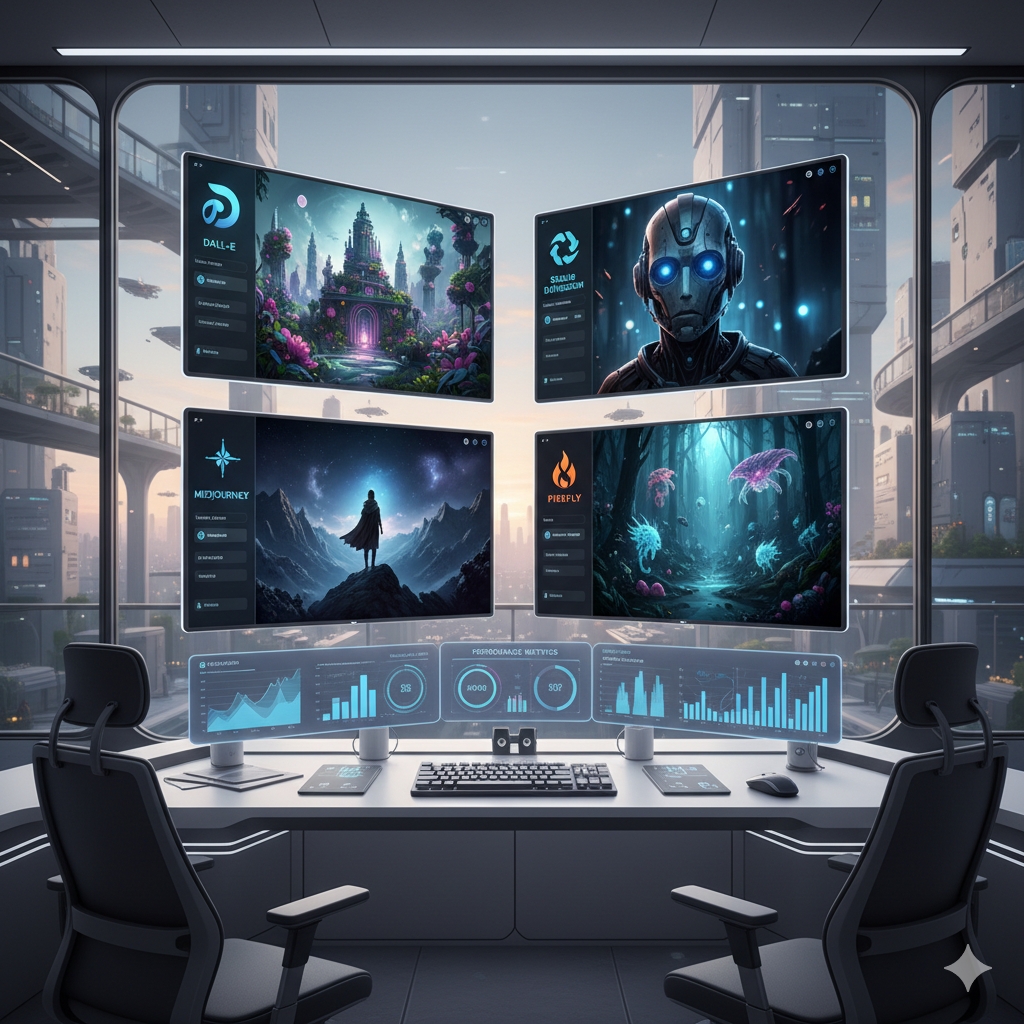
This comprehensive blog post aims to move beyond the superficial awe and provide a deep dive into what DALL-E truly excels at, where it falters, and how it compares to its powerful rivals like Midjourney, Stable Diffusion, and Adobe Firefly. We will explore the intricacies of its technology, dissect its creative strengths, honestly confront its current shortcomings, and contextualize its performance against a backdrop of rapidly evolving AI innovation. Whether you are an artist seeking new tools, a developer exploring generative AI, a marketer looking for creative assets, or simply a curious enthusiast, this ultimate comparison will equip you with the insights needed to navigate the fascinating and complex world of AI image generation. Get ready to uncover the realities of DALL-E and its peers, understanding not just what they can do, but what they can’t, and ultimately, which tool might be the best fit for your specific needs.
Understanding DALL-E’s Core Technology
To truly appreciate DALL-E’s place in the AI landscape, it is essential to grasp the fundamental technology that powers its imaginative outputs. DALL-E, particularly its latest iteration, DALL-E 3, operates on a sophisticated architecture that leverages advancements in neural networks and deep learning. At its heart, DALL-E is a generative model, specifically a type of diffusion model, designed to understand natural language prompts and translate them into visual representations.
The journey from text prompt to image within DALL-E typically involves several complex stages. Initially, a powerful language model, often integrated with or preceding the image generation component, interprets the user’s text prompt. This language model breaks down the prompt’s semantics, identifying key objects, attributes, styles, and relationships described. For DALL-E 3, this integration with large language models (LLMs) like those powering ChatGPT is even more pronounced, allowing for a much richer understanding and expansion of user prompts, leading to more coherent and contextually relevant image generation.
Once the prompt is understood, the magic of the diffusion process begins. Diffusion models work by learning to reverse a process of gradually adding noise to an image. Imagine starting with a completely noisy, random image. The model is trained on vast datasets of images and their corresponding text descriptions to learn how to iteratively denoise this image, guiding it towards a coherent and visually appealing result that matches the text prompt. This iterative denoising process, informed by the prompt’s semantic representation, allows DALL-E to “paint” the image pixel by pixel, refining details and structures until the final output emerges.
A crucial component that often works in tandem with these diffusion models is a contrastive language-image pre-training (CLIP) model. While DALL-E itself uses a related, more advanced architecture for its generation, the principles of CLIP are illustrative. CLIP models are trained to understand the semantic relationship between text and images. They can assess how well a generated image matches a given text prompt, providing a feedback mechanism that helps guide the diffusion process towards more accurate and relevant outputs. This intricate interplay between language understanding and image synthesis is what gives DALL-E its remarkable ability to create novel and imaginative visuals from textual descriptions.
OpenAI’s continuous development has pushed DALL-E through several iterations. DALL-E 1 introduced the concept, DALL-E 2 refined the image quality and prompt adherence, and DALL-E 3, currently the most advanced public version, significantly improved prompt understanding, image coherence, and the ability to handle complex and nuanced requests. The integration with conversational AI like ChatGPT further enhances its usability, allowing users to refine prompts collaboratively and achieve more precise results without extensive prompt engineering knowledge. This technological backbone is what allows DALL-E to stand as a powerful and influential tool in the burgeoning field of generative AI.
DALL-E’s Strengths: Where it Truly Shines
DALL-E has carved out a unique and impressive niche in the generative AI landscape, demonstrating particular strengths that set it apart. Understanding these core capabilities is vital for anyone looking to leverage its potential effectively. Here are the areas where DALL-E truly shines:
-
Exceptional Prompt Understanding and Interpretation:
One of DALL-E 3’s most significant advancements lies in its ability to deeply understand and interpret complex, nuanced, and even abstract prompts. Unlike some competitors that might struggle with lengthy or highly descriptive inputs, DALL-E 3, especially when integrated with tools like ChatGPT, can parse intricate details, relationships between objects, and specific stylistic requests with remarkable accuracy. It excels at translating verbose textual descriptions into visually coherent scenes, reducing the need for extensive prompt engineering.
Example: A prompt like “A whimsical steampunk owl wearing spectacles, reading a tiny scroll in a dimly lit alchemist’s lab filled with glowing potions and intricate gears, in the style of a vintage storybook illustration” is handled with impressive fidelity, generating an image that captures each element and the overall mood.
-
Creative Versatility and Stylistic Breadth:
DALL-E is incredibly versatile, capable of generating images across an astonishing range of styles, themes, and artistic movements. From photorealistic depictions to impressionistic paintings, from cyberpunk aesthetics to classical sculptures, it can adapt its output to almost any artistic direction specified. This makes it an invaluable tool for ideation and exploration, allowing users to rapidly prototype visual concepts in diverse forms.
Example: It can create a “futuristic city skyline at sunset, cyberpunk aesthetic,” then immediately shift to “a pastoral landscape in the style of Van Gogh,” or “a minimalist logo design for a coffee shop.”
-
Object Coherence and Scene Composition:
While earlier versions sometimes struggled with object consistency and spatial arrangement, DALL-E 3 has made significant strides in this area. It can generally place multiple objects within a scene coherently, respecting their relative sizes, positions, and interactions. This leads to more believable and aesthetically pleasing compositions, even for complex scenes involving many elements.
Example: “A cat riding a skateboard down a city street, with a dog chasing a ball in the background, autumn leaves falling.” DALL-E can render these elements in a plausible and harmonious arrangement.
-
Consistency in Generating Specific Items (Improved):
With DALL-E 3, there’s been a noticeable improvement in its ability to consistently generate specific items, including text. While still not perfect, it is significantly better at rendering legible words and phrases within images compared to its predecessors and many competitors. This opens up new possibilities for mockups, advertising, and graphic design where text integration is crucial.
Example: Generating a vintage sign that says “Coffee & Books” or a product label with “Pure Honey” often yields readable results, a major leap forward.
-
Ease of Use and Accessibility (especially via ChatGPT):
OpenAI has made DALL-E remarkably user-friendly. The integration with ChatGPT is a game-changer, allowing users to interact with the model conversationally. You can simply describe what you want, get suggestions, refine your prompt in natural language, and iterate on designs without needing to master complex prompt engineering techniques. This accessibility lowers the barrier to entry for creative professionals and casual users alike.
Example: Instead of a single, highly optimized prompt, a user can say, “Generate an image of a red sports car.” Then, “Make it vintage.” Then, “Add a snowy mountain background.” ChatGPT handles the prompt refinement.
These strengths position DALL-E as an extremely powerful tool for ideation, rapid prototyping, and general content creation, particularly for users who value intuitive interaction and broad creative freedom without deep technical knowledge.
DALL-E’s Limitations and Current Hurdles
Despite its impressive capabilities and continuous improvements, DALL-E, like all current generative AI models, is not without its limitations. A realistic understanding of these hurdles is crucial for users to manage expectations and choose the right tool for specific tasks. Here are some of DALL-E’s current challenges:
-
Inconsistent Text Generation (Despite Improvements):
While DALL-E 3 has vastly improved in generating legible text compared to its predecessors, it is still not 100% reliable, especially for complex sentences, specific fonts, or precise text placement. It can occasionally produce gibberish or misspelling, particularly when the text is small, numerous, or embedded in intricate designs. For critical text elements, manual correction or external editing remains necessary.
-
Anatomical Inaccuracies and Distortions:
Generating perfect human and animal anatomy remains a significant challenge for DALL-E. While it has improved, issues like distorted limbs, extra fingers, mismatched eyes, or uncanny facial features can still occur, especially in complex poses or when depicting multiple subjects. Achieving photorealistic and anatomically correct figures often requires multiple generations and careful selection.
-
Maintaining Consistency Across Multiple Images:
Generating a series of images featuring the same character, object, or scene from different angles or in various actions is extremely difficult for DALL-E. Each generation is largely independent, making it challenging to maintain stylistic consistency, character likeness, or spatial coherence across a sequence. This limits its utility for sequential art, animation, or branding requiring strong visual continuity.
-
Bias in Training Data:
Like all AI models trained on vast datasets, DALL-E inherits biases present in its training data. This can lead to stereotypes in representations of gender, race, profession, or culture. For instance, prompting for “doctor” might predominantly generate male images, or “CEO” might lean towards certain demographics. While OpenAI implements safety measures, the underlying data bias is a persistent challenge that requires ongoing mitigation.
-
Ethical Considerations and Misinformation:
The power to generate realistic images raises significant ethical concerns. DALL-E can be used to create deepfakes, disseminate misinformation, or generate harmful content. OpenAI has implemented guardrails to prevent the generation of explicit, violent, or hateful content, but the potential for misuse remains a societal challenge that needs continuous monitoring and development of robust ethical frameworks.
-
Lack of Granular Control for Advanced Users:
While DALL-E’s ease of use is a strength, it can also be a limitation for advanced users who desire more granular control over specific image elements, composition, lighting, or camera angles. Compared to models that allow for seed manipulation, negative prompting, or detailed parameter adjustments, DALL-E’s interface is relatively streamlined, prioritizing simplicity over deep customization for individual generations.
-
Cost Implications for High-Volume Use:
While OpenAI offers free credits and subscription plans, extensive high-volume generation can become costly. For individuals or businesses requiring thousands of images, especially with iterative refinements, the per-credit pricing structure can add up quickly, potentially making open-source or locally runnable alternatives more cost-effective in the long run.
-
Performance on Abstract Concepts:
While DALL-E excels at interpreting abstract stylistic requests, generating truly abstract, non-representational art that captures a specific emotional or philosophical concept without concrete visual anchors can still be hit-or-miss. It often defaults to semi-representational forms, even when prompted for pure abstraction, reflecting the inherent challenge of translating subjective human experience into visual data.
Recognizing these limitations is not to diminish DALL-E’s achievements but to foster a more realistic and effective approach to using this powerful technology. Understanding its boundaries helps users make informed decisions about when DALL-E is the ideal tool and when another approach or complementary workflow might be more appropriate.
The Competitive Landscape: Who are DALL-E’s Main Rivals?
The field of generative AI image creation is incredibly dynamic and competitive, with several powerful players constantly pushing the boundaries of what is possible. While DALL-E holds a prominent position, it operates within an ecosystem populated by formidable rivals, each with its unique strengths, weaknesses, and target audiences. Understanding this competitive landscape is essential for a holistic view of DALL-E’s true standing.
Midjourney: The Artistic Powerhouse
Midjourney has rapidly gained a reputation as the go-to tool for generating stunning, high-quality artistic imagery. It excels at creating aesthetically pleasing, often surreal or evocative, visuals with a distinctive stylistic flair. Midjourney’s strength lies in its ability to produce outputs that often require minimal prompt engineering to look “good,” making it a favorite among digital artists and concept designers. It operates primarily through Discord, which has fostered a strong community aspect. While exceptional for artistic expression, it historically offered less precise control over specific elements compared to DALL-E 3’s prompt adherence, though this is evolving rapidly with newer versions.
Stable Diffusion: The Open-Source Challenger
Stable Diffusion stands out as a powerful open-source model that can be run locally on user hardware. This accessibility and open nature have fostered a massive community of developers and artists who have created an incredible ecosystem of custom models, fine-tuned checkpoints, and user interfaces (like Automatic1111). Stable Diffusion offers unparalleled control and flexibility through various parameters, negative prompting, inpainting, outpainting, and an array of extensions. Its image quality can rival or even surpass proprietary models, especially when fine-tuned. However, achieving high-quality results often demands more technical knowledge and extensive prompt engineering.
Adobe Firefly: The Creative Suite Integrator
Adobe Firefly is Adobe’s entry into the generative AI space, designed specifically to integrate seamlessly with its existing suite of creative tools like Photoshop and Illustrator. Firefly emphasizes content safety, commercial viability, and creative control. Its strengths include features like “Generative Fill” and “Generative Expand” within Photoshop, which revolutionize image editing. It’s trained on Adobe Stock and public domain content, aiming to alleviate copyright concerns for commercial use. While its raw image generation might not always match the artistic flair of Midjourney or the open-ended creativity of DALL-E, its integration and focus on creative workflow make it a formidable tool for professionals already entrenched in the Adobe ecosystem.
Google Imagen: The Research Powerhouse (Mostly Academic)
Google’s Imagen model has demonstrated incredibly impressive capabilities in research papers, often showcasing photorealistic outputs that set new benchmarks for fidelity. Imagen leverages a large language model to understand text prompts and then uses a cascaded diffusion model to generate high-resolution images. While its technical prowess is undeniable, Imagen has largely remained an internal research project, with limited public access, primarily due to Google’s cautious approach to ethical AI deployment. It serves as a benchmark for what’s possible, influencing the development of other models, but is not directly available to the public as a product in the same way DALL-E, Midjourney, or Stable Diffusion are.
These competitors each bring their unique flavor to the text-to-image arena. DALL-E’s strength often lies in its balance of accessibility, strong prompt understanding, and versatile creative output, particularly for general-purpose image generation. However, for specialized tasks—be it high-artistic quality, extreme customization, or seamless integration into professional workflows—its rivals present compelling alternatives.
Feature-by-Feature Comparison with Key Competitors
To truly understand where DALL-E stands, a direct comparison against its main rivals across several key features is essential. This section will break down how DALL-E, Midjourney, Stable Diffusion, and Adobe Firefly stack up against each other, highlighting their relative strengths and weaknesses in practical terms.
1. Image Quality and Aesthetic
- DALL-E: Produces high-quality, varied images with strong prompt adherence. DALL-E 3 excels at coherence and translating complex prompts accurately. Its aesthetic is versatile, ranging from photorealistic to artistic, often with a clean, polished look.
- Midjourney: Renowned for its artistic, often hyper-stylized and aesthetically pleasing outputs. It frequently generates images that feel “epic” or “cinematic” with rich textures and dramatic lighting. Often preferred for concept art and visually striking compositions.
- Stable Diffusion: Quality is highly variable, depending on the model/checkpoint used and user skill. Can achieve photorealism, artistic styles, or anything in between. With expert prompting and fine-tuned models, it can often surpass the quality of proprietary models, but requires more effort.
- Adobe Firefly: Focuses on commercially safe and high-resolution outputs suitable for professional use. While capable of artistic styles, its default aesthetic leans towards practical, clean, and often realistic imagery, emphasizing utility within creative workflows.
2. Prompt Understanding and Control
- DALL-E: Excellent prompt understanding, especially with DALL-E 3’s integration with LLMs. Can interpret complex, verbose prompts and generate coherent images. Offers good control over composition and elements through natural language.
- Midjourney: Good prompt understanding, but traditionally thrives on concise, impactful prompts to guide its artistic direction. Newer versions (v6+) offer significantly improved prompt adherence and finer control.
- Stable Diffusion: Requires the most precise prompt engineering, including negative prompts, specific parameters (CFG scale, steps, sampler), and model selection. Offers the most granular control once mastered, but has a steeper learning curve for achieving desired results.
- Adobe Firefly: Strong prompt understanding, particularly for real-world objects and scenes. Its strength lies in its contextual awareness when used within image editing, allowing for more intuitive and powerful manipulation.
3. Customization and Granularity
- DALL-E: Offers limited direct technical parameters for customization beyond the prompt. Focuses on natural language iteration.
- Midjourney: Provides a range of parameters (aspect ratio, style stylize, chaos, weird) to influence output, but still less technical control than Stable Diffusion. In-painting and out-painting features are being actively developed and improved.
- Stable Diffusion: Unmatched in customization. Users can choose from thousands of fine-tuned models, use control nets for precise pose/composition control, apply masks for inpainting/outpainting, and adjust numerous technical settings.
- Adobe Firefly: Excels in contextual customization within image editing (e.g., Generative Fill). While direct image generation offers standard controls, its real power is in manipulating existing content based on prompts.
4. Accessibility and Ease of Use
- DALL-E: Very user-friendly, especially through ChatGPT, making it accessible even for beginners without technical expertise.
- Midjourney: Operates primarily through Discord bots, which can be intuitive for those familiar with Discord, but less of a standalone app experience. Its UI is evolving with a web interface.
- Stable Diffusion: The steepest learning curve due to the sheer number of models, interfaces (like Automatic1111), and parameters. However, once set up, it offers incredible power. Cloud-based versions simplify access.
- Adobe Firefly: Highly accessible for existing Adobe users, integrating directly into familiar applications. Standalone web interface is also user-friendly.
5. Cost and Licensing
- DALL-E: Offers a limited number of free credits, then operates on a pay-as-you-go model or subscription for more generations. Images generally come with commercial usage rights, though OpenAI’s terms should be reviewed.
- Midjourney: Requires a paid subscription. Offers various tiers with different fast-generation allowances. Commercial use is typically allowed for subscribers.
- Stable Diffusion: Open-source, so the core model is free to use. Costs are primarily for hardware (if running locally) or cloud computing (if using hosted services). Licensing for generated images can be complex, depending on the specific model/checkpoint and its training data, but generally liberal for outputs.
- Adobe Firefly: Available as part of Adobe Creative Cloud subscriptions. Images are generated with a “Generative Credits” system. Trained on Adobe Stock and public domain, aiming for clear commercial licensing with indemnification for enterprise users.
6. Ethical Guardrails and Content Moderation
- DALL-E: Strong content moderation to prevent generation of harmful, explicit, or biased content. Strict usage policies.
- Midjourney: Also implements moderation policies to prevent harmful content, though sometimes perceived as slightly less restrictive than DALL-E in certain artistic contexts.
- Stable Diffusion: As an open-source model, content moderation largely depends on the user and the specific fine-tuned models used. This means it can be used for almost anything, which is both a strength (freedom) and a weakness (potential for misuse).
- Adobe Firefly: Very strong emphasis on ethical AI, content safety, and preventing harmful generations, in line with Adobe’s professional user base.
In summary, DALL-E excels as a versatile, easy-to-use tool with excellent prompt understanding. Midjourney shines for pure artistic output. Stable Diffusion offers unparalleled control and customization for technical users. Adobe Firefly integrates seamlessly into professional creative workflows with a focus on commercial viability. The “best” tool ultimately depends on individual needs, skill level, and intended use case.
Comparison Tables
Table 1: Key Feature Comparison of Leading AI Image Generators
| Feature/Aspect | DALL-E (OpenAI) | Midjourney | Stable Diffusion | Adobe Firefly |
|---|---|---|---|---|
| Primary Strength | Prompt Understanding, Versatility, Coherence | Artistic Quality, Aesthetic Appeal, Stylization | Control, Customization, Open-Source Flexibility | Creative Suite Integration, Commercial Safety, Generative Editing |
| Prompt Interpretation | Excellent (especially DALL-E 3 with LLMs) | Very Good (improved significantly in v6+) | Requires precise engineering (positive/negative prompts) | Good, contextual understanding within Adobe apps |
| Image Aesthetic | Versatile, clean, often polished | Highly artistic, cinematic, often surreal/evocative | Highly customizable (depends on model/user skill) | Professional, clean, often realistic, commercially safe |
| Control & Parameters | Limited direct technical controls, relies on natural language | Moderate (aspect ratio, stylize, chaos, weird) | Extensive (CFG, steps, samplers, ControlNet, inpainting, outpainting) | Moderate, strong contextual control within Adobe apps |
| Text Generation in Images | Improved significantly (DALL-E 3), but still inconsistent for complex text | Historically weak, some improvement in v6+ but not a focus | Variable (requires specific models/techniques for good results) | Decent for simple text, aims for accuracy in specific features |
| Human/Anatomy Realism | Good, but can still have occasional distortions/anomalies | Excellent for stylized figures, can struggle with pure realism | Can achieve high realism with specific models and careful prompting | Good, focuses on natural and professional representations |
| Platform/Access | Web interface, ChatGPT, API | Discord bot (primary), new web alpha | Local install, cloud services, many web UIs (e.g., Automatic1111) | Adobe Creative Cloud apps, web interface |
| Cost Model | Free credits, pay-as-you-go, subscription | Paid subscription tiers | Free (core model), cost for hardware/cloud services | Part of Adobe CC subscription (Generative Credits) |
| Licensing/Commercial Use | Generally allowed (check OpenAI terms) | Allowed for subscribers (check Midjourney terms) | Variable (depends on specific model/checkpoint used) | Clear commercial use, indemnification for enterprise |
Table 2: Use Case Suitability and Performance Metrics
| Use Case | DALL-E Suitability | Midjourney Suitability | Stable Diffusion Suitability | Adobe Firefly Suitability | Performance Insight |
|---|---|---|---|---|---|
| Rapid Ideation & Brainstorming | High: Excellent prompt understanding for diverse ideas. | High: Quickly generates inspiring artistic concepts. | Medium: Can be slower for rapid iteration due to prompt complexity. | High: Good for quick visual concepts, especially within design workflows. | DALL-E and Midjourney lead for speed of initial creative burst. |
| Concept Art & Illustrations | High: Versatile styles, good composition. | Excellent: Its core strength, produces highly artistic results. | High: With right models, offers incredible artistic flexibility and control. | Medium: Good, but often more practical than purely artistic. | Midjourney often produces the most ‘ready-to-use’ artistic pieces. |
| Marketing & Advertising Visuals | High: Good for diverse product mockups, ad campaigns. | High: Striking visuals grab attention. | High: Customizable for specific branding, but requires more effort. | Excellent: Focus on commercial safety, integration with design tools. | Firefly’s commercial safety and integration are key here. |
| Photorealistic Imagery | Good: Can achieve realism, but sometimes with minor flaws. | Good: Excels at stylized realism, pure photorealism can be challenging. | Excellent: With specific models, can achieve highly convincing photorealism. | Good: Aims for practical and believable realism. | Stable Diffusion often has an edge for true photorealism with fine-tuned models. |
| Image Editing & Manipulation | Medium: Limited built-in editing features, mainly regeneration. | Medium: Iterative generation for refinement, some inpainting. | Excellent: Inpainting, outpainting, ControlNet for precise edits. | Excellent: Generative Fill/Expand are revolutionary for editing. | Firefly is the clear winner for generative editing capabilities. |
| Character Design & Consistency | Low: Struggles with consistency across multiple images. | Low: Struggles with consistency across multiple images. | Medium: Can achieve better consistency with advanced techniques (LoRAs, IP-Adapter). | Low: Not designed for character consistency across different poses/scenes. | All struggle, but Stable Diffusion offers the most advanced workarounds. |
| Accessibility for Beginners | Excellent: Intuitive prompting via ChatGPT. | Good: Discord interface is relatively easy to learn. | Low: Steep learning curve for advanced features. | Excellent: Familiar UI for Adobe users, straightforward web interface. | DALL-E and Firefly are easiest to pick up and use effectively. |
Practical Examples and Real-World Scenarios
The true power of DALL-E and its competitors becomes evident when we look at how they are being applied in real-world scenarios. These tools are not just curiosities; they are rapidly becoming integral parts of various creative and professional workflows.
-
Marketing and Advertising:
Imagine a small business needing visuals for a new social media campaign. Instead of hiring a photographer or searching stock photo libraries for hours, a marketer can use DALL-E to generate unique, eye-catching images tailored to specific promotions. For instance, a coffee shop owner could prompt, “A cozy minimalist coffee shop interior with soft natural light, people enjoying coffee, warm inviting atmosphere for an Instagram post.” This allows for rapid iteration and personalization of ad creatives, testing different visual concepts without significant investment. Adobe Firefly, with its commercial focus and integration into Photoshop, is particularly useful here for creating ad variations or modifying existing campaign assets through generative fill.
-
Design and Prototyping:
Architects, interior designers, and product designers are leveraging these tools for rapid prototyping. An architect might use Midjourney to visualize different exterior styles for a building, experimenting with various materials and lighting conditions. A UI/UX designer could use DALL-E to generate diverse icon sets or abstract background patterns for a website mockup, quickly exploring aesthetic directions before committing to detailed design work. Stable Diffusion, with its ControlNet feature, can be used to take a basic sketch of a product and generate photorealistic renderings with specific textures and lighting, allowing for visual exploration early in the design phase.
-
Art and Creativity:
Digital artists are embracing these AI models as powerful collaborators. A concept artist might use Midjourney to generate hundreds of fantasy creature designs or alien landscapes, drawing inspiration for their next big project. A fine artist could use DALL-E to explore abstract themes, prompting for “the feeling of nostalgia represented as a swirling vortex of sepia tones and faded memories,” and then using the generated image as a starting point for their own unique piece. The sheer volume of diverse imagery generated can spark creativity in unprecedented ways, pushing artistic boundaries.
-
Education and Research:
Educators can use DALL-E to create custom visuals for presentations, textbooks, or online learning modules, making complex concepts more engaging and understandable. A history teacher might generate images of ancient civilizations based on specific descriptions, or a science teacher could illustrate microscopic biological processes. Researchers can use these tools to visualize theoretical models or generate synthetic data (with careful validation) for certain types of studies, aiding in communication and hypothesis testing.
-
E-commerce and Product Visualization:
Online retailers, especially those selling custom or niche products, can use AI image generators to create compelling product visuals without the need for expensive photoshoots. A seller of handmade jewelry could prompt DALL-E for “a detailed close-up of a silver pendant with an emerald stone, elegant display on a velvet cushion,” generating multiple angles and settings. This is particularly valuable for personalized products where a unique visual is needed for each customer, or for A/B testing different product presentation styles on an e-commerce platform.
-
Storytelling and Content Creation:
Writers, bloggers, and aspiring graphic novelists are finding these tools invaluable for visual storytelling. A fantasy author can generate character portraits, scene backdrops, or even book cover ideas for their novel, giving visual life to their prose. A blogger writing about travel can create bespoke images of exotic destinations or cultural experiences to accompany their articles, enhancing engagement without relying solely on stock photos. The ability to rapidly visualize narrative elements accelerates the creative process and enriches the reader’s experience.
These examples merely scratch the surface of the myriad applications for DALL-E and its counterparts. As these models continue to evolve and become more integrated into existing software and workflows, their impact on how we create, design, and communicate will only grow, fundamentally changing the landscape of digital content creation.
Frequently Asked Questions
Q: What is DALL-E and how does it work?
A: DALL-E is an artificial intelligence program developed by OpenAI that generates images from textual descriptions, known as prompts. It uses a deep learning model, primarily a diffusion model, which learns to create images by starting from random noise and gradually refining it into a coherent picture guided by the input text prompt. The model understands the relationships between objects, attributes, and styles described in the text, translating complex language into visual concepts.
Q: How does DALL-E 3 differ from previous versions like DALL-E 2?
A: DALL-E 3 represents a significant leap from DALL-E 2, primarily in its vastly improved prompt understanding and image coherence. DALL-E 3 is deeply integrated with large language models (like those powering ChatGPT), allowing it to interpret more complex and nuanced prompts with greater accuracy. This results in images that better match the user’s intent, fewer anatomical errors, improved text generation within images, and a generally higher quality and more consistent output across diverse requests. It reduces the need for extensive prompt engineering.
Q: Is DALL-E free to use?
A: OpenAI often provides a limited number of free credits for new users or through certain platforms. For more extensive use, DALL-E operates on a pay-as-you-go credit system, where users purchase credits for image generation, or as part of a subscription to services like ChatGPT Plus, which includes DALL-E 3 access. The exact pricing and free credit availability can vary, so it’s best to check OpenAI’s official website or the platform where you access it.
Q: Can I use DALL-E generated images for commercial purposes?
A: Yes, generally users retain full ownership rights to the images they create with DALL-E and are free to reprint, sell, and merchandise them. However, it is always crucial to review OpenAI’s most current terms of use and content policy to ensure compliance, as policies can evolve. This is particularly important for commercial applications to avoid any potential issues related to intellectual property or content guidelines.
Q: What are DALL-E’s main limitations?
A: Despite its strengths, DALL-E has limitations. These include occasional anatomical inaccuracies (e.g., distorted hands or faces), difficulty maintaining consistency across multiple images of the same character or object, challenges with generating perfectly legible complex text, and potential biases inherited from its training data. While DALL-E 3 has mitigated many of these, they still exist to varying degrees, especially for very niche or precise demands.
Q: How does DALL-E compare to Midjourney for artistic results?
A: Midjourney is often lauded for its strong artistic aesthetic and ability to produce highly stylized, visually striking, and often surreal images with rich detail and dramatic lighting. It’s often preferred by artists seeking evocative and “epic” concept art. DALL-E, especially DALL-E 3, is highly versatile and can produce artistic outputs, but Midjourney often has a more inherent artistic “flair” that requires less explicit prompting to achieve visually stunning results in certain styles.
Q: When should I choose Stable Diffusion over DALL-E?
A: You might choose Stable Diffusion if you require maximum control and customization over your image generation. Stable Diffusion, being open-source, allows for extensive fine-tuning, use of custom models (checkpoints), inpainting/outpainting, and precise control over composition (e.g., via ControlNet). It has a steeper learning curve but offers unparalleled flexibility for advanced users or those who need to run models locally for privacy or cost efficiency in high-volume generation.
Q: What is Adobe Firefly’s unique selling proposition compared to DALL-E?
A: Adobe Firefly’s unique selling proposition lies in its deep integration with Adobe’s Creative Cloud suite (Photoshop, Illustrator) and its focus on commercial usability and safety. Firefly offers powerful generative editing features like Generative Fill and Expand directly within professional design tools. It’s trained on commercially licensed content (Adobe Stock) and public domain material, aiming to provide clear commercial use rights and indemnification for enterprise users, which is a significant advantage for businesses.
Q: Are there ethical concerns with using AI image generators like DALL-E?
A: Yes, significant ethical concerns exist. These include the potential for creating deepfakes, spreading misinformation, generating harmful or biased content (due to training data biases), and copyright issues for generated content or content used in training. OpenAI and other developers implement safeguards, but responsible use and ongoing ethical discussions are crucial. Users should be aware of and adhere to the usage policies and ethical guidelines provided by the platforms.
Q: What’s the future outlook for DALL-E and AI image generation?
A: The future is incredibly dynamic. We can expect continued improvements in image quality, realism, coherence, and the ability to handle complex prompts. Integration with other AI models (e.g., video generation, 3D models) will likely expand. Models will become more adept at understanding context, maintaining consistency across sequences, and offering more granular control while remaining user-friendly. The ethical implications and regulatory frameworks will also continue to evolve as the technology becomes more pervasive.
Key Takeaways
- DALL-E 3 Excels in Prompt Understanding: Its integration with large language models significantly improves interpretation of complex, nuanced, and lengthy prompts, reducing the effort required for prompt engineering.
- Creative Versatility is a Core Strength: DALL-E can generate images across an astonishing range of styles, from photorealistic to highly artistic, making it ideal for broad ideation.
- Limitations Persist but are Improving: While DALL-E 3 shows strides in text generation and anatomical accuracy, challenges remain in perfect consistency across multiple images and intricate textual elements.
- Competitive Landscape is Diverse: DALL-E operates alongside strong rivals like Midjourney (artistic flair), Stable Diffusion (maximum control, open-source), and Adobe Firefly (creative suite integration, commercial safety).
- No Single “Best” Tool: The optimal AI image generator depends entirely on the user’s specific needs, skill level, and desired outcome. Each tool has its niche and comparative advantages.
- Practical Applications are Widespread: From marketing and design to art and education, AI image generators are transforming workflows, enabling rapid ideation, content creation, and visual storytelling.
- Ethical Considerations are Paramount: The power of generative AI necessitates careful consideration of biases, misinformation, and responsible usage, with developers continually implementing guardrails.
- The Field is Rapidly Evolving: Expect continuous advancements in image quality, control, integration, and the overall capabilities of AI image generation models in the near future.
Conclusion
The journey beyond the initial hype surrounding DALL-E reveals a sophisticated and remarkably capable AI system that has profoundly reshaped the landscape of digital content creation. DALL-E 3, in particular, with its deep integration of language understanding and visual synthesis, stands as a testament to OpenAI’s relentless innovation, offering unparalleled ease of use and impressive coherence from complex prompts. It has democratized image generation, making powerful creative tools accessible to artists, designers, marketers, and enthusiasts alike.
However, as we’ve explored, DALL-E does not operate in a vacuum. It is a key player in a vibrant and fiercely competitive ecosystem. While it shines in prompt interpretation and creative versatility, its competitors like Midjourney offer a distinctive artistic flair that captivates a different audience. Stable Diffusion provides an unmatched level of granular control and customization for those willing to navigate its steeper learning curve. And Adobe Firefly seamlessly integrates generative power into professional creative workflows, prioritizing commercial viability and content safety.
The “ultimate comparison” is not about declaring a single victor, but rather about recognizing the unique strengths and strategic positions of each of these remarkable tools. For rapid ideation and general-purpose image generation with intuitive natural language interaction, DALL-E is often the top choice. For breathtaking artistic concepts, Midjourney frequently leads the way. For technical users demanding complete control and customization, Stable Diffusion is the undisputed champion. And for professionals embedded in design workflows who value integration and clear commercial rights, Adobe Firefly offers a compelling proposition.
As AI image generation continues its rapid evolution, we can anticipate even more refined models, greater specialization, and increasingly sophisticated integrations. The future promises a world where the boundaries between human creativity and artificial intelligence blur even further, empowering creators with tools that were once the stuff of science fiction. Understanding the true capabilities and limitations of DALL-E and its rivals today is not just about making an informed choice; it’s about being prepared for the creative revolution that is already here, and one that is only just beginning.





























































Leave a Reply