


In the digital age, our inboxes have become central hubs for communication, collaboration, and information. Yet, for many, they’ve also transformed into overwhelming torrents of messages, turning productivity into a constant struggle against email overload. The dream of “inbox zero” often feels like an unattainable myth, perpetually just out of reach. But what if there was a way to reclaim control, to manage your emails not just more efficiently, but almost effortlessly? Enter Artificial Intelligence (AI) – a powerful ally poised to revolutionize how we interact with our inboxes.
This comprehensive guide delves into the fascinating world of AI-powered email management, exploring how intelligent features are moving us towards a truly hands-free email experience. We’ll uncover the innovative ways AI can sort, prioritize, respond, and even summarize your emails, freeing up precious time and mental energy. From smart categorization to predictive follow-ups, prepare to discover how AI is not just a futuristic concept but a practical, immediate solution to the age-old problem of email overwhelm. Get ready to transform your inbox from a source of stress into a streamlined, productive powerhouse.
The Escalating Challenge of Email Overload in the Modern Workplace
The sheer volume of emails individuals receive daily has reached unprecedented levels, creating what many term “email overload.” This isn’t just an annoyance; it’s a significant drain on productivity, a source of stress, and a barrier to focused work. Studies consistently show that professionals spend a substantial portion of their workday managing emails, often bouncing between tasks and communications, leading to diminished concentration and increased errors.
Consider the average knowledge worker. They might wake up to dozens of new emails, ranging from urgent client requests to internal announcements, newsletters, and promotional offers. Throughout the day, this influx continues, demanding immediate attention, careful reading, and thoughtful responses. Each interruption pulls focus away from core responsibilities, leading to context switching costs that are far more detrimental than a simple loss of a few seconds. The constant notifications, the looming unread counts, and the fear of missing something critical contribute to a pervasive sense of anxiety and an always-on culture that blur the lines between work and personal life.
- Decreased Productivity: Constantly shifting attention from deep work to email responses fragments time and reduces overall output. The mental cost of switching tasks can take up to 20 minutes to recover, making email a major productivity killer.
- Increased Stress and Burnout: The feeling of being perpetually behind, coupled with the pressure to respond quickly, contributes significantly to professional burnout, chronic fatigue, and a reduced sense of accomplishment.
- Lost Important Information: Critical emails can easily get buried under a mountain of less important messages, leading to missed deadlines, overlooked opportunities, and severe communication breakdowns with clients or colleagues.
- Inefficient Decision Making: When faced with too much raw information, or information presented in a disorganized, chaotic manner, the ability to quickly absorb, analyze, and make timely and effective decisions can be severely hampered, impacting project progress.
- Reduced Job Satisfaction: The endless, reactive cycle of email management can make individuals feel like they are constantly putting out fires rather than proactively engaging with meaningful work, leading to disengagement and dissatisfaction.
Traditional email management strategies – like creating manual folders, setting aside specific times for email, or using rudimentary filters based on sender or subject lines – have proven largely insufficient against this rising tide. While helpful to a degree, they still require significant human intervention, cognitive load, and can quickly become unmanageable as email volume grows. This is precisely where the transformative power of Artificial Intelligence steps in, offering a fundamental shift from reactive management to proactive automation and intelligent assistance, moving us towards a genuinely hands-free email experience.
Understanding AI in Email Management: How Intelligent Systems Streamline Your Inbox
When we talk about Artificial Intelligence in email management, we’re not referring to sentient machines taking over your correspondence. Instead, we’re discussing sophisticated algorithms and machine learning models designed to understand, categorize, prioritize, and even generate responses based on patterns and data. At its core, AI in this context leverages several key technologies that allow it to mimic human-like intelligence in processing information:
- Machine Learning (ML): This is the backbone of almost all AI email features. ML algorithms are trained on vast datasets of emails to identify patterns, learn from user behavior, and make predictions. For instance, if you consistently move emails from a specific sender or containing particular keywords to a “read later” folder, an ML model will learn this preference and automatically suggest this action or perform it for you on subsequent similar emails. It’s all about recognizing intricate relationships between email content, sender, recipient, and your past explicit or implicit user actions. The more data it processes, the smarter and more accurate it becomes.
- Natural Language Processing (NLP): NLP is the branch of AI that enables systems to understand, interpret, and generate human language. It allows the AI email system to go beyond simple keyword matching and truly comprehend the meaning, sentiment, and intent behind the text in your emails. This is absolutely crucial for complex tasks like summarizing lengthy emails, identifying specific action items embedded within a paragraph, extracting key contact information, or generating coherent and contextually appropriate replies. NLP can differentiate between a casual greeting, an urgent request, or a formal legal notice, even if they share some common vocabulary, by analyzing the overall structure and context.
- Neural Networks and Deep Learning: These are advanced forms of machine learning that are particularly adept at handling complex, unstructured data like email text, speech, or images. Inspired by the structure and function of the human brain, neural networks can identify subtle nuances, recognize sentiment with greater precision, and learn highly intricate, non-linear patterns that might be missed by simpler algorithms. This capability allows for significantly more accurate categorization, a higher rate of detection for sophisticated spam and phishing attempts, and the generation of more human-like, nuanced responses that feel natural and appropriate.
The true magic of AI in email lies in its unparalleled ability to learn and adapt over time. Unlike rigid, rules-based systems that require constant manual updates, AI systems continuously improve as they process more emails and observe your interactions. The more you use an AI-powered email tool, the smarter and more personalized it becomes, refining its automation and suggestions to precisely match your specific workflow, communication style, and evolving priorities. This dynamic adaptability is key to transforming email management from a cumbersome, time-consuming chore into a seamless, highly intelligent, and increasingly hands-free experience.
Core AI Features Revolutionizing Hands-Free Email Handling
The widespread application of AI in email has led to the development of a sophisticated suite of features designed to tackle virtually every aspect of email management, from initial receipt and processing to efficient archiving and proactive follow-up. These innovative tools are transforming the inbox from a chaotic, reactive repository into an organized, intelligent, and proactive personal assistant.
Smart Email Sorting and Categorization
One of the most immediate and impactful benefits of AI in email is its ability to intelligently sort and categorize incoming messages. Instead of relying on manual rules or simple keyword filters that quickly become outdated, AI analyzes the entire email – its content, sender, recipient list, context, and even your past interactions with similar messages – to automatically place emails into relevant folders or assign appropriate tags. This means promotional emails go to a “Promotions” tab, social media notifications to “Social,” and important work-related communications remain in your primary inbox, often segmented further by project, client, or urgency.
- Automatic Labeling: AI can dynamically assign descriptive labels such as “Invoice,” “Meeting Request,” “Urgent,” “Personal,” or “Client Feedback” based on a deep understanding of the email’s content and its likely intent.
- Intelligent Folder Redirection: Emails are automatically moved to designated folders, keeping your main inbox clean and focused. This can be customized to your preferred organizational structure.
- Bundle Similar Emails: Many advanced AI tools can intelligently group related emails (e.g., all messages from a specific newsletter, all notifications from a particular software service, or an entire conversation thread) into a single digest or collapsed conversation, drastically reducing visual clutter and making it easier to process information in chunks.
Priority Inbox and Important Email Detection
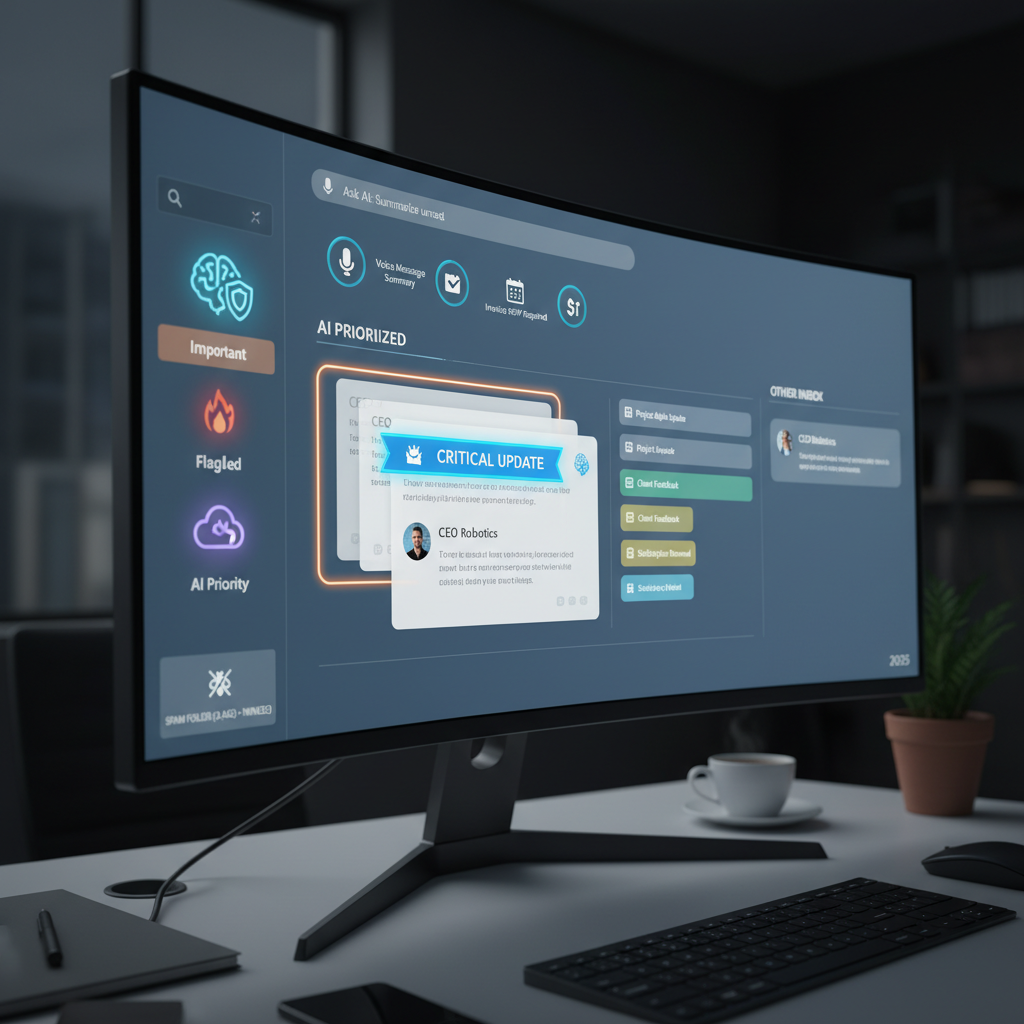
Beyond mere categorization, AI excels at identifying which emails truly matter most to you and bringing them to your immediate attention. By analyzing your historical data (who you respond to quickly, which emails you open first, which projects are currently most active, your calendar commitments), AI can dynamically create a “Priority Inbox” or “Focused Inbox” that intelligently highlights critical communications. It learns what constitutes “important” specifically for *you* and your unique role or current workload.
- Urgency Detection: AI can pick up on keywords, sender seniority, communication patterns, and deadlines mentioned in the text to flag emails requiring immediate action or rapid response.
- Contextual Importance: An email from your CEO regarding a quarterly financial report will be prioritized differently than a generic internal announcement about a new coffee machine, even if both originate from within your organization. AI understands the relative importance based on context.
Automated Response Generation and Suggestions
This is arguably one of the most exciting, innovative, and significant time-saving AI features. AI can analyze the content of an incoming email and instantly suggest short, contextually relevant replies (Smart Replies) or even draft longer, more comprehensive responses based on common scenarios and your past communication style, acting as your personal ghostwriter.
- Smart Reply: Offers 2-3 quick, context-aware, and concise responses (e.g., “Sounds good!”, “I’ll look into it,” “Thanks for the update!”) that you can send with a single click, ideal for acknowledging receipts or short confirmations.
- Drafting Assistance: For more complex emails, AI can generate full paragraphs or even entire email drafts, intelligently incorporating key information from the original message, relevant details from your calendar, and common phrases or templates you frequently use. This can be invaluable for routine inquiries, scheduling confirmations, initial acknowledgments, or even standard project updates.
- Tone Adjustment and Refinement: Some advanced AI tools can even suggest ways to adjust the tone of your message to be more formal, friendly, assertive, or empathetic, helping you ensure your communication always lands appropriately and achieves its desired effect.
Enhanced Spam and Phishing Detection
While traditional spam filters rely on static blacklists and simple keyword matching, AI elevates this to a completely new level of sophistication. Using advanced machine learning, behavioral analysis, and anomaly detection, AI can identify emerging phishing attempts, highly sophisticated social engineering scams, and evolving spam tactics with significantly greater accuracy, providing superior protection for your inbox from malicious or unwanted content.
- Behavioral Analysis: AI doesn’t just look for suspicious keywords; it scrutinizes sender behavior, analyzes email headers, examines link destinations for redirects, and assesses attachment types and content for unusual patterns.
- Real-time Threat Intelligence: Continuously updated AI models can detect zero-day threats and novel attack vectors that traditional, signature-based filters might completely miss, offering proactive defense against cutting-edge cyber threats.
Meeting Scheduling and Calendar Integration
The notorious back-and-forth dance of finding a suitable time for a meeting across multiple busy schedules is a well-known time-sink. AI-powered schedulers can integrate directly with your calendar, analyze your availability and that of other participants, and even communicate with attendees to propose optimal times, send invitations, and manage responses, all without you lifting a finger beyond an initial command.
- Automated Time Slot Proposals: AI can intelligently suggest the best meeting times based on analyzing all participants’ calendars and preferences, minimizing conflicts.
- Conflict Resolution: Automatically identifies and navigates complex scheduling conflicts, suggesting alternative times or durations.
- Invitation Management: Sends professional invites, tracks RSVPs, and automatically updates the calendar for all participants, handling confirmations and reminders.
Email Summarization and Key Point Extraction
For lengthy emails, exhaustive reports, or long, winding discussion threads, AI can quickly distill the core message and extract key information, saving you valuable reading time and cognitive effort. This feature is particularly useful for catching up on discussions you’ve missed, getting the gist of a detailed document, or preparing for a meeting.
- Concise Summaries: Generates a brief, coherent overview of the email’s main points, allowing you to grasp the essence without reading every word.
- Action Item Identification: Automatically highlights tasks, deadlines, decisions, and questions mentioned within the email content, making it easier to track and act upon them.
Follow-up Reminders and Task Management
AI can effectively act as your personal accountability partner, monitoring conversations and proactively reminding you to follow up on emails that haven’t received a response within a set timeframe or to complete tasks that were discussed or assigned within an email. It ensures nothing falls through the cracks and helps you maintain momentum on projects.
- No-Response Detection: Flags emails that you’ve sent but haven’t been replied to within a specified period, prompting you to send a reminder.
- Task Extraction and Integration: Identifies potential tasks directly from email content (e.g., “Please send the report by EOD”) and integrates them with your to-do list, calendar, or project management tools, ensuring seamless workflow.
How AI Personalizes Your Email Experience and Adapts to Your Workflow
One of the most profound and transformative advantages of AI in email management is its unparalleled capacity for deep personalization. Unlike static rules or one-size-fits-all solutions, AI systems are meticulously designed to learn from your unique behaviors, explicit preferences, and subtle communication patterns. This continuous, adaptive learning process leads to an email experience that feels less like using a generic tool and more like having a dedicated, highly efficient, and increasingly intuitive personal assistant.
Here’s how AI achieves this remarkable level of personalization:
Observing Your Interactions and Preferences
Every action you take within your inbox provides invaluable data points and feedback for the AI. It quietly observes and learns when you:
- Prioritize a sender: If you consistently open emails from a particular client or colleague immediately, the AI learns that these communications are highly important to you.
- Move an email to a specific folder: When you drag emails about “Project X” into a dedicated “Project X” folder, the AI quickly understands your categorization scheme for similar messages.
- Delete or archive certain types of emails: If you routinely discard newsletters from a particular source, the AI learns what you consider irrelevant and may suggest unsubscribing or automatically archiving them.
- Respond quickly to some messages and slowly to others: This behavior provides AI with crucial insights into your urgency priorities and the types of communications that demand your immediate attention versus those that can wait.
- Use certain phrases or structures in your replies: Over time, the AI begins to incorporate your common expressions, preferred greetings, and closing remarks into its suggested responses, making them sound authentically “you.”
Over time, these observations, often numbering in the thousands, build a comprehensive and nuanced profile of your individual email habits, priorities, and communication style. The AI doesn’t just apply a rigid set of predefined rules; it develops an intuitive, almost predictive understanding of *your* individual workflow and preferences, meticulously adapting its automation and suggestions to precisely match them.
Tailoring Suggestions and Automations
Based on this learned behavior, the AI can then dynamically tailor its suggestions and automations specifically for you, making them far more relevant and effective than generic defaults:
- Customized Priority: What’s critically important to a CEO might be entirely different from what’s paramount to a sales representative. AI learns your specific role-based priorities, ensuring that the most relevant messages are always surfaced.
- Personalized Replies: Suggested replies will increasingly reflect your actual writing style, common phrases, and preferred tone, making them significantly more likely to be accepted and used, thereby maximizing time savings.
- Relevant Summaries: When summarizing lengthy emails, the AI will intelligently focus on aspects of the content that it has learned are most pertinent to your specific interests, responsibilities, or current projects.
- Adaptive Filtering: As your projects change, new clients emerge, or new contacts become important, the AI automatically adjusts its filtering and sorting mechanisms to reflect these shifts, often without any manual configuration on your part.
Predictive Capabilities
Beyond simply reacting to your explicit actions, advanced AI can start to predict your needs, often anticipating them before you even consciously formulate them. For example:
- If you frequently collaborate with a specific team on a particular project, the AI might proactively bundle all emails related to that project and even suggest an optimal meeting time, complete with a drafted invitation, before you even think to schedule it yourself.
- If you consistently ignore or delete emails from a certain newsletter, the AI might proactively suggest unsubscribing or automatically moving future issues to a non-intrusive “read later” digest, keeping your primary inbox clean.
- It can even anticipate necessary follow-ups, prompting you to send a reminder based on typical response times for similar communications or a specific project’s looming deadlines, ensuring nothing falls through the cracks.
This deep level of personalization transforms email management from a cumbersome, time-consuming chore into a seamless and intuitive extension of your professional self. The AI acts not as a rigid rule-follower, but as an intelligent, proactive partner, anticipating your needs and streamlining your communications in a way that truly complements and enhances your individual work style, ultimately leading to a more hands-free, efficient, and less stressful inbox experience.
Implementing AI in Your Workflow: Best Practices and Considerations
Adopting AI for email management can significantly boost productivity and reduce stress, but it requires a thoughtful and strategic approach. Simply enabling every AI feature might not yield the best results; rather, a conscious integration ensures maximum benefit. Here are some best practices and key considerations for effectively weaving AI into your daily workflow:
- Start Small and Iterate: Avoid the temptation to automate everything at once. Begin by enabling a few key features that address your most pressing email pain points, such as smart sorting, priority inbox, or quick replies, and observe their effectiveness. Gradually introduce more features as you become comfortable and witness tangible benefits. This allows the AI to learn your habits more accurately and prevents you from feeling overwhelmed by too many changes simultaneously.
- Actively Train and Provide Feedback to the AI: Remember, AI learns from your behavior and feedback. In the initial stages, actively guide it. If an email is miscategorized, correct it immediately. If a suggested reply isn’t quite right, edit it before sending. These small, consistent corrections provide invaluable feedback that helps the AI refine its underlying models and become significantly more accurate and personalized over time. The more consistent your input, the faster and more effective the personalization will be.
- Clearly Define Your Email Priorities: Before deploying AI, take a moment to reflect on your biggest email pain points and what you consider most important. Is it eliminating spam? Managing an overwhelming number of newsletters? Ensuring you never miss an urgent client email? Understanding your core problems will help you select and configure AI features that address those specific challenges first, optimizing your initial impact and demonstrating value quickly.
- Regularly Review and Refine Automation Rules and Settings: While AI adapts, it’s good practice to periodically review its performance and your chosen automation settings. Are there any categories that are consistently misfiled? Are the smart replies becoming stale or less relevant? Your workflow and communication needs evolve, and sometimes a slight adjustment or “retraining” of the AI (by correcting its actions) might be necessary to maintain optimal performance and relevance.
- Integrate with Other Productivity Tools: Maximize the power of AI by integrating your email tool with other essential productivity platforms like your calendar apps (Google Calendar, Outlook Calendar), CRM systems (Salesforce, HubSpot), or project management software (Asana, Trello). This creates a cohesive ecosystem where email-related tasks and information flow seamlessly across your entire digital workspace, enabling advanced features like automated meeting scheduling, task creation directly from emails, or updating client records without manual data entry.
- Understand AI’s Limitations and Maintain Oversight: While incredibly powerful, AI is not infallible. It might occasionally misinterpret context, especially in highly nuanced, ambiguous, or emotionally charged communications. Always maintain a level of human oversight, particularly for critical emails, sensitive topics, or any communication that requires a unique personal touch. Use AI as an intelligent assistant to augment your capabilities, not as a complete replacement for your own judgment and empathy.
- Prioritize Data Privacy and Security: When choosing an AI email solution, thoroughly vet its privacy policy and security measures. Ensure your data is encrypted both at rest and in transit, processed ethically, and explicitly not shared with unauthorized third parties without your explicit consent. Opt for providers with strong reputations for data protection, industry certifications, and clear compliance with regulations like GDPR and CCPA, especially if you handle sensitive or confidential information.
- Be Open to Adapting Your Workflow: AI might introduce new and more efficient ways of interacting with your inbox. Be open to adapting your existing workflow to fully leverage these new capabilities. For example, instead of manually searching for emails, you might get used to relying on AI-generated summaries or intelligent priority flags. Embracing these new paradigms can unlock significant efficiency gains and fundamentally change how you approach email.
By diligently following these best practices, you can successfully implement AI into your email workflow, transforming your inbox into a hands-free, intelligent assistant that not only significantly enhances your productivity but also profoundly reduces email-related stress and burnout.
Addressing Concerns: Privacy, Security, and the Balance of Automation
While the myriad benefits of AI in email management are compelling and transformative, it’s natural and indeed necessary to carefully consider potential drawbacks and address legitimate concerns. Issues surrounding data privacy, robust security, and striking the optimal balance of automation are paramount for successful, ethical, and trustworthy adoption of these powerful tools.
Data Privacy Concerns
The core functionality of AI email automation fundamentally involves intelligent machines reading, analyzing, and learning from your private and often highly confidential communications. This immediately raises significant red flags for many users, prompting critical questions: Who exactly has access to this data? How is it securely stored and protected? Is this data used for purposes beyond improving my email experience, such as targeted advertising? These are legitimate and essential questions that demand clear, transparent, and comprehensive answers from all AI service providers.
- Vendor Transparency: It is absolutely crucial to choose providers that are fully transparent about their data handling practices. Look for clear, easy-to-understand privacy policies that explicitly detail what data is collected, how it’s used, whether it’s shared with any third parties, and for what specific purposes.
- Data Anonymization and Encryption: Reputable AI services will employ robust, industry-standard encryption protocols for your data both when it is at rest (stored on servers) and when it is in transit (being transmitted). They should also rigorously anonymize data where possible, particularly when it’s used for training broader AI models, ensuring that individual user privacy is meticulously protected and unidentifiable.
- GDPR and CCPA Compliance: Ensure that any AI solution you consider complies with major global data protection regulations such as the GDPR (General Data Protection Regulation) in Europe and the CCPA (California Consumer Privacy Act) in the United States. These regulations legally mandate how personal data is collected, processed, and stored, granting users significant rights over their information.
- Opt-Out Options: Users should always retain the unequivocal option to opt-out of certain data collection processes or AI learning features if they feel uncomfortable. While opting out might reduce some of the AI’s personalized benefits, the fundamental right to control one’s data should always be available.
Security Risks
Entrusting an AI system with comprehensive access to your emails also inherently introduces potential new security vulnerabilities, especially if the AI system itself is compromised, poorly designed, or its underlying infrastructure is not adequately secured.
- Third-Party Access Implications: If you opt to use a third-party AI tool that integrates with your email service, you are effectively granting that third party a certain level of access to your email account. This makes the security posture and practices of that third-party provider just as critically important as the security measures of your primary email provider.
- Secure Credential Management: Be extremely wary of any AI email tool that requests your direct email password. Most legitimate and secure services use modern, secure API (Application Programming Interface) integrations that grant only specific, limited permissions without ever needing or storing your direct login credentials.
- Sophisticated Phishing Attacks: While AI significantly enhances phishing detection capabilities, a poorly implemented or compromised AI could potentially be exploited to mislead users. For instance, a manipulated AI might suggest clicking on a malicious link or interacting with a fraudulent email. Always maintain a critical eye and double-check suspicious communications, even with AI suggestions.
- Insider Threats: Although statistically rare, the possibility of internal misuse of data by employees of the AI service provider is a concern that should be addressed through strong internal controls, stringent access policies, and clear ethical guidelines within the service provider’s organization.
The Balance of Automation: Over-Automation and Loss of Control
While the primary goal of automation is to free up valuable time and cognitive load, excessive or poorly managed automation can sometimes lead to unintended consequences, such as a sense of detachment or even a perceived loss of control over one’s own communication. It’s about finding the delicate and optimal balance between efficiency and maintaining human oversight.
- Loss of Nuance and Personal Touch: AI-generated responses, while incredibly efficient for routine tasks, may inherently lack the subtle nuances, the deeply personal touch, or the specific emotional intelligence often required for sensitive, critical, or relationship-building communications. Relying too heavily on them for such interactions can be detrimental to professional relationships.
- Reduced Engagement and Critical Reading: If AI consistently summarizes or categorizes all incoming emails, users might inadvertently lose the habit of thoroughly reading emails, potentially missing important details, subtle cues, or context that the AI didn’t deem “key” in its summarization.
- Filter Bubbles and Blind Spots: Over-reliance on AI’s priority sorting can inadvertently create a filter bubble, where you are consistently shown only what the AI *thinks* is important to you, potentially excluding diverse perspectives, less obvious but still valuable information, or tangential topics that might spark innovation.
- Initial Learning Curve and Frustration: While AI aims for ease of use, setting up, customizing, and refining its parameters can initially require some effort and patience. Users might experience a temporary dip in perceived efficiency until the system is well-trained and aligned with their specific preferences, leading to initial frustration.
The fundamental key to successful and healthy AI integration is to view AI as an intelligent, powerful assistant or co-pilot, rather than a fully autonomous agent. Users should consistently retain ultimate control, diligently reviewing AI suggestions, correcting its occasional mistakes, and consciously deciding when to leverage automation and when to adopt a more hands-on, human-centric approach. This symbiotic and balanced relationship ensures that AI significantly enhances productivity without compromising vital privacy, security, or the indispensable quality of genuine human interaction.
The Future of Hands-Free Email: Predictive AI and Beyond
The current state of AI in email management, while already impressive and highly beneficial, is merely a significant stepping stone towards an even more integrated, proactive, and deeply predictive future. As AI technologies continue their rapid and exponential advancements, particularly in areas like natural language understanding and contextual reasoning, we can confidently anticipate a truly hands-free email experience that is seamlessly embedded within our broader digital ecosystems, capable of anticipating needs and proactively managing communications before we even consciously formulate the thought.
Deep Integration with Comprehensive Digital Workflows
Future AI email systems will move far beyond just efficiently managing the inbox itself, evolving to become integral, seamless parts of a unified and intelligent digital workspace. Imagine a future where:
- Contextual Email Generation: AI won’t just suggest simple replies; it will proactively draft entire, sophisticated emails based on your ongoing project activities, relevant data from your CRM system, recent voice commands to your digital assistant, or even automatically extracted notes from your last meeting, needing only a final human review and click to send.
- Cross-Platform Task Management: An identified action item within an email won’t just be flagged for your attention; it will automatically create a detailed task in your preferred project management tool, add a specific deadline to your calendar, and even assign it to a relevant team member, with intelligent follow-up emails scheduled if the task isn’t completed within the designated timeframe.
- Smart Information Retrieval and Synthesis: Instead of manually searching through vast archives of emails and documents, you could simply ask your AI assistant (via natural voice commands or text queries) for “the latest update on Project X from Sarah,” and it would instantly compile relevant email snippets, key documents, related calendar entries, and even relevant chat messages into a coherent summary.
- Unified Communication Hubs: Email will become just one stream of communication seamlessly integrated into a larger AI-powered hub that also manages messages from chat apps, social media, and internal collaboration platforms, all intelligently filtered and prioritized.
Predictive AI and Proactive Communication
The next frontier involves AI not just reactively responding to incoming emails but proactively predicting what you need, anticipating potential communication requirements, and intelligently initiating action or outreach.
- Anticipatory Follow-ups: Based on historical project timelines, observed communication patterns, and external market events, AI could intelligently draft and schedule follow-up emails for you before a deadline even looms, gently reminding you or others of necessary actions or upcoming milestones.
- Automated Information Sharing: If AI detects a critical piece of information in an incoming email (e.g., a competitor’s new product announcement, a significant change in client requirements) that is relevant to a specific team or client, it could automatically summarize and forward it, or post it to a relevant Slack channel, ensuring timely and targeted dissemination of vital intelligence.
- Risk Detection and Proactive Alerting: Moving beyond just spam and phishing, advanced AI could identify potential business risks, emerging opportunities, or shifting sentiments hidden within the complex web of email exchanges, proactively alerting you to changes in client satisfaction, subtle competitor moves, or critical market trends.
- AI-Driven Delegation: For recurring tasks or requests that AI identifies as suitable for delegation, it could automatically draft an email to the appropriate team member, outlining the task and necessary context, awaiting your final approval.
Voice-Activated Email Management and Multimodal Interaction
With ongoing advancements in natural language understanding, sophisticated voice recognition, and multimodal interfaces, managing email hands-free will truly mean speaking your commands and interacting naturally:
- “AI, please summarize all my unread emails from yesterday and flag anything urgent from the CEO.”
- “Draft a reply to John, accepting his meeting invitation for Thursday at 2 PM, confirm the agenda, and suggest we discuss the budget first.”
- “Remind me to follow up on this email from the Marketing team in three days if I don’t receive a response, and add it to my tasks for next week.”
- “Read aloud the key points from the client proposal that just came in.”
This level of intuitive, conversational interaction will dramatically reduce the need for manual typing, clicking, and navigating, making email management not only more efficient but also far more accessible and seamless across various devices and contexts – from your desktop to your car, or via smart assistants.
Emotional Intelligence and Contextual Nuance
Future AI could also become significantly more adept at understanding the deep emotional context, subtle nuances, and implicit intentions embedded within human communication. This would allow for even more sophisticated and appropriately tailored automated responses, or crucially, it could suggest a direct human touch when the AI’s detection of emotionality or sensitivity dictates it. This means the AI might proactively suggest, “This email from the client has a particularly sensitive tone; you might want to consider replying personally rather than using a suggested draft.”
The path ahead promises an email experience that is not only extraordinarily efficient but also deeply integrated, intelligently predictive, contextually aware, and genuinely hands-free. As these transformative technologies continue to mature and become ubiquitous, our inboxes will unequivocally transform from digital burdens into powerful, silent, and invaluable partners, allowing us to focus our precious time and mental energy on higher-value work, creative endeavors, and authentic human connections, truly leveraging the unparalleled potential of human-AI collaboration.
Comparison Tables: AI vs. Traditional Email Management
Table 1: AI-Powered Email Features vs. Traditional Manual Methods
| Feature Category | AI-Powered Approach | Traditional Manual Approach | Impact on User Experience |
|---|---|---|---|
| Email Sorting/Categorization | Automatically analyzes content, sender, and user behavior to sort into smart, adaptive categories (e.g., Important, Promotions, Social, Updates). Learns and improves over time. | Manual creation of folders and rules based on static keywords or sender addresses. Requires constant manual updates and dragging. | Hands-Free Organization: Significant time saved, dramatically reduced visual clutter, much higher accuracy and adaptability over time. Empowers an ‘inbox zero’ philosophy. |
| Priority Identification | Intelligently learns what is critical to the specific user based on interaction history, email content, and real-time context (e.g., current project relevance). Proactively highlights urgent, time-sensitive messages. | Manual scanning of the entire inbox for known senders/subjects, mental prioritization, manually starring or flagging emails. | Focused Attention: Ensures crucial emails are seen first, significantly reduces stress and anxiety of missing vital communications, improving response times for critical interactions. |
| Email Response Generation | Generates concise “Smart Replies” or drafts longer, context-aware responses based on learned communication style and email content, often with tone suggestions. | Typing out full replies from scratch, manually copying and pasting standard phrases from a separate document, or re-typing repetitive information. | Instant Communication: Drastically cuts down email reply time, especially for routine inquiries and acknowledgments, improving communication efficiency and consistency. |
| Meeting Scheduling | Integrates deeply with calendars to automatically find mutual free slots across multiple participants, propose optimal times, and send invitations. Intelligently handles re-scheduling conflicts. | Tedious manual checking of multiple calendars, extensive back-and-forth email exchanges to find a suitable time, and sending invitations manually. | Eliminates Coordination Overhead: Frees up significant time from administrative tasks, minimizes frustration, and accelerates the process of setting up meetings. |
| Email Summarization | Extracts key points, essential facts, and identified action items from lengthy emails or extended conversation threads, providing concise overviews. | Manually reading entire emails, sometimes multiple times, to grasp the core message, identify decisions, and extract necessary tasks. | Rapid Information Intake: Enables quick catch-ups on long discussions, reduces cognitive load, and saves substantial reading time, improving comprehension efficiency. |
| Spam/Phishing Detection | Uses advanced machine learning to identify complex patterns, emerging threats, behavioral anomalies, and sophisticated social engineering tactics for superior, adaptive protection. | Relies on predefined static rules, fixed blacklists, and simple keyword matching; less effective and slower to adapt against new and evolving sophisticated attacks. | Enhanced Security: Provides significantly higher protection against malicious content, reduces the influx of junk mail, and protects against modern cyber threats. |
| Follow-up Reminders & Task Management | Automatically detects if a response is needed or if a task embedded within an email is overdue, and proactively reminds the user. Integrates with task managers. | Manual creation of calendar reminders, mental notes, or separate to-do list entries. Highly prone to human error and easily forgotten. | Ensured Accountability: Prevents critical items from falling through the cracks, improves task completion rates, and streamlines workflow by automating reminders. |
Table 2: Benefits of AI Email Management vs. Challenges of Manual Email Handling
| Aspect | Benefits of AI Email Management | Challenges of Manual Email Handling |
|---|---|---|
| Time Management | Significantly reduces the daily time spent on email-related tasks, freeing up valuable hours for core responsibilities and strategic work. | Hours consumed daily, leading to constant time pressure, less time available for important projects, and missed deadlines. |
| Productivity & Focus | Boosts deep work capabilities by minimizing interruptions, presenting only highly relevant information, and automating distractions. | Constant context switching, fragmented attention, reduced ability to concentrate on complex tasks, and mental fatigue from continuous interruptions. |
| Stress Levels & Well-being | Alleviates email-related anxiety, provides a profound sense of control, contributes to “inbox peace,” and improves overall digital well-being. | High levels of stress, feeling perpetually overwhelmed, risk of burnout, and constant pressure from an “always-on” communication culture. |
| Information Retrieval | Intelligently and quickly finds, summarizes, and extracts key data from vast email archives and lengthy threads, even with vague queries. | Laborious manual searching, difficulty recalling context, critical information getting buried under irrelevant messages, and inefficient knowledge recall. |
| Communication Quality | Ensures timely, consistent, and professional responses, helps maintain high communication standards, and can even suggest tone improvements. | Delayed responses, potential for overlooked messages, inconsistent communication quality, and errors due to haste or overwhelm. |
| Security Posture | Advanced, adaptive detection of phishing, malware, spam, and sophisticated social engineering attacks, providing robust protection. | Higher vulnerability to new and evolving threats that traditional filters might miss, increased risk of human error in identifying malicious emails. |
| Task & Project Management | Automates task creation, deadline tracking, and follow-ups directly from email content, ensuring accountability and seamless integration with workflows. | Manual transfer of tasks from email to a separate system, leading to missed items, forgotten deadlines, and fragmented task tracking. |
| Work-Life Balance | Creates clearer boundaries by significantly reducing the constant need to check and manage email outside of dedicated work hours. | Emails constantly spilling into personal time, blurring the crucial lines between work and life, and impacting personal well-being. |
Practical Examples: Real-World Scenarios of AI in Action
To truly appreciate the transformative power of AI in email management, let’s look at some tangible, real-world scenarios where these smart features make a profound and measurable difference in various professional roles, illustrating a truly hands-free approach:
Case Study 1: The Overwhelmed Sales Professional
Scenario: Sarah, a dynamic sales executive, consistently juggles dozens of leads daily. Her inbox is a relentless barrage of initial inquiries, follow-up responses, critical internal team updates, and numerous marketing newsletters. Manually sifting through this deluge to identify and prioritize urgent client requests or hot leads is incredibly time-consuming, mentally exhausting, and often leads to critically missed opportunities and slow response times.
AI Solution in Action:
- Smart Prioritization: An AI-powered inbox learns that emails containing keywords like “quote,” “proposal,” “meeting request,” or originating from known clients are critical. It automatically flags these emails, moving them to a dedicated “High Priority Leads” folder or highlighting them prominently in her primary inbox.
- Automated Follow-ups: If a hot lead doesn’t respond to her initial email within a pre-set timeframe (e.g., two days), the AI automatically drafts a polite, contextually relevant follow-up, intelligently pulling in details from the previous email, and suggests sending it with a single click.
- Effortless Meeting Scheduling: When a client expresses interest in a demo, Sarah simply uses a command like “AI, schedule a demo with Client X next week,” and the AI instantly checks her calendar, finds mutual availability, and sends out the meeting invite, complete with a video conference link and agenda suggestions.
Impact: Sarah now spends dramatically less time digging through her inbox and significantly more time actively engaging with promising leads and closing deals. Her response times improve exponentially, leading to higher conversion rates, stronger client relationships, and a far more streamlined, efficient sales pipeline. Crucially, she no longer fears missing a critical client communication or a high-value opportunity.
Case Study 2: The Project Manager with Complex Projects
Scenario: Mark effectively manages several complex software development projects simultaneously. His inbox is constantly flooded with updates from various teams (development, QA, design, marketing), crucial client communications, vendor invoices, and detailed internal stakeholder reports. Keeping meticulous track of action items, critical decisions, and looming deadlines across multiple, sprawling email threads is a monumental and often overwhelming task.
AI Solution in Action:
- Intelligent Categorization: Emails are automatically and precisely sorted into project-specific folders (e.g., “Project Phoenix Dev Updates,” “Client Alpha Feedback,” “Marketing Campaign Beta”). Vendor invoices go directly to a designated “Accounts Payable” folder, keeping the primary inbox pristine.
- Email Summarization: For lengthy weekly status reports or extensive bug discussion threads that can span dozens of messages, AI provides a concise, executive summary, intelligently highlighting key decisions made, critical roadblocks encountered, and pending action items, saving Mark hours of reading.
- Automated Task Extraction: When an email states, “John needs to finalize the UI mockups by Friday, latest,” the AI automatically extracts this as a specific task, adds it directly to Mark’s project management tool, and assigns it to John with a clear Friday deadline.
- Proactive No-Response Detection: If a critical question Mark sent to the QA team hasn’t been answered in 24 hours, the AI proactively reminds him to follow up, preventing costly project delays and ensuring accountability.
Impact: Mark gains unparalleled clarity and control across all his projects. He can quickly digest vast amounts of information, accurately track critical tasks, and ensure timely communication without manually sifting through hundreds of emails. His decision-making process is faster, more informed, and project timelines are more consistently met, significantly reducing stress.
Case Study 3: The Customer Support Specialist
Scenario: Emily works in a busy customer support department, handling a high volume of inbound inquiries every day. Many questions are routine and repetitive, but some require detailed, personalized responses or immediate escalation. Manually typing out repetitive answers for common issues consumes a significant and disproportionate portion of her workday, leading to burnout.
AI Solution in Action:
- Smart Reply Suggestions: For common questions (“How do I reset my password?”, “What are your operating hours?”, “Where can I find my invoice?”), AI provides immediate, accurate, and pre-approved “Smart Reply” options, allowing Emily to respond instantly with a single click, dramatically improving efficiency.
- Automated Routing and Escalation: AI analyzes the intent and urgency of incoming support tickets. Complex technical issues are automatically routed to the Tier 2 technical support team, while billing inquiries go directly to the finance department, ensuring customers reach the right department much faster and reducing internal hand-offs.
- Sentiment Analysis and Prioritization: AI intelligently flags emails exhibiting negative sentiment or containing urgent keywords (“frustrated,” “can’t access,” “critical issue”), automatically prioritizing them for Emily’s immediate attention, allowing her to address customer dissatisfaction proactively.
Impact: Emily’s response times dramatically improve, leading to significantly increased customer satisfaction and loyalty. She can now focus her valuable energy on complex, unique cases that genuinely require human empathy, critical thinking, and advanced problem-solving, rather than being bogged down by repetitive tasks. Her overall workload feels far more manageable and rewarding.
Case Study 4: The Freelancer Juggling Multiple Clients
Scenario: David, a talented freelance graphic designer, currently works with five different clients, each with unique project requirements, communication styles, and payment schedules. His inbox is a chaotic mix of project briefs, design feedback, payment inquiries, and new lead requests. Keeping client communications strictly separate and prioritizing urgent design revisions across multiple projects is a constant, exhausting challenge.
AI Solution in Action:
- Client-Specific Bundles and Folders: AI automatically bundles all emails related to “Client A” into a single, cohesive conversation view or a dedicated, easily accessible folder, completely separating it from “Client B’s” communications, ensuring no cross-contamination.
- Deadline and Urgency Detection: If a client sends an email with phrases like “deadline Friday,” “urgent review,” or “needed by EOD,” AI instantly flags it, placing it in a prominent “Critical Client Feedback” category for immediate action.
- Automated Invoice Management: Incoming payment notifications or invoice requests are automatically routed to a dedicated “Financial” folder. The AI can even trigger a proactive reminder for David to send his own invoices based on project completion milestones or pre-set billing cycles.
Impact: David maintains a highly organized, responsive, and professional client communication system. He can effortlessly switch between client contexts, address urgent feedback promptly, and keep meticulous track of all financial matters, all of which contribute to stronger client relationships, reduced administrative overhead, and a significantly smoother, more profitable workflow. He gains back precious creative time.
These compelling examples vividly illustrate how AI is not just a theoretical concept but a practical, transformative force in daily email management across diverse professions. It enables a truly hands-free, highly efficient, and significantly less stressful approach to communication, empowering individuals to focus on what truly matters.
Frequently Asked Questions
Q: How does AI email management fundamentally differ from traditional email rules and filters that I already use?
A: Traditional email rules and filters are static, rigid, and based on predefined conditions (e.g., “if sender is X, then move to folder Y”). They require constant manual setup, meticulous maintenance, and do not adapt or learn. AI email management, on the other hand, leverages advanced machine learning (ML) and natural language processing (NLP) to understand context, intent, sentiment, and your personal behavior. It continuously learns from your actions and interactions, proactively improves its accuracy, and can gracefully handle nuanced, complex situations that simple rule-based systems cannot. For example, AI can accurately understand that an email about a “project update” is critically important even if the sender isn’t explicitly on a VIP list, simply by learning your interaction history with similar emails, projects, and keywords, adapting to your evolving priorities.
Q: Is AI email management truly “hands-free” or do I still need to be actively involved?
A: While AI aims for a nearly hands-free experience for many tasks, it’s more accurate and realistic to describe it as “highly automated and intelligently assisted.” Many routine, repetitive, and low-value tasks can indeed be fully automated, such as smart sorting, advanced spam filtering, and even drafting simple, templated replies. However, complex, nuanced, or highly sensitive communications will almost always benefit from thoughtful human review, editing, and input. The ultimate goal is to liberate you from the mundane, time-consuming aspects of email management so you can dedicate your hands-on effort, empathy, and critical thinking where they truly matter most, effectively transforming your inbox from a perpetual taskmaster into a smart, proactive personal assistant.
Q: How secure is my sensitive data when using AI for email management, especially with third-party tools?
A: Data security and privacy are paramount concerns for all AI email solutions. Reputable providers implement robust, industry-standard encryption protocols for your data both in transit (when it’s moving between servers) and at rest (when it’s stored on their servers). They also strictly adhere to major global privacy regulations like GDPR and CCPA. It is absolutely crucial to choose services that are transparent about their data handling practices, explicitly state that they do not sell your data, and use it primarily for the sole purpose of improving your personal user experience. Always diligently check a provider’s privacy policy, security certifications, and data governance practices before granting any access to your inbox. Most legitimate services integrate via secure APIs, meaning they never need or store your direct email password.
Q: Can AI truly understand sarcasm, complex human emotions, or subtle humor in emails?
A: Current AI capabilities in natural language processing have made significant strides in detecting general sentiment (positive, negative, neutral) and sometimes even subtle tones within written text. However, accurately understanding highly complex human emotions, sarcasm, irony, subtle humor, or deeply nuanced communication, especially without visual or auditory cues, remains a substantial and ongoing challenge for AI. While the technology is continuously improving, AI may still misinterpret these subtleties. Therefore, for emails requiring a high degree of emotional intelligence, cultural context, or delicate interpersonal understanding, direct human review and thoughtful intervention remain absolutely essential.
Q: What is the typical learning curve for setting up and effectively using AI email features?
A: Most modern AI email tools are meticulously designed for user-friendliness and intuitive operation, often requiring minimal initial setup. Many core features, such as smart sorting, priority inbox, or quick reply suggestions, typically work effectively right out of the box and learn by simply observing your day-to-day actions and interactions. The initial “training” phase usually involves simply using the system as you normally would and occasionally correcting it when it makes a mistake (e.g., manually moving a miscategorized email to its correct folder). Over time, the AI gets progressively smarter and more aligned with your preferences. While some advanced customizations or integrations might require a brief learning period, the core benefits of AI email management are often accessible very quickly, delivering immediate value.
Q: Can AI help me achieve and maintain “inbox zero” consistently?
A: Yes, AI can be an incredibly powerful and effective ally in achieving and, more importantly, *maintaining* “inbox zero” on a consistent basis. By intelligently automating the sorting, prioritizing of important messages, summarizing lengthy content, and drafting replies for routine emails, AI significantly reduces the sheer volume of messages that demand your immediate, manual attention. It helps you to process emails much faster, systematically reduces clutter, and keeps your primary inbox clear and focused on what truly matters, making “inbox zero” a far more attainable, sustainable, and less stressful goal than ever before.
Q: What if AI miscategorizes a genuinely important email or suggests an inappropriate reply?
A: It’s important to remember that AI is not infallible; there’s always a slight chance of miscategorization or a suggested reply being less than perfect or even inappropriate in a specific context. Good AI systems are designed with user feedback loops, allowing you to easily correct miscategorizations (which directly helps the AI learn and improve). For suggested replies, they are almost always presented for your explicit approval and review before sending, giving you the critical opportunity to edit, refine, or discard them entirely. The key is to view AI as an intelligent assistant that provides invaluable suggestions and efficiently handles routine tasks, but always requires your ultimate oversight and judgment for critical communications.
Q: Are AI email management tools generally expensive, or are there free options available?
A: The cost structure for AI email management tools varies quite widely. Many leading email providers (such as Gmail, Outlook, and Apple Mail) now offer a range of basic to advanced AI features directly built into their free services (e.g., Smart Reply, Focused Inbox). Additionally, there are numerous premium third-party AI email tools and services that offer more advanced features, deeper integrations, and extensive customization options, typically on a subscription basis (either monthly or annually). Some of these premium tools also offer free trials or freemium models, allowing you to experience their benefits before committing financially. For many professionals managing high email volumes, the investment often pays for itself many times over in terms of saved time, increased productivity, and reduced stress.
Q: Can I safely use AI email management if my company has strict data privacy and security policies?
A: Yes, you can, but it requires careful consideration and due diligence. Many enterprise-level AI email solutions are specifically designed with robust security, comprehensive compliance features, and granular administrative controls tailored for corporate environments. These solutions often integrate directly and securely with existing company email infrastructure (e.g., Microsoft 365, Google Workspace) and are engineered to strictly respect and enforce organizational data policies. However, before adopting any third-party AI tool, it is absolutely essential to consult with your company’s IT security and legal departments to ensure full compliance with all internal security protocols, data governance regulations, and any industry-specific compliance requirements.
Q: What are the key limitations of current AI technology in the realm of email management?
A: While incredibly powerful, current AI in email management does have inherent limitations. Beyond the aforementioned challenge with complex emotions and sarcasm, AI often struggles with highly ambiguous contexts, tasks requiring genuinely creative writing, or understanding deep, implicit human motivations. It excels at pattern recognition, data processing, and automation but is less adept at true abstract reasoning, generating novel ideas, or making ethical judgments. It also heavily relies on the quality, diversity, and volume of data it’s trained on; if your email patterns are highly inconsistent, the AI might take longer to adapt and become truly effective. Ultimately, AI cannot replace human empathy, strategic foresight, or the final nuanced judgment call in genuinely critical or unprecedented situations.
Key Takeaways: Embracing a Smarter Inbox
The profound journey to automate your inbox with smart AI features is not merely about adopting a new set of technological tools; it’s about fundamentally transforming your relationship with email and reclaiming agency over your digital life. Here are the core takeaways that underscore the immense value of this paradigm shift:
- Email Overload is a Solvable Problem: AI offers a powerful, modern, and highly effective solution to the pervasive, productivity-sapping issue of email overload, significantly reducing stress and reclaiming countless hours of valuable time and mental energy.
- AI Learns and Adapts to Your Unique Style: Unlike static, rigid rules, AI systems in email management continuously learn from your specific behavior, explicit preferences, and evolving communication patterns, providing an increasingly personalized, accurate, and truly intuitive experience that feels tailor-made for you.
- Diverse Feature Set for Comprehensive Automation: From intelligent email sorting and priority detection to automated response generation, concise summarization, and effortless meeting scheduling, AI offers a comprehensive suite of features that address and automate nearly every facet of email handling.
- Significant Productivity Gains and Enhanced Focus: By automating mundane, repetitive tasks, AI liberates your mental energy and frees up precious time, allowing you to concentrate on high-value, creative, strategic work that genuinely moves the needle for your professional goals.
- Enhanced Security and Unparalleled Organization: Advanced AI dramatically improves the detection and neutralization of sophisticated spam and phishing attempts, while intelligent categorization leads to a significantly more organized, clutter-free, and manageable inbox, fostering a sense of control.
- Privacy and Security Demand Diligence: While leveraging powerful AI, it remains paramount to select solutions from reputable providers that demonstrate robust data privacy policies, implement stringent security measures, and maintain full transparency regarding data handling practices.
- AI is a Powerful Assistant, Not a Replacement: The most effective and beneficial use of AI is as an intelligent co-pilot, meticulously enhancing human capabilities and efficiency, rather than attempting to completely replace human judgment, empathy, or strategic thinking, especially for sensitive communications.
- The Future is More Integrated and Predictive: Anticipate future AI email to be deeply embedded within your broader digital ecosystem, proactively managing communications, intelligently anticipating your needs, and seamlessly integrating across all your productivity platforms.
- Successful Implementation Requires a Thoughtful Approach: To maximize benefits, it’s crucial to start small, actively train the AI with your feedback, and regularly review its performance, continuously optimizing its powerful capabilities for your unique and evolving workflow.
Conclusion: Reclaim Your Time and Sanity with AI-Powered Email
In an era relentlessly defined by the sheer volume and speed of digital communication, the alluring promise of a truly hands-free email experience might sound like a distant, utopian dream. Yet, as this comprehensive guide has meticulously demonstrated, the astonishing advancements in Artificial Intelligence have now brought this visionary concept firmly and unequivocally into the realm of practical reality. We are no longer condemned to manually sifting through mountains of generic messages; instead, we can intelligently leverage sophisticated AI systems to sort, prioritize, respond, and even summarize our inboxes with unprecedented efficiency and remarkable accuracy.
Automating your inbox with smart AI features is far more than just another superficial productivity hack; it represents a profound, strategic move to reclaim your most invaluable and irreplaceable resources: your precious time and your fragile mental well-being. Imagine the profound relief of waking up to an inbox that has already intelligently filtered out the cacophony of noise, prominently highlighted the truly important communications, and even proactively drafted coherent responses to your routine inquiries. This is no longer merely the stuff of science fiction; it is the tangible present and the exciting near future of email management, readily accessible through the innovative tools and platforms available today.
The thoughtful transition to AI-powered email profoundly empowers you to shift your approach from a reactive mode of constantly battling and reacting to your inbox, to a proactive, highly efficient stance where your communication workflow is seamlessly streamlined, impeccably organized, and remarkably effective. By understanding the core features, diligently embracing best practices, and intelligently addressing legitimate concerns around privacy and security, you can confidently harness the full, transformative potential of AI to fundamentally redefine and elevate your entire email experience.
Do not allow email to remain a persistent source of overwhelm, stress, and diminished productivity. Embrace the intelligent, liberating assistance that cutting-edge AI offers, and decisively step into a new, empowered era of truly hands-free email handling. Your productivity, your unwavering focus, and your invaluable peace of mind will undoubtedly thank you for making this crucial and forward-thinking change.











































































Leave a Reply