


In an increasingly interconnected world, the ability to communicate in multiple languages is no longer just a luxury; it is a powerful asset. Whether for career advancement, international travel, or simply to enrich one’s cultural understanding, mastering a new language can open a universe of opportunities. However, traditional language learning methods often come with their own set of challenges: rigid schedules, high costs, and a one-size-fits-all approach that rarely caters to individual learning styles or pace.
Enter the era of Artificial Intelligence. AI language tutors are revolutionizing how we approach language acquisition, offering unprecedented personalization, flexibility, and efficiency. These intelligent tools leverage cutting-edge algorithms to adapt to your unique needs, providing instant feedback, generating relevant content, and simulating real-life conversations. But with a rapidly expanding market, how do you navigate the myriad options to select the absolute best AI language tutor for your specific goals and to achieve rapid skill development?
This comprehensive guide will demystify the process, exploring the core functionalities, benefits, and practical considerations involved in choosing an AI language tutor. We will delve into what makes an AI tutor truly effective, examine different models, provide comparison tables of leading platforms, share real-world success stories, and address your most pressing questions. By the end, you will be equipped with the knowledge to make an informed decision and embark on your language learning journey with confidence, accelerating your path to fluency.
The AI Revolution in Language Learning: Why Intelligent Tutors are Game-Changers
The landscape of language learning has undergone a profound transformation, moving beyond textbooks and rote memorization. Artificial Intelligence is at the forefront of this evolution, offering dynamic, interactive, and highly personalized learning experiences that were once the exclusive domain of expensive human tutors. AI language tutors are not merely digital flashcards; they are sophisticated systems designed to understand, adapt, and respond to a learner’s individual progress and challenges.
What makes AI tutors truly revolutionary is their ability to leverage vast datasets and advanced algorithms to create an optimal learning environment. They can analyze your responses, identify areas where you struggle, and then proactively tailor exercises and content to address those weaknesses. This adaptive learning approach ensures that every moment spent with the tutor is productive, focusing precisely on what you need to learn next. Furthermore, the accessibility and affordability of AI tutors mean that high-quality language instruction is no longer limited by geographical location or economic status, democratizing language education on a global scale.
Why AI Tutors are Game-Changers for Rapid Skill Development
- Personalized Learning Paths: Unlike generic courses, AI tutors can adjust the curriculum, pace, and difficulty level based on your performance, learning style, and goals. This means you are always challenged but never overwhelmed.
- Instant and Consistent Feedback: AI provides immediate feedback on pronunciation, grammar, and vocabulary. This real-time correction is crucial for solidifying correct habits and preventing the entrenchment of errors, significantly accelerating the learning curve.
- Unlimited Practice Opportunities: AI tutors are available 24/7. You can practice speaking, listening, reading, and writing at any time, for as long as you want, without the constraints of a human tutor’s schedule. This consistent exposure and practice are vital for rapid skill acquisition.
- Engaging and Interactive Content: Many AI tutors incorporate gamification, interactive scenarios, and engaging dialogues to keep learners motivated. This turns what can often be a monotonous process into an enjoyable and addictive experience.
- Cost-Effectiveness: While some premium AI tutors come with a subscription, they are generally significantly more affordable than one-on-one human tutoring, making advanced language learning accessible to a broader audience.
- Access to Native Speaker-Quality Pronunciation Models: Advanced AI tutors utilize sophisticated speech recognition and synthesis to provide accurate pronunciation models and give precise feedback, helping learners develop an authentic accent.
Key Features to Look for in an AI Language Tutor
When selecting an AI language tutor, it is crucial to look beyond superficial design and delve into the core functionalities that truly drive rapid skill development. A superior AI tutor is more than just a language app; it is a sophisticated learning partner equipped with a suite of intelligent tools designed to optimize your learning journey. Understanding these key features will help you differentiate between basic digital aids and truly transformative AI platforms.
Essential Features for Effective AI Language Learning
- Adaptive Learning Engine: This is arguably the most critical feature. An adaptive engine continuously assesses your strengths and weaknesses, then dynamically adjusts the learning material, difficulty, and pace to match your individual needs. It identifies patterns in your errors and focuses on those areas until mastery is achieved, preventing wasted time on concepts you already understand.
- Natural Language Processing (NLP) for Conversational Practice: A robust NLP capability allows the AI tutor to understand and generate human-like language. This is vital for engaging in free-form conversations, asking questions, and receiving contextually relevant responses, simulating real-world interactions. The more natural the conversation, the better your speaking and comprehension skills will develop.
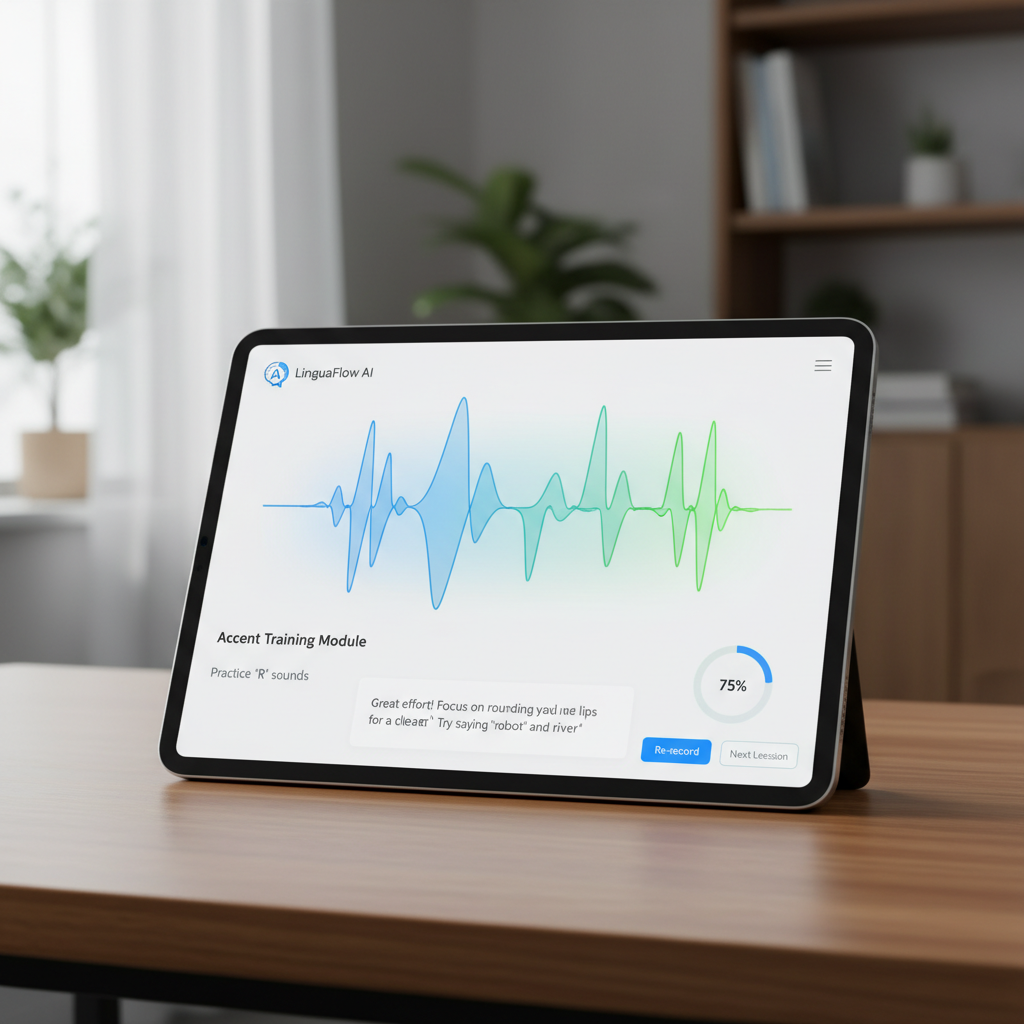
- Advanced Speech Recognition and Pronunciation Feedback: Accurate speech recognition technology is non-negotiable. It should be able to identify nuances in your pronunciation, comparing it to native speaker models, and provide precise, actionable feedback. This includes identifying specific sounds, intonation, and stress patterns that need improvement.
- Personalized Content Generation: The ability for the AI to generate custom exercises, stories, or scenarios based on your interests, profession, or current skill level significantly enhances engagement and relevance. This ensures that the learning material is always fresh and directly applicable to your life.
- Grammar and Syntax Correction with Explanations: Beyond simply flagging errors, an excellent AI tutor provides clear, concise explanations for grammatical mistakes and suggests improvements, helping you understand the “why” behind the correction rather than just memorizing the “what.”
- Vocabulary Acquisition Tools (Spaced Repetition Systems – SRS): Effective vocabulary building often relies on spaced repetition, where words are presented for review at scientifically optimized intervals. An AI tutor integrating SRS ensures efficient memorization and retention of new vocabulary.
- Progress Tracking and Analytics: Detailed dashboards that track your progress, highlight areas of improvement, and show consistent patterns in your learning are invaluable. These analytics help you stay motivated and understand where to focus your efforts.
- Multimodal Learning Support: The best tutors offer a blend of audio, visual, and textual content to cater to different learning styles. This could include video dialogues, interactive quizzes, written exercises, and audio lessons.
- Cultural Context Integration: Language is intrinsically linked to culture. An AI tutor that incorporates cultural insights, etiquette, and relevant context enriches the learning experience and prepares you for real-world interactions.
- Offline Access and Device Compatibility: The flexibility to learn anytime, anywhere, even without an internet connection, and across various devices (smartphone, tablet, desktop) adds significant value and convenience.
Understanding Different AI Tutor Models and Approaches
The landscape of AI language tutors is diverse, with various platforms employing different technological approaches and pedagogical philosophies. Recognizing these distinctions is key to selecting a tutor that aligns with your specific learning preferences and goals. From highly structured, gamified apps to open-ended conversational partners, each model offers unique strengths for different stages and styles of language acquisition.
Conversational AI Tutors: The Digital Speaking Partner
These tutors prioritize real-time, interactive dialogue. They leverage advanced Natural Language Processing (NLP) and Natural Language Generation (NLG) to simulate conversations, allowing users to practice speaking and listening in a dynamic environment. Examples include tools that integrate with large language models (LLMs) like ChatGPT (when prompted specifically for language tutoring) or dedicated apps like Speakeasy AI or HelloTalk (which combines AI with human interaction). The strength here lies in developing conversational fluency, improvisation, and confidence in speaking. They can generate scenarios, role-play, and even correct grammar and pronunciation during the flow of conversation.
- Best for: Developing speaking confidence, practicing real-world dialogue, improving listening comprehension in dynamic contexts, refining pronunciation.
- Limitations: May require a certain baseline vocabulary and grammar knowledge. Can sometimes lack the structured progression of foundational grammar.
Gamified Learning Platforms with AI Enhancements: Learning Through Play
Platforms like Duolingo have pioneered gamified language learning, making it accessible and engaging. With the introduction of features like Duolingo Max, AI is now being integrated to enhance these experiences further. These tutors use points, streaks, leaderboards, and interactive exercises to motivate learners. AI enhancements allow for more personalized feedback, generated explanations for errors, and even AI-powered conversational practice within the gamified structure. The core idea is to make learning fun and addictive, encouraging consistent daily engagement.
- Best for: Beginners, maintaining motivation, building foundational vocabulary and grammar in an engaging way, consistent daily practice.
- Limitations: Can sometimes prioritize breadth over depth, and AI conversational features might be more scripted compared to dedicated conversational AI.
AI-Powered Pronunciation and Feedback Tools: Mastering the Sound
Some AI tutors specialize in pronunciation, leveraging sophisticated speech recognition technology to provide detailed, actionable feedback on how you articulate words. ELSA Speak is a prime example, focusing on identifying precise phonetic errors, intonation patterns, and stress. These tools break down words into individual sounds, compare your utterance to a native speaker’s, and offer visual cues or exercises to correct specific issues. They are invaluable for refining accent and ensuring clear communication.
- Best for: Improving accent, correcting specific phonetic errors, developing clear and natural pronunciation, preparing for presentations or spoken exams.
- Limitations: May not offer comprehensive grammar or vocabulary instruction as their primary focus is pronunciation.
AI-Driven Adaptive Curriculum Platforms: The Smart Study Plan
These platforms excel at creating highly personalized study plans. They continuously monitor your performance across all language skills (reading, writing, listening, speaking, grammar, vocabulary) and dynamically adjust the curriculum to target your weakest areas. They might use spaced repetition systems for vocabulary and grammar, present content at optimal difficulty levels, and automatically review concepts just before you are likely to forget them. Pimsleur’s digital platform, for instance, uses a scientifically proven spaced repetition system for audio-based learning, now often enhanced with AI for additional practice and feedback.
- Best for: Structured, efficient learning across all skills, long-term retention of knowledge, learners who prefer a guided path.
- Limitations: Might sometimes feel less ‘free-form’ than conversational AI, with a more structured progression.
Many modern AI language tutors combine elements from several of these models, offering a hybrid approach. For rapid skill development, a tutor that effectively integrates adaptive learning, robust conversational practice, and precise feedback across all language modalities will often prove most beneficial.
Customization and Personalization: The Core of Effective AI Tutoring
The true power of an AI language tutor, especially for rapid skill development, lies in its ability to offer unparalleled customization and personalization. Unlike traditional classroom settings where one curriculum fits all, AI can dynamically adapt to your individual learning journey, making every minute of study time maximally productive. This personalized approach addresses your unique strengths, weaknesses, motivations, and learning style, accelerating your progress in ways static resources simply cannot.
Consider the difference: a generic textbook might present chapters on verb conjugations in a fixed order. An AI tutor, however, observes your performance. If you consistently stumble on subjunctive mood verbs but master past tense effortlessly, the AI will prioritize more exercises and explanations for the subjunctive, while briefly reviewing the past tense to ensure retention. This intelligent resource allocation ensures you spend your time where it matters most for your progress.
How AI Achieves Deep Personalization:
- Individualized Learning Paths: The AI constructs a unique curriculum for you based on an initial assessment, your stated goals (e.g., travel, business, academic), and your ongoing performance. This path evolves with you, making sure you are always learning at the optimal edge of your capabilities.
- Content Tailoring: An advanced AI can generate or select content that aligns with your interests. If you are passionate about sports, it might present articles, dialogues, or vocabulary related to sports. If you are a doctor, it can focus on medical terminology and scenarios. This relevance dramatically boosts engagement and retention.
- Adaptive Difficulty Adjustment: Exercises and challenges are continuously adjusted in difficulty. If you are excelling, the AI increases the complexity; if you are struggling, it provides more scaffolding and simpler tasks until you grasp the concept. This ensures a constant state of productive challenge.
- Targeted Feedback and Error Analysis: Beyond simply marking an answer as right or wrong, personalized AI tutors can analyze patterns in your errors. Do you consistently confuse certain verb tenses? Are you omitting articles? The AI identifies these recurring issues and provides specific, focused exercises or explanations to correct them.
- Flexible Scheduling and Pace: While not strictly personalization of content, the ability of AI tutors to be available 24/7 means you can learn at your own pace and schedule, fitting language learning into your life rather than forcing your life into a rigid class schedule.
- Learning Style Accommodation: Some AI tutors offer different modes of interaction – visual, auditory, kinesthetic – allowing you to choose how you engage with the material. This might mean more audio lessons if you are an auditory learner, or more interactive exercises if you prefer hands-on learning.
Ultimately, a highly customizable and personalized AI tutor acts like a dedicated personal coach, constantly observing, adapting, and guiding you. This tailored approach is the most efficient route to rapid skill development, as it eliminates wasted effort and keeps you focused on what truly matters for your linguistic growth.
Data Privacy and Ethical Considerations with AI Tutors
As AI language tutors become more sophisticated and integrated into our daily lives, it is imperative to address the critical aspects of data privacy and ethical usage. These platforms collect a significant amount of personal and performance data to provide their personalized services. Understanding how this data is handled and the ethical implications of AI in education is crucial for making an informed and responsible choice.
AI tutors often record your voice for pronunciation analysis, track your progress through exercises, store your vocabulary lists, and may even infer your learning style or interests based on your interactions. While this data is essential for the AI to adapt and personalize your learning experience, it also raises questions about who owns this data, how it is protected, and whether it could be used for purposes beyond improving your language skills.
Key Data Privacy Considerations:
- Data Collection Policies: Always review the privacy policy of any AI tutor. Understand what data is collected (e.g., voice recordings, input text, progress metrics, demographic information), why it is collected, and how it is used.
- Data Storage and Security: Inquire about where your data is stored and what security measures are in place to protect it from breaches. Look for tutors that use encryption, secure servers, and comply with international data protection regulations (like GDPR in Europe or CCPA in California).
- Data Sharing with Third Parties: Be aware if the platform shares your data with third parties (e.g., advertisers, analytics firms, research institutions). Ideally, a reputable AI tutor will either not share your data or will only do so with your explicit consent and in an anonymized form.
- Data Anonymization and Aggregation: For research or product improvement, data is often anonymized (stripped of personal identifiers) and aggregated (combined with data from many users). This is generally a safer practice, but transparency about this process is key.
- User Control and Deletion: You should have control over your data. Can you access, correct, or delete your personal information and learning history? Does the platform offer an easy way to revoke consent for data processing?
Ethical Considerations of AI in Language Education:
- Bias in AI: AI models are trained on vast datasets, and if these datasets contain biases (e.g., reflecting certain accents, dialects, or socio-economic groups more than others), the AI’s performance and feedback could inadvertently perpetuate those biases. For instance, an AI might struggle with non-standard accents or provide less accurate feedback to certain demographics.
- Transparency and Explainability: It is often difficult to understand how an AI arrives at its conclusions or recommendations (the “black box” problem). Ethical AI advocates for more transparency, where users can understand why the AI gave a certain correction or suggested a particular learning path.
- Over-reliance and Critical Thinking: While AI tutors are powerful, an over-reliance on them could potentially hinder the development of critical thinking skills, problem-solving without immediate prompts, or the nuance required for natural, unscripted human interaction. Learners should still be encouraged to seek real-world practice.
- Emotional and Social Aspects: AI cannot replicate the full spectrum of human interaction, including empathy, cultural sensitivity in dynamic contexts, or the subtleties of non-verbal communication. Learners should integrate AI with opportunities for human interaction to develop these crucial social language skills.
- Fair Access: While AI can democratize access, a digital divide still exists. Ensuring that advanced AI tutors are accessible and affordable to all, regardless of socio-economic status, remains an ethical challenge.
By carefully evaluating the data privacy policies and considering the ethical implications, users can make more responsible choices, ensuring that their language learning journey with AI is not only effective but also safe and equitable.
Integrating AI Tutors with Traditional Learning Methods
While AI language tutors offer incredible advantages for rapid skill development, they are most effective when viewed as powerful complements, rather than wholesale replacements, for traditional learning methods. The most successful language learners often employ a “blended learning” approach, strategically combining the precision and personalization of AI with the rich, nuanced interactions and foundational structure offered by human teachers, textbooks, and cultural immersion.
Think of it this way: an AI tutor is an indefatigable practice partner, a meticulous grammar checker, and a patient pronunciation coach, available 24/7. However, a human teacher brings empathy, cultural context from personal experience, the ability to read subtle non-verbal cues, and the capacity for truly open-ended, spontaneous conversation that even the most advanced AI struggles to fully replicate. Textbooks and workbooks provide structured foundational knowledge and a physical reference that some learners still prefer.
Blended Learning Approaches for Optimal Results:
- AI for Drills and Repetition, Humans for Nuance:
- AI Role: Use your AI tutor for consistent daily practice of vocabulary, grammar drills, pronunciation exercises, and short conversational simulations. Its adaptive nature ensures you get targeted repetition where you need it most.
- Human Role: Engage with a human tutor or language exchange partner for deeper discussions, role-playing complex scenarios, understanding cultural nuances, practicing idiomatic expressions, and receiving subjective feedback on your communication style.
- AI for Self-Study, Classes for Group Dynamics:
- AI Role: Leverage AI for self-paced learning, pre-learning new topics before class, or reinforcing concepts taught in a classroom. It can fill gaps in your knowledge and provide extra practice without judgment.
- Class Role: Participate in group classes to develop communicative competence in a multi-person setting, engage in debates, group projects, and benefit from peer learning and diverse perspectives.
- AI for Instant Feedback, Textbooks for Structured Overview:
- AI Role: Utilize AI’s instant feedback on written assignments or spoken responses to immediately correct errors and solidify correct usage.
- Textbook Role: Refer to well-structured textbooks or online grammar resources for comprehensive explanations of grammatical rules, verb conjugations, and syntax. The AI can then help you apply these rules in practice.
- AI for Preparation, Immersion for Real-World Application:
- AI Role: Use AI to extensively practice specific vocabulary, phrases, and scenarios related to an upcoming trip or cultural event. This builds confidence before immersion.
- Immersion Role: Actively seek opportunities to speak with native speakers in real-life situations, watch foreign films, listen to music, and read local news to truly integrate the language into your daily life and understand its living context.
The key is to identify the strengths of each method and integrate them strategically. AI excels at consistent, personalized, data-driven practice and feedback, while human interaction and traditional resources provide the emotional connection, cultural depth, and unstructured real-world application that are vital for complete fluency. By blending these approaches, learners can create a powerful, holistic language learning ecosystem that dramatically accelerates skill development.
Future Trends in AI Language Learning: What’s Next?
The field of AI is constantly evolving, and its application in language learning is no exception. We are currently witnessing just the beginning of what intelligent technology can offer. Looking ahead, several exciting trends are poised to further revolutionize how we acquire new languages, promising even more immersive, personalized, and effective learning experiences.
Emerging Technologies and Their Impact:
- Hyper-Personalization with Generative AI: Current AI tutors personalize content, but future iterations, driven by even more advanced generative AI, will create entire, dynamic learning worlds tailored to an individual. Imagine an AI tutor generating a full interactive novel or a complex business negotiation simulation, complete with characters and dialogue, all based on your specific interests, proficiency, and learning goals.
- Virtual Reality (VR) and Augmented Reality (AR) Integration: VR and AR will provide fully immersive language learning environments. Learners could “travel” to a virtual Parisian cafe, order coffee, and engage in conversations with AI-powered avatars, receiving real-time feedback on their speech and cultural appropriateness. AR could overlay translations and vocabulary onto real-world objects, making everyday life a continuous learning opportunity.
- Brain-Computer Interfaces (BCI) for Enhanced Cognition: While still in early stages, BCI technology holds the potential to monitor brain activity during learning, optimizing content delivery based on cognitive load and engagement. Future BCIs might even facilitate direct neural feedback to improve memory retention or accelerate language processing. This is a longer-term vision but represents the ultimate in personalized learning.
- Emotional AI and Affective Computing: Future AI tutors will likely incorporate emotional intelligence, detecting a learner’s frustration, boredom, or excitement. This allows the AI to adjust its pedagogical approach – offering encouragement, simplifying tasks, or introducing more engaging activities – to maintain motivation and optimize the emotional state for learning.
- Real-time, Contextual Translation and Explanation: While real-time translation exists, future AI will offer more nuanced, contextual explanations. For instance, when encountering a complex idiom, the AI won’t just translate it but explain its cultural origins, appropriate usage contexts, and common variations, all in real-time within a conversation or text.
- AI-Powered Tutoring Networks: We might see AI acting as an intelligent intermediary, connecting learners with the most suitable human tutors or peer learners globally, based on detailed AI-driven compatibility assessments. The AI could facilitate the initial match and provide session summaries for both parties.
- More Sophisticated Multi-Modal Feedback: AI feedback will become even more holistic, combining not just pronunciation and grammar, but also discourse markers, coherence, cohesion, and even non-verbal communication cues in VR/AR environments, guiding learners towards more natural and effective communication.
These trends point towards a future where AI language tutors are not just tools, but intelligent, adaptive, and empathetic learning companions that dissolve barriers to language acquisition. The focus will increasingly shift from simply ‘learning a language’ to ‘experiencing a language’ in deeply personalized and immersive ways, making fluency more attainable for everyone.
Comparison Tables
To aid in your selection process, here are two comparison tables that highlight key features, pricing, and specific benefits of various types of AI language learning tools. These tables are designed to give you a quick overview of what different platforms offer, helping you identify potential candidates based on your priorities.
Table 1: Feature Comparison of Leading AI Language Tutors and Tools
| Feature | Duolingo (AI-enhanced) | ChatGPT (Custom Prompts) | Speakeasy AI / AI Chatbots | ELSA Speak | Pimsleur (AI-driven) |
|---|---|---|---|---|---|
| AI Conversation Partner | Limited (Duolingo Max – role-play, “explain my answer”) | Highly advanced, open-ended, customizable scenarios | Advanced, scenario-based, role-playing, dynamic | Basic, focus on pronunciation drills and phrases | Limited interaction, mainly audio-based Q&A |
| Adaptive Learning Path | Yes, for core lessons. AI-suggested practice. | User-driven through prompts. No inherent path. | Yes, adapts to user errors and progress in conversations | Yes, adapts pronunciation lessons based on weak sounds | Yes, spaced repetition for recall; adaptive lesson pacing |
| Pronunciation Feedback | Basic (identifies correct/incorrect words) | Text-based feedback on phonetic errors (if prompted) | Real-time, detailed audio analysis and correction | Highly detailed, sound-by-sound analysis, intonation, stress | Audio prompts for correct pronunciation, limited feedback |
| Grammar & Syntax Correction | AI “explain my answer” for errors | Excellent, provides explanations and corrections | Real-time, contextual corrections with explanations | Focuses on clear articulation, less on grammar structures | Indirect (through pattern recognition in audio) |
| Vocabulary Acquisition (SRS) | Yes, integrated flashcards and review system | User-prompted lists, no inherent SRS | Contextual vocabulary within dialogues, some review | Vocabulary building focused on pronunciation | Core of the method, highly effective audio-based SRS |
| Personalized Content Generation | AI generates review exercises, some role-play scenarios | High, user can prompt for any topic, role, or scenario | High, generates dynamic dialogues based on user input/needs | Focuses on personalized pronunciation practice | Standardized core content, adaptive pacing |
| Target Audience | Beginner to intermediate, casual learners | Intermediate to advanced, learners seeking deep interaction | Intermediate to advanced, focused on conversational fluency | All levels, specifically for pronunciation improvement | All levels, focus on practical spoken fluency from scratch |
Table 2: Pricing Models and Value Proposition
| Tutor/Platform | Free Tier | Subscription Cost (Monthly Avg.) | Key Value Proposition | Best For |
|---|---|---|---|---|
| Duolingo | Yes, extensive free content with ads | $6.99 (Duolingo Plus), $13.99 (Duolingo Max) | Gamified, accessible, broad language selection, basic AI features for explanation/role-play | Beginners, casual learners, daily habit formation |
| ChatGPT (Plus) | Basic free access (older model) | $20 (ChatGPT Plus for advanced models like GPT-4) | Unparalleled flexibility, highly customizable AI tutor via prompts, deep conversational practice, content generation | Learners seeking a powerful, adaptable conversation partner and content creator |
| Speakeasy AI / Advanced AI Chatbots | Often a trial period or limited free features | Typically $10 – $30 (varies by platform) | Dedicated AI conversational practice, scenario-based learning, real-time feedback on fluency and grammar | Intermediate to advanced learners focusing on speaking confidence and accuracy |
| ELSA Speak | Yes, limited free exercises | $6.99 – $12.99 (depending on plan/promotions) | Specialized in detailed AI pronunciation feedback, accent reduction, and phonetics practice | Learners focused on improving their spoken accent and clarity |
| Pimsleur | 7-day free trial | $19.95 – $20.95 (for Premium Access) | Audio-based, scientifically proven spaced repetition for rapid spoken fluency, strong emphasis on core vocabulary and grammar | Learners who prefer auditory learning and structured, efficient progress towards conversational ability |
Practical Examples: AI Tutors in Action
Understanding the features and models of AI language tutors is one thing; seeing them in practical, real-world scenarios brings their value to life. These case studies illustrate how diverse learners can leverage AI to overcome challenges and achieve their language goals efficiently.
Example 1: Sarah, the Busy Professional Learning Spanish for a Promotion
Sarah is a marketing manager who needs to learn Spanish to communicate with a growing segment of her company’s client base in Latin America. Her schedule is demanding, leaving little time for traditional classes. She initially felt overwhelmed by the prospect of adding another commitment to her busy week.
AI Solution: Sarah subscribed to an AI language tutor that offers strong conversational capabilities and adaptive learning. She uses her 15-minute commute for vocabulary and grammar drills. During her lunch break, she engages in AI-powered role-playing scenarios, practicing business negotiations and client presentations in Spanish. The AI provides instant feedback on her pronunciation, suggests more professional vocabulary, and corrects grammatical errors on the fly. On weekends, she uses the AI to generate short articles about marketing trends in Spanish, expanding her industry-specific vocabulary and reading comprehension.
Outcome: Within six months, Sarah felt confident enough to lead a small presentation entirely in Spanish. Her colleagues noticed her rapid progress, and she successfully secured the promotion, attributing much of her success to the AI tutor’s flexibility and targeted practice.
Example 2: Kenji, the University Student Mastering Japanese Pronunciation
Kenji is a university student studying Japanese, aiming for an exchange program. He excels in reading and writing but struggles with spoken fluency and pronunciation, feeling self-conscious about his accent. He finds traditional drills in class insufficient for refining his speech.
AI Solution: Kenji integrated ELSA Speak into his daily routine. He spends 20-30 minutes each day using the app, which uses advanced speech recognition to analyze his pronunciation of individual sounds, words, and phrases. The app visually highlights specific phonetic errors and provides targeted exercises to correct them. It breaks down complex words into component sounds, allowing him to practice tongue and mouth positions. He also uses a conversational AI tutor to practice full sentences and get feedback on his overall fluency.
Outcome: After three months, Kenji’s pronunciation dramatically improved. He received positive feedback from his professor and felt much more confident participating in spoken Japanese discussions. The AI’s precise, non-judgmental feedback allowed him to pinpoint and fix specific phonetic issues that were holding him back, preparing him perfectly for his exchange program.
Example 3: Elena, the Traveler Preparing for a Trip to Italy
Elena is planning a month-long backpacking trip across Italy and wants to be able to communicate effectively with locals beyond basic tourist phrases. She needs practical, everyday Italian quickly, but doesn’t have time for extensive coursework.
AI Solution: Elena opted for a hybrid approach. She uses Duolingo for daily gamified lessons to build foundational vocabulary and grammar. For conversational practice specific to travel, she uses ChatGPT (with a Plus subscription) as her AI tutor. She prompts ChatGPT to act as a barista, a hotel receptionist, a train conductor, or a market vendor, practicing ordering food, asking for directions, booking accommodation, and bargaining. The AI corrects her language in context and provides alternative phrases.
Outcome: By the time her trip arrived, Elena could confidently navigate various situations. She enjoyed authentic conversations with locals, felt less stressed by unexpected interactions, and fully immersed herself in the Italian culture, all thanks to the AI’s ability to provide practical, scenario-based conversational practice on demand.
Frequently Asked Questions
Q: What exactly is an AI language tutor?
A: An AI language tutor is a software application or platform that uses Artificial Intelligence to teach and facilitate language learning. Unlike traditional language apps, AI tutors are designed to be interactive, adaptive, and personalized. They leverage technologies like Natural Language Processing (NLP), speech recognition, and machine learning to understand user input, provide instant feedback, generate relevant content, and tailor the learning experience to an individual’s specific needs and progress, mimicking aspects of a human tutor.
Q: How effective are AI language tutors compared to human tutors?
A: AI language tutors offer unique advantages such as 24/7 availability, instant and non-judgmental feedback, and unparalleled personalization based on vast data analysis. They excel at drills, pronunciation practice, and consistent reinforcement. Human tutors, however, provide empathy, nuanced cultural insights, the ability to read non-verbal cues, and truly spontaneous, complex conversations. The most effective approach is often a blended one, where AI complements human instruction by handling repetitive tasks and providing efficient practice, allowing human tutors to focus on higher-level communicative and cultural coaching.
Q: Can an AI tutor help me achieve fluency?
A: Yes, an AI tutor can significantly accelerate your journey towards fluency by providing consistent practice, personalized feedback, and adaptive learning paths. It helps build a strong foundation in vocabulary, grammar, and pronunciation. However, full fluency also involves cultural understanding and the ability to navigate complex, unscripted human interactions, which are best refined through real-world practice with native speakers and cultural immersion. AI tutors are powerful tools that, when used diligently and perhaps combined with human interaction, can very effectively lead you to high levels of proficiency and near-fluency.
Q: Are AI language tutors suitable for beginners?
A: Absolutely. Many AI language tutors are designed with beginners in mind, offering structured lessons, foundational vocabulary, basic grammar explanations, and simple conversational exercises. Their adaptive nature means they can start you from scratch and gradually increase the difficulty as you progress. Gamified AI apps are particularly good for beginners to build initial motivation and consistent habits.
Q: What is the minimum level of technology proficiency required to use an AI tutor?
A: Most AI language tutors are designed to be user-friendly, requiring only basic proficiency in using smartphones, tablets, or computers. If you can download an app, navigate menus, and use a microphone, you likely have enough technical skill. The interfaces are typically intuitive, and many platforms offer tutorials or help sections to guide you through their features.
Q: How do AI tutors provide pronunciation feedback?
A: AI tutors use advanced speech recognition technology to analyze your spoken language. They compare your pronunciation, intonation, and stress patterns to those of native speakers. The feedback can range from simple ‘correct’ or ‘incorrect’ indicators to highly detailed analyses that highlight specific sounds you mispronounced, offer visual cues for mouth and tongue placement, and suggest exercises to improve those particular phonemes. Some even provide an overall ‘pronunciation score’.
Q: Can AI tutors help with obscure or less common languages?
A: The availability of less common languages depends on the specific AI tutor. Popular platforms like Duolingo or Babbel primarily focus on widely spoken languages. However, some advanced AI models, particularly large language models (LLMs) like ChatGPT, can be prompted to act as tutors for a broader range of languages, even those with smaller digital footprints, as long as sufficient training data for that language exists. For highly obscure or endangered languages, a human tutor or specialized resources might still be necessary.
Q: What are the privacy implications of using an AI language tutor?
A: AI language tutors collect various data, including your voice recordings, typed responses, progress metrics, and potentially demographic information. It is crucial to review the platform’s privacy policy to understand what data is collected, how it is stored and secured, and whether it is shared with third parties. Reputable tutors prioritize data protection, use encryption, and often anonymize data for research. Always ensure you are comfortable with the data practices before committing to a platform.
Q: How often should I use an AI language tutor for rapid development?
A: For rapid skill development, consistency is more important than infrequent long sessions. Aim for daily practice, even if it’s just 15-30 minutes. Consistent exposure and interaction help solidify new knowledge and maintain momentum. Many users find short, focused sessions several times a day to be highly effective, fitting learning into natural breaks in their schedule.
Q: Can AI tutors really teach cultural nuances?
A: AI tutors can integrate cultural information (e.g., historical facts, common etiquette, idiomatic expressions and their origins) into lessons and dialogues. Some can even simulate culturally specific scenarios. However, the deep, implicit understanding of cultural nuances, emotional context, and social dynamics often requires interaction with native speakers and direct exposure to the culture. AI can provide the informational framework, but real-world experience is essential for true cultural fluency.
Key Takeaways
Selecting the optimal AI language tutor is a strategic decision that can significantly impact your language learning journey. Here are the key takeaways to guide your choice and maximize your potential for rapid skill development:
- Prioritize Personalization: Look for AI tutors that offer adaptive learning paths, tailored content generation, and dynamic difficulty adjustment based on your individual performance and goals. This is the cornerstone of efficient, rapid progress.
- Assess Core Features: Ensure the tutor has robust Natural Language Processing for conversational practice, accurate speech recognition for pronunciation feedback, and comprehensive grammar/syntax correction with explanations.
- Understand Different Models: Identify whether your primary need is conversational fluency (conversational AI), foundational building (gamified platforms), accent refinement (pronunciation tools), or structured progression (adaptive curriculum platforms). Many effective tutors combine elements.
- Consider Data Privacy and Ethics: Always review the privacy policy to understand data collection, storage, and sharing practices. Be aware of the ethical implications of AI bias and strive for a balanced learning approach.
- Embrace Blended Learning: AI tutors are most powerful when integrated with traditional methods like human tutors, textbooks, and real-world immersion. Use AI for consistent practice and instant feedback, and humans for nuanced interaction and cultural depth.
- Consistency is Key: For rapid skill development, daily, consistent practice with your chosen AI tutor, even in short bursts, will yield far better results than infrequent long sessions.
- Explore Future Trends: Be open to emerging technologies like VR/AR and advanced generative AI, which promise even more immersive and personalized language learning experiences in the near future.
- Evaluate Value: Consider the free tiers, subscription costs, and unique value propositions. The “best” tutor isn’t always the most expensive, but the one that best meets your specific learning style and objectives within your budget.
- Practical Application Matters: Choose a tutor that allows you to practice the language in contexts relevant to your life or goals, whether it’s business, travel, or academic.
Conclusion
The advent of AI language tutors marks a pivotal moment in language education, transforming what was once a challenging and often inaccessible endeavor into an engaging, personalized, and highly efficient pursuit. By intelligently harnessing the power of Artificial Intelligence, these tutors provide an unprecedented opportunity for individuals worldwide to accelerate their language skill development and achieve fluency faster than ever before.
Selecting the best AI language tutor is not about finding a universally superior tool, but rather identifying the platform that most perfectly aligns with your unique learning style, specific goals, and personal preferences. It involves a thoughtful evaluation of key features, understanding different pedagogical approaches, considering crucial aspects of data privacy, and envisioning how these intelligent tools can seamlessly integrate into your daily life and complement other learning methods.
As you embark on or continue your language learning journey, remember that consistency, engagement, and a willingness to embrace new technologies are your greatest allies. The right AI language tutor will act as your tireless companion, providing relentless practice, immediate feedback, and a constantly adapting curriculum that keeps you challenged and motivated. By making an informed choice, you are not just selecting an app; you are choosing a partner that will empower you to unlock new linguistic abilities, broaden your horizons, and connect with the world in profound and meaningful ways.
The future of language learning is here, and it is intelligent, adaptive, and incredibly exciting. Embrace the revolution, choose wisely, and prepare to master your target language with unparalleled speed and effectiveness.












































































Leave a Reply